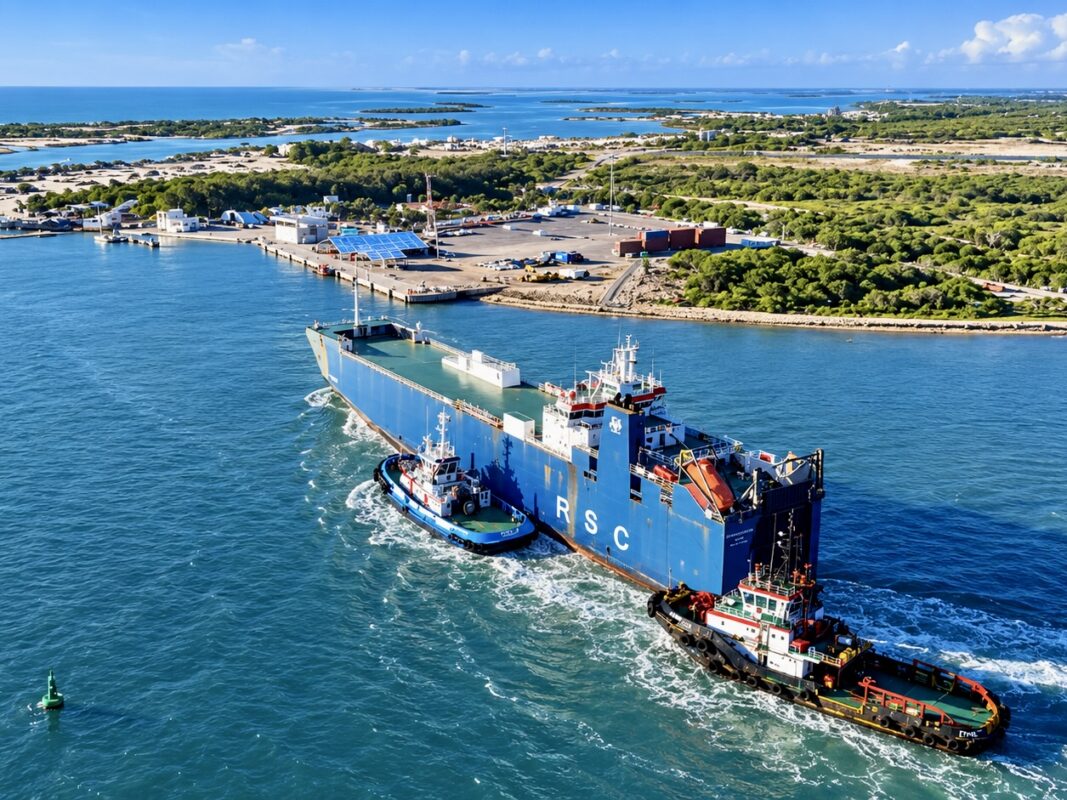
In a few years, natural gas from the U.S. could be liquefied at the Port of Matamoros, known as Puerto del Norte, and be exported globally, a move that would make the Mexican port an emerging LNG supplier to nations that need it for electricity and heat generation.

The U.S. Department of Energy published a Federal Register notice Tuesday regarding an application submitted last month by Texas-based Freedom LNG LLC. The company is seeking a 20-year authorization to export U.S. natural gas to Mexico via pipeline and to re-export it as LNG abroad, including to countries in Europe, Latin America and the Caribbean.
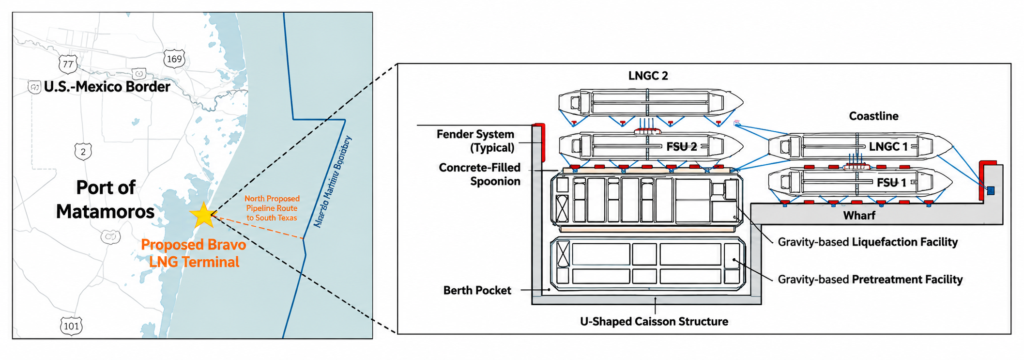
Processing would take place at BRAVO LNG, a $4.5 billion proposed nearshore facility at the Port of Matamoros that would use floating barges to liquefy the gas and also have storage capacity.
“We have to recreate a mini city around Port of Matamoros,” Muthu Chezhian, President of Freedom LNG and a long-time energy developer, told the Rio Grande Valley Business Journal.
Chezhian expects the project to create about 6,000 construction jobs over a four-year period and about 1,200 permanent jobs. He also hopes to engage local fabrication facilities, logistics services and existing LNG expertise in the area.
The developing company behind the project is Singapore-based LNG Alliance Pte. Ltd., an affiliate of Freedom LNG that Chezhian is chief executive of and which is also spearheading a separate LNG project on Mexico’s west coast.
If realized, BRAVO would join a growing cluster of proposed and existing LNG operations along the Gulf Coast, including the nearby Rio Grande LNG and Texas LNG projects in Brownsville. Data compiled by the Global Energy Monitor show that there were at least seven active export terminals in the region as of September 2025, with several others under construction.
The terminal’s expected capacity is six million metric tons per year, about the same as the canceled Annova LNG project in Brownsville and about a tenth of the total capacity that NextDecade’s Rio Grande LNG would have if all 10 trains were ultimately built.
“We cannot ignore the fact that geographical proximity between Matamoros and gas producer basins in Texas is perhaps the most important advantage, and so is the existing infrastructure that connects both,” Adrian Duhalt, Nonresident Fellow at SMU’s Texas-Mexico Center and Adjunct Professor at El Colegio de Veracruz, told the Rio Grande Valley Business Journal.
Freedom LNG is currently working on the engineering required for construction of the terminal and it expects $1.2 billion of the project’s equipment and technology package to be sourced from the U.S. The floating barges would be built in Southeast Asia or the United Arab Emirates and transported to Matamoros. Chezhian said they’re exploring the use of wind to partly power the project.
The company noted that it has reached a memorandum of understanding with the Mexican state of Tamaulipas, but the project still needs to undergo environmental review from Mexican regulators. Commercial exports are targeted to begin in 2031.
“We believe it’s probably the most well placed country to become an energy hub for the future,” Chezhian said of Mexico.
BRAVO’s opportunity and obstacles
The BRAVO project would expand Mexico’s role as an emerging LNG supplier at a time when global LNG trade is expected to grow in the coming years.
LNG trade levels in 2025 hit a record high following growing U.S. exports and increased demand from Europe amid reduced Russian pipeline gas. Conflict in the Middle East this year is adding further uncertainty to LNG markets, given that Qatar is the second largest LNG exporter after the U.S.
BRAVO would have the capacity to produce six million metric tons of LNG each year. For reference, about 428 million metric tons of LNG were imported globally last year, according to an industry report by the International Group of LNG Importers.
Mexico supplied just over one million metric tons of LNG last year, but the country’s export capacity tripled this year after a terminal on Mexico’s Pacific coast shipped its first cargo earlier this summer.
Chezhian is also betting on Mexico’s Pacific coast with the Amigo LNG project in the state of Sonora, which is still in development and would supply LNG to Asian markets. The executive said that Amigo LNG has secured financing and permits and that contractors have been lined up.
A current roadblock Amigo LNG faces is a court order from a Mexican federal judge that temporarily blocks construction of the project, according to Mexico Business News. The judge’s order follows a lawsuit earlier this year from environmental organizations challenging the environmental review process.
Chezhian said he is confident the dispute will be resolved this month and that more details regarding when a final investment decision will be made as to Amigo LNG will be revealed next month.
Amigo LNG has also faced development delays. In a late 2025 letter to the DOE seeking to extend its export commencement deadline from late 2027 to late 2029, Chezhian cited geopolitical uncertainty, pandemic supply chain disruptions and other challenges as reasons for the requested relief.
Market uncertainty also affected a proposed LNG project in the RGV. In late 2013, the proposed Annova LNG project in Brownsville – an LNG project with similar capacity to BRAVO – sought authorization from the U.S. Department of Energy to export LNG. Annova ultimately canceled the project in 2021, citing changes in the LNG market.
Nevertheless, Chezhian said he is confident in BRAVO and that they have secured strong interest from the market.
“We have done the homework,” he said.

José Luis Martínez
Reporter
José Luis Martínez is a Houston-based journalist and contributor to the Rio Grande Valley Business Journal. He has previously worked for Law360, the Houston Landing and the Connecticut Mirror, and his work has also appeared in the Texas Observer.
Most Read
- Is SpaceX quietly building a data center at Starbase? Job postings offer clues
- Developers begin $12M master-planned community near Rio Grande City
- Edinburg ISD rejects nearly $6M offer for prime land near La Sienna despite $15M budget deficit
- Dickey’s Barbecue Pit to open new McAllen location inside Cambria Hotel
- Port of Brownsville approves $2M SpaceX pipeline deal, with millions more on the table
Get the latest business news delivered to your inbox every morning for free.
Try 30 Days Free!
Get full access to award-winning journalism covering business, real estate, health care, economic trends, and the people shaping the Rio Grande Valley.
30 Days Free!
$9.95/month
Limited time offer
Subscription renews after your 30 day free trial at $9.95/mo.
Included Benefits
- Unlimited access to all articles
- Daily business news and analysis
- Subscriber-only content and features
Stories That Matter
- Bosnian rapper turned LinkedIn marketing coach shares storytelling tips at McAllen Social Fest
- SpaceX aims to make history with first catch of both Starship stages in Friday launch from Boca Chica
- McAllen Food Truck Park to close after 11 years
- Mission’s first Small Business Expo puts $25K on the line for local entrepreneurs
- McCoy’s gives $10K, tools to launch Mid-Valley construction academy
- UT Health RGV performs new digestive procedure for first time in the Valley
- TSTC bets on advanced manufacturing to meet RGV’s industrial boom
- RGV Business Journal heads to Social Fest to find stories worth telling
- Pharr’s cross-border business push earns international recognition
- Brownsville eases drought restrictions after nearly three years as Rio Grande reservoir levels improve