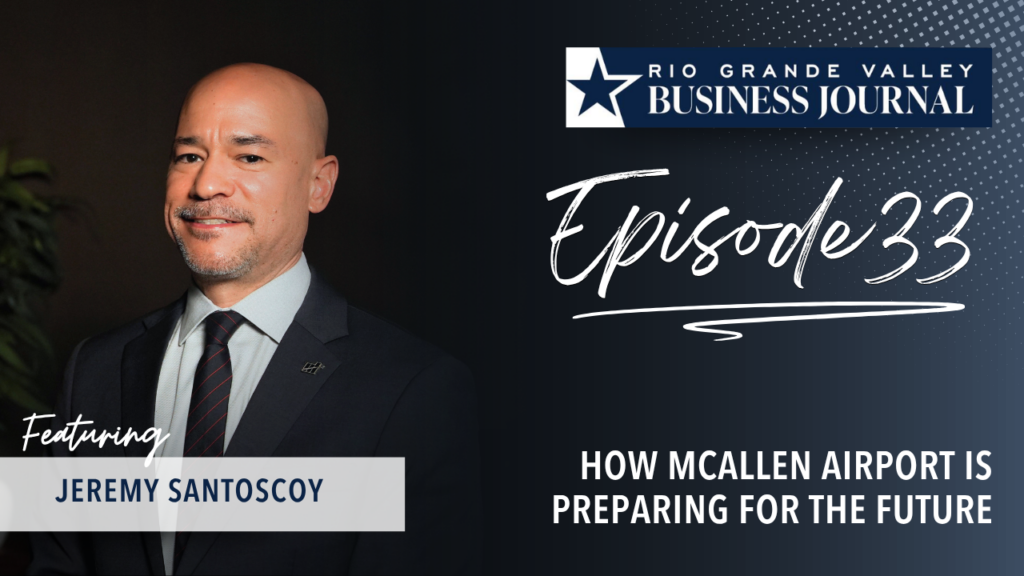
McAllen International Airport is in the middle of one of its busiest stretches in years, with a new nonstop route, fresh federal funding, and a major terminal expansion all advancing at the same time.
Director of Aviation Jeremy Santoscoy joined the RGV Business Journal podcast to walk through what’s driving the growth and what’s coming next for the Rio Grande Valley’s busiest airport.
The headline news: a new daily American Airlines flight connecting McAllen to Phoenix Sky Harbor International Airport. Santoscoy said the route gives travelers efficient West Coast connections beyond the airport’s already dominant service to Dallas-Fort Worth, which accounts for roughly 60 percent of the market share among the Valley’s three commercial airports.
The new route comes as the airport keeps setting records, surpassing 1.1 million passengers for two consecutive years and remaining on pace to do it again in 2026 — growth Santoscoy credits with generating about $1.2 billion in yearly economic output for the region. That momentum is also behind a $7 million FAA grant recently awarded to the airport, one piece of a larger, roughly $180 million terminal expansion plan that includes four new gates, renovated terminal space, additional parking, and growing general aviation capacity.
Santoscoy also discussed the airport’s new nonstop service to Monterrey, Mexico, which launched in late March, and the ongoing effort to restore the McAllen-to-Mexico City route. That flight was suspended last year amid a broader dispute between U.S. and Mexican aviation regulators, and Santoscoy said the airport continues working with federal officials and elected leaders to bring it back.
The conversation closes with advice for travelers heading into the airport’s busiest season: arrive early, consider TSA PreCheck or Global Entry, and plan for growing summer crowds.
The following is a rough, AI-generated transcript of Kristen Mosbrucker-Garza’s interview with Jeremy Santoscoy, Director of McAllen Airport. Minor errors and misspellings may appear. For the full conversation, listen to the episode above or through your preferred podcast platform.
Jeremy Santoscoy: So we’re growing on all sides of the house, which is, you know, important to our economy. The airport generates over about $1.2 billion of yearly economic output. It creates about 12,000 jobs. And so, you know, as we continue to develop, you know, as the region continues to develop, as this binational region continues to develop and grow, we want to be there to support the growth. And I think it’s important to keep investing in our infrastructure so we can support that growth. It it is essential to our economy and to the people that live in our in our region.
Kristen Mosbrucker-Garza: Well welcome everyone. Kristen Mosbrucker-Garza and this is the podcast for the Rio Grande Valley Business Journal. Thanks so much for joining us. We have a really special guest, and I’m super glad that you could join us. So we have the director of the airport. I don’t want to mispronounce your last name. So Jeremy, you got to say it for me.
Jeremy Santoscoy: Jeremy Santoscoy Thank you for having me here, Kristen.
Kristen Mosbrucker-Garza: Absolutely. And so it has been a pretty big year for the airport. Honestly. I mean, there’s been a lot going on. And so, I believe sometime this week or even today or this evening, y’all have some pretty big news about a new flight. What’s going on with that?
Jeremy Santoscoy: Yeah. So we’ve had a continuous good news the last several years. You know, we hit over 1 million, 1.1 million passengers, total passengers in 24. And then we did it again last year in 25. And we’re on pace to do that again this year. So the growth has been there and we’re experiencing the pinch. And you know to put the cherry on the top we got yesterday, we had the you know, the event for the launch of our Phoenix flight for American Airlines, which is going to be a daily flight to Phoenix, Arizona, Phoenix Sky Harbor International, which is another American Airlines hub. And it’s a big deal for the value, a really big deal. What that means is that not only do we have seven daily connections to DFW, which is about 60%, which is the market share of the three airports in the valley, because of the that high frequency that we serve. You know, now, Phoenix, which we have good numbers to, allows us not only, you know, to not have to bounce off of DFW to get to Phoenix, to American Airlines, but it also gets a nonstop to Phoenix. And in addition to that, westbound service, so we can get from the Pacific Northwest all the way down to the LA basin. You know, in the in the morning and probably be back the same the same day because of that daily service that we’ll be having with American Airlines. So it is a big deal for us for our connectivity to the West Coast.
Kristen Mosbrucker-Garza: Oh, wow. You know, I, I had seen the Phoenix one. And honestly my first was reaction, especially since it was starting in the summer. I was like, well, you can go for the really humid heat or you can go for the really dry heat. But I think that’s a really good point about, you know, you can pop over to LA. You can go up to the Pacific Northwest where it’s a little bit cooler. And so that connectivity, I guess I didn’t quite realize the potential there.
Jeremy Santoscoy: Yeah, it’s a big strategy in that with West Coast Connection and even beyond Phoenix is another American Airlines hub. So now with American Airlines, you’ll be able to connect to two major hubs that are part of American Airlines offerings. Phoenix Sky Harbor has over 130 different destinations. It has over 30 international destinations, so it is another major hub that we connect to outside of the Texas area, which is, you know, Houston, Dallas and Austin. So it is a big deal for us. And that westbound connectivity really helps people trying to reach the West Coast in an efficient manner. And even geographically, if you think about it, you know, the folks to the northeast and now you’re heading west to connect to the west. And so it makes the travel more efficient. So it’s a little bit more strategy than just, you know, that nonstop to Phoenix, which we already have good numbers from the Valley, which you know, is in itself a big deal. But you have that West Coast connectivity.
Kristen Mosbrucker-Garza: Was there a much demand from the business community for a nonstop to Phoenix? I know, like, for example, the airport in San Antonio, their business community often goes to DC. Right. And so they were really pushing for that. And I just wonder, you know, is there a lot of business folks going back and forth?
Jeremy Santoscoy: Absolutely. There’s, you know, the business there’s the heritage markets. It is another border, you know, type of community. And then there’s government. There’s a lot of development of Phoenix. Sky Harbor is very large airport here in this country. So it does account for a lot of different needs. And the numbers show it. And so there’s that natural connectivity just to Phoenix. But even beyond that to the West Coast.
Kristen Mosbrucker-Garza: Awesome. And you said daily nonstop and leave in the morning.
Jeremy Santoscoy: Yes. Right now it is scheduled to leave about 6:00 in the morning, which is really great because it hits all the banks in Phoenix. So you get there to Phoenix, and then you can spread across that West coast very easily, very efficiently. And so it does return late in the day. So you could essentially get to the West Coast and then get back the same day.
Kristen Mosbrucker-Garza: Okay. Interesting. And so I also understand that the airport is going through a lot of upgrades. Walk us through this kind of like, you know, expansion retrofitting plan. And I understand that y’all were recently awarded about $7 million in a grant. What could you do with that?
Jeremy Santoscoy: So, you know, it’s part of the growth that that I mentioned earlier and then surpassing the 1.1 million those those couple last years, we’ve had very steady growth since pre-COVID. And so we’re an airport that bounced back after Covid very well. Not the same for all airports across the country, but we did. And with that growth, you know, it it we could physically start feeling the pinch in the terminal. So we commissioned a study. And that study was conducted with several public meetings with stakeholder meetings. And it concluded that we needed more space. And so part of that was the addition of four gates, adding about 90,000ft² of terminal space and renovating about 70,000ft². The total estimated improvements in the plan was about 180 million. Since then, we’ve proceeded with getting a design contract in place, getting a construction manager at risk in place. And we’re working through the logistics on how do we get something, a bid package that we can responsibly afford without raising rates too high. And, you know, just trying to afford something that we can do without incurring so much debt. And so we’re going through those exercises right now, and we continue to work on that to see how we add capacity because of the growth that we’ve had. But not only that, in the terminal, we’re also growing on the land side. So we’re developing a couple of parking lots, 200 space parking lot across the street, 44 space adjacent to the terminal. And then we’re even investing on the general aviation side, which is the private planes. We’ve purchased about ten acres that we’re continuing to develop and build the infrastructure for the development of more general aviation space. So we’re growing on all sides of the house, which is, you know, important to our economy. The airport generates over about $1.2 billion of yearly economic output. It creates about two 12,000 jobs. And so, you know, as we continue to develop, you know, as the region continues to develop, as this binational region continues to develop and grow, we want to be there to support the growth. And I think it’s important to keep investing in our infrastructure so we can support that growth. It it is essential to our economy and to the people that live in our in our region.
Kristen Mosbrucker-Garza: And so would you say that that those investments would enable y’all to attract like other carriers or other flights, or is it really about accommodating the existing tenants?
Jeremy Santoscoy: It’s a little of both. You know, the existing tenants want to grow as well. I mean, you see this new announcement with American with Phoenix with seven daily departures to Dobie. I mean, that just tells you a lot. And, you know, not very many places have around the country, have three commercial airports so close to each other, which is great for the region because you have the options. But we have the frequency. So 60%. You know, seven daily departures even we have mainline aircraft, you know, eight through 2737 737 Max states with this legacy carrier, which is kind of unheard of for a regional market. But it is just, you know, that shows how big our business community is and how much need of air travel we have. And so that need has transformed into the capacity study, into the design contract, and it will continue through the construction to be able to add capacity terminal, to be able to make the travel, the air travel more efficient for not only our customers, but for the airlines that are trying to operate efficiently, you know, to the customer.
Kristen Mosbrucker-Garza: And what will the $7 million be earmarked for?
Jeremy Santoscoy: So the 7 million is going to be a piece of the puzzle, per se, of the big program. And so we are working with the FAA to identify a piece of that puzzle. But it is a piece of the big program.
Kristen Mosbrucker-Garza: Okay. Cool. And so it’s from the Federal Air Administration.
Jeremy Santoscoy: Federal Aviation Administration administration.
Kristen Mosbrucker-Garza: Okay. Awesome. And so, you know, another big announcement this year for the airport has been a new nonstop international flight to Monterey. Tell us more about that. And how is that flight going? I think it started what in late March.
Jeremy Santoscoy: Late March. Yeah. So it’s been a couple of months. They’ve started off a little bit slow, but Monterrey like, wow. You know Monterrey is such an important part of our economy. Our you know, our friends, our business partners, our family, you know on the the novelty on side, on the Tamaulipas side, they’re very important to us. So having that air service in place is important and it continues to grow. You know that that daily connection is important because of the fact that Monterrey, such an important partner to us and our economy. So we’re happy to have that and it continues to improve. You know, we did have Mexico City with Omaha and we’re still waiting for the Dot decisions to, you know, see how that progresses. But we keep working on that to get that flight back in because it was such a important part of our service, our international air service. We had historically served Mexico City with Edelman, which was a regional carrier that ended up succumbing to their financial pressures, and they went under. They flew ATR 72 and ATR 42. Those aircraft, you know, were sold. Business went down. So we’re without Mexico City service for about a year and a half. And so when we were able to strike a deal with that, amigo, we not only upgrades, you know, we went from a 72 seater to a 99 seater, a number one night, but we went to a daily service. So we went from we upgraded, and then we upped the frequency, which and we moved to the new airport to IFA to Felipe, which I think most of people that travel to Mexico City, you know, somewhere like, let’s get back in and somewhere. No, it’s too far. It’s not going to work. And so we had the challenge of trying to work with it to make this thing work. Now it started when we commenced service. It started more or less where we thought it was going to start around the 3,040% load factors, and then it jumped to 5060 and it held pretty steady, about 70% load factor. And in fact, Domenico had won that route itself. MFA to IFA had won an award of number one on their small volume networks. So they did really well on Metal Maples network. And, you know, we really missed that flight. I think the Valley misses that flight. I’ve heard from such so much of the business community that that need is there. And, you know, they rather fly out of McAllen than drive to Reno and fly to Mexico City. So it’s a little bit of a challenge right now. Hopefully things continue to progress. Secretary Duffy did announce about a month ago that he sees the progress in the the Mexican officials and the issues and the concerns they had, how they operated by the main airport in Mexico City. And so they continue to work through the concerns that the Dot had to be able to bring a lot of those flights back in, and we ended up being one of them. So we continue to work with our elected officials and the Dot to see when and how fast we can bring that back. We’re still in constant talks, so that will make Will to bring that service back to the to the region.
Kristen Mosbrucker-Garza: Yeah. And so, you know, folks who aren’t very familiar, it’s a it’s a little convoluted in terms of, you know, there’s a lot history there. But essentially, you know, it was quite a bit of a shock. You know, you had this really popular route. You know, you had the daily service and a lot of business folks like, you know, we’ve heard as well use that flight just because we have so, so much binational, you know, whether it’s the industry or, you know, what have you. And so we’re just so closely networked with Mexico being on the border and, you know, essentially. So Mexico City has two airports. And the the US government asserted that, you know, there were essentially being unfair because they had had all the non Mexican carriers sort of move over to the newer airport. Right. And so.
Jeremy Santoscoy: Yeah, and, you know, it was a political shift in Mexico to push service to the new airport. And so when they reduce slots in the main airport of Mexico City, essentially what Dot is saying is that you reduce slots over here. So that lowers the competitive playing field of the US airlines trying to provide services to Mexico City. When the Mexican airlines are providing more and more service to the US airports. And so that’s why you see the Dot ordered cut Mexican Airlines service into the US. And we were one of them. We were one of the casualties out of the 13. So, you know, it was a big impact to us, over $120 million a year of economic impact to us and the need, you know, that hurt those heritage markets. Most importantly, the business markets were really impacted. And, you know, we’re we’re fighting to get that back.
Kristen Mosbrucker-Garza: For sure. And so is there anything else sort of coming up with the airport that people should keep an eye or an ear out on? I know if you’re not parking at the airport, the Uber and Lyft is more expensive technically, at least for the transportation network companies. But, you know, it’s it’s certainly not as crowded as as some of the bigger markets.
Jeremy Santoscoy: You know, you have your options on how to fly. I mean, you know, luckily, most of us that live close or near the airport can get dropped off if you can’t. You know, most of the people that are using the Ubers and lives are probably people visiting. And we have our parking as well. The bus passes through there, the city bus passes through there. I mean, there’s there’s several options taxis and whatnot. But, you know, as we come along, the summer travel, it’s our longest duration peak of the season. Everybody’s out of school. All the families are traveling, plus the business community. So it gets pretty busy during summer. And so really the message, you know, when take that vacation, take that much needed vacation, enjoy it. And the way to enjoy it is to get to the airport a little bit more time. If you’re going to check bags, get pre-check. If you don’t have to say pre-check, so you don’t have to go through all the security that you usually do. If you don’t have PreCheck, that’s a that’s a big one. Global entry, you automatically get pre-check. That always helps. And getting there with some time the patients always helps the travel. That makes it a little bit more fun.
Kristen Mosbrucker-Garza: Absolutely. Well, thank you so much for your time and sharing all of this. Lots of big things ahead. And hopefully we’ll we’ll see some news on the horizon on the Mexico City flight.
Jeremy Santoscoy: Thanks for having me.
Kristen Mosbrucker-Garza: Absolutely. Well, thank you so much. You all for joining us. This is Kristen Mosbrucker-Garza at the Rio Grande Valley Business Journal. Subscribe and stay tuned.