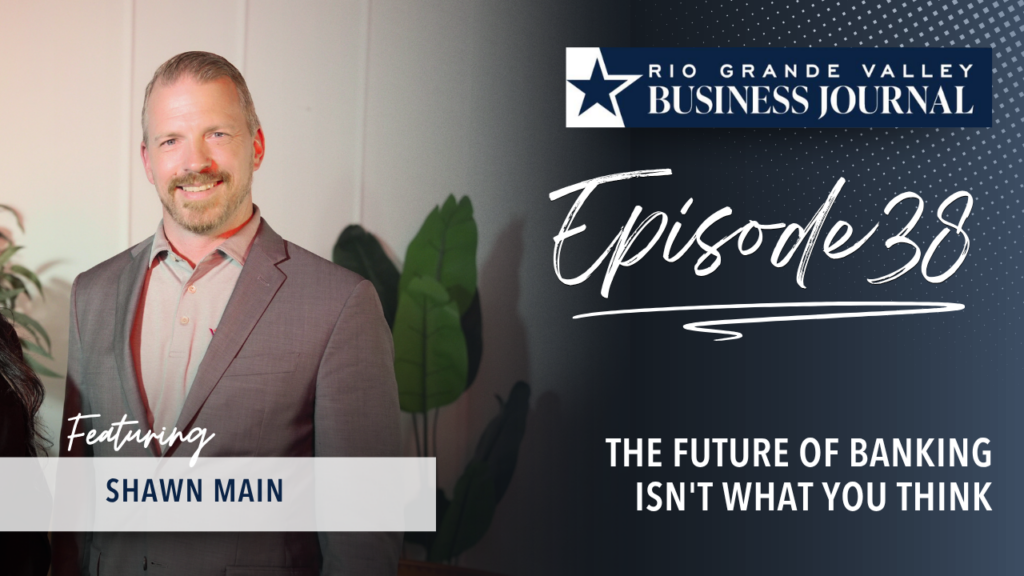
“Tokenization” has become one of banking’s biggest buzzwords, but according to Shawn Main, it boils down to something far simpler: moving money faster.
Main is the chief business architect at Vantage Bank and founder of the Hazel Network, a division built to give community banks and credit unions access to tokenized payment technology without stepping outside the regulated banking system.
In this episode of the Rio Grande Valley Business Journal Podcast, host Naxiely Lopez-Puente sits down with Main to unpack how tokenization and stablecoins could reshape the way RGV businesses — particularly those trading across the U.S.-Mexico border — send and receive payments.
Main compares stablecoins to a “digital cashier’s check,” capable of settling manufacturer-supplier transactions in real time without the delays, fees, and intermediary banks that come with traditional wires.
He also argues that, for the first time in the industry’s history, falling technology costs give community and regional banks a genuine shot at competing with big banks and fintechs on payment infrastructure.
Read the full transcript below, watch it here or on YouTube, or listen to the episode wherever you get your podcasts.
The following is a rough, AI-generated transcript of Naxiely Lopez’s interview with Shawn Main from Vantage Bank and the Hazel Network. Minor errors and misspellings may appear. For the full conversation, listen to the episode above or through your preferred podcast platform.
Shawn Main: Well, you know, I think when it comes down to tokenization, it’s nothing more than really a buzz term. What everyone cares about you as a customer, your business is. They just care that, you know, I have my money, I can move my money fast and I don’t necessarily care how it gets there. I think the manufactured supply relationship is actually like the best example of where you’re going to see this technology, stablecoins, they’re going to act a lot like a digital cashier’s check.
So instead of me having to go into a branch and pull out, you know, $1 million sticking on a cashier’s check and physically hand it to you. I’ll be able to do that with a stablecoin, and you’ll have the same trust behind that stablecoin, knowing that it’s worth the million dollars, just like we do today with a cashier’s check.
I definitely foresee that everything will be tokenized. And so when you’re talking about money being tokenized, you know, ETFs, securities assets, and that’s going to mean that the velocity of money, how fast money moves around the economy and how quickly that’s going to change.
Naxiely Lopez-Puente: Hi. Thank you for joining us on this episode of the Rio Grande Valley Business Journal. Today we have a very special guest, Shawn Main, with Vantage Bank. He is the chief business architect and a founder of the Hazel Network. Thank you for being with us today. Of course. And today we’re going to be discussing how small banks, credit unions and small businesses can take advantage of tokenization, which is buzzword, but it’s very important and it’s coming and it’s going to help your business or your bank move money faster, is my understanding.
Shawn Main: That’s right. Yep. It’s going to help automate a lot of your processes, move money faster, and really make your business more efficient.
Naxiely Lopez-Puente: All right. Okay. Real simple question. Tell us about yourself.
Shawn Main: Well, I’ve been in banking for 25 years. I’ve been at Vantage for 18 years. Prior to that, I was actually at Rackspace Technologies. I was an engineer, I did coding.
Naxiely Lopez-Puente: Is that the email? Right. The email. Rackspace.
Shawn Main: Well, you know, they do hosting and so they also have email services.
Naxiely Lopez-Puente: That’s how I know it by email.
Shawn Main: They were kind of like the original cloud provider way back in the day. And I would say even before AWS and Azure and all those companies. So it was really fun company to be a part of. I cut my teeth there and learned a lot about technology and how hosting happens and what gets built, and, you know, some of the chaos behind the scenes.
Naxiely Lopez-Puente: Yeah. I’m sure.
Shawn Main: So yeah, it was it was fun time. And then prior to that, even I was I actually started in banking when I was right around I think 17. We did data processing and I was actually running proof operations for a very small bank. It was a little $40 million bank out of Tilden, Texas, and so kind of been in banking the whole time, but then kind of spun out for a little bit, went to the tech side of the world.
And then banking always kind of sucks you back in and you know, you know, came to build something new with Vantage Bank.
Naxiely Lopez-Puente: Awesome. And so are you from the Valley. Where are you from?
Shawn Main: I’m technically from California, but we moved here when I was younger, about when I was six, and I’ve been living in San Antonio for about 40 plus years. And then I just recently moved up to Fort Worth.
Naxiely Lopez-Puente: And so have you always been a tech guy? Did you always know that? You know, that was kind of your inkling?
Shawn Main: Actually, I, I tried to avoid it. Believe it or not, I, I went to school for biology. I just wanted to kind of, you know, go, go learn the sciences. And it was just always this nagging thing in the background. My mom had these Packard Bell computers, and she would destroy them constantly. She’d wipe them out or break them or something.
And so before I knew it, I was always just repairing computers. And then my friends would ask me to repair computers. Then different companies would be like, hey, I learned you, you know how to do computers. Why don’t you come help me set up this thing? So before I know it, I’m installing floppy disk on everybody’s stuff and building little networks.
And so it just kind of kept following me around and eventually gave in and said, all right, I need to just get into technology.
Naxiely Lopez-Puente: Yeah, well, you made the right decision, right? Not that, you know, biology is not a good career, right? But technology right now, especially in banking, I mean, actually in every sector. Right. But I we hear a lot about it in banking. And I know that Vantage Bank is doing something new. Tell us about this whole new Hazel Network that, that you guys have created.
Shawn Main: Well, you know, I think it starts a little bit of history is, you know, you’re right. Banking has been sleepy and slow for a while. We’ve always been a little bit kind of a laggard in responding to technology. But a lot of other industries adopt that technology move quickly. Five years ago, Varney said, hey, let’s do a risk assessment.
What is actually going to impact our business, what is going to, you know, change how we operate, what’s going to impact our revenue streams. So we did a risk assessment, and that risk assessment led to digital assets. And in 2020, we actually tried to buy a custody provider because we said, you know, this is right up the fairway for what banks do.
We protect assets. We provide custody services safekeeping. And we said, okay, well can we do that? Well, at the time, crypto really wasn’t a thing and wasn’t something that, you know, regulators and many were happy with. So they didn’t really let us do it. And because of that we said, well, let’s just stay as close as we can to the industry.
Let’s try to understand the customer base and you know, who’s operating and what the you know, what the economy really looks like. And that led us to ultimately, hey, we need to start thinking about how do we tokenize our assets, how do we actually start to provide these types of services that are already out there in DeFi space and crypto land?
But how do we do that under a trusted brand within the banking system that led us to the Hazel Network? And so the Hazel Network was all about, can we build the tool sets, the infrastructure, the technology and the capabilities that banks are going to need to provide these new services to their customer while still keeping it within the banking system and not having to kind of go outside to, you know, you know, I guess, you know, the wild, wild west of.
Naxiely Lopez-Puente: Digital assets, the dark web, I don’t know.
Every time we hear, at least for me, right, digital assets and tokenization and crypto, I mean, there’s a there’s a sense of trying to be kind of like a little bit apprehensive. People don’t completely understand it. I don’t completely understand it. Help us understand it.
Shawn Main: Well.
You know, I think when it comes down to tokenization, it’s nothing more than really a buzz term, because in the end, what everyone cares about you as a customer, your business is they just care that, you know, I have my money, I can move my money fast, and I don’t necessarily care how it gets there, what the technology is, the underlying technology.
But you know, can you do that for me if I need you to do it? And banks are currently leveraging some older rails wires. ACH checks these types of different systems to move money. Tokenization is just a new way to move that money on a faster, more digital rail than what we have today. And so the industry itself, digital assets as a whole, the crypto industry, they’ve built some really great tech and really good innovations using this technology.
Now, our job as banks is to actually kind of abstract away all that technical complexity and the jargon and everything that comes out of that, and just make it more simple for customers to leverage that technology to serve their own needs, their own purposes, whether that’s a faster payment or automating something in the background for them. That’s really what the technology is about.
Naxiely Lopez-Puente: And I was going to ask, right, because obviously, you know, our viewers and our small business owners, right. How would you explain tokenization and what it can do to a small business owner, like over coffee? Right, so that they first of all understand it and that they, they can see the benefit, like, why would a small business owner want to do this for their company?
Shawn Main: Yeah. So think about today if, if I want to send you money to pay for services, I have multiple options. I can pull out a checkbook, give it to you. And that feels like easy because I don’t have to call my bank and get your routing number and account number and all those types of things. Or if I do want to, you know, maybe use wires or get it to you faster, maybe I got to recur that payment and I’m not in person.
I need a digital medium to do that. Right. So that could be a wire transfer. Could be ACH, that’s the current technology. And then I have to get a lot more information about your business, your account number, your routing number. I have to know the times that you’re willing to operate. And, you know, we have to manage money together.
And so those those technologies today allow me to do it within a window. I can do it Monday to Friday, 8 to 5. And if you and I happen to be, I don’t know, night owls. And we’re working at night and we want to be able to pay each other and sell our debts between each other in more real time.
Or, you know, because I’ve just given you a service. I need to have a new technology to do that. So tokenization allows us to get to that real time, 24/7 settlement to allow you as a business to actually operate on the schedule. That means the most to you that is most effective for you. And so that’s that’s going to be the main difference in how, how.
Naxiely Lopez-Puente: Faster access to your money or somebody else’s money, I suppose.
Shawn Main: Yeah. And then hopefully a little bit easier. Right. I mean, if you look at like, you know, Venmo or PayPal.
Naxiely Lopez-Puente: Right.
Shawn Main: I click a button, I pay you, we’re done. You know, we split the check, whatever that might be. It’s very easy. And more and more businesses, especially small businesses, are expecting that type of capability so that they can now just do business when they need to do business or settle their transaction or pay for those goods and so forth.
So that’s that’s really what I think businesses are starting to demand is the ability to do that, you know, kind of a more easy fashion than we do, but it’s just not as feasible and not as possible with the current technology.
Naxiely Lopez-Puente: Interesting. And that was a really helpful analogy. The Cash App, the Venmo. Right. Because you as a regular consumer, you have it in your hands and you can do it. And you would I mean, as someone who’s not a small business owner, right? And not in the banking industry, you would imagine that you’d be able to do that with your business account.
But that’s not the case.
Shawn Main: That’s right.
It’s not as easy.
And, you know, and and even in some cases those technologies don’t allow you to do those business to consumer type transactions or they charge you a fee to do that. And so it’s just not as simple yet to do that. And and really our belief is, is that that type of capability should come from the banking system. Like we should be able to give you that.
Right. We shouldn’t have to rely on. Well, do you have Cash App? You have Venmo. Do you have Starbucks? Do you have whatever service you’re trying to pay with? It’s a convoluted system today, and we need to find ways to make it simpler for small businesses to move money.
Naxiely Lopez-Puente: Now, is there a risk, right, for for the business owner when when you trust Vantage Bank for to tokenize your how would you say your bank account, your money.
Shawn Main: Your.
Tokenize deposits.
Naxiely Lopez-Puente: Okay.
Shawn Main: So that’s the term that that is being used in the industry. And no, there’s no risk. And actually there’s you know, what you see is a lot of customers are starting to leverage stablecoins or other tokenized assets and technologies, especially if they’re more digitally native. They’re using those technologies, but they’re outside the banking system. They don’t have the same protections as as a bank, FDIC insurance, all the compliance and regulations.
And so actually, I would say it’s the opposite is the banks need to actually provide tokenized deposits so that we have that trust, those capabilities, you know, that FDIC insurance and all the compliance checks that are necessary so that you can continue to know that your money is safe and secure versus having to use alternative services where you may not always know if it’s truly, truly safe.
Naxiely Lopez-Puente: Interesting.
And so I know that Vantage Bank is one of our sponsors. And we had we actually had a sponsored content not too long ago that talked about how being able to use this tokenization was going to help companies, especially the ones that worked between, you know, Mexico and the U.S. get their money faster. And of course, we’re on the border.
A lot of our commercialization, a lot of our business is handled that way, right, between not just the U.S. and Mexico, but other countries. How can somebody in manufacturing or logistics make this work for them?
Shawn Main: Well, I think the manufacturing supply relationship is actually like the best example of where you’re going to see this technology. So stablecoins just kind of is a little bit of a primer for for the audience. They’re going to act a lot like a digital cashier’s check. So instead of me having to go into a branch and pull out, you know, $1 million, stick it on a cashier’s check and physically hand it to you.
I’ll be able to do that with a stablecoin, and you’ll have the same trust behind that stablecoin, knowing that it’s worth the million dollars, just like we do today with a cashier’s check in a manufacturer supply business. What do they have to do? They’ve got to call up their bank, set up a template or a relationship with that bank to send a foreign wire or a foreign transaction down to the supplier in Mexico, or it could be reversed manufacturer and supplier up here.
But either way, they’re always, you know, funneling money across the border and they’re having to handle, you know, potentially multiple intermediaries could be multiple banks in the middle of that transaction. There could be multiple fees that are a part of that transaction just to get the money to flow between the manufacturer and supplier. And stablecoins are going to allow us to make those payments in a very direct, non-intermediary way to lower cost, lower fees and really remove the intermediaries from the process.
It’s going to make it faster for the manufactured supplier to actually pay their supplier when when the goods get dropped off. So the best example we always come up with is, well, you know, let’s say, you know, the logistics company, the supplier and the manufacturer, you know, logistics truck drops off the supplied goods. Foreman says, hey, yep, I got the I’ve got the goods.
Everything’s here. What if when he checked the box, the money went out to the logistics company, the driver and and the supplier all at the same time without anybody in the back office actually having to do anything. That’s really some of the benefits you’re going to start to see from faster money movement, programmable money. It’s going to enable us to actually automate a lot of those things.
That today requires literally people picking up the phone and going, hey, you know, tell John and Susie in the back office to click the button here and send the wire there and send it to this person. So that’s going to be the major difference okay.
Naxiely Lopez-Puente: And so you know I hear you speaking about this in my little antenna goes up. Right. Because as I’m thinking of Joe and Susie in the back, I’m thinking, hey, you know what? These people might actually be out of a job now because AI is, you know, changing, right? We see it in every industry. It’s changing. Talk to us about how AI is changing the banking industry and and those other, you know, insular or like indirect jobs, I should say.
Shawn Main: I think it’s going to empower a lot of people to do a lot more and a lot of great things because, you know, AI is not going to replace humans. It is going to change how we work, and it’s ultimately going to make individuals that, you know, today maybe are doing mundane tasks and minutia tasks that that don’t add as much value to the business.
It’s going to allow them to shift more of their time and energy towards, you know, valuable aspects of the business. So you may be doing something in the back office where you’re just downloading a spreadsheet and putting it into a into a bunch of, you know, systems and, and then clicking go, the agents are going to actually help you do those things.
That way they can spend more time actually understanding the financials or understanding the, you know, the revenue streams and things like that. So it’s going to it’s going to pull them away from the things that, you know, I think we would all consider kind of minutia work or work that doesn’t add a ton of value to the business, and it’s going to enable them to actually shift the direction that way.
Naxiely Lopez-Puente: All right. Makes sense. Have you noticed and I imagine, you know, the market because you guys are headquartered in San Antonio. Right.
Shawn Main: But all.
Over Texas.
Naxiely Lopez-Puente: Put all over Texas, right. Have you seen a difference in markets as far as apprehension? And, you know, kind of are people in Central Texas perhaps adopting this faster than small businesses along the border or, you know, is is that just a misconception on my part?
Shawn Main: Well.
I think right now, like kind of back to the start of the conversation, I don’t think a lot of customers necessarily care about the underlying technology, whether it’s tokenization or whatnot. But what we do here from our customers is, you know, I want to be more efficient in my business. I want to be able to move money faster.
I want to increase my margins or improve my throughput as an organization. And, you know, it’s incumbent on us as institutions to try to help them with their business and help them figure out how to do that, how to be more efficient with their money. So I want to say that customers are necessarily demanding that we have tokenization because, again, I don’t think that they necessarily care about that, but they do care about the underlying benefits that will come from having a tokenized product, tokenized deposit stablecoin, and those types of things.
Naxiely Lopez-Puente: Okay.
And so how does the Hazel Network fit into all of this?
Shawn Main: So the Hazel Network is all about giving every institution, including RGV banks and banks across the nation, access to the technology. So as we started with the risk assessment that we did back in 2020, we realized it was going to impact Vantage’s business and it was going to impact our anonymous income and our fee income. And it was going to, you know, really have an impact on how we operate as an institution.
So we said, well, if that’s going to be a problem for Vantage, then that’s going to be a problem for every bank. And so if that’s going to be a problem for every bank, how do we actually help those banks actually offer that technology and make it more available to their customers? Because in the end, what this is all about is back to the customers aren’t going to care that it’s tokenized, that they’re going to care that they’re able to automate their payments or move money faster.
Well, that also means that all the banks that they do business with and the relationships they want to have need to have the capabilities and technology. So that’s why we built the Hazel Network. It’s for banks, credit unions, regional banks. And it’s really designed to help those banks gain access to this technology much more quickly, because we also feel like the industry itself is shifting very quickly.
You’ve got stablecoin volumes over $300 billion. You’ve got a lot of growth in tokenization from the big banks actually providing this technology or using this technology. And so we figured, you know, there’s got to be a way to give all banks this technology more quickly so that we don’t, as an industry, go too slow because we fear that if banks go too slow, you know, in trying to adopt this technology, they’re going to be left behind by the bigger players that have access to it.
Naxiely Lopez-Puente: Interesting. So if there’s a bank out there that wants to, you know, learn how to do more, they can, you know, go to the Hazel Network and, and you guys will help set them up.
Shawn Main: That’s right. We’ll give them the infrastructure, the tools, the compliance packages and everything that they need so that they can safely and responsibly innovate with this technology.
Naxiely Lopez-Puente: Okay.
And you mentioned stablecoins, right? I’m not sure exactly what that means. But if I’m a small business owner, do I have to go out there and do anything, you know, by cryptocurrency and then come to you guys, or do you guys take care of everything? I just sit there and tell you this is kind of how I wanted to work.
Or.
Shawn Main: I would say there’d be minor shifts in some of the ways that they operate. But overall, no, the bank’s job is to effectively abstract away that complexity and make it simple on the customer so that they can use these stablecoins to support their business and their money movement. Today. You’re not wrong. If you wanted to use a stablecoin, you first have to establish a relationship with an exchange.
You then have to figure out which stablecoin you actually want to use. You then have to buy that stablecoin wire money to the exchange. Then you can start using it. So you’re five steps in and you then maybe can move money at.
Naxiely Lopez-Puente: Yeah, that sounds very complicated.
Shawn Main: Complicated. And it’s kind of like, why do you have to do that? You know, a bank should be able to just take your money and let you do what you need to do with it, including use of stablecoins or tokenized deposits.
Naxiely Lopez-Puente: Okay.
All right. So where do you see the industry in maybe like five years from now, given everything that we’re seeing when it comes to technology and finance?
Shawn Main: Well, I definitely foresee that everything will be tokenized. And so when you’re talking about, you know, money being tokenized ETFs, securities assets, you know, real estate, you’re going to see a lot more of that. Being tokenized doesn’t mean everything will be tokenized in five years. It’s going to take a long while for each asset class to actually get tokenized, but you’re going to see more and more of those assets start to tokenize.
You’re already seeing tokenized money market funds, tokenized ETFs, tokenized securities. You’re seeing tokenized loans even, which is just again, it’s the same terms. They’re just using the different technology to represent that that asset or you know, that that money and you’re going to see a lot more of that tokenized. And that’s going to mean that the velocity of money, how fast money moves around the economy and how quickly that’s going to change.
And so within that five year time period, I think more and more of these more and more money is going to be flown at a faster rate using these new tokenized rails, and you’re going to be able to gain access to products that today we don’t even know exist. And that’s just because we are going to be able to innovate so much more quickly as an industry or as a nation as a whole, to provide new products, to provide customers more liquidity, more capabilities, more automation.
Naxiely Lopez-Puente: What do you think that will do to like the business world, right. Being able to just move money around a lot faster.
Shawn Main: It’s going to remove a ton of friction. I mean, again, going back to the back office example today, banks are, you know, banks require their customers implement this fraud tool or put in positive pay or put in these various controls because you’re trying to move money, you’re going to actually be able to automate a lot of that process.
So a lot of the stuff that that someone in the back is clicking and managing and keeping spreadsheets on, that’s that stuff is going to start to flow away. And what I think that’s going to do is it’s going to allow businesses to not focus so much on the operations of their business and, you know, the bookkeeping side of things, but actually start focusing on how do they generate revenue or generate new capabilities for their customers and explore new niches within their own business.
And so I think that’s just going to shift where where they put focus and allow that business to shift more towards value creation than it is just keeping the lights on.
Naxiely Lopez-Puente: Right. Interesting.
So what other trends are we seeing in banking right now?
Shawn Main: Well, you mentioned it earlier. AI obviously is a huge trend and I don’t think it’s just banking. I mean, obviously it’s widespread across the entire world. But AI, like I said, is going to change a lot of the ways that we operate. And you’re already seeing this. You know, I think it was Facebook that let go a ton of people, you know, saying that they’re able to automate a lot of it.
With AI, you’re going to see a lot more companies start to do that, hopefully not layoffs again, hopefully more shift your people towards value creation. But, you know, AI itself is in banking is going to enable us to remove a lot of some of that back office stuff that banks have to do to just maintain compliance or maintain safety and security, and it doesn’t mean we will be giving up those, those kind of responsibilities, but it means that we’ll be able to focus more on the higher risk items and allow AI to kind of, you know, manage some of those lower risk items that that often are happening in the background in the bank.
And what that’ll do is it’ll ultimately enable banks that adopt the technology to lower their efficiency ratio, you know, increase their revenues, increase their margins, and really be able to build better products because they’ll be able to shift their back office teams from just operational. Same thing for what we said will happen for small businesses. The same thing will happen for banks is they’ll be able to shift away from just that operational mindset to more of a value creation mindset.
Naxiely Lopez-Puente: Interesting.
All right. What else can you tell us?
Shawn Main: Well let’s see. You know, I think the most interesting part about the Hazel Network in general is, you know, for the first time in our nation’s history, I really do think it’s the it’s it’s the golden opportunity for community, regional banks. And so why is that? It’s for once the for once in really our entire history. It’s not just big banks, it’s not just big tech that is able to actually create these these systems and these networks.
The barriers for cost to build these things are coming down. And that’s allowing community banks, regional banks to for for the first time ever to actually take over control of the payment networks and what they’re doing and offer new products, new capabilities. So I think that’s really the most important thing, is that we’re now able to start to innovate as a community banking industry.
We’re really going to be able to offer new products, and we’re not going to have to rely on some of the legacy things that we’ve done in the past that ultimately have, I think, slowed the industry down from creating new things that that do help, you know, small businesses, corporates that have needs. But sometimes we’re not always able to respond as quickly as something like a fintech, right?
Fintechs have been very good at adapting to better user experiences, better capabilities. But you know, they they have they have not always been great at, you know, safeguards, trust protections and compliance. Those things are starting to converge. And banks are going to, for the first time, have the ability to actually do that themselves.
Naxiely Lopez-Puente: Very interesting. And so talk to us about the Hazel Network is this, you know, in partnership with Vantage Bank, is this, you know, an idea that was born out of the bank? You know, what’s what’s the relationship there?
Shawn Main: So the Hazel Network is currently was started within Vantage Bank. And it’s it’s a division. It runs very much like a correspondent banking division, at Vantage Bank. Depending on how it grows, it’s it is possible that, you know, this will become something on its own, but currently it lives just as a product within Vantage Bank. But again, a product that we offer out to all banks and credit unions.
And, you know, obviously, our hope is, is that we continue to grow, that we get broad adoption from all the banks and credit unions out there, because really having the endpoints and having the connectivity in a network is the most important thing.
Naxiely Lopez-Puente: Because I was going to ask, why would you want, you know, your competitors, so to speak, to have this technology. But then if they don’t have that technology, how are you going to transfer money between banks? Right. Is that the idea?
Shawn Main: It’s a cold start problem. And just like any network, when you want to grow a network, you know you’ve got to have enough individual users and contributors of the network. And so, you know, our hope is, is that the industry understands that, you know, this isn’t really about being competitive. This is about making sure that everyone has access to technology.
Everyone has the ability to operate these types of networks, and that you have access to the broader ecosystem of banks and system banking credit unions, because if you don’t have that right, the network won’t have as much value. There’s tons of networks out there today. There’s already hundreds and hundreds of payment networks. And that’s part of the problem is they’re not they don’t interoperate.
You know, they’re hard to work with. Like Venmo doesn’t always work with PayPal pay. You know, Zelle doesn’t work with X, right? There’s a lot of different networks. And that creates a lot of friction for customers. And what this is ultimately about is if we build a network, right? And as an industry, if we come together and we take, you know, take this network and build this network for the larger good, then what will happen is you as a customer, small businesses will not face that friction because all banks will be a part of it.
And that will enable those banks, those credit unions to actually build new products on top of that. And that’s where the value is. It’s not so much in the network. It’s what you’ll be able to do in the future.
Naxiely Lopez-Puente: Interesting. Okay. So for our viewers out there, for our small banks or our credit unions, if they’re interested in learning more about the Hazel Network, who should they speak to? How do they get more information?
Shawn Main: Well, we have a website, Hazel Network, and then obviously they can reach out to me. Shawn Main, Shawn Main at Vantage. I’m happy to provide any more information on that. You know, I’d love to talk to you and learn more about your business and understand how we can help you.
Naxiely Lopez-Puente: Wonderful. Okay. And what about those small business owners? Where should they go if they want to? You know, if they’re interested in learning more about tokenization and getting that money across the border faster or not even across the border, but just, you know, between customer to customer.
Shawn Main: Well, for sure. Obviously Vantage has plenty of offerings and capabilities for those businesses, but I would encourage you to go talk to your institution as well about this. Make sure they understand that this is a technology that they need to access, that they need to have, and then have that bank come and talk to us because it’s, you know, we want to make sure that you maintain the relationship that’s important to you.
Obviously, you can have a relationship with Vantage as well, but I think it’s really important that that you talk to your institutions, you talk to your banks about this because this technology is coming and it’s very important that that your bank, your institutions and really institutions across the United States have access.
Naxiely Lopez-Puente: Wonderful. Anything else you’d like to add? You know that maybe I didn’t ask that you’d like to relate to our viewers.
Shawn Main: Yes. I can’t think of much, you know, either way. I mean, I appreciate, obviously, you having us out and, you know, talking about this, I think it’s a really important topic. Again, not just tokenization, but just AI in general and how this is going to help businesses and industries really just improve and get better at what they do.
So, again, that they can focus on the customer and spend a lot more time with their customer versus kind of spending time on on the minutia aspects of the business.
Naxiely Lopez-Puente: All right. Well, Shawn, thank you so much for joining us. We really appreciate you coming down here helping us break down this very complicated but important subject. You know, we can’t get away from technology. We can’t get away from from AI. It’s coming. And so we really do appreciate you taking the time and helping us break down break down that topic.
So all right. Thank you.
Shawn Main: Thank you very much.
Naxiely Lopez-Puente: All right. And for our viewers at home you know what to do. Subscribe. Keep watching and we’ll see you next week.