It’s not every day the governor of Texas stands beside the CEO of a red-hot Austin startup to announce a multibillion-dollar investment in South Texas — but that’s exactly what happened this week in Brownsville.
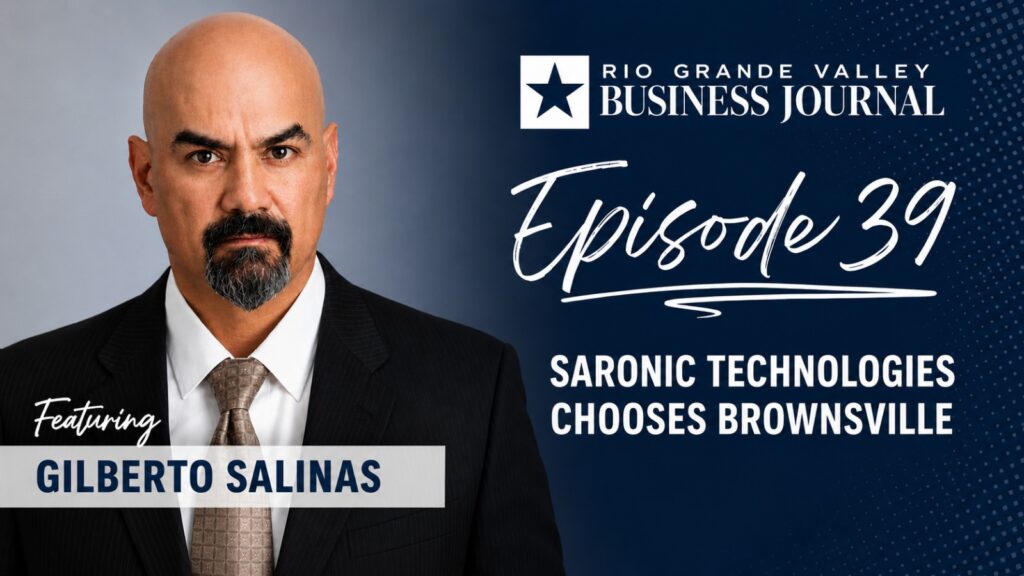
In our latest Rio Grande Valley Business Journal podcast, journalist Kristen Mosbrucker-Garza sits down with Gilberto Salinas, president and CEO of the Greater Brownsville Economic Development Corporation (GBEDC), hours after Saronic Technologies unveiled a $3.2 billion investment plan for the Port of Brownsville that’s expected to bring 10,000 direct jobs to Cameron County over the next decade.
In this wide-ranging conversation, Salinas walks through how the deal came together in just over a year, why Saronic’s founders say Brownsville moved “at Saronic speed,” and how GBEDC rallied nearly 20 workforce and education partners in a single Saturday meeting to prove the region could staff a project of this scale.
Salinas breaks down the four-part incentive package — including an $80 million state closing fund, believed to be the largest ever awarded in Texas — and explains how GBIC’s own $10 million contribution, funded by a quarter-cent local sales tax, is designed to pay for itself many times over.
Salinas also reflects on what this new wave of investment means for a port long defined by shrimping, how Brownsville stacks up against Houston, Corpus Christi and San Antonio, and why he believes the region is entering a new industrial era alongside SpaceX and the growing LNG sector — one he compares to Henry Ford’s leap from horse carriages to automobiles.
Listen to the full conversation below, and read on for how Brownsville landed one of the largest job-creation deals in state history.
The following is a rough, AI-generated transcript of Kristen Mosbrucker-Garza’s interview with Gilberto Salinas, president and CEO of the Greater Brownsville Incentives Corporation. Minor errors and misspellings may appear. For the full conversation, listen to the episode above or through your preferred podcast platform.
Kristen Mosbrucker-Garza: I’m Kristen Mosbrucker-Garza, a news reporter here at the publication, and this is a special edition. I’m here with Gilberto Salinas, president and CEO of the Greater Brownsville Incentives Corporation. We’re here in Brownsville today because it’s not every day you wake up on a Thursday and the governor of Texas stands in front of the cameras with the CEO of a hot tech startup out of Austin and talks about investing in Brownsville.
Gilberto Salinas: Yeah, you’re correct. It’s not every day that something like that happens. It’s interesting because at the press conference, when they announced the project, they were very big on the Valley, obviously big on Brownsville and Cameron County, but also on how tech is coming to this area — how the deal came together, and how Brownsville, Cameron County and the Valley are now up there with the growth of DFW, Houston and Austin. A lot of great information came out of that. But when they said that, that’s when it finally dawned on me: OK, this is kind of a big deal.
Kristen Mosbrucker-Garza: Yeah. And I heard y’all have also been having a lot of conversations on the federal level — folks in the space and defense industry talking with leaders in Washington. How is that a different level from where y’all were when all of this started?
Gilberto Salinas: So this project — we started working on it a little over a year ago, in the spring of 2025. For a project of this scope, size and magnitude, it happened really, really quickly. It’s interesting because, as one of the founders and the CEO of the company said, one of the reasons they chose Brownsville was that we moved fast — at Saronic speed. I’m going to use that one, that was pretty good. But leading up to this, a couple of years ago, we knew things were changing. We just kind of felt it. I’ll go back to SpaceX, back in 2011, when we first started working on that project. We were really excited to be working on a space project, and we’d tell ourselves, how exciting will this place be? We can’t wait to see what this place is going to be 10 to 15 years from now, when we become a space city. Well, we’re living that future right now — we are that space city now. About a year, year and a half ago, we started to see certain elements, certain stars — no pun intended — line up where this area could be a place not just for space and energy, which we already have, but also for AI and tech. Sure enough, this project popped up, and it’s defense, it’s tech and it’s AI. That helped open the door for other projects we’re looking at. This is the first one — a real big one, mind you — but the first one we’re going to start seeing, especially at the federal level, with a lot of funding coming in through the maritime industry bill, where this place is now going to be front and center for a lot of these defense projects. It’s very exciting, because we’re asking ourselves: What will this place look like 10 years from now? We think we have an idea, but we’re most definitely working to create that narrative and that future for us.
Kristen Mosbrucker-Garza: Something that really stuck out to me the first time I heard of this — I think it was in a public notice in the local newspaper — was seeking incentives, and how many jobs could potentially be brought. Direct jobs. Because with development, you might hear that the spinoff or indirect jobs could be 10 times or five times that, with the supply chain and so on. But we’re talking about 10,000 potential direct jobs. When you look at the landscape of employers, particularly private-sector employers across the Valley, not just in Brownsville — correct me if I’m wrong, but by my calculation, this would be the largest employer.
Gilberto Salinas: In 10 years out, they’d have the potential to be the largest employer. Let’s not forget about SpaceX — they’re bordering about 5,000 employees and continue to grow. But as far as what Saronic is planning to do here, I’ll be honest, it’s a scary number — 10,000. It’s up there, like when Amazon announced its second headquarters, which was upward of 10,000-plus jobs. These are massive projects. But working with the company, they were concerned — we met with them over the course of the last 14, 15 months, and halfway through the process the company asked, “Look, it makes sense for us geographically, it’s Texas, to be down in the Brownsville area, but we have concerns with the workforce. Can you all provide it?” So we started sharpening our pencils and coming up with strategies. We brought in all the different workforce and educational institutions — higher education, the universities, community colleges, smaller training operations — and in all, we had about almost 20 entities come to our office. I remember it was on a Saturday, and it was cold, and we said, OK, let’s go through this drill: We have this project, we have this company, it’s 10,000 jobs, but the beauty of it is they’re going to grow at 1,000 jobs a year. So let’s concentrate step by step — step one, 1,000 jobs the first year. How many can you create? The university said this many, you said that many, another 100 here — by the time we knew it, we’d gotten to 1,000. OK, we checked that box off. Year two, where are we at? We went through that drill twice, and both times we came up with those numbers. So we said, OK, this is doable, we just have to do the work, and we have to have what I like to call “the power convener” — make sure everybody comes in and plays well in the sandbox, too, because a lot of them are competitors. But they were all hands on deck. After we presented that to the company, they said, “OK, we see it, we see it.” That was one of the tipping points as far as when the project was looking at us, and that’s what got us from the middle of the pack to being one of the front-runners. The governor and the founder of the company both said today that the workforce piece was a huge component of their decision to pick Brownsville, Texas.
Kristen Mosbrucker-Garza: That’s really interesting, because I actually just asked the port director: It’s one thing to recruit a project, it’s one thing to land a project. How do you define success moving forward, through this implementation phase, through the phase where everything could go wrong or everything could go right?
Gilberto Salinas: Success is actually a process. It’s an ongoing process — pouring concrete, opening up the shop, hiring their first cohort, and that’s going to happen very soon. Today is a successful day, because once they pour concrete and hire and build, that’s the second wave of success. It’s really happening now. We’re seeing people getting hired, and over the next few years we’ll see them grow. But the way I define success is when a person on the street stops you and says, “I’m working for Saronic, I’m getting paid a very good salary, I’m getting upskilled, I have an opportunity for a career and advancement within this company. They’re taking care of me and my family.” Even if they don’t know who you are, just the fact that they say, “Yeah, I work at this place and we’re doing great” — that’s success to me. That means we accomplished our mission, which is to provide an opportunity at a good-paying job, at a career, for our local people in the Rio Grande Valley.
Kristen Mosbrucker-Garza: There’s been a lot of emphasis on manufacturing jobs, and I think a lot of municipalities are interested in manufacturing because of the spinoff effect. If I remember correctly, the average salary for one of these jobs could be about $75,000 or so, and that means something to an individual and to the workforce. But just like with SpaceX, I’ve heard that there are local suppliers and contractors across the Valley and even into Matamoros, into Mexico. So what does that potential supply chain look like?
Gilberto Salinas: We’re seeing it with SpaceX and the LNG plants, how they’re helping us build that supply chain. It’s on hyperdrive right now — even as far away as McAllen, which is an hour away, which in Houston wouldn’t be far, but we have a lot of businesses, vendors and suppliers coming in from the Upper Valley, as well as within Cameron County, to work for SpaceX, the LNG plant or Saronic. As the company put it very well, we’re now going to really build and complete that ecosystem — a solid corridor for business, commerce and national security. Those gates are going to open, and whatever we’re seeing today is going to be easily twofold, threefold, maybe fivefold — I’m not sure. But I know it’s going to be massive, because it’s going to enhance and complement what’s already happening here. We’re living in exciting times right now, and as an economic developer, this is what we dream of — working on projects that make a huge difference and impact in people’s lives.
Kristen Mosbrucker-Garza: I used to live in the Valley, and then I lived in San Antonio.
Gilberto Salinas: So you’re from here? You left and came back?
Kristen Mosbrucker-Garza: Yes. Technically, I was born in New Jersey, but I grew up in a small town in western Pennsylvania. I moved to Philadelphia for college and the first couple of years of my career, then rode a motorcycle across the country to Southern California. I had a choice about my next job — either here in McAllen, or in a small community called Borrego Springs in Southern California, out in the desert near Palm Springs, just west of Los Angeles. The job paid the same amount of money — not very much, but the same. I looked at the tax structure and cost of living in Southern California, and then the local newspaper flew me out to McAllen. I didn’t realize — you read so many times about a “dusty border town” — but there was no dust. There was so much irrigation and so many beautiful flowers. I liked the outdoors, so I took the job in McAllen. I worked here a couple of years, then got offered a job in San Antonio. I’ve also spent time in Corpus Christi, and this confluence of the economy in the Valley reminds me a lot of San Antonio and Corpus, in the sense that — I used to work at a business journal in San Antonio, where I covered the defense industry, the U.S. military as a business, finance, and technology, tech startups and venture capital. I also lived in Baton Rouge, Louisiana, where I covered the petrochemical industry and gas refineries, the whole chemical corridor. So I’ve been to a lot of very industrialized communities, I guess is my point. I go to Starbase and Boca Chica pretty often, since I cover their commission meetings every so often. They have a new EDC, so I got to meet their economic development director, Max Levin. I have this distinct memory of driving down Boca Chica Boulevard, Highway 4, looking around and seeing all the activity, and just how industrialized it was — I had that same sensation as driving from San Antonio to Corpus, that same confluence of a very military community, with Joint Base San Antonio, and a very industrialized one, with the oil refineries — and there’s an oil refinery now planned for the port as well. I could just see Corpus on that highway, since they’re expanding it to four lanes. When I talked to the port today, they said it may be more than four lanes because of Saronic — if you look at the map, you have the port entrance here, SpaceX over here, and Saronic is going to be literally in the middle, between the port entrance and the Boca Chica Beach area. I just envision that, and I wonder — that’s going to be defining in a lot of ways moving forward.
Gilberto Salinas: I think you said it very well. Brownsville has a little bit of what Houston has, a little bit of what Corpus has, a little bit of what San Antonio has, all in one — and it’s happening in real time, really fast. We’re seeing people move in. I think the last figure we saw was that for every one person who leaves Brownsville, three are moving in. So we’re going through major growing pains right now. There’s enough housing for the foreseeable future, and we have more coming online. And — shameless plug — the Greater Brownsville Tech Park, an industrial park of about 700-plus acres, should be having a groundbreaking ceremony in the next month or two. That’s going to be used, no pun intended, as a landing pad for the suppliers of SpaceX, the LNG plants and Saronic. So you’ve got all these different things happening at once, and it’s an alignment, but it’s no accident — there was a lot of planning that went into it, years ago, with SpaceX being the first one that opened the door. Here we are today, and we’re hopeful there will be some other announcements in the very near future.
Kristen Mosbrucker-Garza: For folks who aren’t familiar with the tech park — I’d describe it as down the road from the Amazon center. When you think about economic development and how a community grows, there are certain key indicators, or key companies, that are national or international brands, that are so keen on predictors. When I saw the Amazon center go up, to me it’s kind of like when Starbucks comes to a community — some communities think you need the rooftops first, or this or that, before you get the stories you want. But it’s like those two companies must have a magic eight ball or something. They’re always so accurate about their customers, and I think it’s because they’re really close to their customers — they probably know who buys from them and can track it very closely. They probably just got so many orders they thought, why don’t we have a warehouse there?
Gilberto Salinas: I think companies like those — and I can’t speak on Amazon’s behalf — but that was our first big win in a long time, a little over a year ago. When an Amazon comes in, like you said, they have that eye for growth — it’s like, we need to be here, because in five or 10 years there’s going to be a lot more business here. And that’s exactly what happened here.
Kristen Mosbrucker-Garza: I don’t mean to take up all of your time, I know folks are busy, but to land a deal of this size, there are some incentives in play, right? From what I remember, the Point Isabel Independent School District board agreed to a tax abatement, I believe for at least a decade. Cameron County did a 95% tax abatement for 19 years. And y’all chipped in, too — I think it was $10 million. Is that a grant, or a forgivable loan?
Gilberto Salinas: There were four major programs that helped in the recruitment of the company: the school district tax abatement, the Cameron County tax abatement, and the Texas Enterprise Fund, which is through the governor’s office — the closing fund, which was about $80 million. I think that’s the biggest deal-closing fund ever awarded through the state of Texas, and it was for this project down here. We’re pretty proud of that. And ours was $10 million, which kind of broke the bank — it wiped out our budget. But that’s how much we believed in the project. That’s tied to job creation, for the 10,000 jobs over the next 10 years — as they create the jobs, they start getting paid for that.
Kristen Mosbrucker-Garza: For folks who may not be familiar, where does that money come from? How is it funded? My general understanding is it’s sales tax.
Gilberto Salinas: Economic development funds, by state statute, are there to be used for the growth of a particular city or region — in our case, it’s a quarter-cent sales tax. So for whoever buys something in Brownsville, part of that money goes into our fund, and that fund is used for the recruitment of industry to grow the local economy. We do that through the recruitment of companies such as Saronic. We had a decent incentives pool we could pull from for different projects — this one just happened to be bigger than we thought, but we figured out that we could afford it and needed to do something for them. Four or five years down the road, that money is going to come back many times over, as more employees are working there, people are getting paid well, people start buying more stuff, more retail and commercial development comes in, and the tax base starts growing.
Kristen Mosbrucker-Garza: I think that’s a really important point, and that’s why I always break down the incentives — I think for a lot of reasons, people may not be super familiar with how that works, so I really appreciate that.
Gilberto Salinas: I’ll add that the governor said at the press conference today that Texas continues to be, for almost 20 years straight, No. 1 in the recruitment of major companies and Fortune 500 headquarters — and we now have a space headquarters down here. That’s because the state’s model for economic development is to empower local communities. Case in point: us, with the Greater Brownsville Incentives Corporation, empowering us to use those funds to go recruit companies for our community. Most other states have it the other way around — you have to go through the state to recruit and incentivize a company. Here, you use your funds, you know what you need, you recruit those companies, and then the state comes in and works other programs for you. That’s been a great model, and we’ve used it several times — hence the growth you’re seeing, not just in Brownsville, but across the entire state of Texas.
Kristen Mosbrucker-Garza: That’s really interesting. The folks at the port mentioned today, in front of an audience of a lot of elected officials, that this project in particular — for folks who aren’t familiar — is a $3.2 billion investment. The plan is to put all of that money into the site, some 800-plus acres, with the potential for 4,000 acres here at the Port of Brownsville. But there’s going to be a lot of demand for infrastructure to support that — for the roadways, the electric grid, the water supply. So there’s a blessing in disguise for the community: You did all the work to land the company, but now you have to keep the company. You’re in the business retention phase.
Gilberto Salinas: You’re pretty good at this. So yes, recruitment is the first part, but the real work is fostering the entry of the company, then the retention of that operation, and the recruitment of suppliers to help retain the company. I’m not going to say the recruitment is easy — it’s not — but the real hard work is making sure they have everything they need in order to be successful.
Kristen Mosbrucker-Garza: Do you have any advice for other leaders, whether across the Valley, in Texas or in other communities — this won’t come along every day, but you’ve now handled quite a few deals with some pretty prestigious companies of different types, that startup style. What would you advise for communities interested in working with this next generation of companies?
Gilberto Salinas: If you’re not looking at AI, if you’re not addressing your water needs and basic infrastructure needs, and if you’re not looking at tech, you’re behind — you need to be looking at those. Those are the main ones, and obviously there’s other kinds of manufacturing, advanced manufacturing, aerospace, energy. But those are the big ones right now, because AI, and tech associated with AI, is very early — we don’t know what that’s going to grow into. It’s going to grow into something big and very special. So if you’re a leader in another community, you need to be looking at that. And the other thing — whether you have an economic development team, whether it’s your chamber or your city’s economic development arm — you need to be, I don’t want to say aggressive, that’s too strong, but assertive. Promote your community. You’d be surprised how many companies will let you in, as long as you have a good proposition for why they should invest in your community. All you need is to get your foot in the door and start working it.
Kristen Mosbrucker-Garza: Was there anything else you wanted to add, anything important people should know, or that you think I might be missing? Obviously we’ll be tracking the progress of this company and everything that comes along with it. For a long time, something I’ve been thinking about is that we used to have Fathom & Fillet, and now we have the “car power ship” — they’re doing lots of interesting stuff with LNG and power. There are also plans for a power plant inside the Port of Brownsville — we have a story about that, so check that out, and we’ll be monitoring it. But some of the OG folks at the port were the shrimpers, right? They really held down that port for generations, and it’s interesting — everyone thinks of Fathom & Fillet, and when I saw it closed —
Gilberto Salinas: Broke all of our hearts.
Kristen Mosbrucker-Garza: — I had a moment where I thought, is this the same story I’ve written before? Because I’ve lived up north, near the Port of Philadelphia, or in Louisiana, or other ports, where those jobs move somewhere else, somewhere cheaper. Is that where we’re going?
Gilberto Salinas: We did have some closures, and what I usually say is that all businesses have a business cycle, and a lot of that comes down to external variables you can’t control. I can’t speak on behalf of the city, but there were some variables there — global, geopolitical variables. That provided the opportunity for somebody else to come in and use that shipyard. But the companies we have coming in now are forward-thinking companies — the space sector that, 10 years from now, will be different, 20 years from now will be different. It’s not a knock on the automobile industry, but we know the cycles behind that — this is the industry of the early 1900s. I like to say space is kind of like when Henry Ford said, “You see that horse carriage? I’m going to put an engine on it. I’m going to make it work without a horse.” And people said, “What? You’re crazy.” That’s kind of where space is right now — they said, “You see that rocket? It’s going to take people, and we’re going to go to Mars at some point.” Now we’re going to have vessels that operate independently — they’re going to go save people, they’re going to do this, do that — and you’re like, what, we’re going to trust something like that? But yes, this is all happening, like it did back in the early 1900s. It’s a very interesting — whatever it might be called — but I think what we’re seeing here in Brownsville today is a new kind of industrial revolution phase that we have yet to see the full shape of. Today is a very special day, and it’s a preview of what else is to come, and how this area and the Valley are going to keep growing.
Kristen Mosbrucker-Garza: I also feel like the chances of people not wanting to shrimp anymore are probably never going to happen — you’ll probably have the shrimp boats that go out at night, and then you’ll also have the autonomous vessels, and maybe we’ll catch more shrimp on camera, I don’t know. It’s an interesting confluence, because we also just had that thing with the potential renaming of Boca Chica Beach — a fan was really excited and wanted to name it Cyber Beach, and the city of Starbase and a lot of folks in industry were like, maybe that’s a little too much. We can embrace jobs, we can embrace technology, without changing everything about who we are as a community. That was a really interesting story for me personally, because I think it represented a nuance you don’t always see.
Gilberto Salinas: Yeah, I think people in Brownsville are proud of who we are. Brownsville and Boca Chica — I can’t speak to all the history of how that happened, but I think people love the name Boca Chica. So here we are.
Kristen Mosbrucker-Garza: Yeah, it rolls off the tongue more. Well, thank you so much for your time. Y’all stay tuned for more on Saronic and everything happening at the Port of Brownsville, with all of these road expansions — we’ll try to keep monitoring, and I know there will be job fairs and other opportunities, so for folks interested on the workforce side or businesses interested on the supply chain side, we’ll do our best to keep folks informed. Thank you so much, and I hope you have a great day.
Gilberto Salinas: Thank you. You too.
Kristen Mosbrucker-Garza: Thank you. I’ll stay tuned.