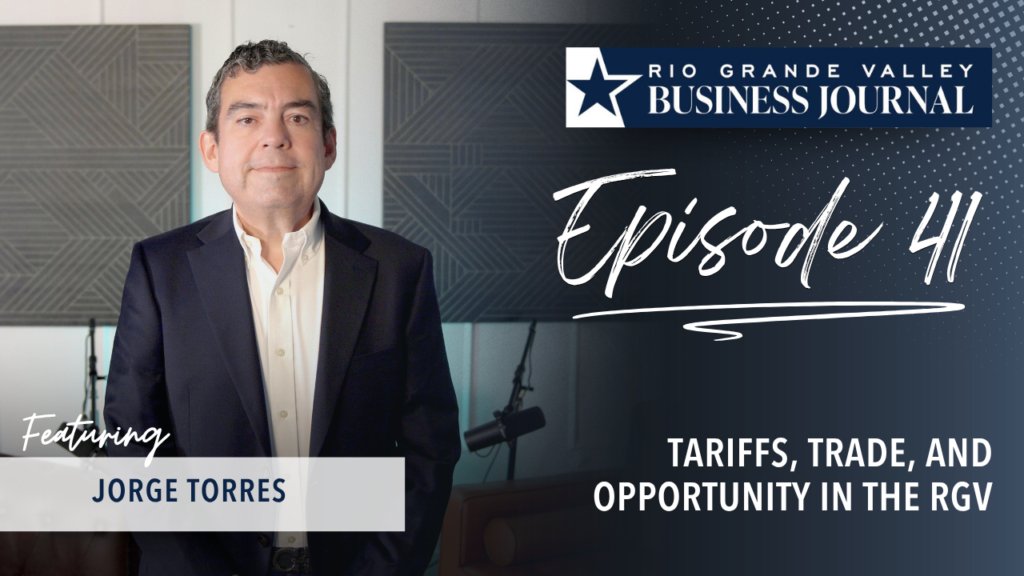
USMCA isn’t ending — but it is entering a new phase of year-by-year uncertainty, according to Jorge Torres, president of Interlink Trade Services and a licensed customs broker, in the latest episode of the RGV Business Journal podcast.
Torres joins host Naxiely Lopez-Puente to unpack what happened July 1, when the United States declined to join Mexico and Canada in extending the U.S.-Mexico-Canada Agreement for another 16 years. The decision, tied to USMCA’s built-in sixth-year sunset clause, doesn’t terminate the pact — it remains in effect through 2036 — but it does trigger a rolling cycle of annual reviews and continuous negotiations among the three countries.
The conversation ranges from the mechanics of that review process to the real-world toll of tariff volatility on importers, customs brokers and manufacturers weighing whether to bring production to Mexico. Torres details the roughly $166 billion collected under tariffs later struck down in court, the pace at which new provisions can upend supply chains overnight, and why some companies are simply eating the cost rather than filing for refunds.
Despite the uncertainty, Torres sees the Rio Grande Valley positioned to benefit — pointing to investment at the Port of Brownsville, growth in medical device and data center manufacturing in Reynosa, and the region’s push to build its own trade ecosystem rather than compete head-on with Laredo. He also lays out what Mexico needs to do, from infrastructure to strategy, to remain competitive as the review process unfolds.
Watch the full conversation for a deeper look at where cross-border trade stands — and where it’s headed.
The following is a rough, AI-generated transcript of Naxiely Lopez-Puente’s interview with Jorge Torres, president of Interlink Trade Services and a licensed customs broker. Minor errors and misspellings may appear. For the full conversation, listen to the episode above or through your preferred podcast platform.
Jorge Torres: I think, in particular in our region, the Rio Grande Valley, we’ve seen that there are opportunities being created. For example, the Port of Brownsville — we have all these investments, SpaceX, LNG, the new investment that was just announced. And there’s other things coming here in McAllen; we have the Valeo facility. And being close to Mexico, we can have dual production and meet the requirements of USMCA. So I think our region is going to benefit from this uncertainty, believe it or not.
Naxiely Lopez-Puente: Thank you for joining us on this episode of the RGV Business Journal podcast. I’m Naxiely Lopez-Puente, and today we are here with Jorge Torres. He is the president of Interlink Trade Services and a customs broker. Jorge, thank you so much for joining us today. All right, so let’s start unpacking this very complicated issue that is USMCA. Talk to us about what’s going on with that.
Jorge Torres: Yes. Well, USMCA — the U.S.-Mexico-Canada Agreement — came into effect on July 1, 2020. It replaced NAFTA, the North American Free Trade Agreement. This agreement is different from NAFTA in that it has an expiration date, which is 2036 — it’s valid for only 16 years. So what was going to happen this year, in 2026, was the sixth-year sunset clause provision, which is the revision of the USMCA agreement to extend it for another 16 years. The three countries — the U.S., Canada and Mexico — were supposed to agree on extending it for another 16 years. Mexico and Canada did submit their official letters requesting the extension, but the United States, on July 1, said no, we’re not going to agree to extend it for another 16 years. That triggered a lot of confusion, because people thought that was the end of USMCA. Not necessarily — USMCA will be here with us until 2036. What this triggers is yearly revisions. So every year they’re going to have to meet and see if they want to extend it for another 16 years. It’s not that it ends; it just triggers that yearly revision process.
Naxiely Lopez-Puente: Until they —
Jorge Torres: Until they decide to extend it. Or by 2036. Right now, each country has the right to withdraw from the agreement with a six-month notice.
Naxiely Lopez-Puente: Right.
Jorge Torres: Notice of withdrawal. But those provisions are already in USMCA — it’s not something new; it’s there in the agreement. So right now we’re going through that process, through the yearly revisions. That’s what’s going on with USMCA right now.
Naxiely Lopez-Puente: So it’s not that the U.S. pulled out — it’s that the U.S. didn’t agree to extend it another 16 years.
Jorge Torres: That’s what happened this year.
Naxiely Lopez-Puente: Okay. And so what do you call these yearly reviews?
Jorge Torres: Yearly reviews.
Naxiely Lopez-Puente: Reviews. What do they do?
Jorge Torres: Well, what they’re trying to do — NAFTA was a good agreement, but it had weaknesses. It was very locked into its provisions and didn’t have provisions for renewal or revision. So with USMCA, it has to adapt to the —
Naxiely Lopez-Puente: To the changing —
Jorge Torres: To the changing world, geopolitical economy, technology. So that’s what these revisions are for. They’re trying to revamp the rules of origin. For example, one of the key areas is that the United States wants more regional value content, especially in the automotive industry. Yeah, that more value added, including parts and labor, are performed in the North American region, and especially in the United States. As we know, President Trump wants to bring industry into the United States, reshore, or have companies invest here. So that’s one of the areas. And then there are environmental issues, labor issues and other issues that have to be tackled. So that’s what they’re working on right now. Mexico has its wish list, as well as Canada, on what they want to change, based on the experience they’ve had up to now.
Naxiely Lopez-Puente: Which means what — more parts?
Jorge Torres: Yeah, that more value added, including parts and labor, are performed in the North American region.
Naxiely Lopez-Puente: So I guess, hypothetically, if they had all agreed to extend it, these yearly reviews wouldn’t be triggered.
Jorge Torres: Exactly.
Naxiely Lopez-Puente: But what if, two or three years from now, the U.S. — or any of the countries — wants to revisit? Would they even have an avenue to revisit some of these?
Jorge Torres: Yeah, in another six years.
Naxiely Lopez-Puente: So it’s a six-year — okay, every six years they get back to the table and look at everything.
Jorge Torres: And if there’s something immediate, USMCA has internal mechanisms to resolve those issues.
Naxiely Lopez-Puente: And so, I know that every time we’ve been writing about trade — we’ve been at it for over a year now in this publication — and every time we reach out to anybody who deals with this issue, they keep talking about uncertainty. And we were talking about this earlier — it seems that uncertainty really began, or at least took off, when President Trump took office. Talk to us about that.
Jorge Torres: Yes. Uncertainty is not good for economic growth. Companies that invest, especially in the manufacturing sector — those investments are long-term, 15, 20, 30-year investments. So they want certainty; they want confidence to set up their facilities, whether in Mexico or the U.S., and their supply chains. That stability isn’t here anymore. And like you mentioned, this started happening when President Trump took office — was it 2024?
Naxiely Lopez-Puente: 2025.
Jorge Torres: Even 2025 — it was January 2025. He campaigned on tariffs; that was one of the topics from his campaign, that he was going to impose tariffs. Everyone thought it was just politics, just part of his campaign to win votes. But he came through with it — he implemented the tariffs in April: the reciprocal tariffs, the Section 232 tariffs on steel and metal, and Section 122 and Section 301 tariffs. So he’s been imposing different tariff provisions — one day they include products, then they exclude products, and they open new investigations to set more tariffs. That uncertainty — importers in particular don’t know what they’re going to be paying tomorrow, because something new might come up. Some of my customers have told me, if they tell us it’s 10% tariffs and that’s it, we’ll deal with it, we’ll work it out with our suppliers, with our customers. But if they tell me 10% today, 15% tomorrow, that creates commotion within our supply chain and our pricing structures with our customers. How can you maintain your customer base and supplier base if pricing and costs are going up and down? So that’s the uncertainty that all these tariffs are creating, and what’s going on right now.
Naxiely Lopez-Puente: So what does that do for someone like you, a broker? Talk to us about that.
Jorge Torres: Yeah, it’s been a challenge for the last year. As customs brokers, what we do is file import transactions on behalf of importers, to import goods into the United States. We make sure the proper values, descriptions and measures — tariffs, duties — are processed correctly, so they’re paid to the U.S. government, to CBP, Customs and Border Protection. We’re in the middle — a middleman — to ensure that importers do the right process, that customs gets paid, and that everything imported is legal, and that the importer knows what they’re going to be paying, how much it’s going to cost to import those products. With all these different tariff provisions and changes, it’s a challenge, because we have to retrain ourselves to understand them and explain them to our customers. One of the challenges is that these tariff provisions come very quickly. For example, they can announce new Section 232 tariffs on metals on a Friday afternoon, to be implemented Monday morning. So we have to digest everything real quick. Customs has to digest it too, because they have to modify their systems. We use software to file those entries, those import transactions — our software has to adapt and make the changes. On top of that, we have to understand it and make sure our customers understand it. So it’s a very short period of time for us to digest and disseminate that information correctly. That’s been the challenge for the last year.
Naxiely Lopez-Puente: Wow. And you were talking about some new tariffs going into effect just a few days ago.
Jorge Torres: Yes. The tariffs were struck down in February, but President Trump immediately imposed another tariff provision under Section 122, for balancing payments, of 10%. But that was only valid for 150 days, so it expired on July 23rd or 24th, in the morning. He then immediately imposed Section 301 tariffs on forced labor on 60 economies, ranging from 10% to 12.5%. So that kind of replaced it — there’s a continuity. He’s using different provisions, different sections of the law, to impose those tariffs. That’s what changed last week — it happened on a Friday, so we had a Thursday-Friday scramble. We’re kind of getting used to it. It’s sad to say, but there’s no other way to do it. But that’s what happened with those new tariffs.
Naxiely Lopez-Puente: And going back to the tariffs that were struck down — I know there was talk about possibly refunding some of those to companies, but we also heard that some companies said it’s too much trouble, we’re not going to do it. What are you seeing, what are you hearing?
Jorge Torres: Well, they collected approximately $166 billion in tariffs.
Naxiely Lopez-Puente: And they can’t keep that.
Jorge Torres: No. As a matter of fact, right now close to $100 billion has been approved for refund, and refunded already. So they’re giving that back. Then there’s another segment that’s still in process — there are different stages in the import transaction. Right now we’re waiting for liquidated entries to see what happens to them. It’s expected that, out of that $166 billion, about 15% will not be refunded, because, like you mentioned, some companies say, well, maybe it’s $10,000 or $50,000 for me — I’m not going to make a big deal of it. I’ll just take the loss and move on.
Naxiely Lopez-Puente: It might be —
Jorge Torres: More complicated, more complicated and more exposure — because when you ask for money back from the government…
Naxiely Lopez-Puente: Well, let’s —
Jorge Torres: See if that’s valid, and they’re going to come back to you. So some companies say, you know what, it’s not worth the risk, it’s not worth the expense to file for that refund. So that’s why it’s expected that of that $166 billion, about 15% won’t be refunded. The government is going to keep that, one way or another.
Naxiely Lopez-Puente: Interesting. Okay, wow. And so, we talk about this uncertainty — is there a real-world example you can point to, maybe an anecdote of someone who was thinking of setting up shop here, and they decided not to, or they were going to expand and —
Jorge Torres: Well, we’re going through that pretty much almost every day. In my experience, for example, we have customers who are thinking of bringing production lines to Mexico from China, because China has certain additional tariffs that Mexico doesn’t. So they’re shifting that production. But at the same time, Mexico isn’t off the hook either, especially if USMCA can’t be applied to certain products — and that’s the case if you bring raw materials from Asia and other countries; that will trigger Section 301 tariffs and all of that. So we’re doing a lot of cost-benefit analysis, landed-cost analysis, to make sure projects are feasible in Mexico. And you’d be surprised — Mexico can be higher in labor costs and certain expenses than China. So some companies, even with the tariffs, say, you know what, I’m not going to bring this production line to Mexico, because we’re still going to have to pay tariffs on our supplies — our suppliers are in Asia, so the logistical costs are going to increase. And doing the cost-benefit analysis, sometimes even with the tariffs, they see it’s not worth bringing those production lines. So that’s one of the challenges the uncertainty is creating — stopping expansions in Mexico, new production facilities in Mexico. The famous nearshoring has slowed, or hasn’t materialized as we expected two or three years ago.
Naxiely Lopez-Puente: And that’s an interesting point, because we ran a story recently about nearshoring — not just nearshoring, but, for example, there was a lot of build-out for industrial space in Reynosa. But right now, or at least the last time we checked, their vacancy was up to 10%, which was pretty high — they hadn’t seen that type of vacancy before. But people kept building, because they keep expecting that, eventually, it’s cyclical and they’re going to see a rise in demand, I guess. What are your thoughts on that?
Jorge Torres: Well, even with the uncertainty, there’s some optimism. Mexico exports 80% of its production to the United States, and the United States needs those materials, those imported products. So even with President Trump saying that we don’t need USMCA, that Mexico is taking advantage of the U.S., that Mexico is the back door for China, and all those comments he makes — the consensus from both the private and public sectors is that the United States needs Mexico as a trading partner. We’re optimistic that, at some point, even with the yearly revisions, USMCA will be renewed or extended. This might happen next year — we have the midterm elections in November, so that’s going to be a barometer of what’s going to happen. But there are expectations — U.S. Trade Representative Greer has already made indications that hopefully, sometime next year, we’re going to have an extension of USMCA. So that’s what’s triggering some level of confidence, if you want to call it that, that this is going to pass and we’re just going to move on. I think eventually things are going to calm down a little bit, but tariffs — serious tariffs — aren’t going to go away.
Naxiely Lopez-Puente: Right — you were talking about how it’s not going to be a free trade —
Jorge Torres: No. If you notice, NAFTA, the predecessor of USMCA, includes ‘North American Free Trade Agreement’ — right? And USMCA is the ‘United States-Mexico-Canada Agreement.’ It doesn’t mention ‘free.’
Naxiely Lopez-Puente: They cut that out.
Jorge Torres: They cut that out. And with all the tariff provisions being imposed by President Trump, they’re not going to go away. Even with Trump 1.0, the first administration, they imposed Section 301 tariffs on China. Then Biden came in — everyone thought, oh, Biden is going to get rid of those. Well, no — as a matter of fact, he added some and increased some of those tariffs, up to 100%. It’s one of those things: if the government sees a revenue stream…
Naxiely Lopez-Puente: Why would you cut it out?
Jorge Torres: It’s one of those things — well, let’s turn a blind eye, keep it and move on. Once they start seeing that revenue, it’s going to be hard to take out.
Naxiely Lopez-Puente: Regardless of who’s in office.
Jorge Torres: Yes. Are they going to come down? Maybe some of them will go away, maybe — but not 100%. And one of the things Mexico has to push in the USMCA revision is that, as long as Mexico is more competitive than other countries — let’s say, for example, right now Taiwan has 15% tariffs on certain products, and Mexico has 25%. If Mexico could get to 10%, that would be great, because that would make Mexico more competitive. That’s something Mexico really has to focus on. And I think the secretary of Economía, Marcelo Ebrard, realizes that, because he knows that even with USMCA in place, other sectoral tariffs, such as Section 232 and 301, aren’t going to go away. But as long as those tariffs are lower than other countries’, Mexico will still be competitive. That’s something they need to focus on.
Naxiely Lopez-Puente: And Mexico imposed its own tariffs recently on Asian countries.
Jorge Torres: Yes, on China in particular, and other countries, on certain products — metals and textiles. That’s pretty much in response to what President Trump is demanding, so they’ve kind of caved to that. That might help in the revision of USMCA. Actually, President Trump is asking Mexico to impose tariffs similar to Section 232 on metal products, particularly from China, because China is the big fish in the pond here for the United States, right?
Naxiely Lopez-Puente: Yeah, the biggest competitor.
Jorge Torres: A competitor. Yes.
Naxiely Lopez-Puente: All right. Do you see any opportunities? I know there are plenty of challenges, uncertainty — but any unexpected opportunities that have come out of all this back-and-forth?
Jorge Torres: Yes. I mean, I think, in particular in our region, the Rio Grande Valley, we’ve seen that there are opportunities being created — for example, the Port of Brownsville. We have all these investments — SpaceX, LNG, the new investment that was just announced. And there are other things coming here in McAllen — we have the Valeo facility, where they’re going to make, you know, the ‘brain’ of the new-generation GM vehicles. And then we have an aluminum plant. So there’s a lot of things going on here in the Valley. And part of that is the uncertainty, because, as I mentioned earlier, what President Trump wants is investment in the United States, so people are realizing, well, we’d better invest in the United States. And being close to Mexico, we can have dual production and meet the requirements of USMCA. So I think our region is going to benefit from this uncertainty, believe it or not.
Naxiely Lopez-Puente: So interesting. All right, so we might come out on top because of all of it.
Jorge Torres: Correct. Yes. And I think we’re doing a great job here — there are different entities, different economic development groups, RíoPlex, the economic developments, that are working together to promote our region and make sure we have the resources in place. That’s a challenge, but I think we’re going to be okay.
Naxiely Lopez-Puente: So, if we removed the uncertainty these tariffs are creating, what other challenges are we seeing when it comes to trade?
Jorge Torres: One of the main ones is infrastructure. Obviously, we border Mexico, and most of our trade crosses by truck. I think we need to develop better bridge infrastructure. I know the Pharr bridge is expanding, and I know Anzalduas will soon be commercial. We need to bring rail to the region as well — there’s Brownsville, Laredo and Eagle Pass for rail, but we need something in this area. Obviously, rail will take maybe 20 years to develop — we might not be here to see it, but hopefully it will materialize. So having better border-crossing infrastructure, better technology — right now AI is the big thing — implementing that better infrastructure, I think, is going to bring opportunities and train skilled labor.
Naxiely Lopez-Puente: So the workforce.
Jorge Torres: The workforce.
Naxiely Lopez-Puente: Yes. Are you seeing any issues? I know there have been mandates — for example, Texas saying drivers now need to be able to take tests in English, English proficiency — and there was something recently in the news, I think, about rail too. But all these new prerequisites — have you seen any issues with that?
Jorge Torres: Yeah, that has created a challenge for freight companies, for border-crossing companies, because a lot of their drivers don’t speak or read English, so they’ve had to decommission, or take out, a lot of drivers. But I know a lot of the trucking companies are providing English classes and all that. So I think that hurdle will eventually be jumped, but right now that’s definitely a challenge.
Naxiely Lopez-Puente: Basically, Laredo eats our lunch when it comes to being the port — the biggest port, and the amount of traffic it has. How do we, as a region, compete for some of that business? One of the pitches we’d make at Mission EDC was, try coming through on us — it’s going to be faster, and you won’t see as much congestion. How do we compete with Laredo?
Jorge Torres: Yeah, well, Laredo has been the main port of entry for a lot of years — they’re the top port of entry in the United States, geographically and historically. They’re in the right position — obviously they have I-35 and access from the interior of Mexico into the United States, and that makes it very convenient. So the transportation, logistics and customs brokerage industry developed there through the years. It’s going to be very hard to take business away from Laredo. Rather than look at them as competition, we need to partner up and say, if trade continues to grow, we can help you — let’s work together as a region and take some of the congestion. It’s not about wanting a bigger piece of the pie — we want to make the pie bigger. So I think that’s the strategy we need to take: instead of focusing on how we take business away from Laredo, it’s how we work together and create our own ecosystem here of trade. And that’s what we’re doing right now. We’re not really focused on taking business — we don’t see Laredo as competition. We need to see ourselves as our own competition, and make sure we grow, and offer things they can’t, which we do right now. That’s why industrial development has been growing in the Valley — Laredo isn’t growing in industrial development. They might be growing in trade, but we’re focused on industrial development.
Naxiely Lopez-Puente: So what does that mean — manufacturing?
Jorge Torres: Yeah, okay, that’s what we’re focusing on in the Valley. And that’s going to create trade too. So we’re shifting gears a little bit, and I think that’s working. If we all work together, that’s not our competitor — it’s how can we partner up and make our area stronger, in the industry and things like that.
Naxiely Lopez-Puente: Right. And has our industry — I know the automotive sector was, at least historically, the bigger industry when it comes to imports and exports. Is that still the case? What’s happening with the automotive industry?
Jorge Torres: The automotive sector, actually, has been dropping, because of the tariffs, as well as the metal industry — steel, aluminum, copper. But there are two areas that are growing: one is telecommunications, computers, semiconductors — that industry, because of the need to support AI and the demand for computers and all that. That’s an area that’s growing. Also medical products, medical devices and things of that nature — that’s growing. The produce sector is also growing. So those are the areas where we see growth. And eventually, if the rules of origin for automotive components and automobiles are redone and agreed to, I think we’re going to see an increase in trade from the automotive industry as well. But for now, it’s decreased — though the industry is growing. And as a matter of fact, Mexico has been exporting more and more. It’s an irony — Mexico’s exports keep growing every month.
Naxiely Lopez-Puente: Wow. But it was so impressive to see everything that’s happening when it comes to health care and industry over there in Reynosa.
Jorge Torres: Yeah, you’d be surprised — all kinds of things: insulin pumps, catheters for dialysis, machinery for dialysis, even some for pediatric repackaging, and, like you mentioned, slings to move patients, inflatable mattresses, compression socks — all kinds of medical products are made in Reynosa, Mexico.
Naxiely Lopez-Puente: The data center — Vertiv, you know, is a company that’s basically helping power the data centers that are popping up everywhere, especially here in the U.S. But most people don’t know that, across the river in Reynosa, this company is basically powering data centers.
Jorge Torres: Yeah, I mean, that’s what we’re seeing — a lot of investment to support that industry, the data centers. Actually, we met with a company a couple of weeks ago that’s going to be making the metal cases for generators, for power generators — they’re looking at Reynosa to install that. So they’re making the case for the generators, to supply part of the supply chain for one of the big generator manufacturers in the United States. They’re getting orders like you wouldn’t believe, because these data centers are going to require generators to provide their own power source. So that’s an example of how things are trickling down.
Naxiely Lopez-Puente: Right. And we had this story published just today on our website, about the Cement Association coming out with a forecast saying construction is kind of down when it comes to residential, but one of the bright spots in the cement industry is data centers. And I mean, we’re obviously having these conversations about data centers here at home too, and —
Jorge Torres: I don’t think we want to get into the politics side of things — I’m not good at that.
Naxiely Lopez-Puente: No, but the demand they’re driving — to hear that companies supplying these data centers are looking at our area is pretty impressive.
Jorge Torres: So there’s a lot of things going on.
Naxiely Lopez-Puente: So a lot of —
Jorge Torres: Interest, even with the uncertainty, even with some of the pessimism we’re going through right now. Whether we like President Trump or not, we have to set politics aside a little bit and focus on what we can do to capitalize on the uncertainty and the new reality we’re living in right now. Globalization of trade has stopped, and we’re going backwards — we’re going to regionalization, what we call Globalization 2.0. That’s a natural move. We learned a lesson with the pandemic, with COVID — that we relied so much on Asia, that getting products from Asia, drugs, computers, chips and all kinds of stuff was a challenge. That was a warning sign, telling us we need to bring those industries to our region, for national-security purposes. That’s what we’ve been working on. So, putting politics aside, we need to be realistic, and we need to rely on our region to be self-sufficient. That’s what’s creating this regionalization of trade.
Naxiely Lopez-Puente: I want to go back one more time to USMCA, because I have a question — now that we’ve missed this, was there a window to extend it?
Jorge Torres: They pretty much announced it — it’s done. It was July 1; that was the time frame. Mexico and Canada submitted their letters requesting the extension for another 16 years. The U.S. said no. That triggers the yearly revisions.
Naxiely Lopez-Puente: So, looking forward, what’s next for USMCA? Is there another critical time we need to be looking at, another critical window?
Jorge Torres: Well, we’re going to have the reviews, like I mentioned.
Naxiely Lopez-Puente: When are those?
Jorge Torres: Every year — well, first every year, but they’re having several meetings. For example, Mexico and the United States are meeting again in September. So they’ll continue to have meetings. And once things are sorted out — it’s not strictly yearly reviews, it’s continuous meetings — once there’s an agreement, that’s when they’ll say, okay, we’re going to extend it. If they don’t agree, they’ll continue those conversations. So more than yearly reviews, we’re going to see a continuation of talks and meetings until there’s an agreement to extend it, or it expires in 2036. That’s what we’re looking at. So we do have USMCA until 2036 under the existing conditions. And then, if they agree to extend it, we’re going to have new, revised provisions in USMCA that we’ll have to deal with.
Naxiely Lopez-Puente: Got it, okay. All right, Jorge, anything else you’d like to talk about that maybe I didn’t ask?
Jorge Torres: Well, I think, like I mentioned, sticking with USMCA — I think the U.S. has the upper hand, obviously, on the extension of USMCA, since they were the ones who said no, let’s do the yearly revision. So they’re working out, during those meetings, how they’re going to reshape USMCA for the future, if it’s extended. I think Mexico, being a critical trade partner to the United States, and the United States realizing that — whatever President Trump says — Mexico has to rethink how it approaches the United States. The mentality in Mexico, the philosophy, was: what can we sell to the United States, what can we export to the United States? And that worked fine, up until now, because this administration is focused on national security, bringing industry back, economic growth through reshoring industry, through investment in the United States rather than other countries. So now Mexico has to rethink and say, okay, how can we become a strategic partner to the United States? How can we help them with national security and economic development? Until Mexico realizes that, and comes to the table with proposals on how they can partner with the United States, they’re not going to be successful. So my message is, hopefully they can understand that and move forward with that strategy. And I think, if they do that, we’re going to be successful in extending USMCA. Mexico has a lot of things to work on — infrastructure, legal certainty, labor and security issues; we’re not going to get into that. But if they can tackle those, as well as redefine their strategy with the United States, I think we’re going to be successful.
Naxiely Lopez-Puente: And what are some of those strong points Mexico has that maybe they haven’t realized — that they could really —
Jorge Torres: Geographical location, a young population. They have challenges — infrastructure, water, the power grid, road infrastructure, security issues, and some of the politics side — so they can look into that as well. But the geographical location — we’re right here — the young population, and they’ve proven that Mexico can support industry. There’s a lot of factories, a lot of components being made all over Mexico — the maquiladora industry has flourished in Mexico. So it’s just a matter of rethinking their strategy and selling it to the United States.
Naxiely Lopez-Puente: Well, I want to thank you for a very interesting conversation, for helping us figure out what’s going on with USMCA, and understanding the trends and challenges of our area. Thank you for that.
Jorge Torres: Well, thank you for the opportunity. Thank you.
Naxiely Lopez-Puente: All right. Well, for those at home, remember to subscribe, keep watching, and we’ll see you next week.