How Produce Moves Through the Rio Grande Valley: Inside Texas’ Fresh Food Supply Chain
The Rio Grande Valley is one of the most important — and least understood — regions in America’s food supply chain. As winter sets in across much of the country, South Texas becomes a critical gateway for fresh fruits and vegetables grown locally and imported through Mexico.
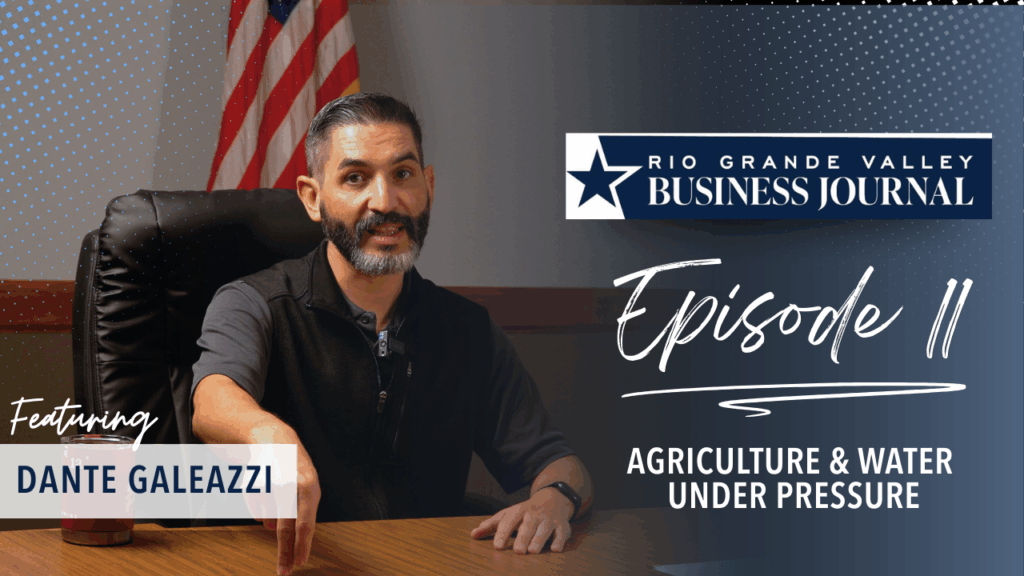
In this episode of the Rio Grande Valley Business Journal podcast, host Naxi Lopez sits down with Dante Galeazzi, CEO of the Texas International Produce Association (TIPA), to discuss the Valley’s role in produce, cross-border trade, water challenges, infrastructure investment, and the economic ripple effects shaping agriculture on both sides of the border.
The following is an AI generated transcript of the Podcast with Dante Galeazzi, “Agriculture and Water Under Pressure.” There may be minor mistakes in the transcript, please refer to the link above or listen on your favorite podcast provider.
Naxi Lopez
Hi, and thank you for joining us on this latest episode of the Rio Grande Valley Business Journal’s podcast. I’m Naxi Lopez, and today we’ll be exploring the Valley’s role in produce — what we’re growing, what comes through our ports every day. Joining us today is Dante Galeazzi, CEO of the Texas International Produce Association. Dante, thank you so much for being with us today.
Dante Galeazzi
Thank you for having me.
Naxi Lopez
Of course. So, Dante, for those at home who don’t know what the Texas International Produce Association — better known as TIPA — is, tell us what your organization does and who you represent.
Dante Galeazzi
Yeah, absolutely. The best way to do this is probably my elevator pitch. We’re a nonprofit organization representing a $13 billion industry that’s either grown in Texas or shipped into Texas as its first point of arrival in the U.S. We represent farmers, growers, shippers, marketers, warehouses, seed companies, and chemical suppliers. Basically, if you’re part of the recipe in growing fresh produce and getting it from someone’s field to their plate, we help that supply chain.
Basically, if you’re part of growing fresh produce and getting it from someone’s field to their plate, we’re here to help that entire supply chain.
Naxi Lopez
Got it. And how many members are in your organization?
Dante Galeazzi
We have a little more than 400 member companies. They represent the entire supply chain — not just farmers, not just grocery stores, but everybody in between, plus all the supporting industries that make it possible.
Naxi Lopez
So talk to us about what’s happening right now in the Valley when it comes to produce. What’s moving? What’s changing?
Dante Galeazzi
The cool thing right now is that we are in season in the Valley. This is the time of year when we’re harvesting and growing produce. There are only three places in the United States that can grow fruits and vegetables during the dead of winter: southern Florida, southern Arizona, and southern Texas.
Our season starts in October with grapefruit and goes all the way through May with watermelons. Fun fact: Texas is the first place in the country to get fresh onions and fresh watermelons.
But this is also the peak period for bringing fresh produce across from Mexico into the U.S. through Texas — more than 200 different fruit and vegetable items. That makes Texas a prime sourcing point for grocery stores across the country.
Your Walmarts, Krogers, Albertsons, Costcos — they’re looking to South Texas for produce because it’s far more efficient to source hundreds of items in a relatively small geographic area than sending trucks to multiple states.
We’re a critical point for the U.S. when it comes to getting fresh produce into stores and restaurants.
Naxi Lopez
And what are we growing here in the Valley?
Dante Galeazzi
We grow more than 45 items in the Valley alone and about 60 across Texas. Our principal commodities include grapefruit, oranges, onions, watermelons, cabbage, carrots, potatoes, squash, kale, mustard greens, cilantro, dill — the list is tremendous.
Naxi Lopez
And what’s coming through our ports of entry?
Dante Galeazzi
Across Texas, we’re bringing in about 13 billion pounds of fresh produce each year. In Pharr alone, about 22 million pounds a day. The main commodities are avocados, tomatoes, limes, bell peppers, and mangoes.
Naxi Lopez
So basically everything you need to make pico de gallo.
Dante Galeazzi
Exactly right.
Naxi Lopez
What role does TIPA play in cross-border trade?
Dante Galeazzi
We help the supply chain do everything except grow and ship produce. Farmers don’t always have the resources to navigate laws, regulations, insurance issues, or international trade rules. That’s where we come in — advocating with lawmakers, working on disaster assistance programs, insurance solutions, packaging regulations, transportation rules, and more.
For example, after the 2021 freeze that devastated citrus crops, we worked to help farmers access government assistance because fresh produce often isn’t insured like other commodities.
Naxi Lopez
Why is citrus only now starting to recover?
Dante Galeazzi
The freeze killed two crops at once — the current harvest and the following season’s flowers and fruit. It takes years for trees to recover, much like a person recovering from a major health event.
Naxi Lopez
We recently reported on blockades in Mexico that disrupted trade. How did that impact the Valley?
Dante Galeazzi
Those blockades caused delays that ripple through the entire supply chain. Trucks had to reroute, increasing costs for fuel, labor, and time. Even a two-day delay can cause shortages on grocery shelves and throw off harvesting schedules for farmers. While consumers may not notice immediately, the impact on farmers — especially in Mexico — is severe.
Naxi Lopez
Water is also a major issue. How do you address that?
Dante Galeazzi
Water is the single biggest issue we’ve been working on for years. South Texas and Tamaulipas are the last users of the Rio Grande. When we don’t have water, they don’t either.
The 1944 water treaty was designed to ensure fairness, but Chihuahua has held back water for decades. This creates an existential crisis for agriculture and communities on both sides of the border.
If we don’t enforce the treaty or renegotiate it properly, we’re headed toward water shortages that affect not just farmers, but entire communities.
Naxi Lopez
How does this affect citrus specifically?
Dante Galeazzi
Without reliable water, growers face tough choices — keep citrus groves that require constant irrigation, switch to short-term vegetable crops, or sell land for development. Once land is developed, it never returns to agriculture.
Despite the challenges, Texas grapefruit remains the best-tasting grapefruit in the country, with enormous demand both domestically and internationally.
Naxi Lopez
You’re also passionate about getting people to eat more fruits and vegetables.
Dante Galeazzi
Absolutely. Only about one-third of Texas kids eat fruit daily, and only one-quarter eat vegetables. That’s a huge opportunity for better health and stronger demand for local produce.
Eating fruits and vegetables doesn’t mean just salads — smoothies, grilled vegetables, fruit parfaits — there are countless ways to do it.
Naxi Lopez
Let’s talk about ports of entry and infrastructure.
Dante Galeazzi
We must continue modernizing our ports. Fresh produce truckloads have more than tripled since 2010. Efficient ports mean faster crossings, fewer delays, and more economic activity. The more efficient our bridges are, the more economic value moves across them.
Naxi Lopez
Lastly, explain the tomato suspension agreement.
Dante Galeazzi
In short, the U.S. withdrew from an agreement that prevented anti-dumping duties on Mexican tomatoes. Now there’s a 17% duty, which significantly increases costs for importers.
That impacts warehouse jobs, trucking, and the entire produce ecosystem in the Valley. Tomatoes are the second-largest produce item crossing the border after avocados, so the economic ripple effects are substantial.
The solution is political — people need to talk to their elected officials and push for the agreement to be reinstated.
Naxi Lopez
Anything else you’d like our audience to know?
Dante Galeazzi
Eat more fruits and vegetables. It’s good for your health, good for jobs, and good for our communities.
Naxi Lopez
Great message. Thank you so much, Dante.
Dante Galeazzi
Thank you for the opportunity.
Naxi Lopez
And thank you for listening. Don’t forget to subscribe, and we’ll see you next week.