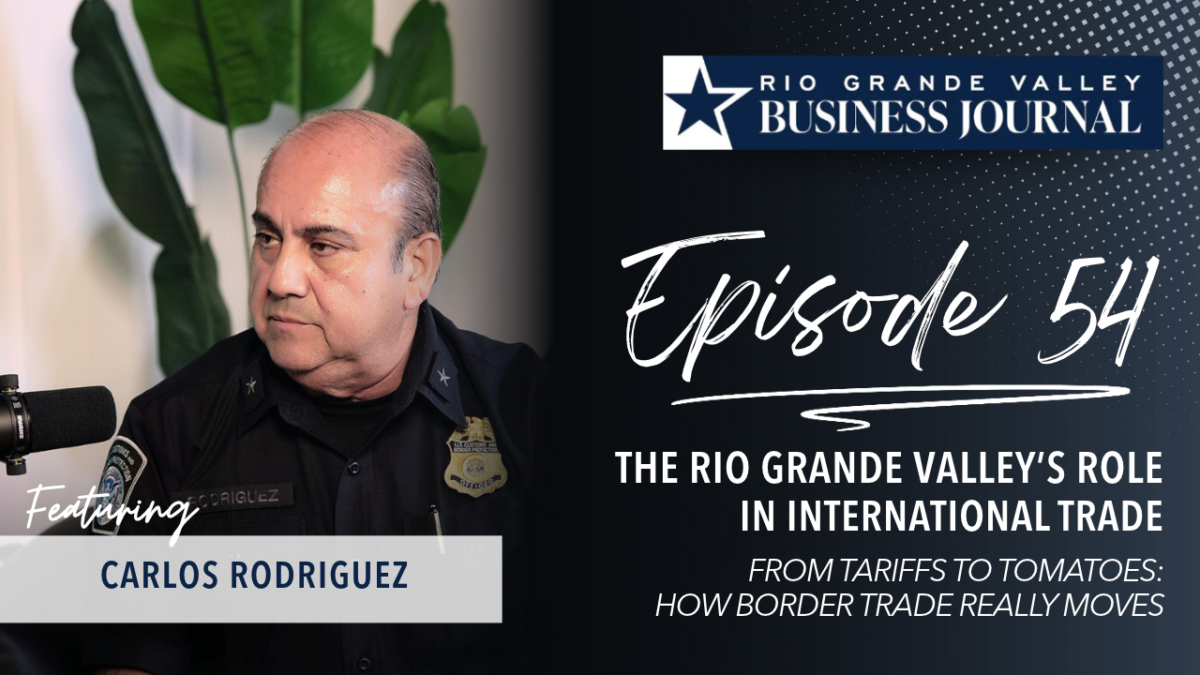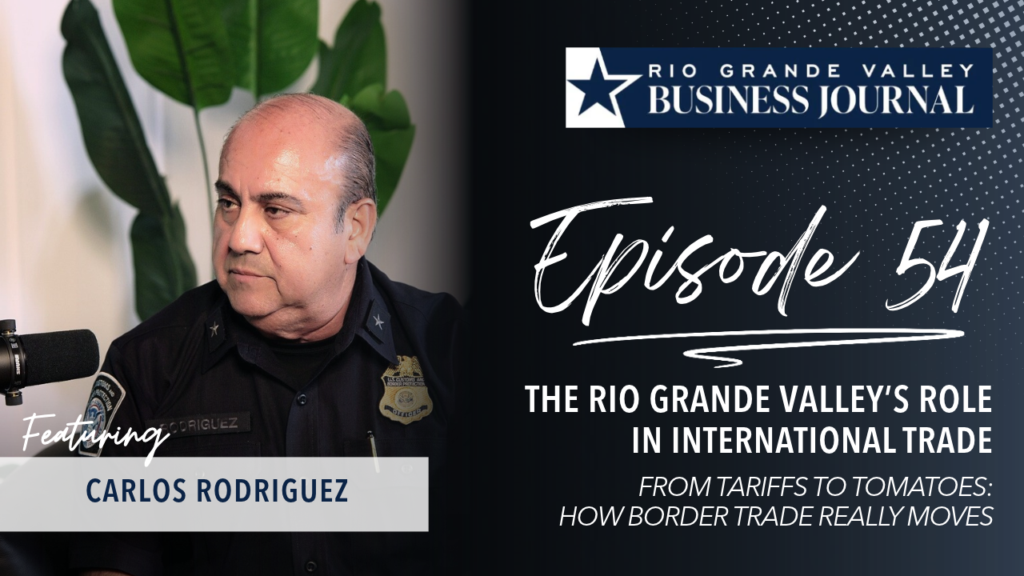
U.S. Customs and Border Protection Port Director Carlos Rodriguez oversees three international bridges, two airports and more than 700 employees across the Hidalgo, Pharr and Anzalduas ports of entry.
On this episode of the Rio Grande Valley Business Journal podcast, Rodriguez joins host Naxiely Lopez-Puente to discuss the future of cross-border trade, including the long-awaited opening of the Anzalduas International Bridge’s commercial cargo facility.
The $84 million facility on the U.S. side is complete, but construction delays in Mexico have postponed its opening. Rodriguez explains how CBP is working with Mexican officials to begin operations under a temporary unified inspection arrangement, potentially by late 2026 or early 2027.
He also discusses how changing tariffs affect businesses and consumers, the Pharr-Reynosa International Bridge’s $50 billion in annual trade, a 10% increase in passenger traffic and the region’s growing warehouse and cold storage industry.
The conversation also covers CBP hiring, border security and efforts to restore nonstop flights between McAllen and Mexico City.
Watch the full episode above, or read the complete transcript below.
The following is a rough, AI-generated transcript of Naxiely Lopez’s interview with Carlos Rodriguez, the port director for Hidalgo. Minor errors and misspellings may appear. For the full conversation, listen to the episode above or through your preferred podcast platform.
Naxiely Lopez-Puente: Thank you for joining us on this episode of the Rio Grande Valley Business Journal podcast. I’m Naxiely Lopez, and today we have our very special guest, Carlos Rodriguez. He is the port director for Hidalgo. Mr. Rodriguez, welcome.
Carlos Rodriguez: A pleasure to be here, ma’am.
Naxiely Lopez-Puente: All right. When we say port director, that’s kind of misleading. You oversee a lot more than just one bridge. Talk to us about your role.
Carlos Rodriguez: Yeah. As a port director, I oversee the Hidalgo/Pharr/Anzalduas port of entry, as well as the McAllen International Airport and the Edinburg International Airport.
Naxiely Lopez-Puente: Wow. So three bridges, with one commercial.
Carlos Rodriguez: Yeah. The Hidalgo port of entry is actually a passenger vehicle bridge. It’s passenger vehicles, pedestrians as well as buses. It’s a 24-hour facility. The Pharr bridge processes commercial traffic and passenger vehicles. There is a modified schedule for Pharr. We’re open from 6 a.m. to 8 a.m. for passenger vehicles, and then once again in the afternoon from 4 to 6 p.m. for passenger vehicles as well. That’s really addressing the commuter traffic in that area, because there is a huge presence of maquiladoras on the Mexican side. And then the commercial facility opens from 7 a.m. to midnight, and that’s strictly for the commercial traffic.
Anzalduas is passenger vehicles. It’s from 6 a.m. to 10 p.m., and here soon we’re going to be opening a cargo facility as well. Right now it’s strictly passenger vehicles, but in the immediate future — the latter part of this year, early part of next year — we intend to open a full commercial facility for imports and exports as well.
Naxiely Lopez-Puente: I’m familiar with that issue because previously I was with Mission EDC, and that was one of the things that we touted a lot, right? We’re about to have commercial traffic coming through Mission. And I know it’s been delayed. We were saying it was going to open about a year ago. What is causing that delay?
Carlos Rodriguez: A lot of it has to do with timing, right? The city of McAllen, or the bridge board for the Anzalduas bridge, made an investment of $84 million. The facility on the U.S. side is already completed. It’s the Mexican side that hasn’t been completed yet. There’s already a presidential permit to open the facility, but we had to make some modifications because the Mexican side is not fully built yet. So the intent here is that we’re going to do a unified inspection, where we’d have Mexican customs officials working on the U.S. side as they’re building their infrastructure on the Mexican side. Once that is completed, the Mexican customs officials will go back to Mexico and process the traffic on the Mexican side.
Naxiely Lopez-Puente: And that requires a new presidential permit?
Carlos Rodriguez: Well, the presidential permit just has —
Naxiely Lopez-Puente: To be amended.
Carlos Rodriguez: Has to be amended, modified, because the original one was intended for the construction to be done in tandem. But of course, there were some issues that came to light, changing administrations, and so there are some things that have to get realigned. We’re actively working with our Mexican counterparts and the State Department as well to make those amendments and finally push it through the finish line.
So again, we’re looking at the latter part of this year, early part of next year, when we intend to open under a modified version, which is called unified inspection, where you have Mexican customs officials working on the U.S. side under some special provisions. And then eventually they’ll go back to the Mexican side once the facilities are built. So we’re excited to have that facility open.
One of the things about that facility is that it’s going to be for certified companies. This is the first of its nature in the nation. Certain companies are going to have the privilege to use that bridge. CBP has a program called CTPAT, Customs Trade Partnership Against Terrorism. These are vetted companies. These companies have the highest security standards in their facilities, so pretty much it covers the entire supply chain, so it doesn’t get compromised.
Naxiely Lopez-Puente: My understanding — and like you just mentioned — is that you have to be vetted, from where the company is in Mexico, where this load comes from. It’s a very rigorous process to obtain CTPAT.
Carlos Rodriguez: Yeah. It’s maintaining the supply chain. Basically, CBP gives you the minimum standards for security. Then the company adopts those security standards. Then CBP will do site surveys — we’ll go and take a look. We gave you the minimum standards. You can always go higher on the standards. It’s up to you, because there is going to be an investment from the company. So CBP will give you the minimum standards that CBP requires, and we will go down to those locations and conduct those inspections to make sure you meet the standards. And of course, if you go higher than what we gave you, it’s very welcome.
So those companies have the minimum standards, but when it comes to security, it’s of high priority. Basically, that bridge is only going to be dedicated to those companies that are part of CTPAT and FAST. The transport company is FAST — it’s like the SENTRI program.
Naxiely Lopez-Puente: For cars, right?
Carlos Rodriguez: Yes. That’s for passengers; this is for the trucking industry. So FAST is the carrier, and CTPAT is the actual company. Both of those have to be in place in order for you to qualify to use that bridge. Basically, what it does is it minimizes the wait times, because there are fewer inspections, right?
Naxiely Lopez-Puente: Because you’ve already done all the work previously to make sure that you’re up to —
Carlos Rodriguez: Up to standards. And also, that particular bridge is going to have pre-primary X-ray systems that are going to conduct X-rays on the trucks as they’re traversing through the port of entry. So basically, it’s already been inspected. Once it gets released from primary, the officer will get a notification that the X-ray system has already conducted the initial screening, and there are no anomalies or anything that requires additional screening. Then the truck leaves the compound. So it’s a quicker turnaround. It’s all attributed to the efficiencies and other processes that CBP is incorporating to make sure that we’re able to process those legitimate companies traversing through the port of entry.
Naxiely Lopez-Puente: Interesting. I would imagine, because Anzalduas seems to be the preferred bridge for people coming from Monterrey — my family is actually crossing today — a lot of the concern is, when you start allowing commercial traffic there, what is that going to do to my wait time as a passenger in a passenger vehicle, right? To get to my destination.
Carlos Rodriguez: One of the things that we’re going to be doing there is making some modifications to the traffic. We’re looking into segregating the truck traffic through the bridge. Basically, we’re going to separate the traffic: Trucks are going to be using one lane while the cars are using two lanes. How do we intend to do that? We’re going to put Jersey barriers along the bridge so it divides the traffic. Trucks will go into the import lot, and the passenger vehicles will have their own dedicated lanes to cross through. So we’re not going to be mixing them. You’re not going to be behind a truck the entire way. The truck is going to be behind the truck, and the car is going to be behind the car. We’re making those modifications, and we’re working with the bridge board and the city of McAllen as well to make sure that happens — to make sure that trucks are trucks and cars are cars.
Naxiely Lopez-Puente: Got it. We were talking earlier about the task of having to coordinate with not just your team, but also the different bridge boards. You mentioned you work with five mayors on the U.S. side and one on the Mexican side. What is that like? What are the challenges of bringing everybody to the table and getting things done?
Carlos Rodriguez: It’s teamwork at the end of the day. We want to work with the municipalities, the cities. We want to make sure that both countries help each other out in terms of economic growth, right? As a service-oriented organization, we want to make sure that we provide that service to our communities. So my role as a port director, as the head of the agency here in this area, is for us to sit at the table and look at the issues that impact both of us.
Like I mentioned, there are five mayors that I serve on the U.S. side. There’s one mayor on the Mexican side. And with the three bridges, there are three bridge boards: the Pharr bridge board, the Hidalgo bridge board and the Anzalduas bridge board. I sit on those three boards, and we make sure that anything that impacts our area is addressed at the table. For example, if there are any needs that I have within the bridges, I pose them to the bridge board, and then the bridge board will vote on it, either for or against. By the same token, if the bridge board has any issues that they want CBP to address, then we’ll go ahead and place them on the table. We’ll look at it, and then collectively, as a group, we’ll come to what’s going to be the end result of that ask, whether it’s from CBP or from the city.
At the end of the day, it’s partnerships. Partnerships go a long way, right? As an agency, it can’t be, ‘Whatever the government says, that’s what we’re going to do,’ or, ‘Whatever the city says, that’s what they’re going to do.’ Collectively, we’ve got to sit together and figure out what the issue at hand is, and collectively, we’re all going to work at it together. I often say that it’s not your problem, it’s not my problem — it’s our problem. So together, as a team, we’re going to sit down at the table, and we’re going to come up with a consensus about how we’re going to move forward on this particular endeavor.
Naxiely Lopez-Puente: I imagine that your role is one of those complicated ones, because you’ve got Washington, right, which is sometimes so far removed from the actual issues on the ground. A lot of the people who make decisions on our borders sometimes haven’t even been to the border. And then you have the locals here who see the problems. So are you that connection between Washington and the locals?
Carlos Rodriguez: Absolutely. The agency will come up with any new guidance or any laws or anything that we have to look at. We get our direction from Washington, and we have our field office here, which is located in Laredo, which represents eight ports of entry — from Brownsville all the way to Del Rio. As the lead for the port of entry, the guidance is given to us, and then collectively, as port directors at each of the eight ports of entry, we are the heads of the port. We make those decisions, and whatever we have at hand, we make it known to our trade partners and to the municipality — in my case, the bridge boards — to say, ‘This is what we’ve got going on. This is how we’re going to be addressing this issue.’ And then we’ll go back and forth to make sure that it doesn’t impact the operation.
We still have a mission to do at the end of the day, but we want to make sure the needs of the area are met by collectively sitting together at the table and making sure that all those issues are placed on the table, and we’ll go ahead and address them. It’s very important that we sit at the table with our stakeholders — our direct and indirect stakeholders, the municipality or whoever needs to be there — so we can make sure that those equities are met. Because it’s our job to make sure that collectively, as a team in the region, we continue to process legitimate trade and travel through our ports of entry without impeding trade or commerce.
Naxiely Lopez-Puente: You mentioned trade and trade partners. We’ve had a couple of guests who have talked to us about the different policies when it comes to tariffs and trade, and how sometimes, from one day to the next, you’ve got to prepare, right? One ends and then another tariff pops up. Talk to us about that process. Has it been challenging for you and your staff, and for the people who have to cross these goods? What has that been like?
Carlos Rodriguez: Even though it seems complicated, it’s relatively easy, because at the end of the day, the guidance is the guidance, and we all have to follow it. We need to make ourselves available to our trade partners to be able to address those challenges. Every time there’s any change in tariffs or what have you, there’s a lead time or a leeway that says, effective this date, this is going to be the new tariff, right? There are tables within the agency where all this information is transmitted electronically. But collectively, we all need to make sure that we read through all this information that’s being sent to us and make sure that we are executing it the way it’s supposed to be executed.
I know there have been some challenges where tariffs have been changing from one day to the next. So it’s imperative that our stakeholders, our U.S. customs brokers, are up to date, because they are the middleman between us and the importing community. All importations that come into the country go through a customs broker. The customs broker is the one that transmits all the information to CBP and makes sure that information is accurate. So if there are any changes in regulations where the tariffs change up or down, then those tables are adjusted, and the broker is able to identify what’s going to be the new tariff on that commodity, whether it goes up or down. And in the event that there is a difference in tariffs — meaning that it’s going to be less, and somebody is owed money — then there’s a process so that the importer is going to get that back.
Within CBP, there are a lot of processes in place. There are different components for different processes. We are the front line — we’re the enforcers of the inspections. But then on the back end, there are other components that will be addressing the tariffs, and we’ll guide them to specifically which branch is going to deal with that. And they’ll help them through the entire process. They’re not alone. The help is there, and it’s going to be given to them.
Naxiely Lopez-Puente: So how have you seen tariffs affect our imports and exports through the bridges that you’re in charge of?
Carlos Rodriguez: It’s impacted them to some degree, right? Some have been favorable tariffs; some have not been too favorable. But at the end of the day, the tariff is what’s been implemented, and it’s something that we have to adhere to. In some instances, you will see a little bit of diminishing traffic, only because they want to see what’s going to be the next step, what’s going to be the next outcome of this particular tariff. Because there are some adjustments that have to be made — the tariff only impacts the price of the commodity, right? Then there’s the logistics that come with it. So that’s another component that might be directly or indirectly impacted as a result of the tariffs. The logistics have to be adjusted.
Let’s just use the example of a pencil. The price of a pencil is 10 cents. Then the tariff is a nickel. Then who’s going to transport that particular pencil throughout the country? What’s going to be the price of the transportation? So from 10 cents, it went to 15 cents. You have to adjust those prices. That’s why sometimes the industry takes a back seat for a couple of days or weeks while they start making those operational adjustments on the fees. Because at one point, that pencil was going to cost 10 cents to be transported throughout the United States, and now, from 10 cents, it’s going to be 25 cents. So there has to be that adjustment on the price.
That’s why typically a decision is made, whatever the outcome is, and then they start making those operational adjustments on how it’s going to impact the pricing. Because ultimately, at the end of the day, the consumer is going to be paying the price for that particular pencil, whatever it may be. So there are a lot of moving parts when it comes to the increase or decrease of tariffs. That’s why the industry typically takes a step back a little bit, to see how they need to make these operational adjustments. And then right after that: OK, here we go. We need to start rolling this pencil throughout the United States to its final destination.
Naxiely Lopez-Puente: So what are some of the industries that you have seen take that step back?
Carlos Rodriguez: Actually, all of them, because a commodity typically is not made by one country. There are some components — just like, for example, this microphone. The sponge was made in Mexico, but the electrical portion of it was made in another country, and then the —
Naxiely Lopez-Puente: Nothing ever is. We had someone tell us recently that no car is truly American-made, because all of these parts come from different countries. I know that we play a big role when it comes to manufacturing.
Carlos Rodriguez: Exactly. So that plays a big role when you hear about a particular product. That product is made in different countries, and every country has a different tariff. That’s what affects the pricing. Those are the things that you have to look out for, because it’s not just black or white. There’s a lot of gray in there that needs to be adjusted. And everybody who has a role or an impact on that particular commodity says, ‘Hold on. For me, this is going to cost me this. That’s going to cost me that.’ And then the final product — that’s the price of the product. So there are a lot of moving parts.
Like I said, it’s a little bit of gray, and that’s why a lot of industries take a step back a little bit, to see how all of this is going to be impacted. Because the sponge had an increase in the tariff, but the back part had a decrease in tariffs, so now the price is going to change completely. That’s why everybody tends to take a step back — the automotive industry, the medical industry, televisions. And then, for example, Pharr is the No. 1 produce port in the nation. Some of those have tariffs; some don’t. So again, there are a lot of moving parts. It almost seems like a broken record, but it’s really the reality that there’s so much that has to be looked at. All industries are impacted one way or another — some favorably, some negatively. But at the end of the day, they have to make those operational adjustments.
Naxiely Lopez-Puente: OK. We talked about trade. What are the trends right now when it comes to imports and exports? My understanding is that the volume may have decreased, but the value may have increased. Is that accurate? Walk us through what you’re seeing at your bridges.
Carlos Rodriguez: We do see an increase in value — not by a lot. There are trends. Right now, the produce season in Pharr, for example, just started Oct. 8. We just had the grand opening for the produce season, which runs for six months. So that commodity is going to start peaking as the harvests are going on down in southern Mexico. You’ll start seeing that increase. But you’re going to start seeing a little bit of a decrease in automotive, because the ’26 models are already finished. All the ’26 models are out there.
Toward the end of the year — a lot of the parts that are made in the automotive industry, like the dashboard and the screen, all of that is plastic resin, and there are molds to make the dashboard of a vehicle. So come December, you’re going to start seeing a decrease in a lot of the automotive, because they’re switching out the molds for the new models, the colors of the cars and what have you. So there’s an increase in some commodities and a decrease in some commodities.
The televisions — you’re going to start seeing an increase, because here come the holidays, the sporting events, the Super Bowl toward February. TVs are a hot item. The medical field is pretty consistent. That remains consistent. Just to give you an idea, the port of Pharr does $50 billion worth of trade annually in the import-export business. So some commodities are pretty consistent throughout the year, and some commodities go up and down depending on the season.
Naxiely Lopez-Puente: But overall, you started in this role in 2018, right? How have you seen the import-export trend? Is it going up? Is it going down?
Carlos Rodriguez: We’ve seen it increase, even during COVID, when everything in America shut down. Even though America shut down because of COVID, we still saw an increase in traffic, right? Because at the end of the day, you have consumers. You have people — us as consumers. You still need items out there, whether it’s a car or clothing or furniture or anything that’s out there. It has to be manufactured, right?
So traffic has increased. Just for example, in Pharr, the city of Pharr has done a lot of investments in properties, and the properties are getting filled up. Cold storage — there’s a lot of cold storage in the city of Pharr. There’s warehousing on the east side of the port of entry. Right now, it’s at a boom out there. Most of those warehouses are already sold. There are already customers interested. In Anzalduas, for example, it’s the same thing. We’re starting to see an increase in properties being sold at the park there. So it’s improving.
Laredo is one of the biggest ports of entry on the southern border —
Naxiely Lopez-Puente: And you used to work there.
Carlos Rodriguez: I used to work there as well, exactly. That has increased a lot. So the industry starts looking at areas where they can start moving. The logistics, the transportation, are also taken into consideration. There are a lot of moving parts in what’s considered as you start increasing the business.
One of the things that we started seeing here — and the reason Pharr has now become the No. 1 produce port; it used to be Nogales — is a bridge down in Mexico, in Durango, the Baluarte bridge. That bridge is actually taller than the Empire State Building.
Naxiely Lopez-Puente: Wow. Is it because of the topography?
Carlos Rodriguez: Yeah, exactly. It’s in the mountainous areas. The reason it was built is to save on transportation costs. Most of the traffic was going through Nogales, and then from Nogales it was circling around to the East Coast. Now that the bridge is built, instead of going all the way [through Nogales], it comes down to the Pharr bridge. And depending on who you speak to in the trucking industry, some people have said they can save 10 to 16 hours of travel time.
Naxiely Lopez-Puente: That’s money.
Carlos Rodriguez: Every truck that’s rolling on the highway has to make money. That’s why they always have to be loaded. You rarely see empty trucks, because when they’re empty, they’re not making any money. So that bridge was built in Mexico, and it has been able to facilitate more of the produce coming this way, because all of the produce traffic that comes to this area is East Coast traffic. Most of that merchandise is already sold to market when it arrives here. It arrives at any of the cold storage facilities in the area, gets transloaded into a U.S. truck, and off it goes.
Most of the trucks that go into Mexico are U.S. trucks that already come loaded with merchandise, so it’s very easy for a U.S. trucking company to pick it up and go north. And for the Mexican trucks, the cold storage area allows them to do that transfer to a U.S. truck and hit the highway. So you’ll have a U.S. driver come down with a loaded truck, and when they head north, they’re going back with a truck loaded with produce that comes from this area.
Naxiely Lopez-Puente: What have we seen as far as passenger vehicles?
Carlos Rodriguez: Passenger traffic has increased. Right now, we’re actually at a 10% increase in traffic over last year. So more people are coming. Obviously, the RGV has grown a lot. There are businesses everywhere. It’s always been known that McAllen is the hub for all the tourists who come, but people still go to other areas of the Valley. You have Mission, Mercedes, the outlets. Edinburg is very, very busy. La Plaza. But everybody says, ‘I’m going to McAllen. I’m going to McAllen.’ McAllen represents the region. That’s their language: ‘I’m going to McAllen.’ But again, they’re going to South Padre Island as well.
It’s always been one of the areas that a lot of people come to visit. A lot of people from Monterrey — like you mentioned earlier, your family coming down from Monterrey. Most of the traffic coming in through Anzalduas is vehicular traffic from Monterrey. Why? Because it’s so close to the river, and that allows the traffic to go into Monterrey and —
Naxiely Lopez-Puente: And you avoid going through the city, through all the population.
Carlos Rodriguez: Some people say that it takes about 45 minutes just to hit that area if you’re going to travel into Reynosa and through Hidalgo, because Reynosa has grown so much over the years that the traffic has become a little bit congested. But our job as CBP is to allow that legitimate traveler to traverse through any of the ports of entry. That’s our job — to make sure we facilitate the movement of traffic.
Naxiely Lopez-Puente: Now, how do you balance that? Because you want to facilitate the movement of goods and people, but you also have the role and responsibility of making sure that the security is there. How do you balance that?
Carlos Rodriguez: Our officers are trained. They’re trained to look for deception. We now have pre-primary X-ray — for example, at all three of our crossings, Hidalgo, Pharr and Anzalduas, we have pre-primary X-rays. So when the cars are coming onto our bridge, vehicles are already going through X-ray. That X-ray gets sent over to our command center. We’re able to adjudicate the image. At least we can say that there’s nothing that appears to be foreign in that vehicle. Then it’s just a matter of our officers taking a look at the immigration documents to make sure that travelers are admissible into the country. And basically, if they make a determination that they’re admissible, they’re free to go without having to go to a secondary inspection.
But it’s a balance. Our officers, like I said, are trained and experienced. Yes, we do have X-rays. We have canines, narcotic dogs. Those are tools. But you can never get away from the officer’s experience, because the officers see people. You’re trained to look for that deception. Is that traveler being honest during the interview? There are little things that —
Naxiely Lopez-Puente: Little tells.
Carlos Rodriguez: Yeah, little telltale signs that the officers pick up on as they’re conducting their inspections. We can always rely on that officer experience to make that judgment call — whether this is a bona fide traveler who can come into the country, and he or she is admissible and on their merry way.
Naxiely Lopez-Puente: You mentioned a 10% uptick in passenger traffic. I know when you started back in 2018, you had a little more than 560 employees. How many employees do you oversee now?
Carlos Rodriguez: Now we’ve gone up to over 700 employees.
Naxiely Lopez-Puente: And is that because of growing demand?
Carlos Rodriguez: Yes. It’s like anything — as the facility grows, it requires additional manpower. Like I mentioned, that new port out there that we’re going to open requires additional manpower. But also, we always have to look at our attrition. There are some officers who retire, some who move. So we’re always looking for additional officers.
Naxiely Lopez-Puente: And it’s not like you can hire somebody off the street, right? There’s a whole process of actually becoming —
Carlos Rodriguez: You have to become a CBP officer, and sometimes that can take anywhere between a year and a year and a half. It all depends, because as government agencies, we’re competing for the same workforce that’s out there, right? So just when you think you had, I don’t know, 1,000 applicants or 5,000 applicants — of those 5,000 applicants, maybe 100 or 150 might be available to us. And then from those 100 to 150, they have to go through the entire process. Some of them are going to be weeded out through the process. But that’s just like any other job, any other company. Everyone’s competing for the same workforce that’s out there. We’re always looking for the best and brightest people out there to join the ranks of CBP.
Naxiely Lopez-Puente: Speaking of that, what kind of skills does a CBP officer need?
Carlos Rodriguez: Well, we just need a person who’s willing to work, who wants to work. Now, some people come with the skills — the natural skills they have, their background, perhaps prior law enforcement — and some are just fresh out of college. Those skills are going to be taught to you when you go to the academy, but a lot of it comes from the individual. Do they have the drive? Do they have the honesty and integrity to be a part of CBP, or any government agency? But the skills are going to be taught at the academy.
You go to the academy in Georgia, the Federal Law Enforcement Training Center, where you go through 21 weeks of training. You go through academics, and you go through physical training as well. And then after you graduate, you still continue with training through the agency. When they come back from the academy, they also go through mobile field force — that’s for riot control and things of that nature. So our officers are always getting trained — qualifying with their pistol four times a year, physical training as well. So even though you graduate from the academy, when you come back, there’s additional training that the officers go through. But a lot of it, you’re going to learn as you go.
Some of them already come with that skill set. There are also former military — soldiers who finished their term in the military — and they can always apply to CBP or any government agency, and they will receive priority in getting hired. So the skill set comes in a variety of ways. But if you don’t have that skill set, it’s going to be taught to you, and eventually you’re going to pick it up as you go through the agency.
Naxiely Lopez-Puente: We’ve spent quite a bit of time talking about our international bridges. What about our airports? You oversee McAllen and Edinburg. What’s going on at those airports?
Carlos Rodriguez: At the airport right now, we only have one international flight, Aerus, and that’s coming out of Monterrey. We did have Aeroméxico for a while. I know the city of McAllen is still trying to —
Naxiely Lopez-Puente: No, they just did. They announced —
Carlos Rodriguez: I didn’t want to —
Naxiely Lopez-Puente: Jump the gun? You didn’t want to break the news. Don’t worry, we’ve got the scoop. Yes, they did announce that the federal government allowed it. I guess they have to go through an application process — they’ve got to go through the whole thing again. But as far as we know, McAllen said it is back. We’re going to get that flight sooner rather than later.
Carlos Rodriguez: We had that flight out of Mexico City. We were actually the No. 1 international airport as far as quick turnaround, because you had the arrival of the flight and then a quick turnaround to send it back to [Mexico City]. It was more of a business-class type of flight, but that flight was always full coming out of the new airport in Mexico City. It used to be out of the one in downtown Mexico City, and then it moved over to the new one —
Naxiely Lopez-Puente: Is it [Felipe Ángeles]?
Carlos Rodriguez: [Felipe Ángeles], or something like that. It’s a new airport — a very nice airport, by the way. But yes, it was always a full flight coming in, and it was always a full flight leaving. So that was very good for the city. Unfortunately, there was a certain period of time when some of the contracts weren’t renewed. But now it’s been renewed, so we’re looking forward to that flight once again, once it starts up again.
Naxiely Lopez-Puente: For our audience, that is very important, because here, with international business, you’ve got to be able to get where you’ve got to go quickly, and one of those places is Mexico City. So I know a lot of our audience is happy to hear that flight is going to be restored soon.
Carlos Rodriguez: Exactly. So we’re excited about that one. The Edinburg airport is more for companies — for cargo arrivals of merchandise, mostly for the automotive industry. It doesn’t have the same type of traffic that we have at the McAllen airport. The McAllen airport is more passenger, and Edinburg is more on the commercial side. So you have options. You can arrive here at McAllen for commercial travel and for business, but Edinburg is more tailored to the business type of service, if you will.
Naxiely Lopez-Puente: I know there’s been a lot of investment at the Edinburg airport. I used to work for The Monitor, and a few years ago, I remember covering when you finally got the CBP inspection facility there at the airport, which I guess allowed international flights to land there. What kind of growth have you seen?
Carlos Rodriguez: The growth hasn’t been where we thought it would be. It’s been consistent, but nevertheless, the airport still operates, right? We’re always looking for any business that wants to get out there. There are a couple of warehouses that have shown some interest in using the Edinburg airport, so we’re in talks with those companies that are willing to start moving their business over to the Edinburg side. But like I said, we’re service-oriented, and we’re there to provide that service for the companies that want to use any of our international crossings or our airports.
Naxiely Lopez-Puente: Perfect. All right, one of my last questions: What keeps you up at night?
Carlos Rodriguez: Well, what keeps me up is making sure that our borders are safe, right? Making sure that our personnel are out there, engaged with the traveling public, and also staying true to our traditional mission — making sure that we keep narcotics off the streets, weapons, money, any potential terrorism that wants to come into our country. That’s one of the things I’m always making sure of: that our officers are always alert, vigilant in everything that they do, and hoping that everybody goes home at the end of the night. Because every day is a new experience. Every day is a new challenge. But more importantly, we want to make sure our officers go home safe every day.
Naxiely Lopez-Puente: Perfect. All right, Mr. Rodriguez, anything else you want to tell us that maybe I didn’t ask?
Carlos Rodriguez: No, I think we’ve covered everything. I sincerely appreciate the invite, and thank you for having me here.
Naxiely Lopez-Puente: No, thank you for joining us. Always a pleasure. And for those of you at home, keep reading, keep subscribing, keep watching, and we’ll see you next week.