Durante la pandemia de COVID-19, las familias del Valle del Río Grande se enfrentaron a una realidad desgarradora: uno de los tratamientos más avanzados para salvar vidas simplemente no estaba disponible a nivel local.
Eso ha cambiado.
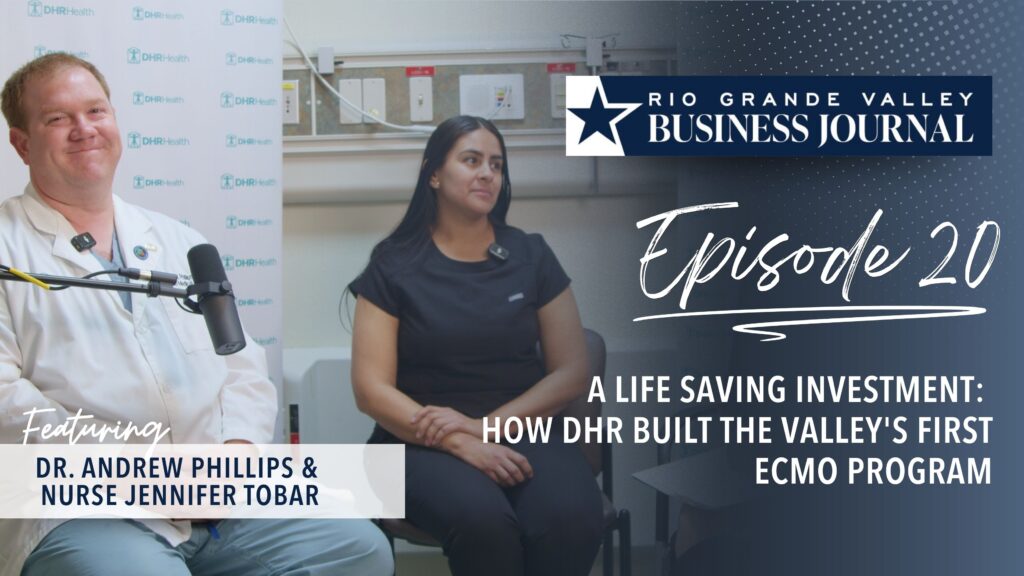
En este episodio del podcast del Rio Grande Valley Business Journal, hablamos con el Dr. Andrew Phillips y Jennifer Tobar, del Doctors Hospital at Renaissance, sobre la puesta en marcha y el rápido crecimiento del programa de ECMO de la región, una forma de soporte vital avanzado que puede sustituir temporalmente la función del corazón y los pulmones.
La ECMO, que antes solo estaba disponible en las grandes ciudades, ahora salva vidas aquí mismo, en el Valle, lo que permite a los pacientes permanecer cerca de casa y rodeados de su familia.
Phillips y Tobar nos cuentan qué supuso poner en marcha el programa, cómo funciona el equipo especializado las 24 horas del día, los 7 días de la semana, y nos presentan los conmovedores testimonios de los pacientes que ponen de relieve la importancia de esta inversión.
Desde la tecnología más avanzada hasta momentos profundamente humanos, esta conversación ofrece una visión excepcional entre bastidores de cómo la atención intensiva de primer nivel está transformando los resultados sanitarios en el sur de Texas.
A continuación se incluye una transcripción aproximada, generada por IA, de la entrevista de Naxiely López-Puente al Dr. Andrew Phillips y a la enfermera Jennifer Tobar. Puede que haya pequeños errores en la transcripción y posibles errores ortográficos en los nombres propios. Para escuchar la historia completa y sin cortes, haz clic en el enlace de arriba o descárgate el episodio desde tu plataforma de podcasts favorita.
ANDREW PHILLIPS: So this is the machine. This is the pump itself. And this is part of the tubing that would go to the patient. And on the back side is the oxygen. After that red thing that’s where the blood goes through and the action is put in.
JENNIFER TOBAR: So this is one of our can. And as we put in the groin, this is we call it a drainage cannula that drains blood from patient to the circuit, and then it returns it via a separate cannula, that we call the return. And we are mostly a groin. Groin, approach. But we have done our groin and neck approach as well.
ANDREW PHILLIPS: So we have to, to calculate that in a way that we get enough blood over to all parts of the brain without blowing up the ventricle, the heart, and with one button. So that’s why kind of the simpler the machine, the more challenging the task, because you have to change other parameters around it.
NAXI LOPEZ: Hi. Thank you for joining us on this episode of the Rio Grande Valley Business Journal podcast. I’m Nick Lopez pointing at the height of the Covid 19 pandemic. A Rio Grande Valley teen reached out to Governor Greg Abbott with a desperate plea. His mother was dying and the only treatment he thought could save her was not available in the Rio Grande Valley.
Governor Abbott responded, and he flew in a team of specialized doctors and nurses who transferred his mother to Houston. She died a few months later. But today, the Rio Grande Valley, does have that treatment, thanks to doctors hospital at Renaissance. And today we are here with Doctor Andrew Phillips and Jennifer Tow Bar to talk to us about that treatment and what it’s doing here for our region.
First of all, thank you so much for joining us.
ANDREW PHILLIPS: Thank you for having us.
JENNIFER TOBAR: Thank you for having us.
NAXI LOPEZ: All right. Well, this is, you know, this is a very critical therapy. Very important. We didn’t have it in our region. Talk to us about what it is.
ANDREW PHILLIPS: Yeah. So, Ekman, it stands for extracorporeal membrane oxygenation. And it is the thing that makes it. You’re right. It’s critical. It’s not like other therapies it tries to. If you go to Houston or Dallas, they get the diagnosis and they want to go elsewhere. They have that option. This is something is emergent. So our our community members were quite frankly, they were dying here because they couldn’t get an access.
It’s extraordinarily difficult to get a team to come down. It’s not just having a machine. It’s it’s also getting patients on the machine. And it is a way of it really. It’s the ultimate life support. So so people don’t realize that you can you can die on a ventilator there even though you have 100% oxygen going to the breathing tube.
Sometimes it’s not enough. And we saw that a lot during Covid. And so Eskimo provides that bypass. And there are two versions. One is venous venous. So you can think of it like dialysis for the lungs. It takes blood out of the veins. It washes it through puts in oxygen, takes carbon dioxide out and then puts it back in.
Doesn’t do any kind of blood pressure support. There has been arterial and that supports the blood pressure. It’s basically like bypass. If you know about, a bypass surgery, like coronary artery surgery, same idea, but in a portable fashion.
NAXI LOPEZ: I interesting I remember, so I covered the story with the Rio Grande Valley team a few years ago when I was with the monitor. And I remember at the time they described it as having a machine that could basically serve as your heart and your lung outside your body.
ANDREW PHILLIPS: Exactly.
NAXI LOPEZ: And it’s, you know, it’s not, it’s one of the most invasive life support, therapies is my understanding.
ANDREW PHILLIPS: It is. And it’s the last stop. So what we have here now is the same thing you would see in Dallas, in London, New York. There there is no there’s no more. That’s it. And the device we have, we were just talking about is the best device you can buy. There is no, higher quality, greater monitoring, more reliable device than the one we have.
So this really is we talk about having world class care. This is what you would get.
NAXI LOPEZ: Well, so we went from a region of over a million people who didn’t have this available to now having top of the line, this type of therapy we.
ANDREW PHILLIPS: Are and that can’t be understated. 1.6 million people in the Valley, 2.4 more or less. In San Antonio. They have three active centers collecting around 350 people a year. We had none. We don’t even have to know what it is. You know, that’s a disparity.
NAXI LOPEZ: Right? All right, before we get into what it took to to bring all of this in here, I’d like to start talking with a little bit about your history. Because you are a Valley native, right?
ANDREW PHILLIPS: I am water is a mission.
NAXI LOPEZ: All right. Tell us a little bit about yourself.
ANDREW PHILLIPS: So, yeah, I come from mission originally and it was that was in the 80s. And as much as we have now, when people say we don’t have enough health care, it was worth said, everyone there recognizes, right? You you didn’t have access to a lot of, specialists. You had to leave the valley for a lot of care.
Certainly had no level one trauma center. I mean, all of that was sort of far flung idea. And so I left here trained. I was faculty at University of North Carolina at Chapel Hill. And then, I was, working in the community for a little while. And Covid hit. And towards the end of Covid, I got a call from Dr..
I’d been talking about wanting to do, equal. So when I worked at the USC Chapel Hill, I was in the cardiothoracic ICU. So we did chemo Lvad. It’s a durable agreement, if you will. Heart transplant, lung transplant. That was a unit that was my subspecialty within a critical care. And I from here, I still had, you know, roots and talk to people.
And, you know, is there ever a possibility we could do this? It’s a challenge to start a program. And so, you know, there have been conversations, but it was until Covid hit. And honestly, until more conversation about it started, it was, too high of a hurdle to get until we really saw the disparity that we were seeing with Covid.
NAXI LOPEZ: And Jennifer, you are from California. Yes. Tell us about, yourself. Right. What brought you to the Valley and the role that you have here with the chemo team?
JENNIFER TOBAR: So, we moved. My husband and I moved to the Valley due to his job about, I want to say, 17 years ago, I finished my nursing career here in the Valley, and I started working at about 11 years ago. So I was here when the pandemic hit, and we had very little supplies and resources to help our patients.
We wanted to give more and we couldn’t. So I saw that I was here when that report and when the team came to get, Elias mom. And we all thought that was so cool, like, wow. So when he came on and brought this idea that we could be that for our people, I didn’t think twice about jumping in.
And I honestly had never seen a machine in my life. I saw it that day. But other than just seeing them and leaving, I hadn’t seen anything else. So I started as an national specialist, training and learning alongside with whatever Doctor Phillips was teaching us. And then I became the coordinator, and now we lead about 22 people that we do this day in and day out for our patients.
NAXI LOPEZ: Wow. So you got to see Amelia’s mom basically being transferred this team of doctors and thought, how cool. And then you get to be one of those, you know, very specialized nurses that is part of that. Not just that, but a bigger role leading the effort here.
JENNIFER TOBAR: Yeah, we got to see them load everything, their cases and we just thought, wow. Like they are so cool. And now we get to be on the other side and go to another facility and see the all from them, how we saw the other team. So it’s awesome.
NAXI LOPEZ: And you know what? You mentioned something very important. Yes. H.R. is the only one that has this treatment here in the Valley. But they take patients from everywhere in the Rio Grande Valley. Talk to us about that and why? You know, why not just here? You know our patients.
ANDREW PHILLIPS: Sure. But.
JENNIFER TOBAR: So we want to make sure that we share what we have. And there, like he was saying, there’s a disparity in what we can offer. So if we can bring people and help them get better, there’s nothing better than that. There’s nothing better than to be able to bring people here and have, like the gratitude that they feel when they tried everything at their facility and it just wasn’t enough.
And we are able to give them that extra chance at life.
ANDREW PHILLIPS: It took a lot to make it. It was an investment. The air had to buy into it. There was a lot of capital upfront, and they had to have faith that we were going to be able to have the patients, and the program was going to sustain itself. It’s no small ask for a hospital to invest in a new program.
And so we we understand that that’s a challenge for, it took a lot. And we want to build off of the complete program. So, you know, in some circumstances and certain other hospitals have put people on active in particular, after like a heart surgery, if they have to for a little while. But what we’ve built is a comprehensive a residential program, meaning that the patients stay here.
We have a gentleman on right now who’s on for today’s day 102. And we walk our patients. They eat regular food. We take the breathing tube out. We have a specialist, under, Jennifer’s leadership that that group who’s in House 24 seven. We have a physician that I call physician on call 24 seven. We around Daly. Building that structure, allows us to keep the patients, and it gives you a groove.
So we did. We’ve done over 100 so far. We did 63 last year alone. So it comes into a rhythm. And in the first year we did eight. And actually I was a slight tangent for my brain here, but, Jennifer, I shared a story that probably year and a half ago, close to two years ago, a year and a half ago, we were going to candlelight.
Someone we do here in the ICU. We don’t go to the operating room or the cath lab. We just do it right here, bedside with an X-ray machine. And so we needed to kill a patient. This is a shift change. And the incoming guy who was going to do the cannulation started to deploy materials and one of the nurses was grabbing a few items and just kind of chitchatting put together.
And it was there, was there. There’s nothing special about it. And that’s what was special, because for the first few patients, the very first one, the second one everyone was was was look at what is this? How does it work? Where is this piece of equipment? How does it go? But the fact that at that point it was just like any other procedure, it was just another day at the office to us was was very significant because now we’ve hit that rhythm.
Right.
NAXI LOPEZ: That’s when you knew we got this, you know, we were a team.
ANDREW PHILLIPS: That takes a lot. It takes time. It takes, development of the program. And so to us, that also makes it safer for the patients. This is something we do day in, day out. People are very we have five on pump right now. It’s this is just that’s a quarter of the cardiac carrying. It is our patients on unequal.
And so having that routine means that to us we’re we’re more able to and happy to pick up transfer to smaller facilities because what we do and and we do it routinely as opposed to having one, one a year or two a year, which is viable, but not quite the same.
JENNIFER TOBAR: And we’re able to keep them home. That’s a big thing here. Family support in our culture is huge and we’re able to keep mom home. We’re able to keep their daughter home. Were able to get them together and we take them outside. And if there’s a birthday we celebrate the birthday with them. If there’s any event, big in the family, we’re able to bring them together.
They don’t have to leave the valley to get the care that they deserve.
NAXI LOPEZ: It’s very important. Let’s talk about the investment. Right. Because it’s not just, you know, buying equipment that is very costly. It’s also training the nurses. Right. Talk to us about the expenses. I know at the time when I was researching this during Covid, I did speak to, specialized nurses, a traveling nurse who was part of an HMO team, and she mentioned that, you know, the machines can run, each machine can run up to $100,000.
But my understanding is that price is no longer. Yeah, that’s no longer the baseline price. How much did, did your invest talk to us about that?
ANDREW PHILLIPS: It was it was a fair amount. We started with three machines. We have five now. And actually, we were expanding, so. So we will be getting more machines were renting. The one we’ll show you here in a moment is actually a rental from the same company. It’s the same quality machine. Don’t get me wrong. It is buying from them.
It’s also a cardio health. They range now from around, 100 to $200,000. All in. But if you look at the different products that are out there, because it’s also not just the machine itself, you also need the warmer day to do the warmer to get the blood warm, because we’re taking blood out of the body and when it’s outside, the body will cool off.
So, you know, warmer. You need, the car to be able to keep the machine to move them around there with the CT scanner. Such. I mean, we do all of that with the patient. I think people may not realize we’ll go to the CT scanner when we get in the ambulance with them on pump. We do all of their components.
Do you have to, to purchase that, make it, flexible to everything that you need to with them. That’s the non disposables. So then there’s the circuit itself. And that’s that is an expense right. Several thousand dollars just to open the the kit to get started there. The Cannulas. And then they’re the expenses that go along with the just taking care of patients.
A lot of them need blood transfusions. That said, you know, it’s hard to put a price tag on, a life. And that’s that’s what this is. So. So we don’t get called until someone’s risk of mortality is up 50%. So they already have a fifth in our world. And that was part of the change, was having to educate everybody and let them realize patients who they already would have been have the the end of life conversations I have for comfort care hospice.
That’s where we had started. Wow. And so we come in. Yeah. It’s it’s worth it.
NAXI LOPEZ: And it’s really important to know, right, that not everybody is a candidate for this type of therapy because, you know, I know that there are people out there that might not know that and might think, hey, this why won’t they give my my family member this therapy, talk to us about that decision. Right. It’s not easy. Who who gets to be on this therapy?
How do you decide? You know, what are the parameters there?
ANDREW PHILLIPS: Yeah, I’ll answer it. And if you want to add to it, I suppose, we use criteria, some, some tables that give a prediction of someone’s survival on Egbo has been around long enough that we can give a general sense to be sure, age goes a long way. So they they’re the younger you are, the faster you are to be able to heal.
There’s some circumstances we just can’t fix. We also respond to codes. So if someone loses pulses, we’ll potentially put the monarch bow. But if you have, like, a massive head bleed, I won’t fix that. What? Adding to that.
JENNIFER TOBAR: And long term cases, like if we have some besides the head bleed, terminal diseases, those patients would not be a candidate. We try to your point earlier, life expectancy. How are they going to be in a year from now? It’s a very hard decision in the moment. But we want to give everybody the opportunity, but also a great quality of life.
ANDREW PHILLIPS: And, you know, we’ve been able to push the limits. I was just thinking about the obesity side. So, so obesity had been a contraindication to go for a long time. And there are other centers like in San Antonio, I’m thinking, of course, on my head who will not calculate a BMI greater than 40. Which is it’s obese, but not not that large, and.
NAXI LOPEZ: Not uncommon for our area.
ANDREW PHILLIPS: I would just say it’s pretty, pretty common here. So I mean, yeah, 40 is a valley healthy. So, so, we’ve, you know, we are bariatric center bariatric surgery center of excellence, and we have all the supplies to, to take care of, of, patients who need those special supplies. We have the special beds and all that.
So we’re set up, and they’ve been incredibly supportive for us. We’ll take those patients. The, about a month ago. I can’t believe the patient whose BMI was 93. And he did great.
JENNIFER TOBAR: What was our 100th patient?
ANDREW PHILLIPS: I believe he was 84. 84. It was 90. There was the other gentleman. Was 93 later.
JENNIFER TOBAR: Oh, yeah.
ANDREW PHILLIPS: Yeah.
JENNIFER TOBAR: But it’s our 100th patient will also be.
NAXI LOPEZ: And so, you know, this is the issue with obesity right. It’s not just the comorbidities and things like that but like the positioning. Right?
ANDREW PHILLIPS: I it’s challenging the channels. And so we we tend to do femoral bilateral femoral cancellations I’ll translate.
NAXI LOPEZ: Yeah. Please. We don’t want to lose our readers. You’re our viewers growing.
ANDREW PHILLIPS: So no matter what with obesity, it’s challenging to do any sort of physical procedure to, So we put both in the groin. And so there’s one cannula. Is it here? Can I show it to you?
NAXI LOPEZ: Sure. Yeah. But you know, you know what? Let’s bring out the machine. Let’s bring out the cannula. And that way we can show our view is what it looks like.
ANDREW PHILLIPS: Right. So this is the machine. This is the pump itself. And this is part of the tubing that would go to the patient. And on the back side is the oxygen. After that red thing that’s where the blood goes through and the actions put in. But this is the whole thing. This is it just this blue thing is the pump itself.
This all would be on the patient from the outside, the patient. And you can see here the only thing it’s while for as complicated as it is part of the reason it’s complicated because we only get one button. And so this is the knob that changes the RPMs, the revolutions per minute. So it changes the flow. But let’s say they don’t have a lot of volume.
They had bleeding or something and they don’t have a lot of blood. Well that’s going to change the flow because they don’t have as much blood to, to flow. And so it’s challenging because you only get one button and you have to make everything work with the one button. If we have more buttons to be a little, little easier on the backside, let me show you just a little bit.
So the blood comes in on the blue side. So it’s deoxygenated, if we’ll go back to high school biology.
NAXI LOPEZ: Right.
ANDREW PHILLIPS: So blue side no oxygen or little oxygen comes in here and it will go into, you know, we show you saying.
So it goes in the back here. And there is a motor with a magnet going around here at currently while we’re at zero, we usually around 3000 revolutions per minute. It spins the motor and then it sends the blood into this area here. And here’s the oxygen it runs through. And then it goes out this tubing through the cannulas that general G.
JENNIFER TOBAR: Right. So this is one of our can is as we put in the groin, this is we call it a drainage cannula. It drains blood from patient to the circuit, and then it returns it via a separate cannula, that we call the return. And we are mostly, groin, groin, approach. But we have done our groin and neck approach as well.
ANDREW PHILLIPS: So we’re talking about obesity and the challenges. And so we just have to be able to position the patient in such a way that we can get the candle in place. But just like the rest of our patients, we will get all of our patients, all of them that are possible to including those, who have bariatric needs to ambulate to walk.
It’s hugely important. We are upright creatures, and that’s why we here. I really want to I want to give you a chance to to chest out, sir.
NAXI LOPEZ: Let’s do it.
ANDREW PHILLIPS: So you can’t hurt anything. There’s no one attached. It’s a really satisfying feeling to kind of crunch a little bit and you can clamp off. That’s how we prepare. And you give it a shot. Yeah. Clamp on anywhere. Anywhere you like. Yeah. Try that. Oh, no. That’s. That’s fine. Wow. Yeah. So so so yeah. It takes a minute is a little bit of a hamstring there.
So we have to change the tubing out or cut on either side for example. And then reconnect these. When we put them on on pump we we take this out the sterile the inside here is sterile. And we’ll have to Clinton. Then we connect to that part that Jennifer has. So you can imagine if you cut right here, there’s an end here.
If you take the cap off,
JENNIFER TOBAR: This all comes up,
ANDREW PHILLIPS: I have to do this is the rotary, Edinburg Rotary. They got to put one of these together. Oh, they had a blast.
JENNIFER TOBAR: So it connects.
ANDREW PHILLIPS: Here. That end would go into the tubing. And so this connects to this, which goes into the patient.
NAXI LOPEZ: Wow. Very cool.
Are these forceps.
ANDREW PHILLIPS: Clip.
JENNIFER TOBAR: Clips.
ANDREW PHILLIPS: Tubing clamp with the close. It looks very similar I give you half credit. Yeah. Yeah.
NAXI LOPEZ: All right. So very.
ANDREW PHILLIPS: Cool. That’s the device and it’s you know deceivingly simple but but to that, that point well so the other side of this it is the same machine for the lung, kind of economical as it is the heart kind of back now. So we talked about it’s bypass, right. Bypass the heart and lung. It’s the same machine for two different processes.
So we can do the lung kind that that always dialysis of the lungs if you will. And with the same machine to the arterial side because of the place that we put the cannulas. So if we’re doing the lung kind than we put this in a vein and we return the blood to another vein. If we’re doing the, the kind bypassing the heart, a lot of the physiology on this, we take it out of the vein.
Okay, I swear this is the truth. We put the another cannula into the artery, also in the groin. So here’s my my body. We send the blood backwards so your heart pumps here, get back technology and goes forward. Right. You have your artery to your arm and your brain and coming off right. So your heart’s going this way.
And we send the blood backwards against the flow of the heart. So it is my native flow coming out of the heart that we push against so far to the point to get our oxygenated blood all the way to the right hand side so the brain is perfused so the heart is still trying to pump. We have to.
NAXI LOPEZ: Push against this, the current.
ANDREW PHILLIPS: We do, and.
NAXI LOPEZ: That’s to get to the other side.
ANDREW PHILLIPS: The blood with one button. Yeah. So we have to calculate that in a way that we get enough blood over to all parts of the brain without blowing up the ventricle, the heart, and with one button. So that’s why kind of the simpler the machine, the more challenging the task, because you have to change other parameters around it.
Blood pressure for us, your bill would say 120 over 80. You go to your doctor’s office, right? We do not like a hard 20 over 80. We are much happier with like 80 over 50, 550 because then we can flow better and we control that flow a lot more easily. So you change other parameters because you only get one button if you don’t remember.
Very nice to me. I’m really sorry, ma’am. Let’s just finish.
Very well. I thank you for a agreeing to some folks, doing a podcast about ECMO.
NAXI LOPEZ: Well, yeah.
ANDREW PHILLIPS: And bring patients back to DHR.
ANDRES: My name is Andres Mateos. Tuesday morning, I had an asthma attack, and, like, a Tuesday, like, around 330. I didn’t remember nothing. And when I got here, I woke up, like, at 930. And with the. That’s when. That’s when I started. Remember stuff.
NAXI LOPEZ: And you were already hooked up to. So by the time you woke up.
ANDRES: Yeah, I was hooked up to a lot of things.
NAXI LOPEZ: Hi, Andres. How are you? How’s it going? How you doing? Yeah. All right. Andres. So talk to us. What happened? You don’t remember anything? What’s. What’s the last thing you remember?
ANDRES: The last thing I remember is I went to the ER clinic, and then from there they transferred me to Edinburgh Hospital. And then from there they didn’t remember nothing. Wow. I don’t remember the saying I can breathe. That’s it.
NAXI LOPEZ: So do you know what happened to you? Was it an asthma attack? I talk to you about it.
ANDRES: They’re saying that it was an asthma attack.
NAXI LOPEZ: Take an asthma attack. Right? No. Right.
ANDRES: Yeah.
NAXI LOPEZ: No. And so, you understand, what they did with the ECMO treatment, you know, did you know that this therapy was not available in the valley until just a few years ago?
ANDRES: Yeah.
NAXI LOPEZ: There to talk to us about that. I mean, the doctor pretty much said it.
ANDRES: Wasn’t for that. I don’t think I’ll be here. Really. So thanks to to that, to the doctors.
NAXI LOPEZ: My goodness.
ANDRES: Yeah.
NAXI LOPEZ: Wow. Who came and, how do you feel? You know what?
ANDRES: Right now I’m feeling great.
NAXI LOPEZ: You’re feeling great.
ANDRES: Way better ten times better.
NAXI LOPEZ: Wow.
ANDRES: Yeah.
NAXI LOPEZ: And so are you in school. Talk to us about what you’re doing now.
ANDRES: I’m not in school. I’m a body tech.
NAXI LOPEZ: You’re a body tech. Okay. Come here. Yeah. Oh, you have a baby. Okay. So, I mean, you were very close to death, is what, in my understanding.
ANDRES: What they were waking up is hearing my daughter scream. You know, wake up. That’s. I heard and I woke up quick.
NAXI LOPEZ: Like, from here.
ANDRES: Yeah. That’s weird. Okay. Like, no, it was on the phone or FaceTime, and she just. She said, daddy, wake up and I woke up.
NAXI LOPEZ: Oh, yeah. Wow. So what do you think now that you get to go home to to your kids because of this?
ANDRES: Great.
NAXI LOPEZ: This therapy. Wow.
ANDRES: Yeah.
NAXI LOPEZ: And, so when did this happen?
ANDRES: Say it happened Tuesday morning. Tuesday morning.
NAXI LOPEZ: And you suffer from asthma a lot. Is this something that you know or did this come out of the blue?
ANDRES: Yeah, all my life. That’s for.
NAXI LOPEZ: Wow. What is your wife think that? You know, you came so close and look at you now.
ANDRES: Yeah. You’re scared.
NAXI LOPEZ: Is there anything that you want to say to the team of doctors and nurses who went in there and, you know, got you, picked you up, brought you here?
ANDRES: I appreciate all on each one of them. Appreciate it.
NAXI LOPEZ: What does it mean to you?
ANDRES: Wasn’t one for them out there would been here? I would have been. Who knows where. Yeah. Thanks to them. Yeah. I feel good to walk my line. It does. Doesn’t hurt. It’s just a normal.
NAXI LOPEZ: And so you’re hooked up right now. The blood is coming in and coming out. You know, this is the machine that, that really kept you alive and is making sure that, you know, you recover.
ANDRES: Yes. The this actually, you know.
NAXI LOPEZ: All right, well, I won’t take up any of your time. I know you’re tired. You got recovery to worry about, but I really do. Thank you for sharing your story with us. You know, it’s important for, I think, our viewers to see, not just hear about what’s happening, right, but to see it in action and see, you know, how it’s helped this family.
So we do thank you for that, for sharing your story for sure. You know, we wish you the best. All right. Thank you for showing us that incredible machine. Now let’s talk about the people that it has helped. I know you guys have had some very, touching cases, right, of patients. People graduating. Tell us about that.
Talk to us about it.
JENNIFER TOBAR: I guess we can talk about the. I’ll. I’ll start with mom. It was, that patient that case in particular was very near and dear to our hearts. First time mom, was very happy to go into labor and she went into cardiac arrest right after having a baby. And, you know, she was without a pulse for a very long time.
And we were able to get her on pump. She was across the street, brought her over here and started the process of waking her up. And she woke up and she was able to meet baby, and she was able to see him and carry him. And she was able to go home. She didn’t have to go to another center.
She didn’t have to go to a rehab. She was able to go home and take care of her baby. That is just a miracle. That’s been all for us to be able to see the transition of everything she went through, everything the family went through. And then at the end, she was able to go home carrying her baby.
That’s awesome.
NAXI LOPEZ: Wow. Amazing. And you know, you mentioned it. She flatlined.
JENNIFER TOBAR: She was she was gone.
NAXI LOPEZ: She didn’t have a pulse. For how long?
JENNIFER TOBAR: About 40 minutes, about 40 minutes.
NAXI LOPEZ: And this machine was able to.
JENNIFER TOBAR: Bring.
NAXI LOPEZ: Her back in her back. Wow. Amazing. My goodness. Any other cases like that?
ANDREW PHILLIPS: You know, it’s a lot. I mean, some of those I agree with you on that. One in particular was really touching because it was not just saving mom, but making sure that that baby, her son had a mom and her husband had a wife. So those those maternal cases are tough. And and I’d be remiss if I didn’t say that this particular service has some incredible highs and some really awful lows.
JENNIFER TOBAR: Yeah.
ANDREW PHILLIPS: There there are patients. So it go all across wards about 50% survival on we talked about we don’t even get started looking at the patients in Chile without I don’t have a 5050 chance of living which most people would say those are bad odds. And that’s in our worlds. Great. I’ll take 5050, before we get started, because that gives us really pretty good, good runway.
But those I bring up not not to mention the salmons or harp on that, but that makes the ones we are able to help all the sweeter. Because it’s I think those who aren’t involved in this families want us to recognize how important their, their survival and their success is to to us. I think sometimes we’re just seen as, a healthcare community or is the job.
And let me tell you, this isn’t just a job. It’s it’s I mean, yeah, sure, we work here, but this particular service and the, emotionally charged cases that we handle, it, it we need people to survive and get better and see them. There is nothing I want to speak for Jennifer, but nothing fills me more than having our survivors come back and say hi.
It it just it fills the cup. Because sometimes you they’re these cases, you just you really thought really well, and you really try and, it doesn’t, doesn’t fix everybody. And we’re grateful for the ones that it does.
JENNIFER TOBAR: There are we’re there at the bedside 24/7. So it’s impossible to not get involved and not get, have that connection not only with the patient, with the family members. We’re we’re there for the family members just as much as we are for the patients. And seeing those that survive and come back, it we need that just as much as they need their family, and it makes it so much more special to have that and know that we’re able to help.
We wish we could do it for everybody, but to see that we’re able to do it, even if it’s just for that person that came back and said hi.
NAXI LOPEZ: And you mentioned, a very good point too, right? You guys have to have a team. You have somebody there 24 seven, if I’m not mistaken. Right. You have it’s not like, hey, we put you on, you know, a on chemo and we walk away and let the machine do its job. It’s it’s a team of people. Right.
Talk to us about that.
JENNIFER TOBAR: Yeah. We have, 21, specialist 20 our nurses. One is a respiratory therapist, and we’re all very connected. In a sense, we have the same goal. I want to say last year in November was the first time we ever had seven patients going at the same time. And, you know, it gets tiring not only physically but mentally and emotionally.
And this is a group of specialists that don’t stop. They don’t stop. And even if they work 12 hours, 13 hours, four days a week, they’re calling in and asking, do you guys need me to go in? Do you need me to go? Or we put we have a chat and it’s like, oh, we have a console in in certain floor in another hospital.
And they know we have seven patients, five patients on. They will call and say, I’m available, I’ll go with you. Let’s go. Like we will not stop because it’s my day off. So that’s the type of team that we have.
ANDREW PHILLIPS: It’s an impressive group. There is no day off. They they they really I love that team.
JENNIFER TOBAR: Yeah.
ANDREW PHILLIPS: Do you group and the 24 seven. So any time. Right. And that’s a big deal because that also means that, someone is instantaneously here being able to have another patient who talked about the, the volume. When we first started, I only did eight in the first year. We couldn’t have someone in house 24, so it didn’t make sense.
But now that’s available. So any cardiac arrest in the hospital if they qualify, someone’s already in house here. It’s not a call back.
NAXI LOPEZ: Right. And you mentioned the volume of patients is is getting higher. Right. Eight the first year. How many.
ANDREW PHILLIPS: 30 the second year. 63 last year.
NAXI LOPEZ: And then January, just this month alone. How many did you have.
ANDREW PHILLIPS: It was seven, I think.
JENNIFER TOBAR: We had the month of January. We had seven, seven this month alone, and we’re February 12th. We already have seven patients.
ANDREW PHILLIPS: We had we’re very grateful that the the other hospitals when we started, they would occasionally send us a patient to let us know. And we were a baby program. I get it, you kind of same rarely we have to send the patient out for a special kind of surgery or something like that that, we don’t offer yet.
Sure. Let me say yet we’re always adding services, but, you know, you want to send patients somewhere you trust. That’s your patient. You want to do right by them and sent to a place that you trust. And it speaks volumes to us that that we’re getting a lot more transfers people are also seeing. I don’t want to overstate, but but this this technology is therapy.
It moves the line of death. It it does. And that sounds really, bold to say, but it’s, it is it changes the definition of where death is. And part of that is education for folks to to know that this is available. And we definitely have gotten some calls where people expect us to say, no, there’s nothing else to do.
The patient’s too sick for our service, and we will hop on a on a rig and we’ll come get them. And so that’s a big deal.
NAXI LOPEZ: And you have a guarantee, right? With these hospitals. What does that guarantee?
ANDREW PHILLIPS: So four hours and that’s that’s huge because everywhere else is a long way away from, San Antonio is, a long drive. And so within four hours. So within four hours of them calling on us, accepting, well, they’ll call will you a 15 minute accept or decline and almost always accept within that time will be at their doorstep with a consulting physician that’s a physician who can put in the cannulas we just looked at and a lot of specialists like Jennifer or someone off of her team, within four hours at the bedside, ready to, to do the procedure.
So now when I say 90% of the time, we will calculate at the facility, because by the time we’re called the patient is already too sick to travel safely on the ambulance. I honestly, by the time we’re called, they’re usually too sick to even travel within the hospital to the CT scanner or get anything more on their bedside X-ray.
And so we put the candles in, at the bedside at the other facility, and then we’ll get on the ambulance. And it’s also you talked about people’s reaction. It’s it’s fun to see the EMS will assume because the patient is ill. We got to go. Lights and sirens. Right. Speed home and it’s more now we got to speed lights and sirens to get there.
And then once you put them on the machine it’s it’s smooth cruising takes time. Well yeah. We we got everything squared away. And it, it, it was a big day for us and we’ve been, we’ve been growing with the, the needs of the community and we’re very happy to be able to. Our bench depth was such that we actually had two teams out simultaneously picking up patients.
So I think it’s important to convey that this is not a get a call, hey, you’re free. I don’t know you free. Hey, you want to go with this 5:00 curfew like it’s a system, right? It’s, our transfer is fantastic. We we can’t go without. Thank the transfer center they are for. They are on top of it.
And, two of the EMS groups have trained with Jennifer so that they are aware of what’s going on as well with the pump. So we don’t just go with any EMS crews. We want to make sure that they understand their role and safely transporting us there. Take care of the patient too. So it’s it is a collaborative.
It is collaborative and planned. It’s just it’s a routine. It really has become routine. Get a call. Go out to the patient. Come back.
NAXI LOPEZ: Wow. Very specialized work that, the air is providing for our community. Is there anything else that you would like to add that maybe I didn’t ask that. You think, you know, our viewers should know?
JENNIFER TOBAR: No. I just are just so happy and proud of what we have here. And three years ago, it was a dream. And now it’s our everyday lives. So it’s just awesome.
ANDREW PHILLIPS: When you can actually, you folks can call as well. There’s a hotline for our remote transfer and that is 95636203266. So again it’s (563) 623-2660. And you in 24 hours, we’ll get someone responding to the physicians out there. There’s a physician who, is available to answer that call and ask if you have a loved one who you think you know.
Maybe this should be considered for, Bring it up fast. We’re we’re happy to evaluate people. To your point, it’s not for everybody. But for those who who it is indicated we’re happy to come get them.
JENNIFER TOBAR: And we will never not evaluate someone. So any phone call, we will take the time and evaluate and speak to family members hospitals, doctors. We will never not take that call.
NAXI LOPEZ: Wonderful. All right, well, folks, you heard it. New service available, a new type of cutting edge technology here at DSR. I want to thank you both for not just for being here, but for what you do and what you’re doing for our community. So thank you. And, you know, for those at home, you know, keep subscribing and we’ll see you next week.