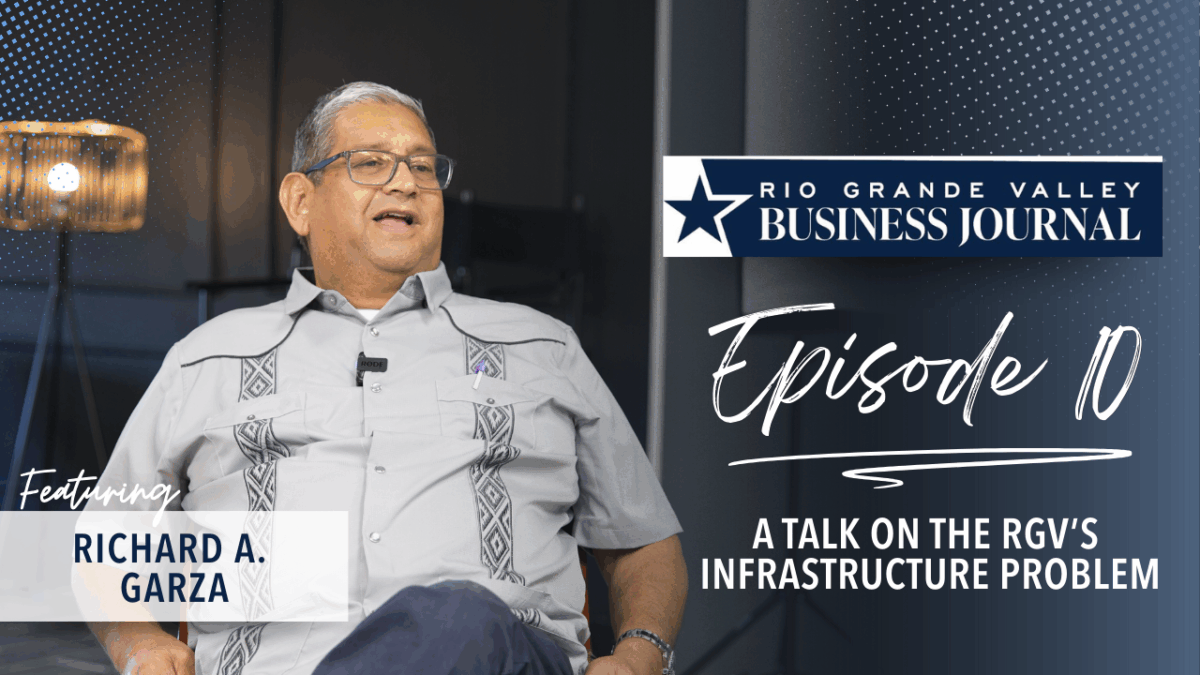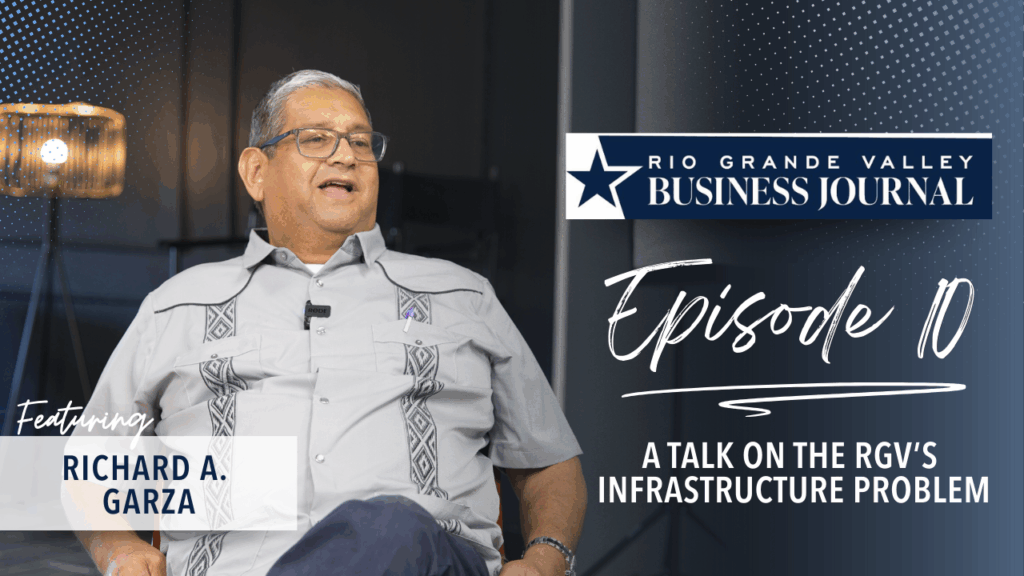
Longtime Rio Grande Valley real estate broker and developer Richard A. Garza joins the RGV Business Journal Podcast to explain how the region’s tax base grew 44-fold, why outside investors are flocking to local projects, and how water scarcity and immigration enforcement are reshaping the housing and construction markets. He also shares advice for first-time buyers navigating today’s buyer’s market in the McAllen area.
Rio Grande Valley real estate broker and developer Richard A. Garza shares how he started in real estate as a high school senior in 1977 and evolved from brokerage into rental properties, commercial buildings, and large-scale developments. Over nearly five decades, he has watched Hidalgo County’s tax base grow from about $2 billion in 1991 to roughly $85 billion today, transforming the Valley from a sleepy agricultural region into what he calls a “mini San Antonio.”
Garza explains that while local buyers still drive much of the market, the Rio Grande Valley has finally been “discovered” by outside investors. He now works with clients from Monterrey, Mexico, other parts of Latin America, California, Florida, and the Midwest—drawn by comparatively affordable prices, a young workforce, and what he sees as one of the region’s biggest advantages: its culture of friendliness and willingness to help investors succeed.
But the rapid growth comes with serious challenges. Garza points to infrastructure strain, congested roadways, and especially water scarcity, warning that reservoirs are well below normal levels and some cities have already put moratoriums on new developments. He notes that the Valley’s reliance on the Rio Grande—and the fact that it shares that resource with Mexico—makes long-term water planning urgent, even as cities and irrigation districts explore desalination and water reclamation projects.
On the residential side, he describes the McAllen MSA as a buyer’s market, with higher inventory and the potential for lower prices, especially as interest rates ease. For first-time buyers, Garza recommends taking advantage of grant-supported programs and shopping around while there is ample selection. At the same time, he warns that ICE raids and immigration enforcement are disrupting the construction workforce and driving a sharp rise in mortgage defaults among his in-house loan clients, as families prioritize food over payments and some breadwinners are afraid to go to work.
Garza hopes for more rain, smarter water policy, and for legislators to ease enforcement practices that destabilize the local workforce and economy. He describes the Rio Grande Valley as a thriving, young, skilled community that can keep growing—if it can secure water, maintain infrastructure, and keep people working.
Below is a rough, AI-generated transcript of the interview. Click on the YouTube link to listen to the podcast so you can hear the full discussion! (Also available from your favorite podcast platform.)
**************************************
Naxi Lopez Hi, and thank you for joining us on this episode of the Rio Grande Valley Business Journal’s podcast. With us today is Richard A. Garza of Busy Realty. Welcome, Richard.
Richard Garza Thank you. Thank you for being here.
Naxi Lopez All right, Richard. So, Richard is a longtime broker, right? You’ve spent a lot of time here selling homes, businesses. Talk to us about how you got your start.
Richard Garza Sure. It all started back in ’77, when I was a senior in high school. I was taking classes, and a teacher of mine was taking her real estate license, and she mastered what she was doing, and she said, “I can do that together.” So we go way back with Carol Hill. I started the real estate business in ’77, and I’ve been doing it ever since. Ten years after that, I started buying rental properties and commercial buildings and things of that nature. Then another ten years later, I started doing real estate developments and subdivisions. That’s pretty much my forte—about 90% of my time is doing real estate developments.
Naxi Lopez Real estate development?
Richard Garza Yes. And I’m still maintaining the brokerage operation.
Naxi Lopez Okay. And so what can you tell us about the climate of real estate here in the Valley?
Richard Garza Boy, has it changed. I’ve been the chairman of the board of directors of the Hidalgo County Appraisal District for 34 years now. Back in ’91, our tax base at the time was about $2 billion with a B. Today we’re about $85 billion—44-fold. And that does not include churches, municipal buildings, city halls, universities, courthouses, things of that nature. The area has changed immensely. I’ve watched farm roads and citrus groves turn into subdivisions. Fortunately or unfortunately, we’ve done a lot of that. The Valley has grown; it’s no longer the agricultural, sleepy little community we all grew up in. It’s a mini metropolis—what I call a mini San Antonio. And in the next 20 years or so, I foresee it being at that level.
Naxi Lopez Wow. And what kind of interest are you seeing? Is it local interest, or is it being fueled by out-of-market investors?
Richard Garza Great question. We’ve finally been discovered by the rest of the world. It used to be that I’d go to Houston or Dallas to conferences and people would ask, “Who are you guys? What do y’all do?” Nowadays my clientele comes from Monterrey, Guadalajara, Austin, Dallas. Lots of California money. Lots of Florida money coming in. The price of real estate here is unbelievable compared to other markets, and we’ve finally been discovered. There’s a lot of corporate money coming in. Yes, the locals continue to feed the economy, but the outside, what I call “extra” money, is coming in. Just this morning, I met with clients from San Pedro and Monterrey who want to invest several million dollars in the Valley because they see the growth pattern here and they see us going places.
Naxi Lopez What percentage would you say is outside investment versus local?
Richard Garza It’s tough to measure, but if I had to guess, probably around 20% of the money coming in is outside money. Lots of California, Florida, and Midwest money. And that’s not something we were seeing a few years ago.
Naxi Lopez When did that shift start?
Richard Garza I want to say in the last 5–10 years. Pre-COVID, I don’t think it was evident, or at least not in our helm. Social media has changed things, and of course the internet has changed the world. People can look at investment properties from anywhere. I get calls from people out of the country—from India, from Latin America, etc.
Naxi Lopez Aside from the price, what else is driving outside investment here? What’s our forte here? Why do people all of a sudden know where the Rio Grande Valley is?
Richard Garza Well, I think exponentially it feeds on the fact that we’re a local economy with skilled labor. We have price on our side. And one thing people laugh about, but it’s true—we’re friendly down here. My son lives in Manhattan, and we spend a lot of time with him up there, and it’s not very friendly up there. Here, everybody’s friendly. They’re good to you. They want to shake your hand. They want to buy you a cup of coffee. They want to visit with people. It’s a different environment altogether, and we’re blessed to live here.
Naxi Lopez That reminds me—when I was working for Mission EDC, we were able to attract a call center here to Mission. One of the main things the executive said convinced him was that when he came here, at the airport and at restaurants, everyone was so friendly and willing to help.
Naxi Lopez And so it seems like that’s something that, you know—
Richard Garza I think it’s an attribute that we have in this area. I think it’s awfully helpful. It’s just a different climate altogether. You spend time in the Midwest or in New York and people walk by in the street and they laugh at you if you say hello to them. Here everybody’s friendly, and I think that makes a big difference.
Naxi Lopez So what do you think, aside from our friendliness, somebody from outside our market should know about doing business here in the Valley?
Richard Garza I think that, again, we’re eager to help people. We have things such as our economic development corporations here in Edinburg, in McAllen, and all over the Valley. People are helpful. People want to help you make that investment work instead of putting a brick wall in front of you and saying, “You can only do X.” People are eager to help. The banks are also very helpful in lending money in this area. That’s a big thing because people are confident that the area is going to continue to do well. And the numbers I shared earlier—it’s amazing to have that type of 44-fold growth in a matter of a generation. That’s unheard of. We have new schools, new office buildings, new city halls. You go to the Midwest and everything is old and tired and there is no new money. We have a young generation that’s willing to do a lot for our area.
Naxi Lopez And so, of course, with all of this growth, there come some challenges. What are some of the challenges that you’re seeing right now?
Richard Garza Infrastructure is a big one—roadways. I spend a lot of time on the freeway. You get on the freeway at 5:00 pm, and it’s hard to get from one place to another. My wife grew up 30 minutes from here—well, it’s now 30 minutes. It used to be ten minutes from here. Now it takes 30 minutes to get to see the in-laws only because of the traffic. And unfortunately, like a lot of other communities, the Valley hasn’t kept up with that. Other areas that suffer are utilities—power and water sources. I think the big issue that people are not recognizing or thinking about is our water shortage. If we don’t get this thing corrected soon, there are going to be issues. There are a couple of cities in the area that already have moratoriums on building out additional developments, and I think that’s smart. You can build a subdivision and all of a sudden you can’t get building permits—how are you going to pay that loan back to the bank?
Richard Garza So I think those issues are here. We hope that they rectify themselves soon. Unfortunately, what we probably need in the Valley is a big hurricane with lots of water but little wind. We don’t want damage, but we do need water in the reservoirs. If you look at the stats today, they’re less than 10% of what they normally should be, and that’s not a good thing.
Naxi Lopez Right. And we just published a story a couple of days ago that talked about how the metros here in South Texas rely heavily on the Rio Grande. We don’t have access to other sources of water that other metros throughout Texas do. And not just that—we share a river with Mexico as well. So it’s not just water coming to us, but we also share it with another country.
Richard Garza That’s correct. And again, we need to focus on that. A few months ago I was at a conference in Dallas, and they asked the audience if they had any questions. I raised my hand and said, “What are we doing about the water issue in the Rio Grande Valley? We have a big issue.” The speaker gets up and says, “You don’t have a water problem down there.” I said, “I assume you haven’t read the papers. We have a problem.” He said, “No, you don’t have a water problem. You have a cheap water problem.” I said, “What do you mean?” He said, “Do you see this bottle of water? Today it cost me $2. You have access to water—just not cheap water. You can desalinate.” And that’s the truth. But what will we pay for bottled water at that time? Is it $20? Is it $30? You’ll pay whatever it takes because it’s a necessity, not a luxury.
Naxi Lopez And there are projects around the area that are being carried out. I think McAllen is doing its own desal project, and then the water reclamation project that the county irrigation district number one is also doing. So we’re trying to find different ways of procuring that very precious resource.
Richard Garza Absolutely. And I think we need to look for alternate sources. For too long, our entire region has relied, like you said earlier, entirely on the Rio Grande. We need alternate resources, because what are we going to do with all this industry if we can’t supply the water?
Naxi Lopez Okay. And so, shifting gears a little bit to the residential sector. I think we ran a story a couple of days ago, too, about how the inventory in the McAllen MSA is right now a buyer’s market. What does that do for the area, for homebuyers?
Richard Garza It’s supply and demand, like everything else. At this time it is an excellent time, I believe, for homebuyers. We have developments where our inventory is up and moving slowly at this time. What we do is our profit margin suffers, so we continue to reduce prices until it catches up. I think that’s good news for the consumer and good news for the buyer. Interest rates appear that they’re going to be reduced here soon, and that’s certainly going to help. So it’s definitely a buyer’s market. Will it correct itself? Probably so, because of the water supply issue we just talked about. People are going to slow down making new developments, thus eventually it’ll catch up, in my opinion.
Naxi Lopez And so for a young couple looking to buy a home, what kind of advice would you give them?
Richard Garza Today is an excellent time for young homebuyers to purchase. There are many resources out there. There are such things as first-time homebuyer programs, which basically is grant money available if they hit a certain income level. There’s a big variety out there. It’s like going to Luby’s Cafeteria—you have a choice as to what you can eat. At this time you have a choice of houses that you can pick because the time is right for buyers, in my opinion.
Naxi Lopez Okay. And when we’re talking about real estate, we’re also talking about construction. And I know right now construction in the Valley especially has kind of a spotlight on it because of all of these ICE raids. Talk to me about what that’s done to the industry here. I know there was a worker shortage for a while. Tell me what you’re seeing.
Richard Garza I’m seeing that. I’ll give you an example. We had a development on the east end of Edinburg that we were doing, and we could not complete our houses timely because we had a worker shortage. ICE came in, picked up a few people, and then afterward everybody else was scared. They don’t want to move; they don’t want to do things. So it definitely had an impact on us. It continues to be an issue. Just this morning, we had an ICE raid on one of my other businesses north of Edinburg for no reason whatsoever. And what that does is it scares off our employees, it scares off our clientele, and it’s not a good thing for the area. Donald Trump continues to do this, and I think that that’s certainly hurting our local economy.
Naxi Lopez What will it do if this continues?
Richard Garza Another aspect of my business—I do a lot of different things. We own an in-house mortgage company where we finance all our products. What we’re seeing today is a big default rate that we didn’t have previously. I’ll share something with you: a year ago, our default rate was about 6%. Today it’s about 28%, as of this morning. So I tell my staff, “Work with your people. Don’t foreclose on them. Reduce your payments. Work out terms as long as you can,” because I think this thing will pass. We hope it does. Why aren’t people making payments? Not because they don’t want to, but because they have to put food on the table. They don’t have SNAP anymore, number one. And number two, the husband is not working because he’s afraid to go to work because ICE might come around. These are problems that really are out there today. Few people see that, but we’re in it day in, day out, and we see it on a daily basis.
Richard Garza It’s not a good thing for the Valley. Not a good thing.
Naxi Lopez Absolutely not. Any closing remarks—anything that you’d like to add that maybe I didn’t ask you?
Richard Garza No, I think you were thorough. I think we covered a lot of topics. But I think we need to continue praying for lots of rain, because we need that for our drought-stricken area. And I think we all need to push our legislators to have people like ICE back off, have them reconnect SNAP, and let’s get back to work. This is a thriving community, a young, skilled community. We need to continue working, and to do that we need everybody’s help, including the federal government. But thank you for the opportunity to speak to you today.
Naxi Lopez No, thank you for speaking to us and enlightening us and our readers. We really appreciate it. Thank you so much. Make sure to follow us next week with another episode of the RGV Business Journal and subscribe. We’ll see you next week.