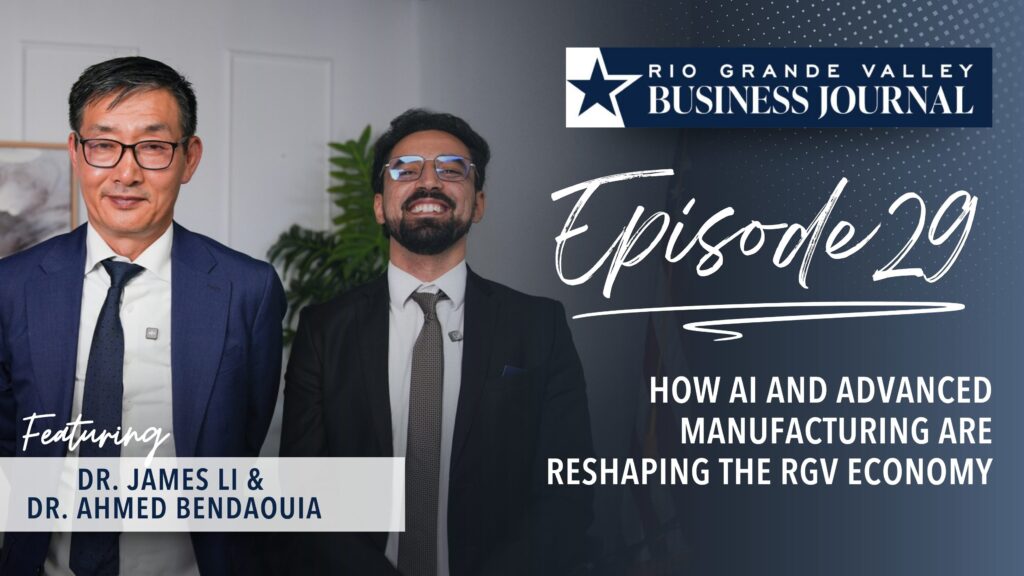
Manufacturing is no longer just about assembly lines — and Rio Grande Valley leaders are racing to position the region for what comes next.
In this episode of the Rio Grande Valley Business Journal Podcast, reporter Kristen Mosbrucker-Garza sits down with Dr. James Li and Dr. Ahmed Bendaouia of the University of Texas Rio Grande Valley’s Institute for Advanced Manufacturing to discuss how AI, robotics, digital twins, and workforce training are changing the future of manufacturing.
Li explains why manufacturing remains one of the strongest engines for job creation and innovation — and why the Valley may have a narrow window to attract the next generation of high-tech industrial investment.
The conversation explores what it will take to build a stronger manufacturing ecosystem, from anchor companies like SpaceX and potential projects such as Saronic, to supply chains, workforce pipelines, university partnerships, and the role of AI in making production more flexible and accessible.
It also looks at emerging opportunities in rare earth minerals, recycling, semiconductors, and autonomous systems — and why UTRGV researchers believe the Valley could become a new point in the “Texas diamond” of economic growth.
The following is a rough, AI-generated transcript of Kristen Mosbrucker-Garza’s interview with Dr. James Li and Dr. Ahmed Bendaouia of the University of Texas Rio Grande Valley. Minor errors and misspellings may appear. For the full conversation, listen to the episode above or through your preferred podcast platform.
KRISTEN MOSBRUCKER-GARZA: Welcome to the Rio Grande Valley Business Journal podcast. I’m Kristen Mosbrucker-Garza, a news reporter here at the Rio Grande Valley Business Journal.
We have some special guests today from the University of Texas Rio Grande Valley. We have Dr. Li, and Dr. Ben as well. If you all want to introduce yourselves to our audience.
DR. JAMES LI: I’ll go first. My name is James Li. I’m a professor and director of the University of Texas Rio Grande Valley Institute for Advanced Manufacturing. I do research. I also do education, teaching, and so on.
So I’m a professor at UTRGV, but also someone who is active in the Valley. We provide services to the community. We do research, we publish, and we go into the classroom and teach. I’ve been here for almost 22 years.
KRISTEN MOSBRUCKER-GARZA: For sure. And you’re the inaugural director of this manufacturing institute, specifically advanced manufacturing, which I think is really important because there are so many folks in the economic development world where manufacturing jobs are the number one thing they want to bring to our communities.
DR. JAMES LI: That’s right. We’ve been talking about how critical manufacturing is.
If you look at most of the superpowers in the world, they have more than 10% of their GDP from manufacturing. In the U.S., before 2000, almost 20% of GDP came from the manufacturing sector.
Now, even though some manufacturing sectors moved into other countries and other regions of the world, we still have about 11% of GDP from manufacturing.
One manufacturing job can create four jobs in other sectors. So it’s an engine for job creation.
And research expenditures — about 80% in the U.S. — come from manufacturing firms. So it’s very important. It’s the engine for innovation. It’s the driver for jobs and economic prosperity for the country and for communities.
I can’t overstate how critical manufacturing is to any community or country.
KRISTEN MOSBRUCKER-GARZA: For sure. And Dr. Ben, speaking of innovation, I understand that’s your area of expertise. Could you share with our audience what you’re working on right now?
DR. AHMED BENDAOUIA: Yes, sure. Thank you for having me.
I’m an associate research scientist in AI, digital twins, and digital transformation for manufacturing.
Nowadays, we believe it is mandatory to have this digital transformation layer over advanced manufacturing. That includes the use of AI, deep learning, machine learning, and advanced robotics to support businesses, including local businesses.
We have many partners working with us at the Institute for Advanced Manufacturing, including local industries. They are looking to benchmark and also develop in-house AI to support their businesses.
So I’m there to support them, along with a really strong team at the institute and under Dr. Li’s leadership.
KRISTEN MOSBRUCKER-GARZA: I’ve heard anecdotally from folks in the industry that integrating AI into manufacturing can be difficult because there are so many trade secrets, and you sort of have to create this black-box or closed-box environment.
Because it’s a very competitive industry, versus maybe a pure-play technology company, there’s not as much interest in data sharing and information sharing. So how do you break through that?
DR. AHMED BENDAOUIA: One thing that is important to understand is that AI is not new. It dates back decades.
What makes it important right now is the infrastructure and the devices we have — the Internet of Things, low-cost chips, and sensors that are now almost everywhere.
The main challenge for AI is actually data. With this infrastructure, we can now build AI to solve real challenges.
In addition to that, we need deeper understanding, which takes us to workforce development. We don’t just need AI skills. We need AI skills that can be applied across multidisciplinary domains.
That is the real challenge right now for business and workforce development.
KRISTEN MOSBRUCKER-GARZA: I wonder if that comes into play because a lot of these advanced manufacturing facilities are not just assembly lines. I imagine it’s a lot more dealing with computers or even robotic arms.
It’s not necessarily manufacturing, but advanced warehousing — I’ve been inside some Amazon fulfillment centers during my career. I went into one in Delaware a number of years ago, and a robotic arm was doing the sorting, obviously much more steadily than a human, using camera vision to pick things up and sort them. And it could go 24 hours a day.
Then you had the shelves, and the shelves would come to the human in the warehouse setting. So I imagine you’re dealing with sort of a smart factory setting these days.
DR. AHMED BENDAOUIA: Exactly. But when you put it that way, it can seem like robots are replacing human beings. I don’t want to frame it that way because they are not there to replace people, but to empower them and give them opportunities for higher-quality jobs, better environments, and better tools.
There is a difference between robotics as automation and autonomous robotic systems that can actually do reasoning. That is where there is a difference.
There is still a human in the loop who needs to supervise, monitor, and set the limits for AI and robotics to do the work.
That is the future of manufacturing.
KRISTEN MOSBRUCKER-GARZA: That’s really interesting.
So Dr. Li, what was the inspiration behind the Advanced Manufacturing Institute? I understand there has been some investment by the university in building out and upgrading things, and also a whole network of national consortia.
Paint a picture of the investment you all made about a decade ago.
DR. JAMES LI: Back then, UTRGV was UT Pan American. It was one of the few universities in the nation that had a manufacturing engineering department and an ABET-accredited undergraduate program focused on manufacturing engineering.
So we have a legacy in manufacturing education. But because of offshoring, our student body had been shrinking to the point where we were talking about closing the department in the early 2010s.
Manufacturing is so important, but people didn’t realize that until Covid. Suddenly, we looked around and said: We don’t know how to make things. We don’t have the facilities. We don’t have the factories. We don’t have the ecosystem. We don’t have the supply chain to make large volumes of goods for our society.
So I really thought we needed to do something to change that situation, and to change the image of manufacturing as a dirty job or a low-tech job.
Actually, manufacturing is the foundation of high tech. It is the foundation of innovation.
So the question became: How do we bring manufacturing back to the U.S., back to Texas, and grow high-tech, high-paying manufacturing operations here?
We started looking at the opportunity. I was invited to an Open Campus conference organized by the Department of the Army. I think that was in 2014. They came back and visited us, and we started collaborating around defense manufacturing-related topics.
The number one challenge for us back then was that we didn’t have a strong pipeline in manufacturing engineering. So we tried to grow programs at that time.
Then Covid hit, and it really showed some weaknesses in our economy. We started working very hard together on how to build the manufacturing pipeline and how to build the future technology of manufacturing.
We started growing the research side. We also started growing technical training programs. We started bringing in more people and more members across the country who believe in the future of the U.S. economy powered by manufacturing.
That is something, in my opinion, everybody across the aisle agrees on. We need to grow stronger manufacturing in the U.S.
So long story short, we started writing for federal funding. We also worked with the university leadership team to convince them that we really needed to invest in manufacturing because it would create long-lasting impact in our community.
Luckily, we have strong leadership within UTRGV that aligned with that thinking.
Now we are talking about bringing manufacturing operations to the Rio Grande Valley. We are talking about an industrial park being considered that could support advanced manufacturing.
Ben talked about robots and AI. I think we have a narrow window over the next five years. If we do the right things, we can bring manufacturing operations back with the right technology. I think we have a golden opportunity to grow the manufacturing sector here.
When we talk about Texas, it’s always the triangle — Dallas, Houston, Austin, and San Antonio. So I’m thinking, what if you put another point on the map?
KRISTEN MOSBRUCKER-GARZA: One more point.
DR. JAMES LI: Yes. You convert the triangle into a diamond. You get the Texas diamond. The Rio Grande Valley can be the other point.
That is part of the vision — how do we make our community ready?
We have a large amount of young talent here in the region, and they are looking for jobs. I hope they are going to find jobs in the high-tech sector powered by manufacturing.
That motivates my team to work hard and provide more opportunities for our students and our community members.
KRISTEN MOSBRUCKER-GARZA: Something I’ve always found interesting about the border — I used to work here 10 or 12 years ago — is that at that time, the twin-plant maquiladora model was still very common.
You would have something more labor-intensive in Matamoros or Reynosa, and then maybe more high-tech manufacturing on the U.S. side that required robotics or high-value materials.
I saw quite a bit of that, bringing manufacturers from up north down here where they could split the difference but keep the advantage of NAFTA.
Then we saw more offshoring. In recent years, there really has been a focus from the top — both political administrations over the past 10 years — to reshore manufacturing because there was a time when the U.S. had the supply chain.
Training the workforce is one piece. But what does it take to bring the manufacturing supply chain back to the U.S.?
Let’s take automotive manufacturing, for example. I know a lot of companies have been interested in investing, and they basically say, well, we do just-in-time work and want to be close to our customer.
DR. JAMES LI: I think it really depends on the type of firms you are talking about.
With large firms, when they select their sites, it is always about incentives, availability of workers, and potential cost savings. That is why they moved to China, Mexico, and Vietnam. That is the low-cost strategy.
If you look at small firms, though, they don’t care as much about low costs in the beginning because they need to survive. They need to be able to make their product somewhere, somehow.
For small firms, they are looking at closeness to suppliers. Some entrepreneurs go to China often because they can find suppliers very quickly there. In a few days, they can identify all the critical components they need to make their products.
They don’t necessarily care whether that happens here, in Mexico, or in China. They care about making the product.
What we should do is think about our geographic advantages here. We are close to the other country in North America, and we can integrate some of the manufacturing ecosystem we have to stand out in site selection for both big firms and small firms.
That is why we are creating an institute for advanced manufacturing. We can provide technical support.
If bigger firms are planning to come here, they need a partner. They need students. They need a workforce. We do workforce training for them. With the technical support, they can use our facility almost like their own laboratory in the beginning.
KRISTEN MOSBRUCKER-GARZA: Really.
DR. JAMES LI: For small firms, we can also play a very important role in their growth.
I have a friend who owns a small firm in College Station. He flew to China to figure out how to make his portable refrigerator.
What I’m thinking is that we can build a one-stop-shop facility here, so someone can come here and figure out how to manufacture their device without flying to another country.
We can help them grow their business here and make their products here.
In the end, that could help more companies move their operations to the Valley and provide more jobs for our students and our community.
KRISTEN MOSBRUCKER-GARZA: Skipping forward to today, SpaceX — which is a high-tech manufacturer building rockets — is now in play in Brownsville.
We just had the announcement with Valeo in McAllen. They are, I understand, a Tier 1 auto parts manufacturer, and they are focusing on software-defined vehicles, which I thought was interesting.
They are breaking out of that twin-maquiladora model. They are saying, we see the workforce here, we see the future in the Valley.
We also saw Texas A&M set up an advanced manufacturing training school.
So where are we today with advanced manufacturing in the Valley? What has changed that we are growing and attracting this?
DR. JAMES LI: I think you have to look at the younger generation and the technology they are familiar with.
When I grew up, there were no computers. But now my kids at home play on computers every day. What they play is almost like a digital twin. You call it a game, but you can also call it a digitalized manufacturing system.
The skill sets young people have today are very different from when we grew up.
So we need to think about what kind of workforce we will be working with and what kind of manufacturing system we have to develop here.
If we want to attract more companies here, we have to let them know what kind of manufacturing technology and information technology we can provide, so they can recruit and hire the talent they need.
It’s a two-way street. While we prepare the talent for them, they have to adopt the right technology.
There is a lot of discussion at the national and local levels about what kind of technology we should develop to help big firms and small firms come to the U.S. and set up facilities here.
The technologies they use — robots, AI, autonomy, autonomous factories — are like the Amazon distribution center you mentioned. Everything is operated by robots with a few operators assisting.
It is almost like a control room at NASA or SpaceX, where operators interact with computers. They are not on the production line. The production line is fully automated with robots.
Young people are very familiar with those technologies, so they can operate and succeed in that environment.
We need to continue exploring the right technology to support manufacturing. We need to understand what skills young people have, what they know, what they like, and what they don’t like.
You can’t force them to do things they don’t like. If you do, we won’t bring them into the manufacturing sector.
KRISTEN MOSBRUCKER-GARZA: I’ve heard at a lot of job fairs, and from a lot of job seekers, particularly younger people who may or may not have degrees, that there’s a lot of anxiety about AI.
What are some ways AI has been integrated into advanced manufacturing that could put people’s minds at ease?
DR. AHMED BENDAOUIA: There are many aspects to that.
I can start where Dr. Li ended. For example, while we are speaking, I believe astronauts are on their way back from the moon. That is a very complicated task.
While the rocket is in space, they have a very accurate idea of what is happening in terms of velocity, temperature, and many other things using sensor data.
Based on that, they build a digital twin of the rocket here on Earth while it is flying there.
That would not be possible without the infrastructure of the Internet of Things and AI, because that rocket is a representation of an AI-powered system.
From that perspective, AI is helping. It is pushing humanity toward better outcomes and broader achievements.
I understand the anxiety you mentioned. People are starting to feel like AI is something that could take their jobs. But it is more accurate to say it is here to facilitate work.
At the same time, I agree it is a double-edged sword, especially from an ethical standpoint. That is true in areas like medical applications of AI, where access to data and other issues still need to be addressed.
This is also where policy becomes important. Europe, for example, is already paving the way with more regulation. It is similar to GDPR, the General Data Protection Regulation that was created for social media and digital platforms.
That wave is already part of daily life. Now the new wave is AI. Europe is moving to regulate how AI is developed and implemented. It should not be something where you just apply AI to any data set for any purpose.
It needs ethical guardrails. There have to be limits around where it is used, what the intended outcomes are, and how to avoid negative effects on everyday life.
DR. JAMES LI: I want to add to that topic.
With AI and computing, I think manufacturing can become much more accessible to ordinary Americans.
Think about appliances in the home. Back then, only wealthy families could afford many of them. Now most families have the equipment they need to cook, store food, and manage their daily lives.
Manufacturing could move in a similar direction. Powered by AI, it is becoming smaller, more modular, and more flexible.
You could bring some of these capabilities much closer to where people live. In some cases, you could even make things yourself on a very small scale.
I think that can empower people to participate in value creation — to make things, build things, and maybe even become the next SpaceX or the next computer company. But to do that, you have to have the ability to manufacture and create value.
That is where I think this is heading.
KRISTEN MOSBRUCKER-GARZA: Interesting.
In terms of new industries that could develop in Texas, there has been more emphasis in recent years on rare earth minerals.
For listeners, the name can be a little misleading. I am not an expert, but in general, some of these materials are not necessarily rare in the literal sense. They are just difficult to process and extract in useful forms. They are also critical to manufacturing.
There is already a mining operation in West Texas. So what could be on the horizon for the rare earth minerals industry in Texas?
DR. JAMES LI: Ben is the expert on that, especially on refining rare earth elements.
But my own view is that while we do not have many refinery operations here, we do have a lot of electronics that contain batteries and rare earth elements.
So I think recycling can help sustain some of that need.
That said, refining these materials raises environmental concerns for local communities. That is why West Texas matters in this conversation. You do not necessarily want those operations in a highly populated area.
But we do have technologies that can economically recycle and reclaim some of those materials on a smaller scale, then use them again in semiconductors, batteries, and similar products.
In my view, that can become part of a more sustainable model.
DR. AHMED BENDAOUIA: Yes, exactly.
The definition is correct in the sense that these materials are rare, but they are also difficult to process and separate into valuable concentrated forms that can actually be used in industry.
That is where the complexity comes in. And that is also where AI can help.
My research focuses on using AI, computer vision, and digital transformation to improve how minerals are processed and upgraded into valuable materials.
When you want to separate useful rare earth elements from the rest of the material, there are many steps involved — crushing, grinding, flotation, hydrometallurgy, filtration. All of those processes involve complicated physical and chemical parameters.
AI has strong potential there. It can help with predictive monitoring, strategic control, and process optimization.
That matters not only for industrial use, but also for supply chains, especially in a period of geopolitical instability.
And for business owners, this can be an opportunity. The U.S. government is pushing to attract more business around rare earth processing and related policies.
So this is the right moment to bring in new technologies and new business models — and for a place like the Rio Grande Valley, its geography near the border could also add value.
DR. JAMES LI: Again, technology is critical when we talk about manufacturing.
I had a conversation today with scientists at Oak Ridge National Laboratory. One of the challenges they mentioned involved magnetic materials that contain rare earth elements.
One strategy would be to extract the rare earth elements from those magnetic materials. But that takes time and effort for a relatively small amount of material.
Another strategy is to recondition or repurpose the magnetic material itself, leaving the rare earth content in place. That would help the supply chain without requiring a full extraction process.
So in my opinion, strategy and technology both matter. We should evaluate those options carefully before putting all our investment into a single method.
Again, research and technology are critical.
KRISTEN MOSBRUCKER-GARZA: What do you think is the biggest challenge to growing the advanced manufacturing sector in the Valley?
DR. JAMES LI: That is a very good question. I ask myself that as well.
First, I think we need anchor companies. We need anchor industries. We have to do an ecosystem analysis. We cannot be good at everything.
You can already see how SpaceX has attracted attention and companies to the Valley. That is what I mean by an anchor company.
So the question becomes: Is there another anchor company we can bring here that helps build out an industrial ecosystem the Rio Grande Valley becomes known for?
The second issue is the ecosystem itself. Even in the space industry, you need suppliers, materials, and support services nearby. If companies can find what they need locally instead of sourcing everything from somewhere else, the region becomes much more attractive.
Policy also matters. Tax policy, incentives, available land, and the overall business environment matter.
And workforce availability is also critical. Organizations like UTRGV and our institute can help companies make the decision to relocate or expand here because we can provide training, support, and technical capacity.
Those are some of the main things we think about.
DR. AHMED BENDAOUIA: And there is also the national consortium Dr. Li leads through the Institute for Advanced Manufacturing at UTRGV.
It brings together partners from across the U.S. to address supply chain challenges and support the return of technologies like casting and forging, but with more advanced, innovative tools — including AI and machine learning.
In the past, those industries were often seen as harsh environments with dust and difficult conditions. But from a supply chain security standpoint, they still matter.
The goal is to bring them back with smarter plants, AI, and more advanced technologies supporting those operations.
KRISTEN MOSBRUCKER-GARZA: When you talk about supply chain, that reminds me of the supporting industries that cluster around a company like SpaceX.
For example, an air separation unit was built nearby because a company like SpaceX needs access to a lot of industrial gases.
People have also talked about the need for a cement plant because of how much material is being used there.
And I recently wrote about how SpaceX is now leasing port space for the next 50 years. It is not just building the Gigabay in Starbase. It is also building a much larger one in Florida, near Cape Canaveral.
Part of that plan involves building rockets here, putting them on a barge, and moving them about 1,000 nautical miles to Florida while that facility ramps up.
That really highlights how important the foundational supply chain is.
DR. JAMES LI: Yes. That is exactly part of the reason behind the national consortium.
Most of the time, activity flows north. We do not get enough visibility here, even though the Valley has strong talent and a high share of young people ready to work.
SpaceX has helped increase our visibility and attract more companies.
The consortium is built around that same idea. We want stronger flows of information, technology, and investment from more mature ecosystems like Houston, Atlanta, Chicago, San Antonio, and Dallas into the Rio Grande Valley.
The more visible we make this region — not just across the country, but internationally — the better.
We have already been working with site selectors from Europe. They are coming here to evaluate whether this could be the right future site for operations.
We still have gaps to address, but we are in a much better position than we were five or 10 years ago.
If the Rio Grande Valley continues to work together, and if UTRGV keeps pulling in resources from the federal and state levels, I think we can have a much better future in the next five years.
But the window is there now. We need to use the right technology and act while the opportunity exists. Other countries are doing the same thing, and they will compete with us.
To bring manufacturing back to the U.S., I think we have about a five-year golden window to be ready.
KRISTEN MOSBRUCKER-GARZA: We are also in the running for Austin-based defense technology company Saronic, which could mean a $3.2 billion investment and around 10,000 jobs.
Would you consider that advanced manufacturing? It is shipbuilding, but it is also autonomous vessels, which suggests a much more technical operation than traditional blue-collar work.
DR. JAMES LI: You still have blue-collar jobs, but you also have high-paying technical jobs. I do not draw a hard line between blue collar and white collar the way people sometimes do.
One of my former students, who earned a master’s degree at the old UT-Pan American, now works at Rivian. He invited me to visit and talk about recruiting interns.
I wanted to see how the company was doing. I did not want to send students into a bad situation.
What stood out to me is how narrow the distinction has become between traditional plant work and high-tech work. If you have the right skills — automation, design, programming, coding — you can earn a six-figure salary even without a college degree.
That is happening already.
And yes, Saronic is clearly within the manufacturing sector. Shipbuilding is manufacturing. Smart vessels are important to the U.S. Navy, and we work with the Navy as well.
A company like that can function as another anchor company, just like SpaceX, bringing more attention and more opportunities to the region.
I am very optimistic about that project.
The LNG project is also one of the largest investment projects in the country. So there are multiple potential anchor companies in play here.
KRISTEN MOSBRUCKER-GARZA: For listeners who may not know, that LNG project involves a roughly $30 billion commitment for liquefied natural gas export infrastructure near Brownsville.
There is also a proposed next-generation refinery on the border, backed by America First Refining, that could be a $3 billion to $4 billion project with about 500 jobs.
So it does seem like the Valley is in line for several of the kinds of anchor projects you are talking about.
Where do you see the Valley in the next five years from an advanced manufacturing perspective?
DR. AHMED BENDAOUIA: It is moving very quickly.
I see that from multiple angles — workforce development, business incubation, and industry support. Local economic development groups in the Rio Grande Valley are doing a strong job. We have been invited many times to meetings with companies that are interested in coming here and want to explore partnerships with local universities.
Those companies want to know what universities can offer them. Can the curriculum adapt? Can programs be tailored to workforce needs?
Those are real discussions happening now.
So you have policy, economic development groups, universities, and industry all working together. That triangle is essential. Each side has a role to play, and I think that coordination is going to move even faster over the next five years.
DR. JAMES LI: Every region has its own character and strengths. In the end, the future depends on the people we have here.
We are not going to become San Diego, but we may be better than San Diego in certain ways.
When I was doing my doctoral work at Texas Tech, people talked about the “U curve” of value added. Manufacturing sat at the bottom. But Covid showed that if you remove manufacturing, the rest of the value chain becomes meaningless because you cannot make anything.
Now we understand that again.
If manufacturing comes back, the other sectors follow. So I think the Valley can become more integrated, more comprehensive, and offer more opportunities to people across the economy.
One manufacturing job creates more than three jobs in other sectors. If you focus only on those other sectors, you do not get that multiplier effect.
So I am very confident that with the work being done by the community, the university, and other partners, five years from now we are going to see more companies and more jobs.
And I hope policy will follow in a way that supports a strong, sustainable community. In the end, success is about the well-being and happiness of the people who live here.
KRISTEN MOSBRUCKER-GARZA: I also think Texas has already been through major manufacturing growth, especially in semiconductors.
And the Valley already has a significant base. I have seen studies showing there are more than 300 manufacturing companies in the region already. So this is not starting from zero.
Is there anything else people should understand about where this is headed?
DR. JAMES LI: I would add one point.
I have a colleague with strong ties to Sweden, and I have visited there. I see similarities between Sweden and the Rio Grande Valley in the sense that both can support a more distributed model.
In Sweden, advanced manufacturing is often spread across smaller towns and communities rather than concentrated in one giant metro. That means the benefits are distributed. People do not have to drive one or two hours — or in Houston, even more — just to get to work.
It also reduces the environmental burden that can come from large concentrations of industrial activity.
If Sweden can build an advanced manufacturing ecosystem on that model, I believe we can do something similar here.
The Valley has geographic advantages. It has land. It has people. Those are the foundations of the future.
That is why I believe this region can become an economic engine for Texas.
DR. AHMED BENDAOUIA: I agree.
The Valley is attractive for many reasons. Housing is more affordable. The community is friendly. It is family-oriented.
A lot of people study here but leave because they cannot find jobs. At the same time, many also want to come back and settle here with their families if the right opportunities exist.
That matters.
You also need to attract skilled people from outside. I moved to the Valley two years ago, and I find it attractive and welcoming.
That combination — local talent, returning talent, and outside talent — can help build the industry here.
All of those moving pieces can make the Valley an important future point in Texas innovation.
KRISTEN MOSBRUCKER-GARZA: Thank you both for joining us. We appreciate it.
Stay tuned and subscribe to the Rio Grande Valley Business Journal podcast.
DR. JAMES LI: Thank you. Thank you for having us.