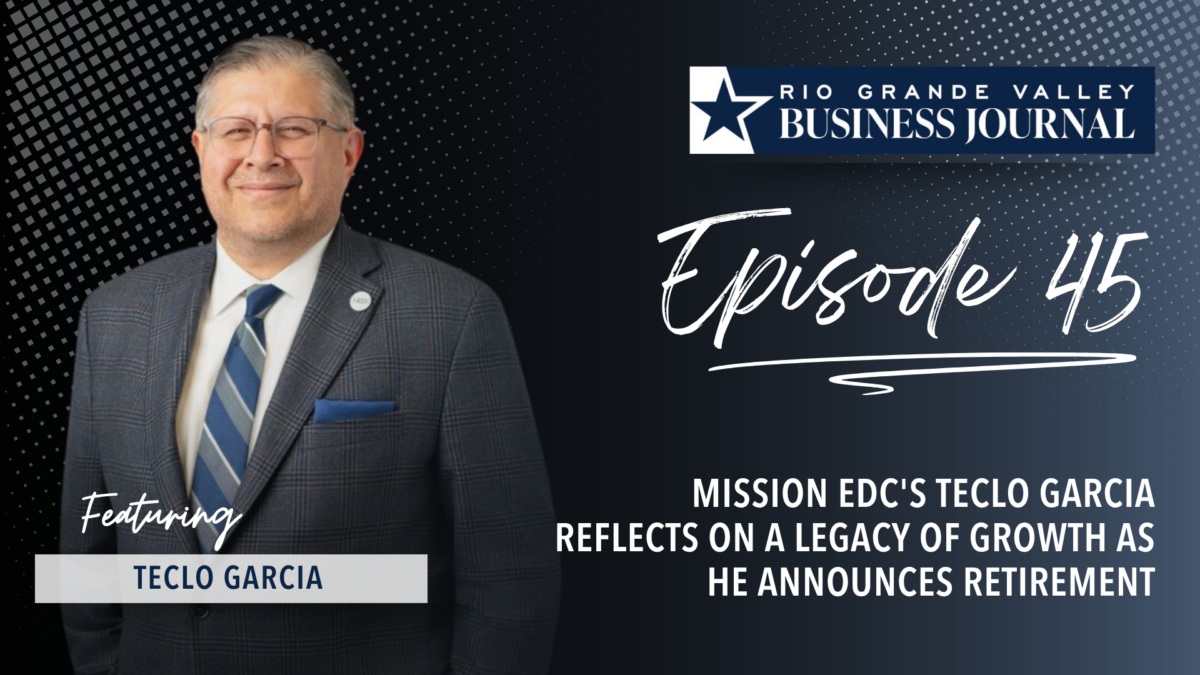
After nearly two decades of public service in the Rio Grande Valley, Mission Economic Development Corporation CEO Teclo Garcia is stepping down.
Garcia notified the Mission EDC Board and the Mission City Council of his retirement, effective Sept. 11, 2026. He became eligible to retire under the Texas Municipal Retirement System after 19½ years of combined city and EDC service.
In this episode, Rio Grande Valley Business Journal reporter Kristen Mosbrucker-Garza sits down with Garcia to look back on a career that began not in economic development, but in journalism.
Garcia moved to the Rio Grande Valley in 1995 to take a job at the Valley Morning Star after finishing his degree at Texas State and leaving the U.S. Air Force. He went on to become editor-in-chief of the Brownsville Herald, spent time at the Arizona Republic, and eventually returned to the Valley to work in city government — first for the city of McAllen, then Laredo, before landing at the Mission EDC.
Garcia talks about what he learned from Laredo’s massive cross-border trade corridor and how he applied those lessons to economic development efforts in Mission, including landing the $50 million Zerluma aluminum plant — the largest private-sector investment in the city’s history.
He also reflects on the roughly $400 million in investment and 2,000 jobs brought to Mission during his tenure, from major retailers to call centers to industrial expansions, and weighs in on how Mission’s approach compares with neighboring cities like McAllen and Edinburg.
Garcia closes the conversation by sharing what’s next for him in retirement.
Listen to the full conversation below or on your favorite podcast host.
The following is a rough, AI-generated transcript of Kristen Mosbrucker-Garza’s interview with Teclo Garcia, CEO of the Mission Economic Development Corporation and the City Council . Minor errors and misspellings may appear. For the full conversation, listen to the episode above or through your preferred podcast platform.
Kristen Mosbrucker-Garza: You’re the CEO of the Mission Economic Development Corporation, and I understand you have some big news to share.
Teclo Garcia: Well, as I shared on LinkedIn, I’m retiring as of Sept. 11, 2026. I notified the Mission EDC board and the City Council on Monday that I was retiring — I sent them a letter of notification. Mainly, it’s because I became eligible to retire after 19½ years of city and EDC work, under the Texas Municipal Retirement System. I became fully vested, and in August I became eligible. So I wanted to take advantage of that opportunity, draw my pension and a lump sum, and create some opportunities for other folks. I kind of like the idea of this being a little bit like the old show “This Is Your Life.”
Kristen Mosbrucker-Garza: That’s a little before my time — unless they came out with a new one.
Teclo Garcia: Well, you know what I mean, right? There’s this concept of “this is your life.”
Kristen Mosbrucker-Garza: Yeah, and I remember interviewing you for the first time. I believe it was 2013 or 2014. And if I remember correctly, you were with the Border Trade Alliance at the time.
Teclo Garcia: I was working at the city of McAllen, but even to this day I’m part of the Border Trade Alliance — it’s an association. I never worked for them, I was just on their board.
Kristen Mosbrucker-Garza: Okay, that’s what it was — you were on the board of the Border Trade Alliance and working for the city of McAllen. So, for folks who may or may not be familiar — I understand you grew up in the Valley, and you mentioned that during some of your public comments. What would you say inspired you to stay working along the border? I think that’s been a big question for a lot of young professionals.
Teclo Garcia: I actually moved to the Valley in 1995. I grew up near San Antonio, in a little town called Kennedy. I had family in the Valley, so I was familiar with it — I’d been to Harlingen, Mercedes, the island and McAllen dozens and dozens of times to visit family, or come down for Christmas break or a month in the summer. So it was very familiar.
When a job opened up at The Valley Morning Star in 1995, I had just gotten out of the Air Force and finished my degree at Texas State. I talked it over with my wife and said, ‘Hey, there’s a job opening, I’d like to take it.’ She said, ‘Yes, let’s do it.’ So we moved here. My wife and I both have a sense of adventure — she’s a military brat, she lived all over the world. A lot of people feel like living in Laredo, El Paso or the Valley is a really big deal, that it’s geographically and maybe culturally challenging. But for us, it was just a great opportunity.
I worked my way up through the newspapers — back then it was Freedom Newspapers in McAllen and Harlingen. I became editor-in-chief of the Brownsville Herald in 2001 and stayed there a few years before moving to Arizona to work at the Arizona Republic. Then I got out of newspapers and moved back to work for the city of McAllen as director of government affairs.
So I’ve been in the Valley non-stop — well, off and on — since 1995, and then when we came back in January 2008, so 18 years ago, I’ve been here since. The Valley has provided a lot of opportunity for me, and I’ve had some great people look out for me as well. I was able to leverage those opportunities into making a living, raising a family, buying a house — working for the city of McAllen for about nine years, then Laredo for three years, and then Mission for about seven and a half.
It’s been a really good ride. I think all the experiences and skills I picked up along the way, and the mentorship from several people, made the CEO job at the Mission EDC a perfect situation, and we’ve been able to do a lot of things since I’ve been there with a really great team.
Kristen Mosbrucker-Garza: Contrast what it was like in Laredo — to be fair, a lot of folks from outside the region have said things to me, like an Uber driver once said something like, ‘Oh yeah, the Valley, Laredo,’ as if they’re the same place.
Teclo Garcia: Yeah, someone told me one day, ‘Hey, I’m going to the Valley, I’m going to Del Rio.’ I said, ‘Del Rio is five and a half hours from here.’ Del Rio is a lot like the Valley, and the Valley is not like Laredo. Culturally, it’s a border town, probably more like Brownsville than McAllen, because it sits right on the river.
One thing Laredo has that the Valley doesn’t is a lot more history. It was founded in 1755, and it’s always had two cities — Laredo on this side and Nuevo Laredo on the other. Right now there’s probably a million people on both sides of the border. It was on the Camino Real, so it has a lot more history. The Valley is more settled, around 1900 to 1910 — obviously there were people here before that, but not in the sense of a city, a crossing point, buildings and all that. Laredo has had that for many years.
Like I said, it’s more like Brownsville than the rest of the Valley, I think, being situated on the border, with people walking, biking and driving across every day. And Laredo’s logistics industry outdoes the entire North American continent — there’s no comparison to the Valley there.
But culturally, it’s primarily Hispanic, and Laredo has a lot of the same challenges we have — water, economic development, education — very similar to the Valley. Laredo has great people, just like the Valley. A lot of Laredo residents don’t drive to the Valley and aren’t familiar with it, unless they’re going to South Padre Island. And I think the vast majority of Rio Grande Valley residents don’t go to Laredo — there’s no reason to. It’s out of the way. But a lot of industry and logistics people work in both Laredo and the Valley, so they’re familiar with both spots. It’s a lot of the same, but each city has its own character and history to be proud of.
Kristen Mosbrucker-Garza: In terms of what you learned in Laredo about cross-border trade and how much cargo goes through there, how were you able to leverage that to move economic development forward here in the Rio Grande Valley?
Teclo Garcia: That’s a great point, Kristen. Being in Laredo for three years was definitely a three-year education process. I knew about trade — the U.S.-Texas-Mexico dynamic — and logistics, but not to the level I learned in Laredo.
Laredo has four bridges and an extremely busy cargo airport, anywhere from 40 to 80 cargo flights a day, along with sometimes upwards of 20,000 trucks crossing per day — $350 billion in trade. For comparison, Pharr does a great job, but that’s probably $50 billion, and Laredo is at $350 billion.
Talking to brokers, logistics CEOs, truck company owners and warehouse developers — everybody involved in that business — gave me a new perspective on trade, on the challenges of keeping drivers engaged, and on companies like FedEx and UPS having major operations in Laredo along with many other logistics companies. I learned that the vast majority of Legos sold in the U.S. and Canada come from Monterrey through Laredo’s bridges and on to Dallas-Fort Worth and Memphis for distribution around the country. Things like that, you really appreciate. It was a huge process, and I learned a lot while I was there.
Kristen Mosbrucker-Garza: I wonder how the economy there is in terms of wages. They’ve grown their logistics manifold, and that’s what a lot of leaders here want to do — they say it’s a good career path for a lot of our young workforce. But then I go to local job fairs all the time, and I talk to job seekers and companies. At the most recent job fair, healthcare and private education are still big drivers of employment here in the Valley, but there were quite a few logistics companies there, and honestly, their tables were empty — there weren’t long lines of people wanting to work in that industry. So I wonder, did it work out really well for Laredo? Could it work out really well here if we grow our trade and logistics?
Teclo Garcia: That’s a really big question, Kristen — I’m not sure I can address it completely, it’s wide-ranging, but I’ll take a stab at it.
The good news is there are a lot of jobs in warehousing, logistics and trade — not just truck drivers, but forklift drivers, warehouse managers, inventory managers. A lot of these forklifts come with an iPad now, so the skill set has to be higher. There’s automated machinery and robots in a lot of warehouses, so the job is different — it’s not just, ‘Go put this box on the shelf,’ it’s fixing the robot that’s working in the warehouse. And there are still truck drivers, managers, coordinators of all sorts, HR personnel — it goes way beyond just truck drivers and forklift drivers. So there are more jobs, and they’re developing into a different kind of job that requires a different skill set.
Anytime you can get positive flow and development, that’s a good thing. Are there some deficiencies? Yes. Truck driving can be difficult, especially long-haul — it can be hard on families, and while the wages are good, it requires a certain lifestyle. The vast majority of driving positions are local or regional, so they may not pay as much as long-haul. And a lot of warehouse workers’ wages can be suppressed a little — they’re not as low as they used to be, they’re higher now, in part because of the border enforcement initiative. But anytime you’re along the border, from Brownsville to San Diego, El Paso, Nogales, Laredo — everywhere — wages can be lower because of competition, the back-and-forth of personnel between Texas and Mexico. Sometimes people accept a lower wage, and that can hurt wages overall, but it’s also positive for business in keeping costs low. That’s a bigger question, though, maybe for people who study labor along the U.S.-Mexico border to give a better perspective — but that’s what I see.
Kristen Mosbrucker-Garza: No, I think that’s really helpful. I actually just wrote a story yesterday about Texas A&M — they’re about to open a $30 million workforce training, advanced manufacturing hub for adults and young people working for all the companies coming to the Port of Brownsville. One of the things I found interesting is we talk a lot about welders — we have a lot of welders in Texas. And they mentioned during the Port of Brownsville board meeting that incoming companies like Saronic Technologies, which is promising to bring at least 10,000 jobs with autonomous war vessels and drone vessels, are going to need aluminum welders. But historically, because the Port of Brownsville has been a shipbuilding powerhouse with Keppel AmFELS for all those years, we have a lot of steel welders, and apparently those are two very different skill sets. They’re still welders, but it’s going to take workforce training to make sure people who already weld have the aluminum welding skills that companies like Saronic are going to need, so they can get closer to the front of the line. I think one of the big issues we face is that we’re attracting so many companies and so much investment — can we build the workforce and their skill sets fast enough in such a fast-changing world and economy, to make sure our local folks can really compete?
Teclo Garcia: That challenge is everywhere, Kristen. I don’t think it’s unique to the Valley — it’s every market. I’ve been to Detroit, Denver and many other cities, and they all struggle with the same sort of question. Even when I was in Laredo, someone asked, ‘What if a car manufacturer wanted to be in Laredo — are we ready for that?’ Of course, the ramp-up gives you time to implement programs to get the workforce you need. The Valley faces challenges, and again, it’s not unique — San Antonio landed Toyota, then the Toyota expansion, and a British heavy equipment manufacturer, and they needed welders and all sorts of industrial skill sets too.
They’re not all there yet, but they can get there. I have a lot of confidence in Texas Southmost College, South Texas College and UTRGV to help get us there. It also takes initiative from county and city governments to help coordinate that with the EDCs. It’s a challenge, no doubt, but I think it can be done — just like we met the challenge with the LNG plants, just like we’re meeting the challenge with SpaceX. SpaceX is a little more specialized — they fly in labor from California and other places to meet their needs. But yeah, a challenge nonetheless.
Kristen Mosbrucker-Garza: Hey, I’ve got about 10 minutes left, I need to take off soon. I’ve always thought of the city of Mission as a unique experiment of sorts when it comes to economic development. Culturally, the local government there has a slightly different philosophy than some other governments — historically, I know mayors are nonpartisan, but you’ll lean a little more toward what people would consider Republican in terms of leadership, the board and so on. So I wonder — what do you think has really worked well that other communities can take away from what you’ve done in Mission? And what would you have done differently?
Teclo Garcia: I don’t think our efforts are too much different than what McAllen, Edinburg, Weslaco or Alton can do. You’re just out there beating the pavement, beating the bushes, trying to figure out what sort of business already in your city you can develop, and what you can attract to create jobs — especially Tier 1 jobs — to get people to work and have money in their pocket, and maybe invest in or build a house or own a home. I don’t think we’re too much different. Besides industrial jobs, we focused on getting some key industrial and service companies into the city, and I think that’s what Edinburg has done, that’s what McAllen has done.
McAllen’s EDC is a little different — they focus on industrial only, and their retail efforts are out of City Hall. Edinburg, us, Pharr, Weslaco — the EDCs do it all: retail, industrial, commercial, whatever. I think a big catalyst for Mission has been the Anzalduas Bridge — that continues to pay dividends in attracting companies, even though it doesn’t have cargo yet, but it will very soon.
Mission has always been in McAllen’s shadow retail-wise. McAllen does about $100 million in retail sales tax receipts — the 2% they keep from retail — and Mission is at about $30 million. McAllen has really nice retail corridors, especially on the west side of town along Ware Road and the convention center, and that’s competition for us. If a retailer is there, they’re likely not going to be in Mission because it’s too close, and they don’t want to take away from one store by building another — although that’s changing. Chick-fil-A is on Shary Road, but they’re also on Wier Road, and coffee shops and so forth in the Wier area are also opening up in Mission.
We’ve been able to talk to retailers and start attracting them to Mission. Mission has about 100,000 people and some of the highest-earning census tracts in the Valley, and we also have a huge population of Mexican nationals, many of whom are well-to-do and part of the spending power that Mission has. So we’ve done well on that, and on industrial.
Lately we’ve had some really good victories — some expansions with Black & Decker and Zerluma, among others. And we’ve gotten a couple of call centers — one has hired more than 300 people, paying $17.50 to start, going up to $22. And we have another call center, a back-office operation, that has signed a lease and is ready to announce — they’re going to hire 300 people at $18.50 an hour to start, going up to $22 or $23.
So we’re working it. Mission has a lot of potential. I don’t know if I would have done anything different. I had a very supportive board and a very supportive City Council that allowed us to go out and make connections — in San Luis Potosí, at foreign direct investment conferences in Washington, and at retail conferences in Dallas and Las Vegas. We were the primary marketing agency for the city, and you have to get out there — you can’t do the job for Mission from behind a desk.
By the same token, you have to pay attention to your own backyard. A lot of the jobs we’ve been able to create have also been expansions, instead of just attracting from the outside — so it’s worked both ways. We even have some homegrown Mission businesses expanding to other cities, including one opening in Edinburg — they listened to their customers and even expanded their existing parking lot. It’s become the kind of place my own relatives in Mission enjoy for birthdays, brunch or any celebration — it’s unique, but you don’t have to leave the Valley to experience it. I think there’s a reason they’re expanding: they’re offering something unique to this community.
Kristen Mosbrucker-Garza: I wanted to hear more about what it was like to land the aluminum plant, and some of the other deals too, because those have been pretty big.
Teclo Garcia: Quickly, because I have to go — we worked on the aluminum plant, Zerluma, with the owner, Mr. Osorio, for at least a year before we could make an announcement and get his commitment. That’s pretty typical — people work on these projects for many years before they happen.
But this is a monumental, game-changing situation for Mission — getting a company that’s going to make a $50 million investment, the largest private-sector investment in Mission’s history. It’s going to be a quality company with a lot of automation and high-skilled jobs, albeit not very many — around 70 jobs, but still, it’s not 200 or 500.
But yes, those are the kind of more sophisticated deals we started doing the longer I was in office and the more experienced our team became, because we hired a lot of young people in their 20s and early 30s to work on the team. Many of them were short on experience in economic development, but through mentoring, workshops, certifications and flat-out experience, we were able to do some of the things we did. During my tenure, as I wrote in my letter, we brought in $400 million of investment and about 2,000 jobs in those four years.
We brought in retailers like the Olive Garden and the Residence Inn by Marriott, a $12 to $13 million hotel, along with Starbucks, Chipotle and a number of others. We were also able to sell the Cimarron property, taking it out of the hands of people who were not great actors, and accomplish other things you don’t always see — like creating small-business programs that invested millions of dollars into small businesses in Mission, and creating an internship program and skill-development programs.
So yes, it’s a lot, Kristen. We’re really proud of the work. I’m proud to have been able to do it, but I think Mission’s in good hands. I’m going to finish out my retirement day, take some time off, and see what’s out there.
Kristen Mosbrucker-Garza: Sure. What are you going to do first?
Teclo Garcia: I’m going to take some time off — go see my son. He lives near Seattle. I’ll go see him, then probably go to Mexico for a little bit and just relax. I don’t know, we’ll see.
Kristen Mosbrucker-Garza: Well, I sincerely appreciate your time, and all your efforts and your availability. Thank you.
Teclo Garcia: You’ve been very nice, and I appreciate you as a reporter — you’re doing a good job. I appreciate how you treat people.
Kristen Mosbrucker-Garza: Thank you.