HARLINGEN — As industrial projects worth billions of dollars take shape across the Rio Grande Valley, Texas State Technical College is retooling its own programs to keep pace.
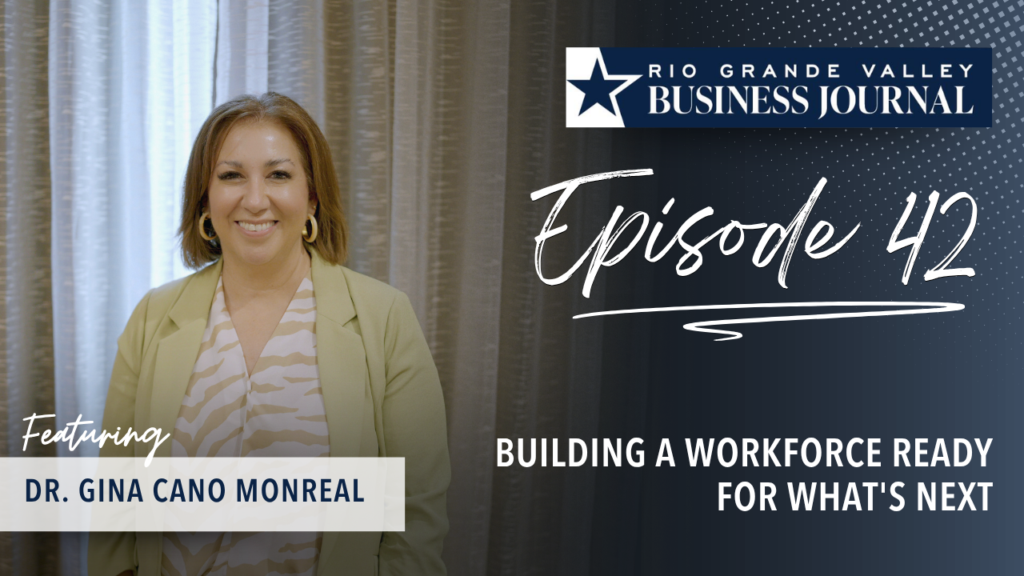
In this episode of the Rio Grande Valley Business Journal podcast, host Naxiely Lopez-Puente talks with Dr. Gina Cano-Monreal, provost of TSTC’s Harlingen campus, about how the college is preparing the region’s workforce for a wave of new employers. Cano-Monreal, who has spent 18 years with TSTC, describes how the college is phasing out its longtime mechatronics program in favor of a new advanced manufacturing track, built around growing demand for industrial maintenance and robotics skills.
She also discusses TSTC’s “triad partnerships” with local school districts and employers, an approach designed to introduce students to skilled-trade careers before they graduate high school. Among the partners shaping that pipeline are NextDecade and Bechtel, the companies behind the Rio Grande LNG project at the Port of Brownsville; Kiewit, which trains TSTC’s electrical lineworker graduates; SpaceX, a regular presence in TSTC’s welding and aviation maintenance programs; and Valeo, which is opening a new manufacturing plant in McAllen.
The conversation turns to a question on many workers’ minds: whether artificial intelligence threatens the jobs TSTC trains students for. Cano-Monreal argues the college’s hands-on, skilled-trade programs are largely insulated from automation, even as some roles evolve.
TSTC’s fall semester begins the Tuesday after Labor Day, and registration remains open at TSTC.edu.
Watch/Listen here, on YouTube, or from your favorite podcast provider.
The following is a rough, AI-generated transcript of Naxiely Lopez-Puente’s interview with Dr. Gina Cano-Monreal, provost of TSTC’s Harlingen campus. Minor errors and misspellings may appear. For the full conversation, listen to the episode above or through your preferred podcast platform.
Dr. Gina Cano-Monreal: We like to say, if you want to AI-proof your career, come visit us. I would say all of our programs are AI-proof in some way or another.
Naxiely Lopez-Puente: Reductions already on the jobs numbers.
Dr. Gina Cano-Monreal: And I think we’re going to have to adapt just like every other entity. But I think for the most part, these are AI-proof careers.
Naxiely Lopez-Puente: And thank you for joining us on this episode of the Rio Grande Valley Business Journal podcast. I’m Naxiely Lopez-Puente, and today we have a very special guest, Dr. Gina Cano-Monreal with TSTC. She is the provost, and we’re here to talk about workforce and human capital. Thank you so much for joining us today.
Dr. Gina Cano-Monreal: Thank you for having me. Excited to be here.
Naxiely Lopez-Puente: Great. And you just got off a panel a few minutes ago, right?
Dr. Gina Cano-Monreal: Yes, so the energy is still flowing. That’s good.
Naxiely Lopez-Puente: That’s good. And so during this panel, you guys spoke a lot about the goal of TSTC and alignment. First, talk to us about TSTC, because I think a lot of people don’t understand the very focused approach that TSTC has. So talk to us about that first.
Dr. Gina Cano-Monreal: I’m glad you asked, because I feel like TSTC is almost one of the Valley’s best-kept secrets. We really want to position ourselves so that we are a first choice for folks and for our industry partners that are coming in. TSTC was established in 1965 and it was originally part of the A&M system. It was then Texas State Technical Institute, and later became Texas State Technical College. So we in Harlingen are part of an 11-campus system throughout the state of Texas. Those campuses were really established when we’ve got legislators pushing for one within their area because they have industry needs that are saying we need a skilled workforce. So we’ve got 11 throughout the state of Texas. The campus in Harlingen is one of the oldest legacy campuses, along with Arlington, Waco and the campus in West Texas, and those are our largest, really, in size and enrollment. So we’re one of the largest within that system, and I’m just proud to be a part of that multi-campus system throughout the state.
Naxiely Lopez-Puente: Very interesting. And I heard you speak a while ago, and you said something that really drove the point home — that your mission is to get more Texans in higher-paying jobs. Did I say that correctly?
Dr. Gina Cano-Monreal: You did. TSTC was established exactly for that point. The Texas Education Code — if you look it up — established TSTC to provide a skilled pipeline of workers to meet the needs of the local workforce. So whatever the local workforce need is, TSTC was established to make sure we’re providing a pipeline of skilled workers for that. And our tagline is really to place more Texans in great-paying jobs.
Naxiely Lopez-Puente: Almost got it. You got it. All right. And if you don’t mind me asking, how long have you been with TSTC?
Dr. Gina Cano-Monreal: I’ve been with TSTC 18 years.
Naxiely Lopez-Puente: 18 years. My goodness. So you’ve seen a very different workforce need from where we were 18 years ago to where we are today. Talk to us about that.
Dr. Gina Cano-Monreal: A different workforce need, and along with that, I’ve seen TSTC have to adapt and change. Because if we want to stay true to that directive from the Texas Education Code, then we have to change. And sometimes it’s not popular — sometimes it’s not what our folks at the college want to hear. But if we’re offering a particular program that’s no longer what our region needs, then sometimes we have to take a step back and say, this is no longer a program where our students, once completing it, are going to be able to provide for their families and find a great-paying job. It’s no longer really serving what our local workforce needs are. So sometimes we have to change and adapt and say, the program mix we’re offering right now may not be the program mix we’re going to offer in the next few years. It’s had to adapt over the last couple of years from saying “this is what we’re offering” to saying, even though it’s going to be hard, maybe these are some programs we need to sunset because we’ve got to be ready for what’s coming next. So I’ve been around to see that change in programs throughout the state and in Harlingen, and really how we’ve had to change to adapt to what those needs are. And it’s happening right now, too. We’re really looking at: this is what we’re offering — is this what we need to be offering? What programs do we need to bring in so that we can be ready?
Naxiely Lopez-Puente: And so before we look ahead, can we look back? What are some of those programs that maybe you guys offered a few years ago that you thought, this isn’t really serving the need that we want to fulfill?
Dr. Gina Cano-Monreal: So we’ve had some programs — I’ll use our dental hygiene program. We also had a component of that, a dental assisting program, and we transitioned from having that as a standalone program and moved it into accelerated training. So sometimes it’s just moving it out of being a full program and saying, can we offer it in a faster, accelerated pace, maybe in a different model, but continue to offer the dental hygiene program, which gives our students a higher wage. So we’ve had to transition that. Last fall we started our diesel program. This fall we’re going to launch electrical construction, which we haven’t had at the Harlingen campus — we’ve had it at our Waco location, but we’re going to start offering it in Harlingen. Right now we’re in our final push for enrollment for this fall semester, and we continue to have students coming in asking for that program. The other one we’ve really had to change is what we called mechatronics. We’ve offered a mechatronics program for a number of years, but because we started to see a demand throughout the state of Texas for specializations within advanced manufacturing — especially within the Austin area for semiconductor, and within our area for industrial maintenance and robotics — by this fall we’ll transition out of mechatronics and into advanced manufacturing. Our students will start within industrial maintenance, and then they can either stay on that trajectory or decide to go the robotics pathway. So it’s really looking at what our local industries are asking for and trying to transition our curriculum, working with our industry partners and saying, is this what we’re offering our students and how we’re training them — is that satisfying what your needs are? Are they able to come out of TSTC and be what you need, or are you having to do a lot of additional training? And if that’s the case, then maybe we need to work with you on adjusting our curriculum. So that’s another program we’re going to see a change in this fall.
Naxiely Lopez-Puente: Okay. And let’s go back to mechatronics, because I’ve had to Google that word before, and for regular viewers out there who don’t understand — and for a lot of students at home, too — what is mechatronics, and what’s the difference between that and advanced manufacturing, without getting into the weeds?
Dr. Gina Cano-Monreal: They’re all really under that umbrella. But it’s really looking at — we’re seeing large-scale processing and automation like you’ve never seen before. So it’s really making a switch so that our students start to understand how they’re going to need to troubleshoot, because even though things are automated, you’re going to need somebody who understands how to set things up, troubleshoot, and be able to run large-scale, complex and efficient process operations. So it’s really transitioning from more of a one-focus, specialized area to now being able to look at more of the automated, big-scale, more efficient side, and really being the one that’s doing more of the programming and troubleshooting of these systems. That’s more of what we’re moving to.
Naxiely Lopez-Puente: Going back to alignment — by the time students get to you, should they already have a foundation in some of this? Are you working with — I know you’re on the school board here in Harlingen — how do we make sure there’s a pipeline, whether it starts even earlier, from middle school, but there’s definitely been a push for high school students to come out with either a degree or a certification. How does TSTC make sure they’re aligning with the younger generation?
Dr. Gina Cano-Monreal: Just this morning, we had our new student orientation for our incoming welding students, and I was walking around getting to speak with some of them — really excited and ready to start. I was impressed, because this was an early-morning orientation, and some of them had already started doing welding throughout the Valley at their CTE programs within their high school. So that was great to hear — they got introduced to it in high school, and this was something they realized they wanted to continue to pursue. There are a multitude of certifications and endorsements that students are now introduced to within secondary education. Some of them can go on to ignite a passion in a student, and they’ll go on to pursue that post-secondary. And sometimes it leads to an endorsement or certification that they don’t really do anything with after they graduate. So one of the big pushes we’re trying to make with TSTC, and with our local ISDs — Harlingen is one of them, but also San Benito and Los Fresnos — is this concept of triad partnerships. How can we bridge together the industry partners who are ready to hire these students after they have those skills and competencies, and the post-secondary partner, like TSTC, who can provide the additional training after they get that foundation in high school? It’s really introducing that concept and the opportunities that are out there to the students and their parents before they even start high school — this is what you can do, this is what’s offered in high school, this is what you could feed into after high school and into post-secondary, and this is the opportunity of a job — a high-paying job, a career, not just a job, that would be waiting for you after that. It’s really this intentional partnership of the industry partner, the ISD and the post-secondary partner, bringing those groups together and saying, look at the opportunity.
Naxiely Lopez-Puente: This is the path.
Dr. Gina Cano-Monreal: This is your path. We’re really trying to lean into that so that our students understand: this is my foundation, and you’re going to help me get from that foundation to a really great career. And I think sometimes we don’t know what we don’t know.
Naxiely Lopez-Puente: You said that, and I thought, oh my gosh. To speak about my own experience — when I was in high school, and I’m talking about like 26 years ago, they were already offering things like medical certifications. I remember I took the first semester to become a CNA and learned all the terminology, and when it got down to actually doing the work, it was like, you know what, this might not be the thing for me. And so I didn’t feel like I wasted any time in my post-secondary education learning that that wasn’t for me.
Dr. Gina Cano-Monreal: I think you mentioned mechatronics earlier — if you hear that, you’re going to think, I don’t know what that is, and what am I going to do with that. But when you come in and see “advanced manufacturing,” that could lead to — we’ve already heard about Valeo coming into the Valley, to the McAllen area — that could lead to a job here. If you have representatives from that industry partner saying, yes, if you start on this path in high school, then complete this Advanced Manufacturing Award, this is what you’re looking at when you come here, or to Toyota — these are partners we’ve had, some upcoming and some long-standing. If they can come in and say, here’s how we’re going to connect the dots for you, and here’s what this pathway would look like, and here are the entities that are going to help you get there — that’s really, I think, how we’re going to make sure our region can provide the large workforce that’s going to be needed. I really think that’s where we’re going to need to start.
Naxiely Lopez-Puente: My gosh. And we talked about all the jobs that are coming through that pipeline — thousands of jobs, especially in the industrial sector. So who are some of the companies you guys are working with, and what are some of the programs or certifications or training they’re saying they need — not necessarily right now, but as they’re building, they might need in a year or two, and they need to make sure the workforce is ready for that? What are you hearing?
Dr. Gina Cano-Monreal: We’ve had some really great partnerships. At this panel today, we had NextDecade, and Bechtel was mentioned. Bechtel has been a wonderful partner with TSTC, coming in and saying, look at our curriculum — this is what you’re producing, this is an additional component we really need in order for us to be successful in what we need to build for NextDecade.
Naxiely Lopez-Puente: What is that?
Dr. Gina Cano-Monreal: Working with them — we know you have these welders, we know you have a plumbing program, but can we combine some competencies, some skills, can we add this additional piece? It’s really sitting down and working with them and saying, yes, can we do that — can we build it into our existing program, or can we build it as part of accelerated training and add in a couple of quick, fast-paced, short-term training options for them to come in and gain that expertise to be able to go out and provide that workforce. Bechtel has been great to sit down with us and really do that planning. I mentioned Valeo — that’s another one. It’s not just with us, but really other entities throughout the Valley — higher education partners they’re working with — and really sitting down and saying, in the next two to five years, this is what we’re going to be needing. So we’re willing to share what those job descriptions look like. We want to see what you’re doing to train, and maybe identify gaps and make sure we provide you information so you can get that workforce ready when we come in, because we’re going to need that large workforce. Kiewit’s been another great partner. A lot of the companies out at the port have been wonderful to work with, coming in and saying, we’re willing to sit down and tell you what we need. SpaceX has been another one that continuously comes in every semester to meet with our aviation maintenance program, to meet with our welding program, and provide feedback — this is what we’re getting from you, they’re doing great, we just need more of those, or, hey, this is something we were not seeing. Just tomorrow — like tomorrow — our Electrical Lineworker program does a family day, and families come out and get to see our electrical lineworker students, get to see their family members climb the poles and show their skills. We bring our industry partners — Magic Valley Electric Cooperative will be out there — so they’re getting to network, meet with our students, see what they’re doing out there, and it’s live feedback for students. It’s live feedback for our program leadership, to be able to tell them, yes, you’re doing what we’re expecting to see, or, hey, these are some areas we want to work with you on. Sometimes they’re even really great — I mentioned Bechtel earlier, saying we’re going to provide you the machinery so that we can make sure your students are trained and ready to come out.
Naxiely Lopez-Puente: — the machines they’re going to be working on. CNC machines, I believe?
Dr. Gina Cano-Monreal: We do, yes. Precision machining as well.
Naxiely Lopez-Puente: Okay.
Dr. Gina Cano-Monreal: Yeah, so that’s been great.
Naxiely Lopez-Puente: And to bring it back full circle — you talked about the lineworkers, the new electrical construction program. We just heard about all the demand we’re seeing when it comes to power generation and distribution. It’s incredible that we’re going to be seeing so many of those jobs. Can AI fulfill those jobs?
Dr. Gina Cano-Monreal: We like to say, if you want to AI-proof your career, come visit us, because I would say all of our programs are AI-proof in some way or another. There might be some changing — I mentioned automation earlier — I think it’s just going to be, for some of our programs, a different way of approaching what they’re doing out in the field. But there really aren’t any of our programs or careers that we’re targeting that AI could take over. So it’s just a different way of thinking about things. But I think when you’re thinking about AI, there are some folks who are worried about what’s going to happen to their job with AI coming.
Naxiely Lopez-Puente: My gosh. And we’ve seen those reductions already on the jobs numbers nationwide.
Dr. Gina Cano-Monreal: And I think we’re going to have to adapt just like every other entity. But I think for the most part, these are AI-proof careers.
Naxiely Lopez-Puente: All right. So if somebody at home wants more information — they’re interested in learning more — where should they start? Where should they go?
Dr. Gina Cano-Monreal: If you’re in the area, we love having visitors — just head over to the TSTC Harlingen campus. We’re located right off the loop, near 99. We’re doing a ton of registration events since we start our new semester in about four weeks, so we have lots of recruitment events upcoming. But if you’re just interested, you can go to TSTC.edu and find out all kinds of information. We’ve got a graduation coming up, we’ve got community events going on typically on our campus, and lots of registration events. We’d love to have you — look on our web page or just come by. There’s a big sign in the front that says Welcome Center, so we’re happy to welcome you all in.
Naxiely Lopez-Puente: Wonderful. And what is the deadline for registration?
Dr. Gina Cano-Monreal: Right now, since our fall semester starts the Tuesday after Labor Day, we will register you right up until that date.
Naxiely Lopez-Puente: Okay. All right, well, you heard it, folks — there’s still time to sign up. Anything else you’d like to add?
Dr. Gina Cano-Monreal: Thank you for having me.
Naxiely Lopez-Puente: No, thank you for joining us.
Dr. Gina Cano-Monreal: It’s easy to talk about something I’m excited about, so — not a problem.
Naxiely Lopez-Puente: Well, thank you so much, doctor. We really appreciate it. And for those of you at home, if you want to learn more, go to their website, go to their campus, and keep subscribing. We’ll see you next week.