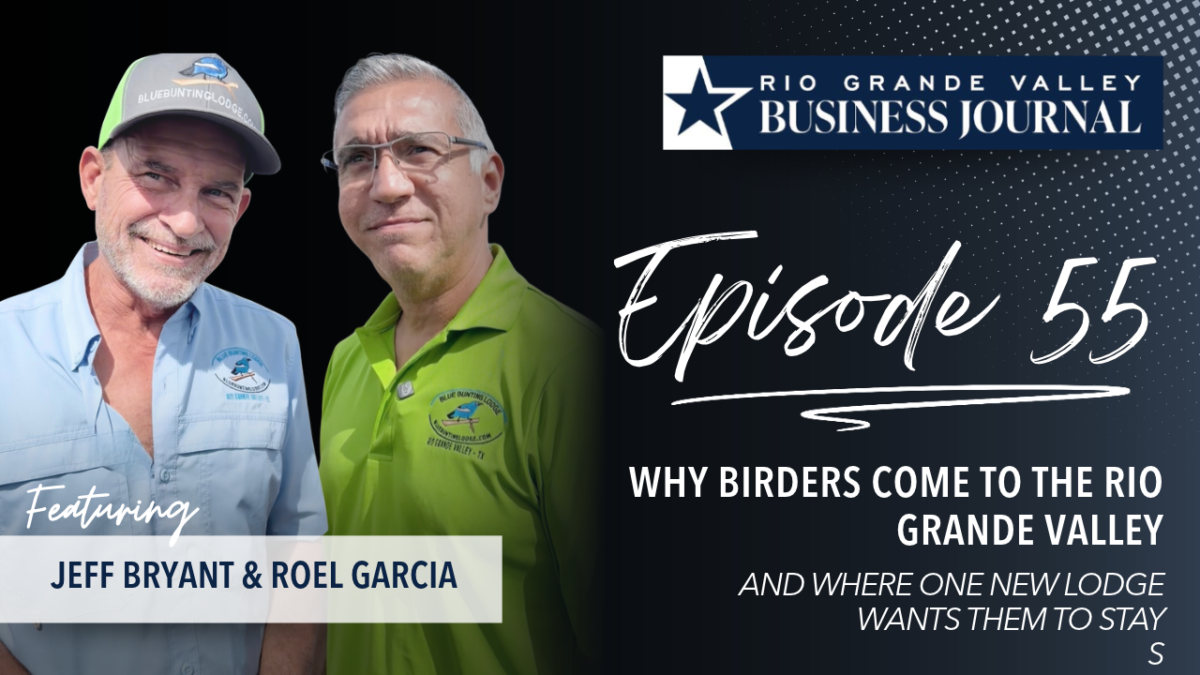
On a 10-acre property in Mercedes, two Rio Grande Valley entrepreneurs are betting that visitors will come for the birds and stay for the quiet.
Jeff Bryant and Roel Garcia, co-founders of the Blue Bunting Lodge, have built a collection of Spanish colonial-style casitas finished with handmade Saltillo tile, original artwork and private trails that run from each back door into native Tamaulipan thorn scrub. The idea is that guests can bird or watch butterflies from their own front porch instead of driving from a hotel to a park.
On the latest episode of the Rio Grande Valley Business Journal’s podcast, reporter Kristen Mosbrucker-Garza tours the property with the co-founders. Bryant, a lifelong birder who has guided tours at the Rio Grande Valley Birding Festival, explains why Cameron, Hidalgo and Starr counties are the only places in the country where certain birds, butterflies and dragonflies cross north of the border, and why that brings ecotourists to the region.
He also draws a line between ecotourists and winter Texans, who he said come mainly to escape the cold.
Garcia, who handles the business side, said the region still lacks the education and infrastructure needed to grow nature tourism, and that many Valley natives don’t realize what’s in their own backyard.
The pair also discuss diversifying their guest base, from Mexican shoppers visiting nearby outlet malls to photography workshops and weddings under the property’s palapa. Bryant shares a few memorable rare-bird sightings, including the South American cattle tyrant that drew crowds to a Corpus Christi parking lot.
The lodge is named for the blue bunting, a rare visitor from south of the border that birders travel far to see and that Bryant is still waiting to spot on the property.
Listen to the full episode below.
The following is a rough, AI-generated transcript of Kristen Mosbrucker-Garza’s interview with Jeff Bryant and Roel Garcia, co-founders of the Blue Bunting Lodge. Minor errors and misspellings may appear. For the full conversation, listen to the episode above or through your preferred podcast platform.
Kristen Mosbrucker-Garza: On this episode of the Rio Grande Valley Business Journal podcast, I go out into the field in South Texas, in the city of Mercedes. There you’ll meet Jeff Bryant and Roel Garcia, co-founders of the Blue Bunting Lodge. It’s an ecotourism venture, and the pair are hoping their 10-acre property will attract not just visitors, but the flora and fauna those visitors hope to see.
Jeff Bryant: Right here, we commissioned a series of paintings from an artist. These are all originals.
Kristen Mosbrucker-Garza: Interesting. Oh, wow. And it’s sort of a Spanish style?
Jeff Bryant: Spanish colonial. This is real Saltillo tile under your feet, and it’s not factory produced, because every so often you get these puppy prints, dog prints, in it. Somebody’s dog ran across the tiles while they were drying and left prints. There are some on the front porch. We’ll see them on the way out.
Kristen Mosbrucker-Garza: Interesting.
Jeff Bryant: And for the backsplash, there’s a different tile in every casita. Each one has its own personality. Those are handmade tiles, too.
Kristen Mosbrucker-Garza: Wow. And how many square feet are the casitas?
Roel Garcia: This one’s the largest. It’s about 480, maybe 520 with the front porch.
Jeff Bryant: It’s a little larger to be ADA accessible and give more turn radius for wheelchairs. And you can see we have a roll-up sink rather than a cabinet underneath.
Roel Garcia: Same thing in the bathroom here.
Kristen Mosbrucker-Garza: Interesting.
Roel Garcia: The others are about 435 square feet.
Kristen Mosbrucker-Garza: Very interesting. I think it’s really unique, because if someone is staying in an RV or a hotel, it’s a very different experience, where you still have to get in your car and go to a specific site. But I imagine the concept here is that you can wake up and have your coffee, and everything comes to you.
Roel Garcia: Yes, that’s exactly what we were envisioning. You can sit out and bird from your front porch and butterfly from your front porch.
Jeff Bryant: And if you’re staying in a hotel, you’ve got someone on the other side of the wall, you’ve got the elevator dinging, people walking down the hallway, and you’re on the highway, so you go outside and you hear cars go by. Here at night, you walk out and you hear the owls calling and the coyotes howling.
Roel Garcia: You’re in nature.
Jeff Bryant: Exactly. It’s peaceful here. Yes, we have an owl. He has a roost in the upper rafter there.
Kristen Mosbrucker-Garza: Really?
Jeff Bryant: Not right now. But he comes at night after he eats, and I know this not because I’ve seen him, but because he coughs up pellets. They can’t digest everything. He coughs up pellets of fur and bones and teeth from his prey and leaves them as gifts for us on the table there.
Kristen Mosbrucker-Garza: Oh, interesting. I rented a house once, and everybody made fun of me, but at night there were so many owls, the white owls. I’d have to bring my dog in, because they hunt them, too.
Roel Garcia: Yeah.
Jeff Bryant: Great horned owls will take a small dog as well, and we have them, too. We have three species of owl.
Roel Garcia: There are the puppy prints.
Jeff Bryant: Right there. Oh, yeah. Ain’t that cute?
Kristen Mosbrucker-Garza: Oh, my gosh. That’s so interesting.
Roel Garcia: There’s one right here, there’s one right there, and then there’s one here.
Kristen Mosbrucker-Garza: And so what type of plant is this one?
Jeff Bryant: This is a Barbados cherry. It’s kind of a native version of a crepe myrtle. Have you ever looked closely at a crepe myrtle flower? It looks exactly like that.
Kristen Mosbrucker-Garza: Oh, interesting.
Jeff Bryant: And the fruit is edible.
Kristen Mosbrucker-Garza: To humans? Oh. And what types of flora and fauna are attracted to this plant?
Jeff Bryant: Mostly birds that dig through the berries and throw them away, because all they want is the seeds inside. But you can eat them. They’re not terribly tasty. What is tasty is that. That’s a granjeno, also known as a spiny hackberry. It’s got little orange fruits that taste just like cantaloupe, and they’re delicious. Sweet. And that’s Turk’s cap. The hummingbirds love this plant.
Roel Garcia: There’s a little bench back there, so people can come out of their bedroom and just sit outside as well.
Jeff Bryant: There is a network of trails running through the entire property. Each casita has a little trail from the back door that leads to the main trail system, and they go all the way to and through the trees in the back.
Kristen Mosbrucker-Garza: So what got y’all interested in birding?
Roel Garcia: He’s been a birder almost —
Jeff Bryant: I’ve been a birder since I was 8, 8-ish, because my dad was very into nature, and he instilled that in his kids. We always had field guides in the house. I remember one night he saw a great horned owl in the backyard in the middle of the night, and he woke everybody in the house up and said, “Come look at this.” So we all peered out the back window to see it. I was probably 5 at the time.
Roel is more the businessman here. He’s helping take care of the desk-job aspect of this.
Kristen Mosbrucker-Garza: I imagine the partnership is important, though, to be in that community. You’ve probably seen things that work really well and things that maybe don’t work so well. What do you think is a misconception about people who are into ecotourism?
Jeff Bryant: Are there any misconceptions? I don’t know. I surround myself with ecotourists, so it’s hard for me to know.
Kristen Mosbrucker-Garza: I get the sense that some people think ecotourism is not as popular in the Valley as it used to be, because they don’t see as many winter Texans, for example.
Jeff Bryant: Winter Texans aren’t ecotourists. They are escaping the cold in the North. Some of them are birders as well. The ecotourists are coming here specifically to see the birds, and now the butterflies. Butterflies are big business now.
Roel Garcia: And dragonflies.
Jeff Bryant: And dragonflies. They’re the next thing. South Texas is the only place where a habitat known as Tamaulipan thorn scrub comes north of the border. The Tamaulipan thorn scrub habitat, which is what you see in the trees back there, is necessary for I don’t know how many bird species. That’s the reason certain birds, certain butterflies and certain dragonflies only come across the border right here in Cameron, Hidalgo and Starr counties, nowhere else in the country. People are coming to see those. These are the people I see every day.
Some of our clients here, like the last two we had, were shoppers. They were Mexican nationals who came up to go shopping, and that’s why they stayed here, because we’re right by the outlet malls. But who we’re really reaching out to is the birders and photographers. I’m in negotiations with a photographer who does workshops far afield. She’s based in Corpus Christi, but she likes to take people out to far-flung areas to get pictures, and this spot is just a perfect match for her.
And we’re looking at our palapa here. I planted that beautiful Mexican olive at the other end. This is going to be a wedding spot. This is going to be a perfect spot to get married, and we even have the honeymoon cabin right there. But ecotourism is the main focus.
Roel Garcia: I think the big thing that’s been lacking for a long time is the education and infrastructure for this type of tourism, because before I met him, I didn’t know the Valley was this big for birds and butterflies.
Jeff Bryant: And that’s true of a lot of Valley natives. They still have no clue.
Roel Garcia: Growing up, the only exposure I had to it was in my biology class. We went to Santa Ana, and that was it. You go and do your thing, and most kids especially were like, “OK, did my thing.” But now that we’ve got Estero Llano Grande and the National Butterfly Center, and all these other parks are doing education and programs for kids especially, to start experiencing the nature here in the Valley and appreciating it, I think that’s going to help a lot.
And we need more infrastructure for this type of business. We need people to start doing what we’re doing, so that there’s more opportunity for people to come down and experience the nature, the beauty of where we are, this habitat, the birding, the butterflies, and just be out here enjoying the peace and quiet.
Kristen Mosbrucker-Garza: Are we in ocelot habitat, too, technically?
Roel Garcia: I don’t know.
Jeff Bryant: There are no ocelots here. There are actually only two spots left in Texas where you can find ocelots, and they’re heavily guarded and protected. Laguna Atascosa is one of them, and the other one is a private tract. You can’t get access to the habitat itself. I would say no, we’re not quite proper ocelot habitat. We’re good bobcat habitat, and I’m still waiting for my first one. We’ve got a lot of rabbits, and we’ve got squirrels, and that’s what it takes to bring bobcats.
Roel Garcia: A lot of rabbits.
Jeff Bryant: Yes, we do.
Roel Garcia: As you can see, there are some pellets on the pavement right here.
Kristen Mosbrucker-Garza: I saw a bobcat one time at the Laguna Atascosa National Wildlife Refuge. Initially I thought it was an ocelot, but then I was like, no, its tail is too short. It was at dusk. When I first lived down here, I was a kayaker, so I would go into the Rio Grande, me and Border Patrol at the time. It was very insightful, because I would even go off the tip of South Padre Island and across the shipping channel to Boca Chica and see all the really interesting, very unique, very special sea creatures, everything from Portuguese man-of-war to some of the sea slugs.
And it’s interesting, because I took one of my nephews. He lives in Weslaco, so he lives near Estero Llano Grande. And I was like, “Hey, I know it’s summer, I know it’s really hot, but let’s do the night hikes. You’ve never been.” You can see scorpions, because they light up at night with a UV light. He really enjoyed it, but it’s not something that would have been on his radar. I just thought that was really wild, considering he lived across the street.
Roel Garcia: Yeah. Like I said, the education and programs to get younger people involved are starting, and we need more of that.
Jeff Bryant: Kids are naturally curious. It’s just about encouraging that. Harry Potter did a huge favor to naturalists and birders everywhere by introducing kids to owls and making them wonderful and interesting, because owls figure heavily in the Harry Potter books. So now whenever I’m on a bird tour, like at the Rio Grande Valley Birding Festival, where I was a guide, and you have kids out and you can find a day-roosting owl, that’s the biggest hit of the day. That makes their day, makes their week and really gets them engaged. So thanks for something, Harry Potter.
Kristen Mosbrucker-Garza: So what is a blue bunting? I’ve never heard of that bird.
Roel Garcia: The bunting is a drawing that my 10-year-old nephew did four years ago. We wanted to get some kind of a brand and a logo, so we got him to draw that, and we decided we’re going to use that as our logo. But a blue bunting —
Jeff Bryant: A blue bunting is one of several dozen birds that very, very rarely come up from south of the border to the Valley. When they do, birders flock here from across the country and across Canada to try to see it. We have not had a blue bunting yet. We have had three of its very close cousins, but not a blue bunting. We will eventually. I just liked the alliteration, the blue bunting. And then when my nephew drew that picture, there was no going back.
Kristen Mosbrucker-Garza: Do y’all remember when there was a rare bird in a Corpus Christi parking lot? It happened last year.
Jeff Bryant: It was a flycatcher from South America, and they’re still debating whether it came in on a ship or by itself. I went to see it.
Kristen Mosbrucker-Garza: Yeah.
Jeff Bryant: Many, many people went to see it.
Kristen Mosbrucker-Garza: And it was in a parking lot, right?
Jeff Bryant: It’s a cattle tyrant. Its normal habitat is cattle pastures, following cattle around and grabbing the bugs that they kick up.
Kristen Mosbrucker-Garza: Interesting.
Jeff Bryant: When I first saw it, it was on the edge of a dumpster. I didn’t really want to get a photo of it there, but that’s where it was: parking lot, dumpster, rooftop.
Kristen Mosbrucker-Garza: And it was there for a while, too?
Jeff Bryant: A very long time. Even after everybody who wanted to see it finally got out there, and people kind of lost interest a little bit, it was still being reported every so often. It was there for the better part of a year.
Kristen Mosbrucker-Garza: Really interesting. I was taking my spouse to work the other day, and I was trying to explain this community to my mother, who’s in her mid-70s and, of course, from Iowa. I was trying to explain the concept: Yes, you can go to remote places and seek out birds and things like that. But also, I was driving through McAllen and saw 200 green parrots on a little side road on the way to work. So you really don’t —
Roel Garcia: There’s a kite right over there, just above the tree line. That’s the kite that’s pretty much a resident in this area.
Jeff Bryant: White-tailed kite. He nests here. They’re named kites because they hover while they’re looking for a mouse below, and it looks just like a kite on a string in the wind, kind of fluttering like this and standing still. They nested in the trees back there the last two years.
Kristen Mosbrucker-Garza: Oh, interesting. But yeah, I was trying to explain to her that on your way to work, you can see entire, I don’t know if they’re called nests or just groups, of green parrots. They’re very loud, and they’re not native to this area. They’re migrating?
Jeff Bryant: They are established in this area. They were probably cage escapes at one point, but they’ve been here so long that they are considered established. They are just one of the birds people come to the Rio Grande Valley for, because you can’t get them anywhere else in the U.S. They’re one of, I don’t know, 20-odd birds you can’t find anywhere else in the U.S. but right here. Another one is the ringed kingfisher.
Kristen Mosbrucker-Garza: And I was surprised, because it was really close to a high-voltage power line. I’ve heard that they like that sensation or something.
Jeff Bryant: I’ve never asked a parakeet about that, so I’m not sure. But I know their roosts are usually in parking lots of strip malls and weird places where you wouldn’t really think, “Oh, I’m going to go birding here.”
Kristen Mosbrucker-Garza: Cool. All right, show me more of your property. Is this a citrus field?
Roel Garcia: Yes.
Kristen Mosbrucker-Garza: OK. Is that still an active orchard?
Roel Garcia: Yes.
Jeff Bryant: Sometimes. We’ve got grapefruits and oranges over here.
Kristen Mosbrucker-Garza: Oh, wow. You probably get a lot of stars out here.
Jeff Bryant: Not as much as you would think. There is still light pollution from the —
Roel Garcia: From Harlingen and around here. We’ve already got a bird list and a butterfly list going.
Kristen Mosbrucker-Garza: Something that really stuck out to me during my conversation with Jeff and Roel is that tourism in the Rio Grande Valley has certainly flourished, despite a lack of infrastructure or significant funding to spur that industry. They really push to preserve more of our natural spaces across the Valley, because we have some really unique ecosystems and environments that will attract people from around the world.
The last time it was studied, though, was more than a decade ago. I think it’s really interesting what they’re doing, and we’ll see how the venture goes. Stay tuned to the Rio Grande Valley Business Journal podcast, and be sure to subscribe.