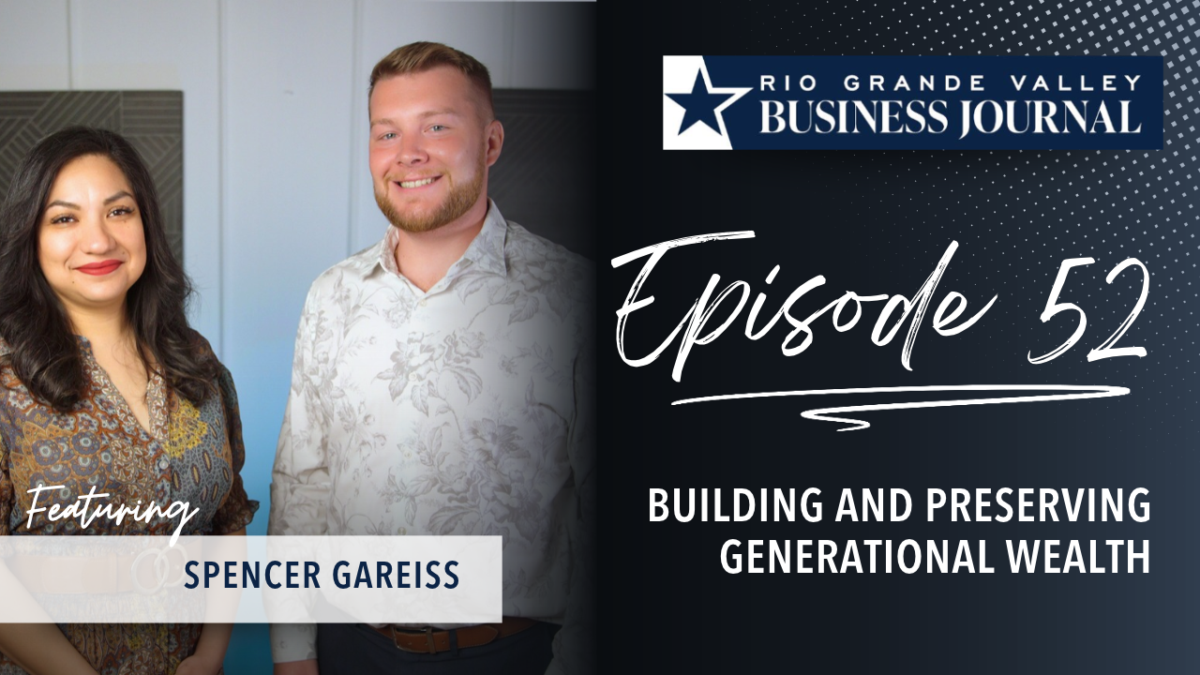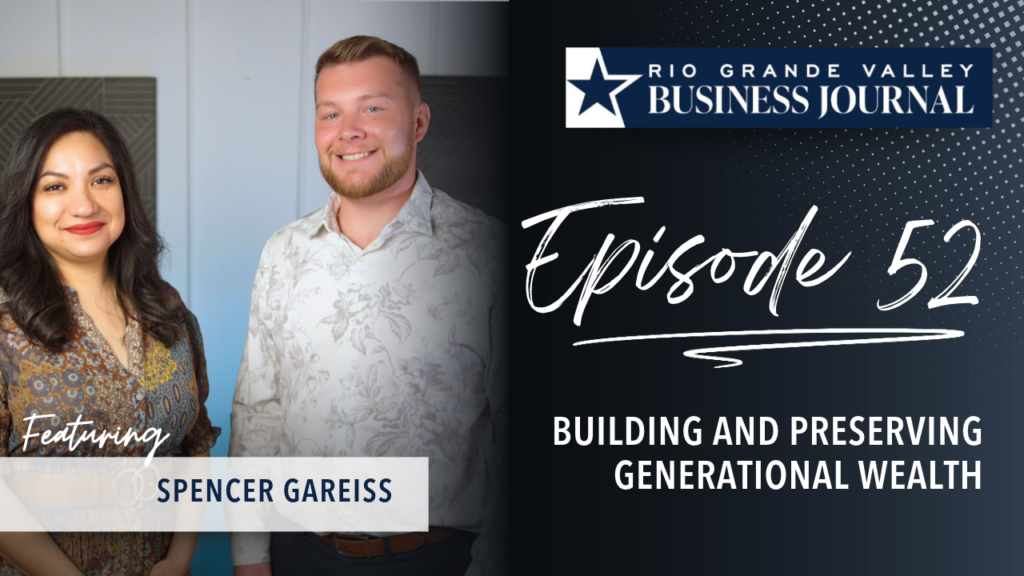
Spencer Gareiss spent four years building new business lines at Robinhood, the trading platform with nearly 30 million users. Now he is applying that experience to a problem close to home for thousands of Rio Grande Valley families: business succession, or what happens when the founder is ready to step away.
On this episode of the Rio Grande Valley Business Journal podcast, host Naxiely Lopez-Puente talks with Gareiss, who moved to the Valley in January and runs Delta Brokers, the brokerage arm of McAllen-based Greenridge Group. The firm helps owners buy and sell businesses, typically in the $1 million to $10 million range.
Gareiss estimates about 5,000 Valley businesses are older than 20 years, and only about 22% of them have a family succession plan in place. Without one, he says, many owners list with a commercial real estate agent, sell the property at a deep discount and close the business, costing the family money and leaving employees to find new jobs.
He also walks through who is buying Valley businesses today: local family-owned companies looking to expand, private equity firms from the Texas Triangle and investors from Monterrey, Mexico, seeking U.S. visas through programs such as EB-5. Gareiss says he tries to keep deals in the Valley, or at least in Texas, whenever he can.
The conversation also covers the supply-chain opportunities emerging around SpaceX and Saronic in Cameron County, why trust and relationships matter more in the Valley than in big-city markets, and his upcoming classes on how to buy and sell a business during McAllen’s Global Entrepreneurship Week, Nov. 16-20.
Gareiss, who received Robinhood’s Founders Award as a product and engineering leader, is also the author of “Mental Models,” a collection of 50 frameworks for business owners and entrepreneurs.
Watch the full episode below, or listen wherever you get your podcasts.
The following is a rough, AI-generated transcript of Naxiely Lopez’s interview with Spencer Gareiss, co-founder of Delta Brokers, the brokerage arm of McAllen-based Greenridge Group. Minor errors and misspellings may appear. For the full conversation, listen to the episode above or through your preferred podcast platform.
Naxiely Lopez-Puente: Thank you for joining us on this episode of the Rio Grande Valley Business Journal podcast. I’m Naxiely Lopez-Puente. Today we have Spencer Gareiss, who is coming from Silicon Valley to the Rio Grande Valley, and he is in the business of buying and selling businesses. Spencer, welcome. Thank you for being with us today. Tell us a little bit about yourself. What brought you to the Valley?
Spencer Gareiss: Thanks so much for having me. I’ve been coming to the Valley for over five years now. All my in-laws are from La Grulla, over in Starr County. As you mentioned, I’m coming from Silicon Valley. I was a product engineering leader for a tech company called Robinhood, and I moved here in January. I’ve been helping business owners buy and sell businesses. I love the 956, and I’m honored to be here.
Naxiely Lopez-Puente: Awesome. Let’s talk about your background, because you went through that super fast. You used to work at Robinhood, which, my understanding is, is one of the biggest platforms for trading stock in the U.S. I read something like 29 million users or customers and around $400 billion in assets. Correct me if I’m wrong, but it’s like having Wall Street on your cellphone.
Spencer Gareiss: That’s right. Robinhood has all types of asset classes. I was focused on brokerage, which was stocks and ETFs, and then built the derivatives business, which was futures and prediction markets. There’s crypto, though I wasn’t on the crypto-specific team. There are banking products. And you’re right, they are coming up on 30 million active users. The business was founded in 2013. I joined in 2021, right after their IPO. They were trading at $7 a share. When I left, they were at about $120 a share.
Naxiely Lopez-Puente: Oh my goodness.
Spencer Gareiss: It’s an over-$100 billion business now. The growth and the team have been amazing over there. So I’m honored to have gotten my fintech Ph.D. at Robinhood University.
Naxiely Lopez-Puente: You were talking to me earlier about your role with the company. It’s a huge company. I think you mentioned over 2,500 employees, but your job was very specific and appreciated by the founder of the company. Talk to us about that award.
Spencer Gareiss: The Founders Award is the one you’re talking about. Vlad, the founder and CEO of Robinhood, gives that award each year to about 150 people on his “apocalypse crew,” the people he would restart the business with today if he had to. I was a product and engineering leader. I helped build futures and prediction markets from zero to one, as we say, meaning you start with literally nothing. You form the entity, get the license, build out all of the tech, go to market, get the users and create a profitable business. I did that with Robinhood Derivatives, built equity shorting and then Robinhood Ventures, which was their corporate venture capital arm. And then I left in December 2025.
Naxiely Lopez-Puente: Just December.
Spencer Gareiss: Yes, December 2025.
Naxiely Lopez-Puente: Wow. So what brought you here? I know we were talking about your wife being from La Grulla, in Starr County. Is that the only thing that brought you here?
Spencer Gareiss: I love the Valley beyond just my amazing family being here. The weather’s lovely. The people are amazing. It’s a robust business environment. Texas taxes are great. It’s a rapidly growing environment here. Edinburg is actually one of the fastest-growing municipalities in Texas, if not the fastest. The region’s exploding. The population is expected to grow, I think, by 40% over the next 10 to 20 years. So there are so many reasons, both personal and commercial, to come to the Valley.
Naxiely Lopez-Puente: And now you’ve started your company.
Spencer Gareiss: Exactly.
Naxiely Lopez-Puente: Tell us what your company does.
Spencer Gareiss: Greenridge Group is the parent company. We’ve got an office in McAllen. Delta Brokers is the brokerage arm that’s helping business owners buy and sell businesses. There are about 5,000 businesses here in the Valley that are older than 20 years. It’s an extremely popular place for entrepreneurship because there haven’t been big corporations here in the past, so you’ve got these families that have built these businesses. About 22% of them have family succession plans in place, meaning kids or grandkids are taking over the business. For the other 78%, they don’t really know what they’re going to do. I’m really passionate about jobs staying in the Valley and the legacy of these businesses continuing on.
So I come in for succession planning and help these business owners exit. I usually run auctions, meaning I try to get top dollar on exit. If a business owner wants $4 million for the business, how can I get them five? On the other side, I have some business owners that have a succession plan. They’ve got two or three locations, but they want to get to five by the time they leave it to their kids. They need help acquiring a couple of businesses, so I usually help quarterback those deals. That’s what I’ve been focused on since moving to the Valley.
Naxiely Lopez-Puente: What have you found about this business environment that is different? We talked about how you’re from Indiana, if I’m not mistaken, and you’ve lived in Arizona, Dallas and San Francisco. You’ve seen a lot of different business environments, I presume. What do you see here in the Valley?
Spencer Gareiss: All of the economies are different, like you mentioned. San Francisco is an amazing place if you want to be a tech founder. Chicago’s great for finance and the food and beverage industry. New York City is finance. Miami is crypto, or decentralized finance. Every city has its own angle. Here in South Texas, it’s even different from county to county. In Cameron County, it’s defense tech, agriculture and space. Space in Cameron County, by the way, is a big $3-plus billion deal. That’s different from Hidalgo County. And even within Hidalgo County, in Pharr it’s produce trade, and in McAllen it’s health and retail. One in three workers in Hidalgo County work in health or education. So it varies depending on where you are in the Valley.
But there’s tons of entrepreneurship and small business, which I love, and a lot of people who are passionate about their businesses. I also notice that customers of businesses in the community are very passionate about the local and regional economy, which is great. It’s a vibrant small-business area. Those are some of the things I’ve noticed.
Naxiely Lopez-Puente: What are some of the most interesting things you’ve seen as far as business development here in the Valley in the last year, and what are you looking forward to?
Spencer Gareiss: Like I mentioned, that defense tech deal, Port Alpha, was huge. I think advanced manufacturing opportunities are big in the Valley. If SpaceX is shipping rockets with increasing velocity, they need to source the inputs for the rockets, and they prefer local and regional vendors. Same with Saronic. They’re producing naval vessels, and they need advanced manufacturing for that. So I’m very excited to see how that impacts Cameron County.
Naxiely Lopez-Puente: Do you think that supply chain is already here in Cameron County, or is it something that’s going to come from the outside?
Spencer Gareiss: I’ve done research on this, and I’ve sent the research to the Greater Brownsville Incentives Corp. There are a lot of things that are already covered, and there are other things that aren’t.
Naxiely Lopez-Puente: Because all of these are emerging industries. We haven’t always been an aerospace, sending-rockets-into-space type of region. As we see those industries emerge, what are you seeing as far as the businesses? Are they here already? Are they coming?
Spencer Gareiss: Definitely. SpaceX, Saronic and these tech-forward companies generally want to have vertical integration. So what I see happening is consolidation toward that, now and over the next 20 years. What does that look like? If you have a manufacturing facility in Hidalgo, Cameron, Willacy or Starr County, they may be looking to acquire your business. If you have a $10 million manufacturing facility, they may purchase that 30-year-old business, because SpaceX, Saronic and some of these other players don’t want to start a manufacturing facility from scratch, not for all of their components. So it’s a really exciting exit opportunity for some of these family-owned businesses. There’s a buyer who will pay above market, so it’s a beautiful time to take advantage of that opportunity.
I don’t have it off the top of my head, but there were about 29 business concepts that will be required that aren’t here today to support Saronic and SpaceX. If you’re aware of those and you’re looking to start a business or expand, those are interesting areas for sure.
Naxiely Lopez-Puente: Give us some.
Spencer Gareiss: Like I mentioned, Saronic is a Navy vessel manufacturer. For every ship, you need two steel hulls, which is complex manufacturing. That’s an example where maybe a steel hull manufacturer didn’t have an opportunity in the Valley before. They do now, because a massive ship manufacturer is in town, and they need to get those from somewhere. That’s just one example. I think robotic manufacturing will be big as well.
Naxiely Lopez-Puente: Going back to the business environment here in the Valley, we were talking earlier about how generational wealth is not something you see very much when it comes to entrepreneurship here. A lot of the businesses here are first or second generation. I think that’s what you saw as well. Talk to us about that.
Spencer Gareiss: The land families are the ones I see that are multigenerational, with undeveloped land or cattle ranching, for example. Also, quote-unquote boring businesses, whether it’s a tire business, a landscaping business or a produce business. That’s where you’ll see more of the second-, third- and fourth-generation families. If it’s a restaurant or a cafe, you’ll typically see a first- or second-generation family.
A lot of it comes from the kids. Nowadays, they either don’t want to inherit dad’s business or they’ve chosen some other industry, and they want to create their own sort of success. That’s where the original founders of the business often want to exit, from my experience.
You see a lot of first-generation entrepreneurs. I think the average age here in the Valley is between 33 and 35, so it’s a younger census relative to some other places.
Naxiely Lopez-Puente: Oh, you mean the population in general, not the entrepreneurs.
Spencer Gareiss: Yes, the population in general, and some percentage of that population is entrepreneurs. If the average age is 33, you’ll see a lot more first-generation businesses. You can go to affluent areas in Florida where the average age is 65, and the dynamic changes from a marketplace standpoint. So I think the average age here plays into the number of first-time entrepreneurs.
Naxiely Lopez-Puente: We have a very young population.
Spencer Gareiss: Which is an exciting opportunity.
Naxiely Lopez-Puente: So these businesses, when they don’t have a succession plan, what happens to them?
Spencer Gareiss: If you don’t have a succession plan, usually what I see is they list with a commercial real estate agent, and they’ll sell their property for what I consider pennies on the dollar, a deep discount. You want to sell the land, the building and the furniture, fixtures and equipment, plus the cash-flowing business, which is where I come in. If they could have sold both for $5 million, they’ll sell one for $3 million. They’re leaving $2 million on the table.
Naxiely Lopez-Puente: Wow.
Spencer Gareiss: Then there’s job loss, because now there’s legacy loss. The 30-year-old business doesn’t continue. The 30-person team now has to go find new roles. And the inventory gets liquidated at cost. It’s not really a great situation for the family.
If you do have a good succession plan in place, either the family takes it on, so it’s a multigenerational business, or you exit and sell the business and/or the commercial real estate. I’ve seen and been part of some transactions recently called sale-leasebacks. Basically, they sell the cash-flowing business, keep the commercial real estate asset and lease it right back. So they can still make $10,000 a month leasing their property, and now they’ve sold their $2 million business. They had a liquidation event, so they can buy their house on South Padre Island. I’m seeing things like that. That’s where, again, good succession planning allows you to have those great outcomes. If you don’t have it, there’s a chance of legacy loss and job loss.
Naxiely Lopez-Puente: How are you finding your clients? I feel like there might not be a lot of business owners out there who feel comfortable with, or have even thought about, who wants to buy their business. How are you finding customers?
Spencer Gareiss: Good question. For my top of funnel, how I’m sourcing people, I’ve got a few different mediums. One is just my SEO and AI. I’ve got a great website, and our Google relevance is high.
Naxiely Lopez-Puente: So you’ve got the tech down.
Spencer Gareiss: Exactly. I have people who call and email me just because they found me on Google. The most common thing they look up is a business valuation. I do free valuations, which helps a lot. Usually people charge $2,500. Since I offer that for free, a lot of people reach out for that, and then maybe one in three say, “Oh, I like that number. Let’s move forward and sell.”
The other one is I teach classes on how to acquire and how to sell a business. McAllen is doing a Global Entrepreneurship Week Nov. 16-20. I have a class on how to acquire a business. I’m partnering with Lone Star National Bank, because they’re going to talk about the financing piece of it. And then I’ve got a class on how to sell a business. With those classes, people engage and ask for support. I did one in McAllen recently that created opportunities. And then I also do mailers. I send paper mail. It’s good old-fashioned shaking hands and kissing babies. I offer them a free valuation. That’s really the hook: “Hey, I’ll give you a free valuation.”
Naxiely Lopez-Puente: Because I bet a lot of people don’t know. I’m thinking of those small mom-and-pop shops, which I think are probably the ones that don’t have a succession plan. I was talking about this with someone the other day, how in the Hispanic culture we’re like, “Well, let’s just do it. Let’s just start a business.” Anyway, I lost my train of thought.
Spencer Gareiss: Well, people here are very scrappy, [inaudible]. So people figure out ways to do it on their own. But not in every situation should you DIY it. I see some of that, too. My sweet spot is the $1 million to $10 million range for businesses, but I’ve got one as small as $50,000 right now: a tuxedo shop. She’s looking to retire after 30 years. It’s a sale-leaseback. She wants to sell the tuxedo business and keep the real estate. It’s been interesting. It’s been fun helping the families, for sure.
Naxiely Lopez-Puente: Now, who is buying these companies? Is it people from the Valley? Is it outside investors? My understanding, as we speak to different guests, is that there has been a lot more attention on the Valley from outside investors. What are you seeing?
Spencer Gareiss: I’m seeing the same. When I’m selling a business, I create my ideal buyer pool, then I run campaigns to the prospective buyers. I line up my short list of qualified buyers, then I run an auction. When I’m doing that, I’m looking at strategic buyers in the Valley: family-owned businesses with one to 10 locations that have either made an acquisition in the past or would be inclined and have the balance sheet to acquire a smaller business. Those are the preference, because then it all stays in the Valley.
Second, there are private equity roll-ups. I’m generally targeting my network in Dallas, Houston, Austin and San Antonio. Their operations are generally already invested in the Texas Triangle, so I really sell them on the Texas Diamond: “Hey, you want presence all the way down to South Texas. Then you can serve the Valley, Corpus Christi, etc.” That’s the second pool.
The third is foreign direct investment. A lot of wealthy Monterrey families want their visa, and an easy way to do that is to acquire a Texas business.
Naxiely Lopez-Puente: And so what is it, the EB-5?
Spencer Gareiss: EB-1, EB-5. Exactly. You nailed it. That’s one of the high-intent buyers.
Naxiely Lopez-Puente: What’s the risk of having all of these outside investors come in and purchase a majority of the businesses here in the Valley?
Spencer Gareiss: There is risk there if it becomes sort of like a national city. You see that in San Francisco, New York City, Miami and Chicago. They become densely populated melting pots, and there is culture change there. People here are sensitive to that, and that’s why I try to find my buyer pool here in the Valley. There’s something special about keeping small business. Usually people are more passionate about their craft, so I usually try to lean there. If I’m not doing that, I try to keep it in Texas and have them headquartered out of Dallas, Houston, Austin or San Antonio, so they’re still proximal. I’m definitely mindful of it.
I think it’s something that will inevitably happen. You’ll have more and more families coming from Monterrey and other places in Mexico. You have people coming from California, Florida and Chicago. It’s just part of it. And really, the Valley, in a sense, needs to import money and resources, so people can relocate and choose to live and operate here, or they can invest their dollars here. At the end of the day, we need to continue to create jobs and continue to create GDP here in the Valley and, as much as we can, keep it family-owned and operated.
Naxiely Lopez-Puente: Perfect. What are some of the challenges you’re seeing that you may not have foreseen?
Spencer Gareiss: Good question. Relationships are extremely important anywhere you go, but in the Valley even more so. Trust is critical. Who you know is critical. I wouldn’t call it unexpected, but I’ve really seen this to be true here. Operating in San Francisco or Chicago, almost everyone is a stranger, in a sense, so business can be easier to incubate for that purpose. Here, I’ve had to spend a lot of time investing in building trust with colleagues, partners and clients. “Who’s this guy? He’s not from the Valley.” I’ve been here for 10 months now. People always ask me twice in the first 15 minutes. They ask me in the first 30 seconds and then 15 minutes later: “Wait, why are you here? Where are you from?”
Naxiely Lopez-Puente: I did that, too, when we first sat down here.
Spencer Gareiss: Right. So that’s been interesting. But I don’t take it personally. I love it. To me, it’s a signal that people are proud of what they’ve built here in the Valley and want to keep it here. I respect and appreciate it.
Naxiely Lopez-Puente: Speaking of building those relationships, we talked about how chambers and EDCs love what you’re doing, because you help keep businesses open instead of seeing them shuttered. Have you built any of those relationships yet? Are you working with any of those organizations? I know you mentioned McAllen and Lone Star. Who else are you working with?
Spencer Gareiss: McAllen is home base. That’s where my office is, so I’m most involved with that chamber and EDC. The city also has a program right now, Refresh 50/50. They’ll pay for 50% of beautification if you’re in a qualified zone. I’m doing that with one of my investment properties. So I like to partner with the chamber, the EDC and the city in their respective places. My top five operating municipalities are McAllen, Edinburg, Mission, Pharr and Brownsville. I’ve engaged people and organizations in all five of those places. I try to teach classes and help out.
Naxiely Lopez-Puente: Awesome. Well, send us your tips and when the classes are so we can share them with our audience.
Spencer Gareiss: Sure.
Naxiely Lopez-Puente: For sure. What else can we talk about?
Spencer Gareiss: The classes, as we mentioned. Nov. 16-20 is McAllen Global Entrepreneurship Week. There are classes all day long, all five days. I’m also on a panel on Thursday, and that’s for tech companies. I’m excited to see more and more tech companies in the Valley. I’ve met a couple of founders, which is extremely interesting to see here. It’s not here in the Valley, but I’m going to Austin for a fintech conference, moderating two panels Dec. 8-9, if anyone listening has a reason to go to Austin. I’ll keep you posted on what else we have coming up.
Naxiely Lopez-Puente: You’ve got a busy schedule, it sounds like.
Spencer Gareiss: Yes.
Naxiely Lopez-Puente: I’m sure people want your advice. Look at everything you’ve been able to accomplish.
Spencer Gareiss: Thank you. I’ve written a book, too, called “Mental Models.” I guess we can mention it. Shameless plug, as they say.
Naxiely Lopez-Puente: Go for it. My goodness. Do you sleep?
Spencer Gareiss: Four hours, max. Thanks to all the cafes around here. “Mental Models” is 50 mental models. People ask for advice, and I like to have something concrete to give them. Usually in the Valley, I’m doing a book signing and giving them away for free at a chamber event. I sell them on Amazon. I make my money on it outside of the Valley and give it away for free here. So anyone here, I can give you a signed copy. It’s really for business owners and entrepreneurs.
Naxiely Lopez-Puente: For our audience, anybody who is listening and wants to learn more or get in touch with you, what’s the best way to do that?
Spencer Gareiss: You can reach out on LinkedIn. I’m active on there. You can text or call me; my phone number is posted. I’ll have you link it to this. I’m also going to have you link the free valuation from Delta Brokers.
Naxiely Lopez-Puente: So people can see what their business is worth.
Spencer Gareiss: Exactly. No strings attached. You can run it on your own, reach out and get a free valuation, and you can email me as well. I’m extremely easy to access. I’m in downtown McAllen, right next to Inspiration Cafe, which just opened, so people can also come by the shop and chat. I may be out with clients, so just give me a call ahead of time to make sure I’m there.
Naxiely Lopez-Puente: Spencer, welcome to the Valley. Thank you for what you’re doing, and thank you for being with us today. Before I let you go, is there anything else you want to share with us?
Spencer Gareiss: I don’t have any more shameless plugs, but I super appreciate you having me on the RGV Business Journal. I would love to come back anytime. Let me know how I can help out.
Naxiely Lopez-Puente: Absolutely. Thank you so much.
Spencer Gareiss: Thank you.
Naxiely Lopez-Puente: Appreciate it. And for those of you at home and at work, keep watching, keep subscribing, and we’ll see you next week.