McAllen International Airport is working to bring back its nonstop flight to Mexico City after the U.S. Department of Transportation revoked a 2025 order that forced the route’s cancellation.
The DOT order, issued Oct. 16, lifts restrictions placed on Mexican air carriers last year. The original order disapproved 13 routes flown or planned by Aeroméxico, Volaris and Viva Aerobus, including Aeroméxico’s daily service between McAllen and Felipe Ángeles International Airport outside Mexico City. That flight ended in November 2025.
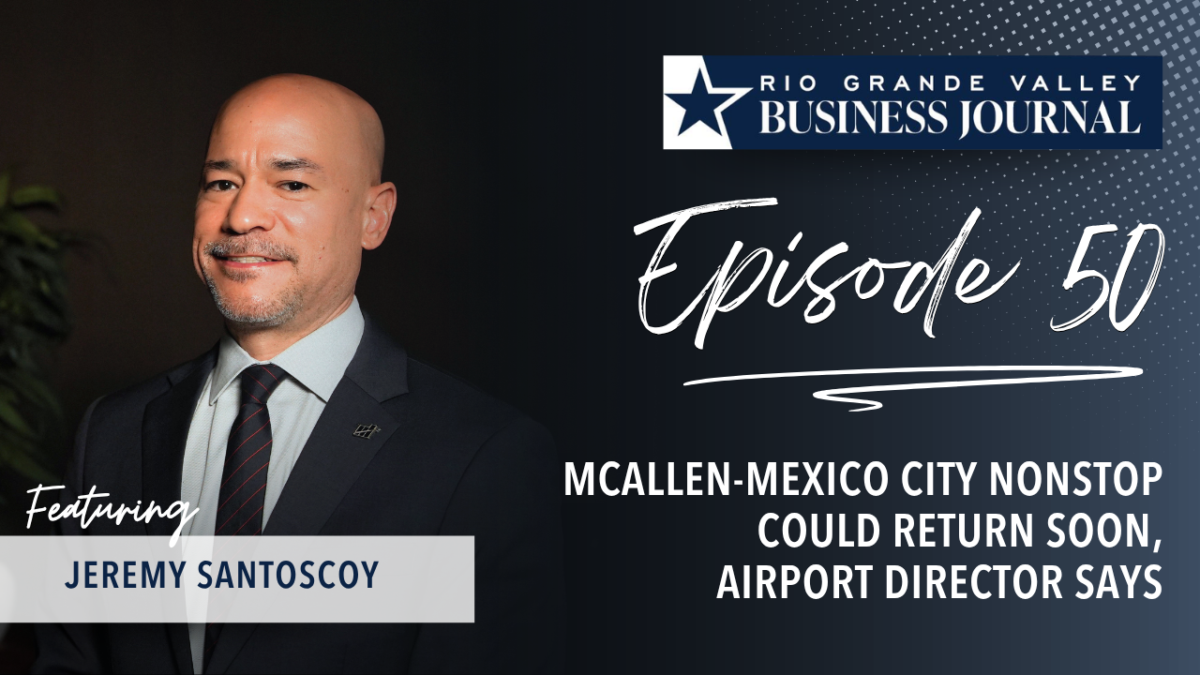
In this episode of the Rio Grande Valley Business Journal podcast, reporter Kristen Mosbrucker-Garza talks with Jeremy Santoscoy, aviation director for McAllen International Airport, about what comes next.
“That was good news to us, and we’re grateful for that decision,” Santoscoy said.
A return won’t happen overnight.
Santoscoy explains that airlines typically plan 90 to 120 days ahead of new or reinstated service, and Aeroméxico would essentially have to reapply for the route. His estimate for flights to resume is about six months.
He also walks through how well the route performed before it was cut. It averaged a 70% to 80% load factor and ranked No. 1 among small-volume stations on Aeroméxico’s network in its first year.
“It became a stronghold of the business community because it was a nonstop and it was high-end service,” Santoscoy said.
The conversation covers which Mexico City airport a restored flight might serve, how rising fuel costs are shaping airline decisions and the $1.2 billion economic impact the airport reports across its routes.
Listen to the full interview below.
The following is a rough, AI-generated transcript of a discussion between RGV Business Journal’s Kristen Mosbrucker-Garza and Jeremy Santoscoy, aviation director for McAllen International Airport. Minor errors and misspellings may appear. For the full conversation, listen to the episode above or through your preferred podcast platform.
Kristen Mosbrucker-Garza: Welcome to the Rio Grande Valley Business Journal podcast. In October, the US Department of Transportation reversed a 2015 order that had grounded several Mexican airline routes, including McAllen nonstop flight to Mexico City. It’s been about a year since this flight has been on hold. Thousands of tickets had been canceled, but now it looks like we’re in a position where the flight is coming back.
I’m Kristin Mosbrucker-Garza, and I’m a news reporter for the Rio Grande Valley Business Journal. I had a chance to sit down recently with Jeremy Santoscoy, aviation director for the McAllen International Airport. We talked about what it will take to bring that flight back and how long it could take. Why the connection matters so much to the Valley’s economy.
[TITLE/OPEN]
Kristen Mosbrucker-Garza: About a year ago, we spoke about a change in federal government policy. The Donald Trump administration oversees the Department of Transportation, and it had put a restriction on Mexican air carriers that happened to affect McAllen International Airport here in our community. Y’all had just gotten a nonstop flight up and running between McAllen and Mexico City with the new airport. So, give us an update. I understand it came down to the wire on Friday, when a new order came out.
Jeremy Santoscoy: Sure. On Friday, there was an order released by the DOT revoking the order that was put in place for cancellation. That was good news to us, and we’re grateful for that decision. We are starting to evaluate and will be in contact with the airline to see how we get to the actual next steps to get them back and flying the route.
Mosbrucker-Garza: I understand it will be a bit of a process. Typically, how long does it take to get a new flight added to y’all’s roster for people to buy tickets?
Santoscoy: The airline has its own process. Typically, an airline will look 90 to 120 days ahead of new or reimplemented service, because schedules are already set and they need time for ticket buys to happen. So there is a definite amount of time that will be in place. Even if we were to announce tomorrow, the airline still needs time to get across the winter schedule, get its fleet aligned and get tickets up for sale. There’s a whole lot of ramp-up time needed to start a route, but we’re definitely looking forward to talking to our partners about implementing that route.
Mosbrucker-Garza: It looks like Aeroméxico is going to put out a statement for its investors and for the public that it’s excited to see this change. The U.S. federal government basically said Mexico met the milestones it had agreed upon and that the restriction was lifted. I checked in with the federal government, too, and they said there is a process as well: about 30 days ahead of time, all Mexican carriers must get a proposed flight schedule approved. So even if that were approved today, it sounds like it would still be another month out.
Santoscoy: Especially after routes were canceled, it’s almost like it’s a new route again, so the airline would have to apply to the DOT for the route. There is work for the airline to do ahead of even getting a contract in place with the airports, then announcing the service, then getting sales and then starting service. So things will slowly ramp up.
We were not the only ones, as McAllen. There were other airports affected throughout the United States. The three Mexican carriers, [Aeroméxico, Viva Aerobus and Volaris], were all part of that order that canceled many routes. So it is a big plus for the Mexican airlines, and it also helps us on the U.S. side because it gives us some additional airlines to consider when traveling southbound into Mexico. It gives us some opportunity, it gives them opportunities to do business, and it also gives U.S. airlines opportunities to do business in Mexico.
What helped this was the freeing up of the slots and the progress on the concerns that originally put this order into place. A lot of work has been done in the background on all sides, and we’re just happy that this order was put into place to rescind all those cancellations. There’s a lot more work to be done.
Mosbrucker-Garza: In terms of demand, I know y’all had a pretty healthy load in terms of occupancy, and I know quite a few tickets were canceled when the cancellation happened. Have people been asking about the route? Is there pretty high demand?
Santoscoy: The airline and the airport collaborated to make the route as successful as it was. It did really well, especially among the small-volume routes on the network. We were No. 1 in the first year of operation. In fact, the McAllen station manager won No. 1 manager on the airline’s network because of the service they were giving and the feedback from the community.
So the route was doing very well. Again, this was something that was out of our hands. We had a lot of investment on the airport side and the airline side to make this a successful route, and it performed very well. With the cancellation, the airline still had ways, with other partners, to get people to Mexico City, and they did. I’ll give them credit for going out of their way to get those passengers to Mexico City.
After that, I know a lot of people have had to drive across the land ports of entry and fly out of Reynosa, either to AIFA or to MEX, the main airport. They have that option because Reynosa is within driving distance and they can fly domestically in Mexico. But a lot of our community, a lot of the passengers who were using that route and made it so successful, really want it back, and our hands have been tied up to this point.
We’ll continue to work hard to get that route back for the community and work with our partner to see how soon we can get it back, because we know the demand is there. It has a big impact on our region, connecting to the capital of Mexico. Our region has a lot of affinity with Mexico City, and we have a lot of history connecting with Mexico City by air.
Mosbrucker-Garza: I’ve heard from people in the business community that, especially being a nonstop, it made a lot of financial sense for business folks to travel back and forth. So I know it’s popular with that community as well. I guess we’ll have to wait until the flight schedule proposal comes out, but do you get the sense it would be to the same airport, or maybe to Benito Juárez?
Santoscoy: We will always work to get to a main airport where we can. It was a different time with different challenges. We had previously served the market for 13 years with a regional carrier, Aeromar, to Benito Juárez. Then that airline went under, and the safety rating downgrade was implemented as well.
When we got back to the original safety rating, where Mexican carriers could open new routes from the U.S. to Mexico, we worked with Aeroméxico, which had never served McAllen before. As the legacy carrier that it is for Mexico, that was a big deal for us, even though we were going into the new airport, Santa Lucía.
I think it was looked at as a bigger challenge than the airport we had previously served, and there was a lot of negativity around the decision. However, we were very successful with it. We went from a smaller-gauge aircraft to a higher-gauge aircraft, from a 76-seater to a 99-seater, and the frequency went from three times a week to every day, into a new airport. Everybody thought it was going to do the same as, if not worse than, the previous airline. However, we did very well. We averaged about a 70% to 80% load factor throughout the time the route was served, and it became a stronghold of the business community because it was a nonstop and it was high-end service.
It had first-class service, too, and then economy class. So the business commuter had the first-class option, and somebody going to visit their family had economy class. The connection was there, and the numbers showed the success. So we’ll work to get back into the appropriate airport, and we will work to get the best connections for our region and our passengers.
Mosbrucker-Garza: I imagine a lot has changed in a year. It seems like the world keeps changing. The price of diesel and, I’m sure, aviation fuel has probably gone up. Is your general sense that there’s still quite a bit of demand, and airlines are not interested in pulling back?
Santoscoy: Airlines around the world have been pulling back somewhat because of fuel costs, and they have to do it in the best interest of their airline. Fuel is about 30% of operating costs, so that’s a huge deal when you’re seeing fuel costs rise over 100% year over year. That can put a very big impact on profit margins. A lot of airlines have made the decision to cut back a little, sometimes even exiting airports, and we see that around the industry. So we’ll just have to see where Aeroméxico finds itself, and we’ll work all that out once we get to the table and start discussing it with them.
Mosbrucker-Garza: To give our readers and our audience a general sense, it sounds like it could come back probably within the next three to six months?
Santoscoy: Very generally speaking, that is about the time frame. I would even venture to say six months is probably generally what we’re looking at.
Mosbrucker-Garza: Was there any other aspect of this you wanted to highlight, or that you think is important for people to know?
Santoscoy: Just that we’re always working to get our people connected and working for the best connections. Because of the success of Mexico City and the history of Mexico City with McAllen and the region we serve, we’re going to work hard to get this service back into our options for nonstops. We will continue to work for the region and get everybody connected to the places they want to go.
Mosbrucker-Garza: I remember during the city’s pitch to federal regulators, they said this is a really big economic impact, bringing people from various parts of Mexico to McAllen. Chances are, if you’re coming all the way from Mexico City, you’re probably staying overnight, and you might even do some kind of extended stay of a month to three months. That has its own economic impact. Then there’s the back-and-forth with businesses and a lot of investment. They said it was a several-billion-dollar economic impact to have that flight and that connectivity between the two countries.
Santoscoy: Yes. We did an economic impact study, and we had a $1.2 billion economic impact with the various routes and frequencies we have. Our Mexico City flight was in that study, so it played a big part, not only in our offerings, but in our international offerings. The impact of the connection to the capital of Mexico is huge, not only for business, but on the leisure side because of all the offerings Mexico City has.
So again, we’ll continue to work to get that back into place, and hopefully before long we may have Mexico City back again. It’s a good sign that the order was put into place to lift the cancellation. That’s definitely a really good start to getting it back into place, so we’re on our way.
Mosbrucker-Garza: Connecting McAllen to Latin America’s New York City.
Santoscoy: And the rest of the world. The connections in Mexico City are huge, so we’ll continue to work on that connection. But yes, it’s a very impactful connection with great economic impact and great connections, whether it’s business, leisure or the heritage markets it serves.
Mosbrucker-Garza: Well, thank you so much for your time. I sincerely appreciate it. Definitely keep us in the loop as y’all move this forward. I think it’s something our audience is keen on keeping track of.
Santoscoy: Yes, ma’am. Take care.