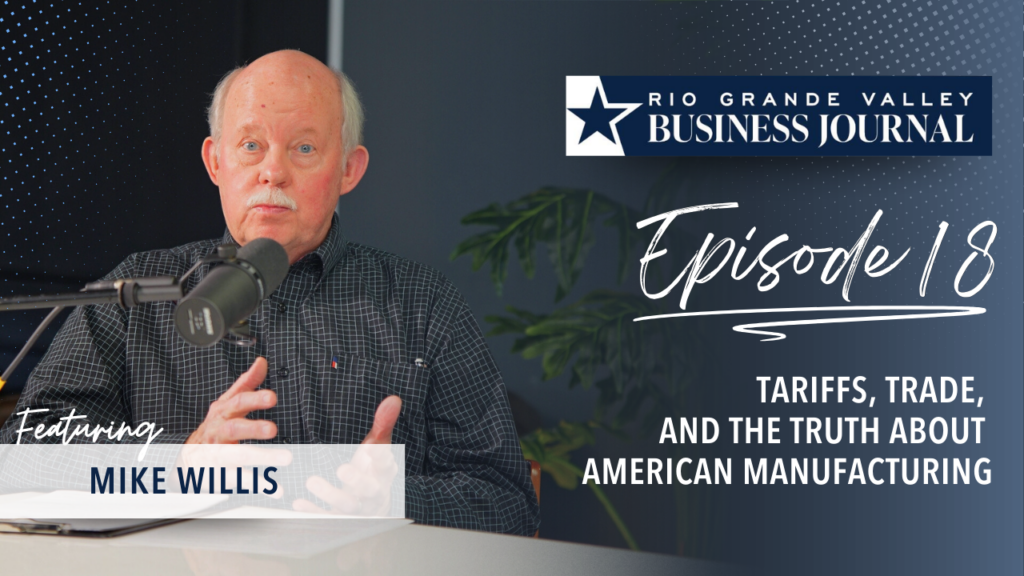
In this episode of the Rio Grande Valley Business Journal podcast, reporter Kristen Mosbrucker-Garza sits down with Mike Willis, executive director of the South Texas Manufacturers Association, for a candid conversation about manufacturing, tariffs, and the Valley’s evolving border economy.
Willis draws on decades of industry experience to explain where manufacturing jobs really go — and why bringing production back to the U.S. won’t look like the factory floors of the past. Automation, global supply chains, and consumer behavior, he says, reshaped manufacturing long before tariffs entered the conversation.
Willis also breaks down how tariff uncertainty is slowing investment decisions — and why predictability matters most for long-term growth.
The episode also touches on SpaceX’s game-changing impact in Brownsville, workforce shortages, wage gaps with larger Texas metros, and the challenge of attracting and retaining skilled talent.
From “potato chips to rocket ships,” Willis says manufacturing touches nearly every industry — and the Rio Grande Valley is positioned to play a growing role in what comes next.
The following is a rough, AI-generated transcript of the interview between Mike Willis and our host, Kristen Mosbrucker-Garza. Please be aware that there might be slight spelling errors for proper nouns and other “misheard” sentences. For the full experience, click the link above, or listen on your favorite podcast provider.
Mike Willis: The story of manufacturing is it’s really not about anybody stealing our jobs. It’s about manufacturers, manufacturers continually trying to find ways to produce their products more efficiently and at lower cost. We didn’t steal them. We sent them there by reaching our hand and grabbing shirts that were made in China, or buying cars that were made overseas because they were better quality and lower price.
Mike Willis: We had almost no inflation for 20 or 30 years because we were getting more goods at more economical prices. Once we opened our economy up to imports and competition and a global market, customers choose where they find the most value.
Kristen Mosbrucker-Garza: Hey y’all, so, welcome to the Rio Grande Valley Business Journal’s podcast. I’m Kristen Mosbrucker-Garza. I’m a news reporter here. And I have a special guest today. Fun fact we actually knew each other about ten, 12 years ago. So a source of mine from a blast from the past. And I was like, I wonder, like, Willis is still around.
And I was like, sure enough. And, making some moves. So, welcome if you want to introduce yourself.
Mike Willis: Sure. I’m Mike Willis. I’m the executive director of the South Texas Manufacturers Association. We’re the industry trade association for the Rio Grande Valley. We have some maquilia members of our association also that most of them have operations on both sides of the river.
Kristen Mosbrucker-Garza: Awesome. And so, you know, I thought this is really interesting because I feel like we hear a lot of talk about manufacturing, but, you know, for folks who aren’t very familiar. How significant is it to our economy here? And what does it kind of look like? What are some of the types of companies that are active in the Valley?
Mike Willis: Okay. So, you know, the economy economists kind of break up the economy into two to big groups, goods producing industries and service industries, right. And nationwide. And then the valley is services provide a service industries provide about 80 to 85% of the jobs. And the goods producing about 15%. Right. So if you think about the goods producing sectors, energy and mining, you have to drill and mine wherever the resources are, right?
Mike Willis: You can’t decide. I think I’ll go, you know, drill a well in, Costa Rica because I like it there. You got to go with the oil deposits. All right. Construction companies have to build where the buildings need to be, but manufacturing takes materials and raw materials in and makes finished products, and they can manufacture anywhere in the world.
Mike Willis: It’s just a function of the cost of labor, the cost of transportation to move the stuff they’ve made to where it needs to go. So manufacturing has always been, a more mobile industry than the other two. And services. Yeah, you can provide a lot of services over the internet now that you’re used to. Not but a lot of stores and retailers and all that need their stores where their customers are.
Mike Willis: So this is why a lot of economic development involves helping the companies in all sectors that are in the community. But manufacturing has always been an industry that economic development professionals try to recruit to entice them to come to their area. Right. And outsourcing and all that sort of thing is nothing new. Most of my career, for 30 some odd years, much of it in the Valley, was in the apparel industry, the garment industry.
Mike Willis: The story of manufacturing is it’s really not about anybody stealing our jobs. It’s about manufacturers, manufacturers continually trying to find ways to produce their products more efficiently and at lower cost. In the past, labor was a big part of it and of course, transportation cost. But the more we can have automation and technology and all that, we reduced the amount of labor required and it makes us more competitive with other countries.
Mike Willis: So economists say that manufacturing should be done where it can be done most economically. And all these jobs that everyone says we stole, you know, from the United States, we didn’t steal them. We sent them there by reaching our hand and grabbing shirts that were made in China, or buying cars that were made overseas because they were better quality and lower price.
Mike Willis: So when a country has a lower standard of living and therefore lower labor costs than the United States does, and they’re more receptive to helping business to grow and not so restrictive with permitting and all that sort of thing, or environmental regulations. Maybe, there’s an advantage for a company to, to move their production to those countries. We benefit because we had almost no inflation for 20 or 30 years after horrible inflation in the 70s because, we were getting more goods at more economical prices.
Mike Willis: And the other companies made a lot more money by, by moving stuff overseas. And that’s probably benefited people that are stockholders more than the the people that lost those jobs. But nobody stole the jobs. American consumers, basically chose once we opened our economy up to imports and competition and a global market, customers choose where they find the most value in the garment industry.
Mike Willis: And then in the 80s, my company was a big supplier for Walmart, which was the up and coming retailer, and Penney’s and Kmart and Sears and all of them. But it’s it’s, it’s actually good for consumers that companies have gone overseas where we were stupid, was letting entire industries that are critical to our national security, but didn’t seem like it then, but now semiconductors, rare earth minerals, steel, aluminum has a lot of defense type components and all of that.
Mike Willis: You know, we became too dependent on other countries so they can blackmail us if they choose. If they chose to. So that’s what’s that’s what’s playing out on the big stage right now. Nobody’s going to bring 100, you know, 500,000, 3 million manufacturing jobs back to the United States successfully. The companies are going to build plants in the US that have committed to them.
Mike Willis: They’re going to be highly automated, very technologically advanced, and a lot lower labor content. And those would be better paying jobs. And a lot of Americans don’t want to work. I’m not sure I know any Americans that actually want to work in a shoe factory. I’m not sure why we’re penalizing, shoes made in China or Vietnam with a huge tariff when, you know, if we if they tried to move those plants to the United States, nobody want to work in them.
Mike Willis: So that’s that’s kind of the whole big picture issue.
Kristen Mosbrucker-Garza: No, it’s interesting. And then, I remember I want to say someone had told me about, the Rio Grande Valley’s history with garment manufacturing and textiles around the time when there was a, I think it was a Brazilian company that was going to open, like Santana Textiles. Yeah. Santana. And they were going to open like, like a jeans, material factory.
Kristen Mosbrucker-Garza: Yeah.
Mike Willis: There were just going to be a textile factory.
Kristen Mosbrucker-Garza: And you know, we hadn’t had one in, in generations. And I do remember that it was going to be much more automated with like more, you know, robotic aspects to it, which I thought was interesting. So you know, and of course we grow cotton here too, right. So there’s always been some sort of, there’s always been manufacturing in the sense of like from agricultural products.
Kristen Mosbrucker-Garza: Right? You know, we had sugar cane and things like that over the years. You know, I kind of wonder, you know, during the time, in the, in the 1990s. Right. You know, we had this concept of, like these twin plants where you where there would be, advanced manufacturing on either the US side and then, you know, maybe something that requires, like, more, labor intensive, skill sets on the Mexican side, like, like what did that kind of look like?
Kristen Mosbrucker-Garza: And how did that kind of transform the valley? And is that still happening?
Mike Willis: Yeah, that’s that’s a good question because, you know, I was kind of right in the middle of that. I was in the apparel industry, which was winding down. And we actually formed the South Texas Apparel Manufacturers Association in 1990. My, my boss and I did and, it was Levi’s Hager’s for the loom. I was with Allison Manufacturing and so on.
Mike Willis: It was a few companies. They all had 2 or 3 plants, and each plant had 4 or 5, 600 employees. So we had 1000 2000 employees. But that was right. When the them Dora, that’s the twin plant, the maquiladora concept. So companies had already started closing plants in the Midwest and up north and opening new plants in Mexico.
Mike Willis: Right. So Congress thought, you know what? And with a lot of encouragement from border politicians and economic development leaders, you know, why don’t we put something together so we can encourage these companies? They’re going to Mexico, at least locate next to the border. And then we get the logistics and the distribution centers and the transportation, and we can put capital intensive component manufacturing plants.
Mike Willis: We can get them to locate and along the border on the U.S. side to supply the labor intensive assembly plants in Mexico. So that was the whole concept, and it worked really well. I mean, it still works. And that’s why, probably 30 to 40% of the manufacturing in the valley is tier two and tier three suppliers, component manufacturing companies in jet plastic injection molding, metal stamping, plating, you know, all these different machining tooling shops and all of that, they typically have more their investment in capital equipment and don’t require as many people as an assembly type operation.
Mike Willis: But what’s happened, as you would expect, Mexico is not the same either. You know, as they’ve tried to develop a supply chain in Mexico to support their plants instead of depending on on us. Right. So, so for years now, our, our manufacturers have been competing with people who do the same thing in Mexico. So, because our labor rates are, you know, 70, 80% lower than ours, even in a capital intensive component manufacturing world.
Mike Willis: That’s enough to make a big difference on the prices of your goods. So also the workforce in Mexico and especially in the Maciel industry, has gotten much more sophisticated. You know, all a lot of the thousands of jobs, it started off on this side of the river for engineers and managers to run the Mickey was and provide the engineering services.
Mike Willis: As you would expect over the years, they’ve developed and grown their own workforce. And now there’s, slowly, fewer and fewer U.S. paid professionals went across to work. There’s still quite a few, but a lot of a lot of the management and engineering teams in Mexico now, or Mexican nationals who learned the business or went to school and and work in those industries.
Mike Willis: We do the same thing if that was on our side of the river. So we have a really good relationship. And the Makina industry has been a tremendous asset for the overall economy of the valley, the the transportation, warehousing, logistics side of things. And of course, the produce industry is not manufacturing, but that’s another huge, fast growing industry that’s closely related to manufacturing.
Mike Willis: So, yeah, it’s it’s, it’s made it challenging for a lot of manufacturing companies along the border. So.
Kristen Mosbrucker-Garza: You know, it’s interesting that you mentioned that concept of the domestic, supply chain. I just went to, coast up. What is it? Council of, South Texas economic progress.
Mike Willis: Council for Economic Progress. Yes. There. Our regional economic development group, they’re not tied to one city. They work with everybody.
Kristen Mosbrucker-Garza: Right. And so, I went to this, coast up presentation and there were representatives from the, automotive, industry, particularly automotive manufacturing, mostly components, from Aguascalientes. So that’s like central Mexico. And it was just interesting to kind of hear it from their perspective. So, you know, while much of the news about tariffs has been, really from the US side with, you know, President Donald Trump, you know, his, policy over the past year has really been to levy various tariffs.
Kristen Mosbrucker-Garza: You know, I was I think the highest was like 100 to 150%, against imports from China into the US. And then, you know, that renegotiation of the, Usmca, which is.
Mike Willis: It’s coming up.
Kristen Mosbrucker-Garza: Yeah. Was essentially NAFTA 3.0, right. The North American Free Trade Agreement, alternative. And it was just interesting that in Mexico there are actually new tariffs as of January 1st, that for sort of, I don’t know if they consider rare earth, but essentially certain metals. So like copper and steel and some of those raw components that those companies, may want to import now are facing 50% import tariffs from all of their non free trade agreement countries.
Kristen Mosbrucker-Garza: And so now all these manufacturers are in a situation where you know their supply chain is essentially broken. Right. And so now they’re looking to the valley. They’re looking at all their options like maybe they can you know stand up something that’s, you know, a a supply chain somewhere in North America. So they don’t have to deal with the layers of tariffs.
Kristen Mosbrucker-Garza: And so if you could kind of, help people understand, you know, what has the South Texas manufacturing industry gone through in the past year with the tariff situation?
Mike Willis: I would say for some companies it’s been quite chaotic. For others, you know, they’re not that that involved with it, but.
Kristen Mosbrucker-Garza: It’s typically a protectionist measure, protectionist actually in steel, you know that the US has a really long history and and U.S. steel you know Chinese steel is still cheaper. But with the tariff it’s it’s more mitigate it.
Mike Willis: It’s a lot more complicated because in with the global supply chain and all of that, there’s it’s not for example, when we did the tariffs on China okay. We buy a lot of manufactured goods from China right. They don’t buy hardly any manufactured goods from us. So so the tariffs aren’t going to convince. And we don’t make a lot of this stuff in America in manufacturing that China makes.
Mike Willis: So there’s no alternative. So so the so the cost of buying those components or those vehicles or motors or whatever from China goes up 50%. But in many cases, there’s not an alternative in the United States because nobody does that in the United States anymore. So all it does is raises the price for the company that results products or for the consumers that buy the products.
Mike Willis: If you’re a retailer like, say, target and you get all your Christmas toys and goods from China or Vietnam or wherever, because that’s where they make them, and you bring them in for Christmas and there’s a 30% tariff. But what China did to retaliate for the tariffs we put on them, as I said, you know what we buy a lot of from America.
Mike Willis: You know what? We buy 50 million tons of soybeans every year. We can buy soybeans from Brazil. We think we’re just going to tell our companies are a communist country. We think we’ll just tell our country to start buying all their soybeans from Brazil. And what happened? American soybean farmers had a glut of soybeans they couldn’t sell.
Mike Willis: The price plummeted. And the administration had to take many, many, many millions of dollars, as happened in the first term, and compensate farmers for their lost revenue from from, not being able to sell it to China. And now that we’ve fixed the somewhat fixed the problem with China, a lot of those companies are not going back. They’re still still buying the beans from Brazil.
Mike Willis: But for companies that decide where they want to source their stuff. So it’s really a kind of a messy situation. But I, I fully agree that, like China has subsidized China. China thinks plays the long game. You know, they they’ve been quietly, subsidizing and supporting their ship building their crane building, their, manufacturing and all of that.
Mike Willis: And, you know, dramatically growing their, raw earth metals. They’re really very astute on the business front, but they think in terms of ten and 20 year windows, we think in terms of 1 or 2 years typically, you know, so they’ve they’ve basically been able to incentivize the migration of almost all of our metal and aluminum manufacturing and rare earth stuff, whether they have the minerals there, but to to China.
Mike Willis: So now that they cut us off, the reason we came back on the tariffs, I think on the first round of punitive tariffs on China is they said, okay, you’re going to do whatever it was, 500% tariffs on us. We think we’re going to stop shipping you rare earth minerals and magnets for your semiconductors and your jet fighters and your automobiles.
Mike Willis: We’re going to hold off on that for a little while now. So we said, you know what? We think we’re going to ease off on these and negotiate some more with you. So it’s important that we do do some things in the United States, even even though it may not be the most low cost or efficient.
Mike Willis: We’ve got to be able to take care of ourselves. But I just, you know, to me, we need to be more strategic and let’s let’s identify the things we really need to go after and not start charging the whole world tariffs for anything and everything that comes from there. The to me, the sector, what they call them, sectoral tariffs.
Mike Willis: Again, national security or whatever copper now copper steel aluminum. But the impact on the and getting back to the valley the they’re all the economic development corporations around the valley are telling me they’ve had lots of conversations going on the last year with companies in Mexico, about potentially opening up manufacturing in the United States. So a good side of all this tariff stuff, is it a lot of countries are starting to realize, you know, what we need to we need to move some of our manufacturing to the United States.
Mike Willis: President Trump to his credits, got huge concessions from pharmaceutical companies, tech companies, that semiconductor a lot of those out of those deals were made under the Biden administration with the Chips act. But President Trump continues to support and enhance that with tax credits and all that. So we’re seeing an explosion of semiconductor plants in Arizona and Texas.
Mike Willis: I think Samsung has committed eight more semiconductor plants in Texas in the next ten, 10 to 15 years. And, there’s a lot of that sort of thing going on. So but the problem is with the tariffs, because you’re on again off again on again, off again may or may not be legal. Where are they going to last past Trump’s next term or not?
Mike Willis: Companies aren’t going to spend hundreds of millions of dollars either closing plants and trying to build new plants and worrying about where to find the workforce to work on them in the United States or something. That’s not going to be permanent. And if terrorists were done by Congress, they’d probably probably be perceived to have more permanence than when we’ve had them coming and going and coming and going for the last year or so.
Mike Willis: Everything I’ve heard and talking to companies, too, is that nobody’s making any major decisions until the whole tariff thing gets settled and there’s some kind of stability. Companies can plan for anything. They just need to know what the rules are. I have seen two companies I’ve visited, two companies that are actually moving some production from Reynosa to Hidalgo County.
Mike Willis: Not big numbers, but it’s mostly companies that already have a facility. Some of the automotive plants around the country that were producing in Mexico, in the U.S., if they had extra capacity in their plants in the U.S., some of them are shifting some production to Mexico to fill up their U.S plants to escape, you know, some of the tariffs.
Mike Willis: So there’s some of that going on. But I think we’re going to have to have some stability in the policies before most of the big decisions are going to be made. But there’s a lot of other stuff going on in the valley of manufacturing that’s got nothing to do with Mexico or tariffs.
Kristen Mosbrucker-Garza: Yeah. You know, I know that there’s like a lawsuit out there that some people are like seeking refunds for tariffs. And so there’s there is a lot that I think is going to be, shaken out about, you know, obviously probably the most notable, manufacturer that we have, I would say is probably Space-x. Right.
Kristen Mosbrucker-Garza: You know, I mean, they’re building that $250 million, Gigafactory. They have, aspirations to, manufacture rocket ships and specifically the starships, right there in Starbase, the new city, outside of Brownsville, near Boca Chica. And then launch them from there. Right. And so, you know, last time I checked, I want to say they had some 3000, some employees, you know, a couple hundred people living in the city of Starbase.
Kristen Mosbrucker-Garza: You know, what was it like to get a manufacturer of that caliber for the Rio Grande do Valley?
Mike Willis: So it was a game changer. I mean, the, probably that I’m. From what I’ve heard, the headcount is probably around 4000 people right now, and I did hear from them. It’s public probably. No, no, they’re planning to hire 4000 more people in 2026. Wow. And you know, they’re they’re I know they’re, this is not any proprietary information or anything.
Mike Willis: I’m not sharing anything. I have seen their heard. That’s not public, but, it’s it’s an amazing company. I know they’re they’re building. There’s hotels. I actually got to go through there for the first time about a month ago, so. But they’re building a I believe I’ve read that they’re building, R&D research, facility south of the launch pad there.
Mike Willis: I know their plan. And I’ve read that they’re planning to, double the launch capacity. And as you can see from from being learning how to catch their booster rockets. Right. You know, that means they’re going to try to reuse those and refurbish those and not just dump them in the ocean. So you can you can see it’s just like a lot of other manufacturing, constant process improvement, finding things that make things more efficient.
Mike Willis: And Elon Musk has been all about disrupting the industry. I can talk a little bit about United Launch Alliance. They were in Harlingen for 35 years, quietly building payload in those sections for for for United Launch Alliance rockets, in Harlingen. And they closed that facility about two years ago. Not really because of space X, but, you know, they, I went through there years ago and they were to me, there was a big contrast between Elon Musk’s philosophy and and the tradition in the industry that everyone walked around.
Mike Willis: Every little piece of metal was picked up and vacuumed and swept when they drilled a hole. And it was all about we only get one shot at this. If we make a mistake. It could cost 150, you know, million dollars satellite and piece of metal get shorted out and all that. So the industry just beats. And there’s nothing wrong with that.
Mike Willis: Super slow and careful and and I think space X is super careful, just like they were. But the philosophy of building one rocket and having it perfect and and then it’s gone and you got to build another one. He’s obviously learning to reuse rockets and he’s using what, lumentum steel rather than all the exotic metals and all that.
Mike Willis: So the cost is lower. So I mean, they’re they’re really disrupting the industry there. You know, look at all the Starlink stuff. They’ve put it. They got internet all over the world. They can turn on the internet for Venezuela or, or Gaza if they want to. So the citizens without dependent on the government can get internet access. It’s just it’s an amazing company and they’ve they’ve had from what I can see, they’ve had no trouble recruiting and attracting people.
Mike Willis: And I think a lot of people buy into the vision that we’re going to, we’re going to be part of the company that’s going to colonize Mars someday, you know? So that’s that’s pretty attractive to young people that are interested in that sort of thing.
Kristen Mosbrucker-Garza: You know, it’s something that really struck me about, a company like SpaceX is that, you know, the company itself may hire, you know, thousands of employees, but, you know, they they probably do a lot of like, subcontract. Oh, yeah. Right. That the, the manufacturer typically has, you know, business deals with, you know, suppliers and, even like metal fabrication.
Kristen Mosbrucker-Garza: Right. Because they, they’re probably not like making the metal. They, they might do like more assembly kind of stuff, like at their facility, but just like making a car, you know, they there’s a whole supply chain kind of behind them.
Mike Willis: Yeah. You know there’s, there’s two terms that get thrown around and manufacturing. One is offshoring. That’s when you take a plant and close it and build a new one in another country, an outsourcing. So in the in the 70s and 60s and 50s, a typical auto plant in the US did everything. They did their painting, they made, you know, they did the metal stamping there.
Mike Willis: They’re all every, all the process just to make all the subassemblies part products and all of that. And then as I had to start competing with the Japanese automakers, they started, working to improve their quality and lower their cost, and they started outsourcing. It always happens. But outsourcing to more, more and more their production to other companies that could specialize in certain parts of the component manufacturing.
Mike Willis: So that’s what’s grown the need for tier, what they call tier two and tier three suppliers. Tier two suppliers make components that they make. And then it typically goes to the assembly plant, the tier one. Like maybe they make radios or something. And then when they finish or a console and then they ship the console to the assembly plant wherever it is, and they put that in the vehicle.
Mike Willis: And then there’s corrugated box companies that make corrugated boxes for everyone and all three levels to put stuff in when they make it. There’s, injection molding that makes plastic parts and components of all different sizes from we got one that makes recycled trash can lids and chairs and, and all of that, and even little bitty tiny parts that go into inside of washing machines and radios and electronics components, metal stampers that have presses that fold and make them metal pieces all the way up to huge pieces.
Mike Willis: So there’s all of that. A lot of that is outsourced. So the assembly can’t plant, can focus on what they what they do the best, you know. So that’s that’s the supply chain everybody talks about. And again you can have that supply chain anywhere depending on what it cost to make it and ship it in about 5 or 6 years ago.
Mike Willis: You know China was had a lot of the manufacturing. Well, what’s supposed to happen, according to economists, is when you, when you put manufacturing in a country and people get better and better quality of life improves the standard of living improves and wages rise. Well, China’s manufacturing wages rose. They rose to the point where when you add the transportation cost on it was it was just as economical to make stuff in Mexico that was being made in China.
Mike Willis: So 4 or 5 years ago, you started seeing a lot more work starting to gravitate back from China towards Mexico. And the last few years it’s been going to Vietnam. So China is rapidly losing a lot of their money. Even before the tariff stuff, they’ve been rapidly losing a lot of their manufacturing capacity and other less developed countries like, Vietnam, Cambodia or whatever, taking full advantage of it.
Mike Willis: So going back to what I said about manufacturing being something that can be moved anywhere, it’s always a race to find the lowest cost place to make things, as long as the quality is good and you’re providing the value to the ultimate customers.
Kristen Mosbrucker-Garza: You know, I wonder, you know, how would your members, so, you know, the South Texas Manufacturers Association is, is a membership organization, right? Y’all are like a, a nonprofit. I have A1305166.
Mike Willis: I’m not a charity. We’re like a chamber of commerce, okay? Except we don’t do all the networking. We we just focus on, you know, serving the industry. We do have. We’ve got.
Kristen Mosbrucker-Garza: Right.
Mike Willis: Yeah, we have 100 manufacturing companies in our organization. We also have, all the economic development corporations around the valley, almost, each RGV, all the community colleges and tech schools. Now we have some industrial suppliers, logistics companies and so on. In 2022, after the pandemic, we stopped living. Service companies join. So now we’re only bringing on within an economic development corporation or school join, but mostly manufacturing company.
Mike Willis: So now our membership is more and more focused on our core customer, which is the manufacturing industry.
Kristen Mosbrucker-Garza: And how would you say the past year was for your membership, you know, what are some trends that you’re seeing, you know, is our manufacturing industry growing because of some of these new companies or are we kind of holding stable or are we a little bit on the decline because we’re not as competitive as some other markets?
Mike Willis: Yeah. Our, our if you look at the, the labor market numbers that the Workforce Commission and the feds put out, our manufacturing workforce is hung around 14,000, about 7000 and each in an hour going to 7000. In Cameron County for about the last four years or so. Well, I see when she kept the landfill stream animals, you know, grows from 200 people to 3000.
Mike Willis: I don’t see the numbers change. SpaceX came to town with 4000 workers, and if they add 4000 more, I’ll be surprised if we see the numbers go up. So, all these employment numbers are estimates and they’re based on employer randomly selected employer surveys every month, quarterly quarterly survey of employment and workers or something like that. They call it.
Mike Willis: And, when I worked at the Regional Workforce Board, I actually filed a Freedom of Information Act thing, and I got it actually in an NDA. And I got a list of the all the companies that were in the survey that were divvied up into all the sectors to count the numbers. And without going into particulars, I found I found some big manufacturing companies.
Mike Willis: I found one in the automotive industry. It was an automotive company, and they were classified as an auto parts store. And what I found out was the companies themselves, when they do those mandatory surveys, they have to pick what industry code to use. And, you know, the Workforce Commission doesn’t have the resources to check every one of them.
Mike Willis: So I think a lot of them are probably errors in classifying themselves because, you know, they’re busy people. They’re not experts on the coding for all the different industries in the world. And sometimes they put the wrong number on there. And so they pop up in a different in a different sector.
Kristen Mosbrucker-Garza: You know, it’s interesting that you say that. And I think that this is something that I’ve actually really took quite a bit when it comes to getting data about the Valley. You know, we are in a really big state, right. Where at the very tip, you know, we’re on the border and, we have two metro areas, right?
Kristen Mosbrucker-Garza: So we have the two MSAs like the McAllen, Edinburg mission, and then we have the Brownsville, Harlingen, you know, and I’ve heard from a lot of industries that it can be difficult to get accurate information about what’s happening in the valley, in part because a lot of the, data doesn’t include the activity in Mexico. Right, because that’s sometimes hard to track depending on what you’re looking at.
Kristen Mosbrucker-Garza: You know, we we have kind of these two MSAs that don’t necessarily include our entire coverage area, you know, like all four counties. You know, even on the, the housing side of it, it’s just like there’s a lot of, like, gaps in between just because of how unique, this area is geographically, you know, and we have grown so much too.
Kristen Mosbrucker-Garza: And so I’m not surprised to hear you say that, I guess, is my point.
Mike Willis: Well, it’s not unique to the Valley that that data process happens all over the country. So it’s not it’s not a bug in the Valley’s data. It’s this is a I’m sure goes on everywhere. So the numbers, the process and the methodology has been pretty consistent over the years. It doesn’t change just because of a president or anyone changes.
Mike Willis: So you know they do the best they can. The word in front of all these numbers is always estimates. No one, no one counts how many people are or are unemployed. Those are household surveys and variables that are used based on the change in the rate of unemployment and the long term unemployed. They have all these complicated 130 different variables that go on a lot of this data.
Mike Willis: So it’s it’s really hard to get your hands around. So my feeling is probably half the jobs we’ve lost in manufacturing are due to companies moving overseas and New Mexico and all that. But the other half is a good thing if you’re a company person, because they lower their labor cost, which means they don’t have to charge as much for their goods and services.
Mike Willis: So so that’s part of it. So the shrinking workforce and, I mean, back in the 70s and 80s in the garment industry, we were constantly introducing new technology and improved methods and all that to lower increase productivity and lower labor costs. So that’s nothing new for manufacturing. We’ve call them green jobs and, you know, all that. But, the process and now we call it advanced manufacturing and all that.
Mike Willis: But manufacturing has always been advancing and continuously finding new and better ways to do things all over the world.
Kristen Mosbrucker-Garza: You know, on the workforce side, something I’ve been thinking about because I know, Texas A&M University has that advanced manufacturing center near Rio Grande, LNG. Right. You know, they they are, you know, training a lot of welders. And folks on the construction side, you know, does the Valley have the workforce for the manufacturing industry that’s here and the industries that want to come here?
Mike Willis: Well, that’s a loaded question because, you know, I think nationwide, there’s I think over the numbers, at least 400,000, maybe higher than that, unfilled manufacturing openings at any given time. And it’s a function of.
Mike Willis: Let me answer this way. We don’t have thousands of openings that aren’t being filled. It’s a lot easier to fill in manufacturing job openings now than 2 or 3 years ago, when we had a really tight labor market and back in 20 1819, before the pandemic hit, I it’s still challenging, but we have plenty of training programs at our high schools and community colleges.
Mike Willis: I organizations work with all the SDC South. Most we work with T-mac. We’ve participated with A&M. The group you talked about and excuse me and develop academic programs. And the schools all have strong customized training programs where not just for students, but they’ll go out and work with the companies and train their employees. STC, DC South most the group at A&M takes and team at our friends at T Mac.
Mike Willis: They all provide training to train up employees and even unemployed people. And the Workforce Commission has skills about my grants and money. The state puts aside that companies and schools can partner to to pay for training. The challenge is finding enough people that want to work in manufacturing. You know, a lot of young people aren’t interested in manufacturing.
Mike Willis: They want to, you know, ten years ago, they all wanted to be graphics designers. Now they want to be social media influencers or or whatever the current thing is. I mean, so that’s one of the challenges. But most of the graduates in a lot of these academic programs that we graduate from our schools don’t go to work here.
Mike Willis: They leave the valley because the wages for manufacturing jobs are about 15 to 35% higher in Austin, Houston, San Antonio and so on. So, they a lot of them will go there and work. And then maybe years later when they have experience, they might come back and and find a job here in the Valley. Some of them do go to work in the Valley, but, a lot of them do leave to work for higher paying jobs elsewhere.
Mike Willis: So the challenge isn’t just in the valley with the workforce. There’s a huge shortage of workers all over central Texas. There are semiconductor plants, battery plants, Tesla, there’s just a lot of jobs, and we haven’t even scratched the surface of all the semiconductor plants are going to be opening in Arizona. There’s going to be I think President Trump announced a 500.
Mike Willis: They doubled Taiwan, doubled their commitment from Taiwan companies doubled their commitment from 250 billion to $500 billion worth of semiconductor plants and foundries in Arizona. A lot of it’s in Arizona, and they can’t even find the people qualified to build the factories, much less to work in them. So we’ve got a lot of challenges on the workforce development.
Mike Willis: And if we think we’re going to, dramatically grow the manufacturing, we’ve, you know, we’ve got to have the wages to attract people into those jobs and, people willing to do that kind of work. So that’s, that’s part of it. So as far as the manufacturing industry, it’s been very sluggish and somewhat and I’m talking overall sluggish and slow for the last two years.
Mike Willis: Didn’t just happen this year. It’s been that way for about two years. That’s supported by the Federal Reserve’s, you know, survey of Texas manufacturers. So it’s just not my opinion. As I mentioned, short term, the tariffs are having a lot of disruption. The port customs brokers, every time a new tariff is announced, they have to go in and reprogram all their software and retrain their people.
Mike Willis: The this item now is going to be this tariff rate. If it’s from this, if it’s this item and it’s from this country, it’s fine. But if it’s this item from this country, there’s this tariff and this country’s this tariff. So it’s very confusing and hopefully there’ll be some resolution on it soon. But on the good side, the tariff deals, you know, the tariffs pressure from the tariffs and the chips act residue from the Chips act that the Biden administration passed is driving major semiconductor foundry investments.
Mike Willis: We had a lot of wind energy and green energy product projects. Some of them are still going on, but some of them have been frozen. You know, they’re had their funding and their contracts frozen. They’re they’re seeking, redress through the courts. One of the big wind farms just got approved by a court to restart.
Kristen Mosbrucker-Garza: You know, I just saw the story the other day about a, solar farm that was supposed to open near Linn, in, northern Hidalgo County. And they were out of North Carolina. They had announced, you know, I can’t remember how big it was, but it was a pretty sizable utility scale solar farm. And the the company filed for bankruptcy.
Kristen Mosbrucker-Garza: Because of the change in policy. So, yeah, you know, we definitely see a lot of that trickle down.
Mike Willis: There’s a lot of, you know, in all fairness, the government had allocated a lot of big incentives because they were completely focused on electric cars. And when solar energy. Now, the truth is, most companies, including our big tech companies, are very supportive of wind and solar energy. And some of them are a little aggravated that that a lot of those projects around the country are being are not, going forward because they feel like.
Mike Willis: But especially with all the data centers, we’re going to need all the energy we can generate. Texas generates, I think 40% of our electricity is generated by wind. We’re one of the most diverse alternative energy, states in the country. So there are a lot of countries, companies in Texas that depend on all that. But in all fairness, it was heavily subsidized.
Mike Willis: And I think all all we did was took a lot of the subsidies away. And trying to let the those sector stand on their own two feet is not going so well, but it’s sort of like changing the rules of the game after they’ve already taken the field.
Kristen Mosbrucker-Garza: Yeah. Do you consider a data center or manufacturer?
Mike Willis: No I don’t, I have to it’s a new category, but I think it would fall under, well there are a consumer of electricity, right. I think they’re going to fall in the information technology space probably, which is, I guess, business and professional services.
Kristen Mosbrucker-Garza: Yeah. And they really don’t create a lot of on the ground jobs either.
Mike Willis: No, actually, the information technology, it is a sector to itself. I don’t even mention it because it’s like 1% even smaller. But the reason it’s 1% is because I’ve had discussions with my friends at Workforce Solutions about about this to. There aren’t that many companies that that’s what they do. Right. But there’s people in every company, every bank, every manufacturing company, every college, every city that are I.T professionals.
Mike Willis: Right. So they’re part of city government or part of a manufacturing company. But what are they? They’re IT professionals. So the Cat classification is by what the company does that they can’t possibly break out every employee and every company in the country and figure out which category, what kind of work they do. So so while you don’t see a lot of I.T companies, there’s also if you look at the employment numbers, there’s lots of information technology and you know, programmers and jobs like that in the workforce.
Mike Willis: They’re just working for companies providing those services inside other sectors.
Kristen Mosbrucker-Garza: That’s interesting. You know, I wonder what are some things you’re looking forward to here in 2026? That is in the manufacturing industry that you are kind of watching for? I had seen a couple months ago there was potentially going to be an announcement about like a new, you know, pretty major, like 600 person manufacturing company.
Kristen Mosbrucker-Garza: They were scouting out a community like Harlingen. And I wonder, like, you know, are we going to see an announcement like that or are we going to see companies finally making decisions in 2026?
Mike Willis: Well, I think it depends on who the prospect or the company is. But, like I said, a lot of them are making contingency plans so that once the tariff picture clears, they can make a final decision about what they want to do. But it’s always been the case that some of the some of the I work with, a lot of the EDC is around the valley, both in this job, and I also was a business service manager for the regional Workforce Solutions board office for for ten years or so.
Mike Willis: And, and I was one who met with the EDC also. So I sat with a lot of site selectors and I’ve sat with, people from auto, automotive plants, transportation plants, manufacturing plants at the table, given labor market information, talking about the industry. And of course, I can’t talk about any of that. Even the stuff in the past.
Mike Willis: But, it’s not uncommon at all for a project or a prospect to take 3 to 5 years. I can remember working at Workforce Solutions with, Rio Grande LNG next decade and a Nova and, Texas LNG in 2015, giving them information about the workforce and talking to the colleges about what kind of training programs were going to be needed and all that.
Mike Willis: So it took years and years and years. We got one of them going on over started and and pulled away and decided not to go forward. And I think that I think their name is still Texas LNG. The smaller one is is making their final investment decision. They’ve gotten all their permits. So and the other thing is the ADCs have non-disclosure agreements.
Mike Willis: Because what happens if the newspaper starts reporting that, oh, this company’s thinking about buying a thousand acres around Harlingen or LAF area for, or McAllen for a new manufacturing plant. People run out, start buying up land, and landowners raise their prices and and all that sort of thing. So people try to figure out how how can it benefit them.
Mike Willis: So the hallmark of a professional economic development organization is that stuff stays confidential. Most of the time. The city won’t even know about it until it’s time to ask for incentives. And then there’s a confidentiality agreement that goes along with that. But I think, I think most of our economic development corporations, or especially the big ones, are very optimistic.
Mike Willis: They have some very good prospects in Brownsville. They have a lot of prospects that have nothing to do with with Mexico. They have to do with the aerospace industry and proximity to the port of Brownsville. I mean, Brownsville and the port area have been on fire the last five years. And they they’ve got they between the port and the Greater Brownsville Centers Corporation, they’ve got tons of prospects that have had very little to do with tariffs, I think, that are in the pipeline already.
Mike Willis: So what I’m optimistic. I think for the first time in many years about manufacturing growing, I think we’re going to see a lot more manufacturing jobs and we’re going to start, screaming about the need for more people. I also think, I warn my members pointed out to my members at our meeting, excuse me, last week that, you know, on the immigration front, I’m down with, you know, following the law and all that.
Mike Willis: But the reality is, because in my opinion, neither political party has been willing to fix an easy fix to our immigration problem by greatly expanding our agriculture and technical and H-1b visa programs where people are vetted, allowed to come into the country, they have to pay taxes, but they never get benefits, and they come over here and work.
Mike Willis: And we know where they are. They work legally. But neither party is wanting to expand those. Every year we have 300,000 agriculture work permits, H-2a visas that are filled like the first week they’re made available. And those people get screened, they come over, they work in the fields. A lot of them are the same people that come here year after year, and then they go home.
Mike Willis: So instead of having 40% of our agricultural workers, illegal immigrants, why don’t we elect Americans don’t want to work in the fields. I mean, they’re often 16 and $18 in California and other places for people work for the farmers, and nobody wants to do it. You know how many Americans want to work in a meatpacking plant in Arkansas?
Mike Willis: When I lived and worked up there, there was a turkey processing plant, and they had job titles like eviscerate or no, not in this tribe, on the on the, in the media, what that job involved. But, you hear a lot about, you know, in manufacturing, a lot of the meatpacking employees are not documented. We know 30 or 40% of the construction industry, probably the smaller companies that don’t usually verify have undocumented people working for them.
Mike Willis: And agriculture is something like 60%. So who’s going to fill those jobs? So what I’ve told my people is, look, if we let’s say, let’s say we’ve deported 500,000 or 1 million, workers or have that many either deported or not, you know, afraid to go to work or whatever. Again, not I don’t have a problem with following the law.
Mike Willis: I’m just pointing out the economics of it. So where are they? Who’s going to pick the crops and who’s going to build all the manufacturing plants that we think we’re going to bring back to the United States if we’ve lost 40% of the construction industry? So those industries are going to have to dramatically wages or raise their wages and find more workers.
Mike Willis: Well, I’m worried about them recruiting manufacturing workers. And then our our companies are having trouble holding onto their people and so on, you know, so some people would argue, well, great. We raise wages. That’s what that’s good for everybody. But it’s not good for the companies because they have to compete. And if they raise their prices we have higher prices.
Mike Willis: So it’s a complicated situation. But to me, we could, we could and I won’t get into the politics of it. Both political parties have political reasons why they don’t support, a more broad based immigration reform program. I know Jamie Dimon at Chase Bank advocated for that publicly stuck his neck out there yesterday. And but we got programs that already work we’ve been using for generations.
Mike Willis: If we just use them. But for some reason, neither political party, an equal opportunity offender who wants to fix wants to address the problem. So, yeah, I’m, I’m worried about I’m worried about the pressure it’s putting on the workforce. It’s already we don’t we don’t have enough births every year to replace us baby boomers that are leaving the workforce.
Mike Willis: The immigrants, legal and otherwise, have helped prop our economy up for the last 10 to 20 years. So we’ve got to be strategic about us all. I’m saying I, I don’t have all the answers. I just I’m just trying to anticipate problems for our for our members.
Kristen Mosbrucker-Garza: Yeah. And, you know, I think that a lot of the immigration policies kind of the, the impact of those on our economy and the potential like, workforce is really going to start shaking out whether it’s, you know, lower consumer demand for, you know, goods and services. You maybe a bit more sluggish economy or just, you know, simply lack of workforce.
Kristen Mosbrucker-Garza: In a lot of industries, you know, was there anything else that you wanted to highlight that you think is important that people should know? Or you think I might be missing in all of this, that, you wanted to add?
Mike Willis: I do want to throw in there that on the other side of that, on the question about undocumented workers. It’s not fair to companies who do hire, who do screen for Social Security numbers and pay good wages and hire, you know, legitimate US workers, to compete with companies you don’t. So that’s the other side of it. And that dynamic is one reason why wages are so low in the valley, I think historically.
Mike Willis: So that’s that’s the other side. And I didn’t want to leave that out. You know, there’s a good argument for, you know, making companies, you know, making sure that companies compete fairly. And to do that you got to follow the law. But I just think the government needs to find legal ways for companies to be able to do that.
Mike Willis: I thought, you asked me about new manufacturing companies in the region. Of course, space is an obvious one. Linda is opening up a chemical processing plant making industrial gases, in Brownsville. I would guess that’s for space-x. But I don’t know that we have a company called for a steel in Brownsville to open in a steel fabrication plant, 650,000 square foot.
Mike Willis: Where? A manufacturing plant, they’re going to make steel tubing and pipes for construction and oil and gas industries and manufacturing.
Kristen Mosbrucker-Garza: And that’s in Brownsville and Brownsville.
Mike Willis: Of course, SpaceX is expanding their Giga Bay and hiring thousands more people. This year, rich products in Brownsville, spent about $177 million expanding their food processing facility there. It’s a amazing operation. A great company in far. Master Brands, previously known as Wood Crafters, has finished 1,000,000 square foot distribution center in far, and I, I don’t know, but, you know, I would bet that they’re also looking at with a turf situation since they make bathroom vanities and furniture and cabinets and all that.
Mike Willis: You know, they probably got plenty of room if they wanted to put manufacturing here. I don’t know if they are or not. Zoho is a company that Keith Patridge and, Ralph and the folks, a couple of years ago at MDC were recruiting to come to McAllen. And they’ve relocated to Edinburg. They bought the Eko Hotel to be a, an administrative offices and training people place for their facilities, and they bought a bunch of land, according to Edmond EDC North on North 281.
Mike Willis: And they’re going to open up a huge campus and operation there. And I’ve I’ve been told there eventually we’ll do some manufacturing there. There are some Indian software company, but they’re also planning to get into manufacturing. So I think we’ll hear more news on that in the future. In Reynosa, LG is expanding their facility there, a couple hundred million dollars, $100 million investment on the down side, Regal Rex Nord closed the factory in Reynosa and moved it to address Negros, where they have another factory, the Brunswick boat.
Mike Willis: Manufacturing plant in Reno is closing as we speak. They’re consolidating all their operations. And I think it’s Kentucky. But I haven’t kept up really well with, Michaela industry, actually, for the for the last couple of years, I’ve slowed down a bit. You know, there’s always companies open, smaller companies opening and closing. There’s a lot of, entrepreneurs.
Mike Willis: We’ve got companies with two people were an engineer and a mechanic got together and they’re building machinery or fabricating machines, and there’s CNC machine shops with just a couple of people. One lady has a 3D printing operation, where she just makes, makes with a 3D printer makes that for people. So there’s a, you know, manufacturing is everything.
Mike Willis: Like I said, potato chips to rocket ships, shine shops, welding shops, tortilla factories all the way to Space-x. That’s all manufacturing. So it’s a huge broad industry. And and there’s career paths for the larger companies inside a manufacturing plant for young people. In a typical manufacturing plant, you’ve got mechanics, maintenance supervisors, maintenance managers, you’ve got, machinists. And if it’s metalworking, you got machine operators, different levels of machine operators, quality inspectors, quality technicians.
Mike Willis: You’ve got to counting human resources, customer service, purchasing. So there’s all these different fields inside of manufacturing. And you can become proficient in those fields and work your way up in a company or go to a different company, or even go to a different industry with those skills.
Kristen Mosbrucker-Garza: Yeah, I think the the workforce development side of it of like, you know, how we kind of build out our talent pool when it comes to the manufacturing sector in the Valley, is something that I think is really interesting, and it’s something that I’m watching in particular, especially as so many economic development organizations seek to, like, attract, because a lot of times I think, you know, companies, yes, they want the infrastructure, they want the access to electricity.
Kristen Mosbrucker-Garza: But it really sometimes comes down to do you have the skilled workforce? Yeah.
Mike Willis: And one advantage I’ve always promoted when I’ve met with EDC is with relocation prospects. And everything is the Valley’s population growth. It’s slowed down from years ago, but we’re still growing at our population at twice the rate the rest of the United States is. Texas is growing pretty fast, but the Valley’s still faster than Texas. So one thing we tell companies when we meet for them, is that, you know, where are you going to go to have a future workforce.
Mike Willis: Right. So that’s one of the advantages of the Rio Grande Valley. So what we need is a way to train our people. And that’s why we’ve been has been working all these years, developing programs to support manufacturing with all the all the colleges and some of the high schools and stuff. So I think I think we kind of get our share.
Kristen Mosbrucker-Garza: Yeah, it certainly will something that we’re watching. But thank you so much for coming out some time to chat with us. We really appreciate it.
Mike Willis: Pleasure. Thanks for listening.
Kristen Mosbrucker-Garza: And so stay tuned. You know, and subscribe to the Rio Grande Valley Business Journal podcast.