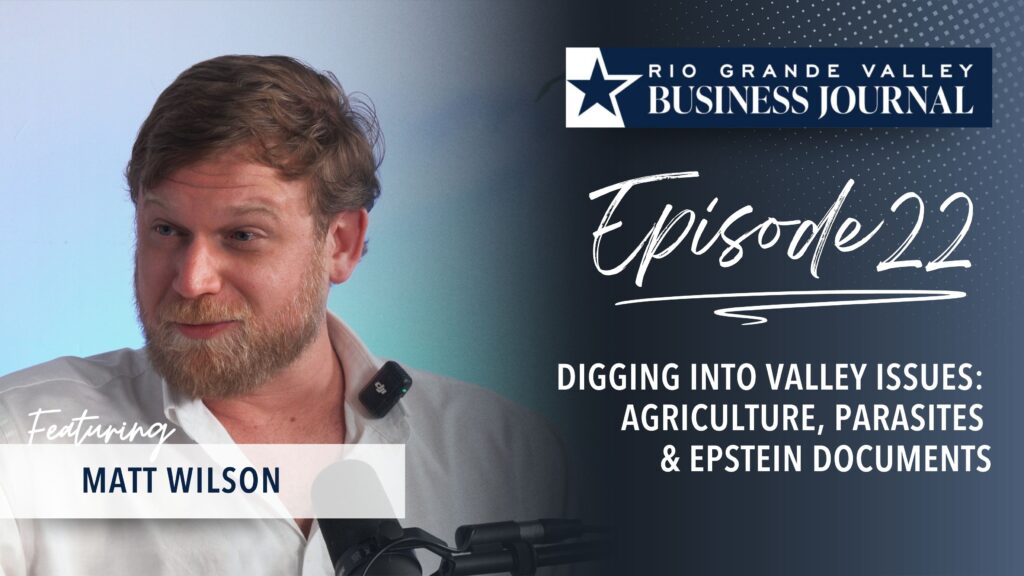
In this episode of the Rio Grande Valley Business Journal podcast, contributor Matt Wilson discusses two topics drawing attention across South Texas: the potential return of the screwworm parasite and newly released documents that connect Jeffrey Epstein to the South Padre Island Golf Club.
Wilson, who grew up in Edinburg and has deep ties to the region’s agricultural community, explains why farmers across the Valley are increasingly worried about water shortages and the potential economic impact of the parasite if it spreads again after decades of eradication.
The episode offers a behind-the-scenes look at Wilson’s investigative reporting and the economic forces shaping South Texas.
The following is a rough, AI-generated transcript of Naxiely Lopez-Puente’s interview with our contributor Matt Wilson. There may be slight errors in the transcription and possible misspellings of proper names. For the full, unabridged story, take a listen above, or get the episode from your favorite podcast host/provider.
NAXI LOPEZ: Another topic that you’ve covered recently that you delved into very deeply was the Epstein connection to the South Padre Island, Golf Course Club.
MATT WILSON: I think it’s really interesting because what those millions of documents tell in a lot of ways is how money works in America. South Padre Island Golf Club was being developed in the early 2000. Great recession rolled around. The developers ran into money issues and with the developers turned to was Jeffrey Epstein. Look for him to link him up with capital.
He tried to in some capacity. He also started paying the salaries of two of the developers. So kind of an interesting local connection. And what I found was it’s just interesting to see how even way down here in the Rio Grande Valley, we can be connected to major stuff in the country like that.
NAXI LOPEZ: Hi, and thank you for joining us on this episode of the Rio Grande Valley Business Journal podcast. I’m Naxi Lopez-Puente, and today we have one of our contributors, Matt Wilson, with us today. Matt, welcome.
MATT WILSON: Thanks for having me.
NAXI LOPEZ: Of course. So, Matt Wilson, have you been following us since September when we launched last year? Has been covering a lot of different topics for us agriculture. Screw worm Epstein recently, so we wanted to get to know him a little better. So, Matt, tell us a little bit about yourself.
MATT WILSON: Yeah, again, thanks for having me. I’m here from here in the valley. Grew up in Edinburg. You know, grew up in the country. My my mom’s family that do a lot of dry land farming. My dad was a contractor, so I’ve got a background in those fields to a degree. Spent my summers in high school working in construction.
So kind of understand that industry a little bit. Understand farming a little bit was never brave enough to be a farmer. And how would you rather like working in the air conditioning? So that’s why I did journalism over like those two industry. But that’s kind of the stuff I enjoy. I, you know, have a lot of family who do that so understands and it really matters to me personally.
NAXI LOPEZ: And you know it comes really handy for us when we’re looking for stories on agriculture. You know you have those connections. Talk to us about what it’s like right to, to to cover an industry that you’ve grown up with and perhaps people that you grew around, with as well.
MATT WILSON: You know, lots of it, honestly. Kind of tragically, it’s sad because increasingly, the valley is becoming more industrialized, which is a good thing. But you see the agriculture industry shrinking a lot. The thing you hear over and over again from farmers is the water crisis. So you can go to, I mean, citrus, you can do the cotton industry, really lots of different types of agricultural industry here locally and all comes back to water, which you know, is a really hard issue to grapple with.
But it’s it’s fun working with these people who have, you know, you’ll go to you’ll talk like a citrus farmer and they’ll say, oh, yeah, my great great grandfather did citrus and they have like a 100 year industry. So covering that stuff, you’ll really be covering some businesses in the Valley that have a history unlike any other business in the Valley, that have really unique stories to tell.
So it’s a lot of fun. Plus, you get to go outside occasionally. You get some for each address. There’s some upsides, right?
NAXI LOPEZ: Of course. And so one of the big things recently, of course, water like you said, is is a big issue. But the screw warm, you know, this darn fly that we keep hearing about and you have kind of delved into the issue, fairly deeply, talk to us about what you’ve learned. You covering this.
MATT WILSON: You hear a lot from and, you know, really on national level at this point, you hear a lot, you know, zombie kind of gruesome, grotesque parasite. But the funny thing is, I don’t think you can use fun really related to screw worms. But the interesting thing is that, you know, this was huge news in the Valley and really nationwide, like 60, 70 years ago.
So if you’re reporting on it, you really have to talk to people who were there then. There’s not a lot of guys around, not a lot of people who are around ranchers and staff who remember it. So a lot of it is very archival. You know, you’ll get clearly that the government is making massive investments and that dealing with screw where I’m at at Moorfield and you’ll get some stuff there.
But lots of it is uncertainty. And it’s it’s kind of interesting seeing the business and, and really the government grapple with this concern that they haven’t had to in years.
NAXI LOPEZ: And so one of our you know, your first piece on, on the series right, talked about how Texas, the U.S. hasn’t really had to grapple with this issue right, in 60, 70 years. So you know, there was a sense, at least from experts, that we weren’t exactly ready to meet this head on. But then, you know, we had, Governor Abbott, I believe, came down, Texas AG Commissioner Sid Miller, and they said, no, we’re ready.
You know, what’s the take on the act?
MATT WILSON: You know, it’s interesting because it it if you look back at the history, it’s something that and I mean, as far back as you can go, it’s not always that well understood, but, you can look back and you can see the United States really grapple with that. It did I mean, 100 years ago was doing tens of millions of dollars worth of damage to the cattle industry.
Now, that estimate is in the billions of it becomes, like, endemic and really a problem. There’s a really unique way of eradicating screw arms, which is really successful. It’s basically an irradiation technique. So like, ultimately they can eradicate the flies, they can eradicate the pest. The question is more like, how long will that take? How significant will the problem become before then?
I think that’s why there’s still a lot of uncertainty, because if you look back, you know, in the United States before, they come up with this technique and start deploying it in the 50s. And then, I mean, here locally in the valley, the last screw worm reports were like in the late 80s. So, I mean, you’re looking at 30 years to eradicate it back then.
And I think there’s a lot of question marks about how that’ll look. You know, back in the day when they were doing this, there were quarantines, which are clearly a concern for the industry. That’s part of the plan. Now, if it’s detected here, more thing that hasn’t been detected here yet. But so I think that’s where the uncertainty comes in.
Everybody you talk to says we’ll get fixed eventually. And clearly the governments investing millions of dollars into that and it will get dealt with. But I think a big question for a lot of people in the industry, even some of the scientists involved, is why is that process look like and how long will it take.
NAXI LOPEZ: And so when we talk about screw we’re not just talking about cattle right. A screw worm can really affect any living organism that has a cut that they can infect. You’ve kind of delved into other issues aside from cattle. What have you learned?
MATT WILSON: Yeah. So I mean, it’s it’s really it’s a gnarly parasite because what happens is a fly while they screw arm flies, which are fairly unremarkable. In fact, they’re not ugly. I mean, they’re kind of a for a fly, pretty iridescent color. But they’ll come and they’ll lay an egg, and basically any sort of cut or wound, small wound and that’ll turn into a maggot that will basically eat something’s flesh while it’s alive.
Very gruesome. But cattle has always been, kind of the major concern because cattle is a huge industry in Texas. But, you know, on top of that, there’s a concern for people. The screw worms can lay their eggs in people, and that can be a problem, much less so, because generally people notice that and can, you know, treat it.
However, I talk to the health department here and, you know, they’ve been educating people on that for the last nine or so months. Texas has a burgeoning hunting industry. I forget the numbers, but whitetail deer hunting is big business in the state. Exotics are. And if you look at, what’s the science around this? Back in like, the 70s and 80s, they noted an explosion in the number of whitetail deer in the state.
Lots of people tie that to the eradication of the screw worms. So there’s a concern for not only the cattle industry, but for some other industries in the state related to it.
NAXI LOPEZ: So you mentioned you spoke to the health department, right. And and you did say that people normally do notice if you know, there’s, an infection like that. But there was a concern about a specific type of population here in the valley that might be more vulnerable to this. Talk to us about that.
MATT WILSON: Yeah. So people with diabetes have diabetic neuropathy so they can sometimes feel parts of their bodies. That’s a concern. I mean usually if you have because essentially what would be is like some worms eating your skin. If a healthy person has that going on they’re going to notice, right. Somebody with diabetes has it potentially they won’t pick up on it.
And then it can turn into an issue that’s more significant medically. Usually it’s not going to be. But we have a very high rate of diabetes here in the valley. So when I talk to them that health experts, they said that is a concern.
NAXI LOPEZ: Are they doing anything to prepare or anything?
MATT WILSON: Lots of education talking to people in the industry. Talking to more high risk groups. You know, it’s not the end of the world, right? Was the impression I got. But they said that they’re saying worth being concerned about. It is worth checking. So. And we could down the road see some human infection.
NAXI LOPEZ: And you have written about those. You know, there were human infections back in the day.
MATT WILSON: There were. And it’s really difficult. From what I’ve seen so far. It’s really difficult to see like how prevalent those were. I mean, you have every once in a while and you can see in Central and South America, the Caribbean, there’s fatalities related to it. And you can find some in Texas. You know, back decades ago.
But yeah, there it’s it’s difficult to tell how prevalent it was. Probably more so before eradication efforts. But there’s you know, I found one report that said back in the mid 30s, before eradication efforts started that were estimating like I think it was like 100 cases in Texas and largely unreported. So yeah, that was a concern back then.
I don’t think it’s going to be as much of a concern now, talking to the health experts there. They’re optimistic about education campaigns and then about eradication efforts, but certainly was before.
NAXI LOPEZ: All right. Okay. We’re going to switch gears very quickly. Another topic that you’ve covered recently that you delved into very deeply was the Epstein connection to the South Padre Island, Golf Course Club. For those that haven’t read that story. Could you give us a little summation about what you found? And then we’ll we’ll get into the details.
MATT WILSON: Yeah. So I think it’s really interesting because, you know, I’m sure everyone’s seen a lot coverage about Jeffrey Epstein and stuff that’s come out given the amount of documents. And I think it’s it’s really interesting because what those millions of documents tell in a lot of ways is how money works in America. So and it’s not all tied to heinous crimes and, and, and some of that stuff we’ve seen in the headlines, Tom, it’s fairly humdrum, but yeah.
South Padre Island Golf Club was being developed in the early 2000. Great recession rolled around. The developers ran into money issues, and who the developers turned to was Jeffrey Epstein. Looked for him to link him up with capital. He tried to in some capacity. He also started paying the salaries of two of the developers. So kind of an interesting local connection.
And what I found was it’s just interesting to see how even way down here in the Rio Grande Valley, we can be connected to major stuff in the country like that.
NAXI LOPEZ: I sure, absolutely. And so, you know, I, I know the amount of work it took because, you know, we talked about it as you were coming up with the the angle and the story. But the viewers at home don’t know how much it takes to to dive into an issue like this, especially when there’s so much documentation.
Talk to us. Talk to us about your process and what it was like.
MATT WILSON: Yeah, it, like, you know, where all these documents are. They’re they’re getting posted by the Justice Department, right? I would not say they’re organized really, in any capacity.
NAXI LOPEZ: It’s just like a dad and some sort of jacked.
MATT WILSON: Up, and you can kind of search through them, but it’s kind of difficult. And then a big thing for me was, you know, I got a fairly clear picture of it after I had read several hundred emails, which.
NAXI LOPEZ: Your.
MATT WILSON: Sort of I’m fairly banal, but, you know, I, I think a good maxim for journalism is you want to turn every page, right? So and lots of the emails are repeats, but I think it’s good to go look at all of them. So lots of it was, you know, one of the developers was essentially hired by Epstein as a, construction manager.
So lots of the emails are them talking back and forth about, I don’t like this tile, or I went to Home Depot and they quoted me that. But I think just to understand the story, it really takes looking at that and getting a good understanding of what actually happened.
NAXI LOPEZ: And you know, I think it’s important to say I right now we use it in everything. Right. But you did not use AI to comb through these documents.
MATT WILSON: Part of that is just my own stupidity. Frankly I’m not that good at AI. I mean, you hire a guy who’s your agriculture, correspondent. I guess he’s going to be better at boots on the ground stuff. But no, I pored over a lot of it with a cup of coffee. Lots of legwork, but, you know, worth it.
I think I it’s I think that’s I and clearly, I think AI can be a useful tool, but I think ultimately in this industry, nothing report replaces actual journalism. Nothing replaces having a person who understands a story as best they actually can. I think that’s important. Although, my goodness, it does take a lot of time.
NAXI LOPEZ: Yeah. How long did it take? How long did you work on this?
MATT WILSON: I shudder to think. I think I lost my mind there for a little while.
NAXI LOPEZ: But just a bit. And so, you know, we did talk about, it shows a lot about how money, right, moves things. And as you were looking into this, you know, we saw mentioned about the second Causeway even back then about the ocelot. What did you find?
MATT WILSON: You know, that was one little thing that stuck out to me. You can see, basically, that the developers of the golf club out there, you know, you can see and this is lots of this stuff is almost 20 years old, so it’s fairly dated, but you can really see how they thought about the development, and you really get access to some documents that you wouldn’t see outside of, like a court case or some kind of investigation like this.
So it’s interesting. There was, you know, you mentioned the ocelot thing. There was one part of an email where one of the developers, essentially says that if the new causeway, which hasn’t been developed, but if it was developed, it would potentially further isolate any potential eyes, ocelots and then make it easier to develop further, which, you know, kind of sticks in the craw, the Valley native because I think the ocelots are a good resource and it’s nice having them around.
So it’s it’s you see, an interesting perspective I guess inside perspective.
NAXI LOPEZ: All right Matt, anything else that you would like to add. Anything that you’re working on that our viewers should know.
MATT WILSON: No I’m always looking for stories though just like got and they’re welcome to call me.
NAXI LOPEZ: Okay. All right. Well Matt Wilson thank you so much for being with us here today. Talking about screw form and Epstein. We really appreciate the coverage.
MATT WILSON: Thanks for having me.
NAXI LOPEZ: All right. Okay, well, everybody back home. Make sure to subscribe if you haven’t already. And make sure to catch those stories on our website at RGV Business journal.com. We’ll see you next week.