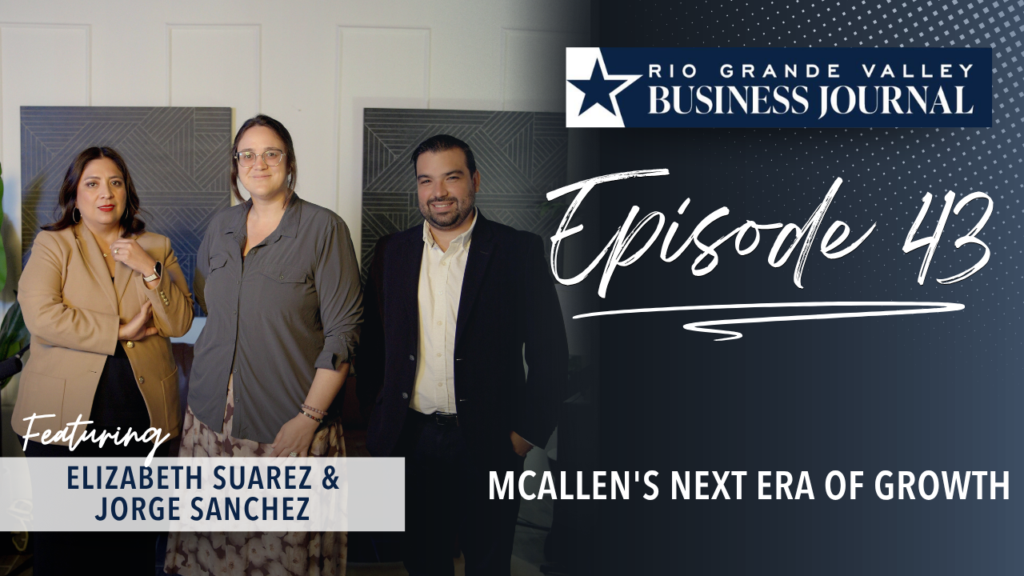
McAllen’s two economic development engines are now rowing in the same direction — and, according to the people steering them, that alignment is starting to pay off.
Elizabeth Suarez, president and CEO of both the McAllen Economic Development Corporation and the McAllen Chamber of Commerce, and Jorge Sanchez, the chamber’s senior vice president of small business and innovation, discuss what’s changed since the city combined leadership of its two flagship business organizations under one office in late 2024.
The biggest headline: Valeo, a French tier-one automotive supplier, is building its first North American plant — and its only BRAIN Division facility — in McAllen, a $225 million investment expected to create more than 500 jobs. Suarez credits the win to years of workforce development work with South Texas College, Texas State Technical College and local universities, and says the city is now racing to build a pipeline of engineers and technicians to match it.
The conversation also covers the pressure that growth is putting on McAllen’s power grid and water systems, why the city is pushing to extend a planned 765-kilovolt transmission line into the Valley, and how Mexican national shoppers continue to anchor the region’s retail economy even as spending patterns shift.
On the small business side, Sanchez walks through Latina HOPE, a 13-year-old entrepreneurship program for women, and Project Next Move, a 17-question assessment that connects small businesses with chamber and university resources. He also introduces Cross Flip, a resale app built by a local entrepreneur through the chamber’s InnovationTX accelerator.
Watch the full conversation below, on YouTube, or listen/view wherever you get your podcasts.
The following is a rough, AI-generated transcript of Kristen Mosbrucker-Garza’s interview with Elizabeth Suarez, president and CEO of both the McAllen Economic Development Corporation and the McAllen Chamber of Commerce, and Jorge Sanchez, the chamber’s senior vice president of small business and innovation. Minor errors and misspellings may appear. For the full conversation, listen to the episode above or through your preferred podcast platform.
Elizabeth Suarez: I think for me it’s that people lean into the chamber — that you invest that money and yourself in learning, that we become a real culture of learning and supporting one another. I think a lot of those things we already naturally do, but it’s important that you’re connected. We hosted an event for Valeo.
Three or four Realtors showed up to the event. Two of those have sold the first homes to that company. Business happens if you’re in the room, and we can’t forget that. Go get whatever you need. Get that investment going. Invest in yourself. Do it with discipline and show up. That’s already more than half the battle.
Kristen Mosbrucker-Garza: Hey, y’all. This is Kristen Mosbrucker-Garza, a news reporter here at the Rio Grande Valley Business Journal. We have some special guests today on our podcast: Elizabeth Suarez, who is CEO of both the McAllen Economic Development Corporation and the McAllen Chamber of Commerce, and her colleague, Jorge Sanchez, who’s also with the chamber — remind me of your title, it’s small business and innovation, correct? Awesome. So we’re just going to have a free-flowing conversation. Feel free to subscribe, everyone. Thank you so much for being here. We really appreciate it.
Elizabeth Suarez: Well, we’re glad to be here. Any opportunity to talk about all the exciting things we can do to support small business and pitch new opportunities for industry, we’re always excited to talk about that.
Kristen Mosbrucker-Garza: For sure. For folks who may not be very familiar, I think a lot of people remember you from your airport days as an executive in the community, and then with the chamber. And for folks who may not remember, we had Mike Allen at the EDC, and then Keith Patridge — big figures in our community. Then there was a reorganization. Just to remind folks a little bit about your role in the community —
Elizabeth Suarez: Yeah, we’re at an exciting point in the history of our city, McAllen, and really across the Rio Grande Valley — so many great things happening. One of the things we’re tasked with is really looking for ways to innovatively work together and align resources. We were grateful for the opportunity that Isaac Tawil gave our team. He came to us in late 2024 to ask if we’d be interested in engaging with our board about a shared role for the CEO and administrative team. His vision was to align economic development efforts a little closer to how the state office does it — right now the state Economic Development Office oversees industrial development, small business programming and tourism development as well. At the chamber, we were already doing outreach with the small business community, building entrepreneurial programs and working with our tourism community. So that program of work lent itself to incorporating an industrial economic development, business angle, and we were excited for the opportunity.
We know we’re still newlyweds because we’re still in transition — even though we’ve completed our first full year and we’re halfway through the second year, it’s still really new. We’re still learning how the alignment works: where do we duplicate efforts, how can we avoid duplicating efforts, where does the city’s role begin and end and vice versa. I think it’s been a great year and a half. It’s a lot of work, but we have endless opportunities, and the alignment has worked really seamlessly.
It should feel this way. Anything that starts industrial and feeds the small business community — and the small business community has a competitive opportunity to also get in front of industry and serve them. At the end of the day, tourism is affected by the work we do on both sides of the house. It’s been a really nice opportunity.
I’ll tell you, the biggest blessing I have is to work with the most amazing group of professionals and experts. We have different vice presidents who lead the different programs of work, each of them experts in their own area. We’re really proud of the work we’ve been able to do so far.
Kristen Mosbrucker-Garza: For sure. And it’s budget time — for folks who may not be familiar, cities across the Valley, all the EDCs, everyone’s getting together and putting together their strategic plan for the year. I happened to sit in during a Brownsville city commission meeting, and their EDC had come up, and they were saying they actually want to invest in a workforce development arm — something new they want to do. So I’m wondering, are y’all still going through that kind of piece of your strategy for what we may expect in the next year?
Elizabeth Suarez: Yeah, I’ll tell you, budgets are tough. The city of McAllen has a really healthy fund balance, and we’ve been one of the communities that’s been really successful — really proud of our city management, governance and city commission governance, because we’re one of the few communities with an A-plus Fitch rating. That’s a big deal, you know.
Kristen Mosbrucker-Garza: So for folks who may not be familiar, she’s referring to the bond rating. That means when the city goes out to do a big infrastructure project, they get lower interest rates.
Elizabeth Suarez: Right. And it takes — I remember the days working under my previous bosses. I started my career 26 years ago. I’ve worked for Mike Perez, for Roy Rodriguez, and now with Isaac Tawil. I think the foundation in McAllen has been so strong in terms of a fiscally conservative approach — pay as you go. We’ve been smart about when it’s time to get debt and issue it, and we’ve looked for opportunities. We’re really proud of that. This year, the city has reduced funding for outside agencies — we’re working with some slight reductions there for the chamber and EDC. But those are real opportunities for us to look at what our priority activities are. I think those are good exercises for us on the fiscal side.
At the chamber, we just sat down and surveyed our membership. I’ll give you an idea: we’ve got about 1,100 members. We had about 500 members that had not renewed. When we reached out to find out why they weren’t renewing, what we heard right away is that they’re struggling. This year, it’s easy to get caught up in the fundraising moment — creating galas and fundraisers to increase resources for the community.
But at some point, it’s like really sitting and looking in the mirror and saying, are we doing enough? What is enough, and what does the business community need? Before we even knew we were going to have budget cuts to deal with, the question was: to help a business — and that doesn’t always take money — what do they really need?
So we started doing the rounds with the businesses that couldn’t renew, and even the ones that are renewing, to understand what the real challenges are. There are real challenges happening down Main Street right now. We don’t always talk about it or see it in the news, but they’re real. As we sit with those businesses, I’m excited for the work that Jorge has done, and I’ll let him do a deep dive into what those programs are.
This year we’re offering a variety of free programs — it’s resources, it’s sitting with our business community, it’s putting a mirror in front of them, too: what are the things they need to face, and how do we support them? How do we hold their hand and walk them through processes that are really challenging?
It’s not always easy to know what resources are out there, so I’m really proud of that program of work. On the chamber side, the other thing that’s near and dear to my heart is the work we do with entrepreneurship. Jorge had a phenomenal program he just wrapped up.
It was a two-year program called InnovationTX. We lost our funding for it, but we’re not done trying to get it funded — we’re doing all we can on the philanthropy side with our foundation, looking for tax-deductible donations, because workforce development is where all paths intersect, both at the chamber and at the EDC.
We’ve been doing workforce development staunchly for the last three to five years. We’re one of the EDCs that has a resident workforce development expert who had a career with Workforce Solutions for over 15 years and spearheads the workforce development angle on all of our projects. You’ll see us with an expanded footprint of programming that speaks to workforce development.
We have to continue, as a region, to grow the network we have with our universities, to make sure our EDC’s efforts are opening the door for industry to sit at the table and help guide how we develop courses and what apprenticeship programs we really need to fund.
What is our public school system doing to promote CTE programming? When we speak to industry and try to land them in our region, the first question we get is, how is your CTE program? The second is, tell us about apprenticeships — because studies, including European models, have found that in sectors like automotive, employees who come in through a CTE or apprenticeship program tend to stay 20 years or longer with the company.
There’s something to be said about giving talent a mobility pathway — that’s what these programs do, and they’re essential to what we’re doing here. And I’ll tell you, when we landed Valeo, that was a big win for our region.
Valeo is a tier-one automotive supplier — one of the top three, one of the biggest. It’s a company based in France with worldwide locations. We’re their first North American plant, and the only Valeo BRAIN Division plant they’ve built. One of the tools that served us best was our young population, our university systems, and their commitment to STEM — the number of engineers we graduate each year ranges from 3,000 to 4,000, and 60% of those engineers, on average, are leaving the community because we don’t have jobs.
So they see a workforce that’s eager, developed, trained and ready to work. Now we’ve got to put our money where our mouth is and make sure all of the job descriptions this employer has will have a matching program feeding it at the university system. We’re starting with the university programs and the community college.
South Texas College is really a leader in advanced manufacturing. When we work with the folks at Toyota in San Antonio, there’s a substantial percentage of every employee pool coming from the Valley — individuals trained through STC and TSTC. You mentioned Mike Allen.
Talk about a foundation that was really designed to keep empowering a community. I had the fortune of knowing Mike Allen, meeting with him on several occasions when I started with the city — I started in public transit, and he was someone I met with a few times for mentorship. His leadership has continued to feed this community.
They had a vision for a day when our people here would have an opportunity for quality jobs and to show off something that’s very special here — it’s not like this anywhere else in the world. It’s an employee who wants to advance. It’s not just about me — it’s about the fact that my mom and my dad didn’t have this opportunity.
I have it, and my kids are going to do better than me. It’s that immigrant story. My grandpa used to say, my heart is in Mexico, but my stomach is in the U.S. — a lot of us live that daily, and it’s still very much a part of our culture that hasn’t gone away.
That makes us such loyal, hard workers, and it’s part of our story and what we do daily. It’s not about selling that out or giving it away — it’s about intentionally looking for opportunities that match us, highlighting the skill set of the employees we have, and giving our local talent more opportunity for growth, so that in the next five to 10 years we’re truly a transformed community.
I’m excited because we landed this deal, and we’re on the ground doing the work daily. If you could see our calendar — it’s not easy work, it’s not sexy. I’m not doing ribbon-cutting pictures. I’m not on the microphone. I’m not in the magazines. I’m not buying the pay-to-play ads.
That’s not where the heart of the work is. The heart of the work is sitting with the professors, writing the program, taking them to the plant, making sure we’ve got the right students. The first student got hired at Valeo — it’s an internship position.
Kristen Mosbrucker-Garza: They just got hired.
Elizabeth Suarez: They’re a college senior — it’s a $56,000 job, and the company has committed to offering full-time employment once that person graduates. This is real — it’s not just a plan on a wall somewhere. That’s what I’m excited about. The ramp-up starts soon. We had the first group of Valley executives land —
McAllen is now their home. We’re excited about those families coming into town, and it’s just starting.
Elizabeth Suarez: I don’t want to go into a lot of detail, but it’s not going to be more than 20 executives — everybody else, we’re looking for local talent. The ramp-up will probably start next summer. Full-scale operations will be ready to go in January 2027.
Kristen Mosbrucker-Garza: So for folks who may not be familiar — my general understanding is that Valeo had been operating for years and years in Rio Bravo. It speaks to this bicultural, binational, bilingual community we have — a lot of companies and people are active on both sides of the border.
Whether it’s a twin-plant facility or historically — in their case, I think they’d been at another location for —
Elizabeth Suarez: Over 30 years.
Kristen Mosbrucker-Garza: Yeah, for decades. It just so happened that folks were doing a business retention visit — just checking in — and they said, well, actually, we’re looking to expand, and that kicked off a lot of these discussions. The total cost of construction is probably going to change, but roughly $225 million, and more than 500 jobs.
And these aren’t minimum-wage jobs — these are skilled jobs considered high-paying in our community, and it’s going to range as well. They’re physically building this new manufacturing facility — it’s down off of —
Elizabeth Suarez: Ware and Military.
Kristen Mosbrucker-Garza: Yeah, and I’ve driven past it once or twice, which is really interesting. But coming back to downtown and what some of the small business owners are saying — something I’ve noticed is that our economy has been going through some really massive changes.
Not just in the past year, not just in the past five years, but really even before COVID. Over the past decade we’ve probably seen more change in the way our economy moves, the way people spend money and the way people work than ever. I really think we’re undergoing a revolution of sorts, especially now with AI.
And I think it always trickles down to Main Street and small businesses, because I used to live in the Valley about 10, 15 years ago, and I remember when there was no Level I trauma center, no medical school. We had a smaller community.
There’s nothing wrong with a smaller community — it’s just different. Coming back into the Valley now, I see the growth and how much has changed. I’m even going to hang out with the folks behind Bert Ogden this evening — they’re building some kind of headquarters on Main and Fern.
If you look at some of their filing documents — the companies we do have, especially the local corporate employers, historically we haven’t had that many of. Historically we’ve had workers — maybe on a visa, maybe in a factory setting or in the fields.
But we haven’t had a lot of corporate headquarters as a community, and now we’re starting to get a little bit of that. I just see a lot of those changes. On the small business side, we have so many remote workers now, especially since COVID — so many new people who love the sun.
They love the weather, and they spend money differently — they might buy more stuff online. So a lot of small business retailers that have historically relied on foot traffic and traditional marketing strategies are really just showrooms now, because they’re selling most of their stuff online.
So when people talk about shaping policy around small business and economic development, I feel like sometimes we miss the reality of how rapidly everything is changing around us. Even — you used to look on Yelp for a food review or a restaurant to go to.
And now a lot of times that’s integrated into Google. Your Google review matters more, your “near me” matters more, and your ability to show up in the large language models matters more than it ever has.
Elizabeth Suarez: Well, you said a lot — I’ll start with this, and then I’ll let you talk more, because he’s obviously more tech-savvy than I am. The first thing I’ll tell you is we’re still very much a Main Street economy. Ninety percent of our business is generated by small business, so small business is the backbone of our economy.
That’s the first thing I’ll say. It’s a challenging world that’s ever-evolving. I’ll talk a little about Jorge’s perspective — he’s one of our longest-tenured chamber members; he’s also the owner of McAllen Sports, a downtown establishment. One of the things he says when we talk about the relevance of the chamber, why it’s worked for him —
Why did he keep the membership? What’s been his experience? One thing he shares is that chamber membership works like church — you’ve got to go to Mass for it to work, so you’ve got to be engaged. It’s not a secret formula that works just by signing on.
You’ve got to be engaged, and it’s an important lifeline. The other thing he talks about is that as businesses, we have to challenge ourselves to change. He says, I remember the ’80s, I remember the ’90s — I used to shop at McAllen Sports, I grew up a few hundred pounds ago, I was a volleyball player, and we used to wear those Asics Tiger shorts, and you could only find them in his store.
There was no online. So we’d order them for the whole season and he’d keep them in stock. If he’d kept that business model, he’d be out of business. He saw it right away — third-party selling, online selling — and the businesses that refused to adapt are no longer around. That never changes.
That’s something you and I have talked about in the programs he offers — maybe touch on Latina HOPE and what he’s doing with skill sets, and a little about what we talked about with AI certification.
Jorge Sanchez: Absolutely. I think a lot of people forget that economic development is a three-legged stool. There’s recruitment, there’s retention — but I think the third leg that’s commonly overlooked is entrepreneurship. Over 90% of our small business community generates its own income.
So through small business, through entrepreneurship, we give a person the opportunity to meet their own needs. That’s exactly what we’re trying to do with Latina HOPE. It’s a program conducted in Spanish. It’s been here for more than 13 years in our community, and we foster entrepreneurship among women — typically women at risk, women who have been in tough situations and need to generate their own income.
They come to us and we help them learn a new skill — typically a handmade product — but most importantly, how to monetize it. We train them how to take pictures, how to post online, how to run their own e-commerce shop, and how to monetize their skill. After a year of training, we hold a small business grant round, where we award up to $956 to several participants so they can generate income and reinvest it into their new skill.
The most important part of this isn’t the money, and it’s probably not the skill either. I think the most important part is that they feel empowered in a group where they feel safe. You’d think the women might be competing with each other — that’s not the case.
We’re seeing a community that’s building from each other, teaching each other how to do different things so they can expand their opportunities and move forward together. Latina HOPE started 13 years ago here in McAllen. It’s already operating in Starr County as well.
Kristen Mosbrucker-Garza: Really? When did that start?
Jorge Sanchez: That started around two years ago. United Way has been a tremendous partner in making that happen. They said, the people in Rio Grande City need something like this — what if we launch it there? Currently it’s operating in Roma, and we’re talking about expanding the program further.
But that’s just one example. As Elizabeth mentioned, we need to keep our focus on who we’re serving. We need to adapt and think like the people we’re serving — our small businesses and partners adapt to different situations, and if for some reason tomorrow we don’t have funding to do what we do, I think we can keep adapting and creating resources for our small business community.
We have 56 different programs at the chamber that help small businesses through networking, leadership, education and a lot of different channels. But giving small businesses a menu of programs and events isn’t enough — we need to walk alongside them. Because of that, we created a program called Project Next Move.
It’s a very simple assessment — 17 questions asked of a small business. It doesn’t ask open-ended questions; it gives five options per question. Based on the answers, it gives a recommendation of programs the chamber already has, programs the university already has for small businesses, and — most importantly — ESOs, entrepreneurial support organizations, in our community.
Any grants that are out there — this is already available; if you go to the McAllen Chamber of Commerce website and search Next Move, you can test it yourself. Most importantly, we receive that report as a chamber and assign a person who will walk the talk with you, making sure you connect with the right resources,
depending on your specific project.
Kristen Mosbrucker-Garza: So do you have to be incorporated, or have your business located inside the city limits of McAllen, to participate? What are the requirements?
Jorge Sanchez: I’m a strong believer that we are a region, and whenever we start thinking with limitations, it becomes a reflection of the limitations we put on ourselves. So this is open to anyone. You don’t need to be incorporated — you don’t need to be an LLC, an S corp, a C corp or a DBA. Even if you’re just doing business, fill out that form.
It’s 17 questions, three minutes to fill out, and you’ll see what your specific next move needs to be.
Elizabeth Suarez: And we’re looking for ways to also integrate cost savings. The economy has been the harshest common denominator we’re seeing — expenses are higher, costs are higher, and businesses are having a hard time keeping up. Most have absorbed a lot of the increased expenditures that resulted from tariffs, for instance. So the conversation we’re having is: what tools can we give them?
We’re really excited to be partnering with a media company offering a deeply discounted rate on digital marketing for chamber members — that’s a way to make your money work for you. We also took the list of professional consultants who are chamber members and gave them a call. Most agreed to one hour of free services.
So we’ve got a list of CPAs, a list of attorneys, a list of different resources you may need. As we determine through Project Next Move what your challenges are, we’ve got an answer for it — a marketing expert, an accountant, an attorney. They’ll give you an hour for free, then a discounted rate for ongoing services.
That matters to me because that’s real money in your pocket. Some of you are small businesses, but one of the key components of our programming this year is teaching the integration of AI into your business — and not just ChatGPT, I’m talking about AI solutions. We’re looking to grow that into our market so we can teach those tools and not stay behind.
We’ve made it a mission of our whole team, both at the EDC and the chamber, to set up the tables and chairs for everyone and make sure we’re at the table talking about AI, preparing for AI. This will be our third year overseeing the McAllen Economic Summit, which is completely dedicated to AI and understanding what it’s doing to transform our world.
That’s very important to us. When you look at studies about technology, one of the biggest things we’re learning is that Latinos aren’t part of that formula. The Valley needs to be at the table — we need to speak for ourselves and give our community those resources. I’m excited, though we haven’t quite figured out yet how certifications will be worked into the programs.
We’ve had some excellent meetings with partners in the community, and I think we’re all invested in that same effort, because we know it’s here, it’s not going away, and we might as well teach our community the benefits and how they can integrate it.
Kristen Mosbrucker-Garza: Why do you think there’s been less adoption among Spanish-speaking communities, Hispanic folks, Latinos or Chicanos — however they identify? Do you think it’s that we tend to ask for advice from family members or tight-knit communities more, or — what’s driving that?
Elizabeth Suarez: I can give you a ton of anecdotes — I don’t speak for the community that way. But what I’ll tell you is what we’ve read in business journals: we know they’ve been left out of that conversation. I don’t know why we do that. I don’t understand it, but now we know we need to act.
That’s kind of where my focus is. I don’t know if it’s cultural. I don’t know if we’re just a little slow to it.
Jorge Sanchez: I think it’s a combination of everything. I used to have an aunt who said, if you wear a good coat and go to a bank, you’ll get a loan — and that’s not how it works. That’s part of the culture. But one can only make assumptions — what’s the biggest representation demographically in our blue-collar market?
And maybe that’s Hispanic. I could be a great tool administratively, behind a desk, but in the field I can’t do much. So maybe that’s one assumption, but we don’t know — we don’t have the data.
Elizabeth Suarez: There’s also cost associated with access — do you have the equipment, do you have the right — I don’t know, it could be a whole —
Kristen Mosbrucker-Garza: Do you even have the internet? The infrastructure — we’ve seen a lot of investment in broadband over the years. I think what stalled our downtown was that it had the only dark fiber available, and it kind of had to —
Elizabeth Suarez: All the other centers, yeah.
Kristen Mosbrucker-Garza: And with all this talk about data centers — it’s funny, because I used to work in San Antonio, where I covered cybersecurity, technology, research and development, a bit of education, and the U.S. military as a business, which included data centers. Years ago, a data center was literally just a closet in your business.
You just had your server in the closet, then we moved to the cloud — servers in the cloud, a shared closet, and the co-location data center is like the Chase Tower. It’s really only somewhat recent, honestly, with hyperscale. And even inside hyperscale data centers, there’s nuance — different power sources, different cooling systems.
I think I wrote about the data center cluster in Willacy County. That data center conversation could be a lot more nuanced, especially because we’re now starting to get infrastructure and interest.
Elizabeth Suarez: There’s a lot of misinformation, too, and I don’t blame our communities for reacting with concern when they hear about these projects. As leaders in industry, it’s really important that we push our industries to be as transparent as possible,
while also staying competitive in the market. But once we’ve landed a project, there has to be an integration of that industry into the community. We have to be intentional about the industries that fit — understanding our power grid and water infrastructure, to know what we can reasonably accommodate. Our goal isn’t to cast a net into the sea and see what we catch — it’s to hand-pick.
With Valeo, that’s how we felt — that it was a company that valued workforce, had competitive wages, didn’t need a huge footprint, and was looking for advanced skill sets. We knew this was the type of company that would elevate the game for our community, so we want to be just as selective as we continue to grow opportunities.
In McAllen, we’ve got 2,200 acres vacant and ready to be developed, and we’ve got to be picky about who we partner with and how. Valeo is also really focused on sustainability — water reuse programs, emergency preparedness, safety and security.
There’s a lot of conversations that go into this pitch and this process of landing a deal. We continue to work closely with ERCOT and with AEP on distribution. We’re really proud of the work we’ve done at the EDC to make sure they’re at the table with our city leadership, so we understand the dynamics of the grid and where we stand.
We cannot be waiting for the power company to tell us what that is. We need to be leading that conversation.
Kristen Mosbrucker-Garza: And AEP has been trying to really build out the substations in McAllen. I covered some of that — the demand has really outpaced supply. There’s been so much growth, whether residential, commercial or industrial — it wasn’t just one type of business or community requiring that electric growth.
But it takes time for them to build the transmission network and the infrastructure — and then whether or not we’re going to get that big 765-kilovolt line from West Texas down —
Elizabeth Suarez: It’s not slated to come to McAllen or to the Valley — it stops in Corpus Christi. That’s a big problem. That’s the Howard-Solstice project. We’ve been advocating that they expand it all the way into the Valley. We need to be thinking about where we’ll be in the next five to 20 years and planning for that.
In the aviation world, when you’re at 60% of capacity, that’s when you’re requesting funding for the next potential growth. We’re at 90% of capacity. Communities can’t be dormant to this — economic development isn’t all the fun pictures and sexy stuff. It’s really hard conversations about how we move forward.
It’s collaboration — that’s why we’re so grateful for the leadership at City Hall, and that they’ve built this model where the EDC, the chamber and the city are working so closely together, because it has to be that way. If not, it’s fragmented. For us, it’s about making sure infrastructure partners are at the table at City Hall, looking at land acquisition plans, master plans for substations.
What zoning requirements should we have? Where should we be developing? All of this is essential. We’re grateful — we’ve always had very strong water leadership at our city as well. We’re at 60% of capacity at peak usage, so we have a healthy approach to water, and a phenomenal reuse program we’re approaching with desalination.
I’m glad to hear most Valley communities have some version of that. Diversification of water sources is essential to what we’re building. Texas is open for business, and the Valley is right up on deck, ready to bat — we’ve got to be ready to go with those conversations.
Kristen Mosbrucker-Garza: And even from the immigrant business owner perspective, I’ve noticed — just anecdotally — that we have entrepreneurs from other Texas markets moving to the McAllen area. They basically say, hey, I used to run a business outside of Plano, I used to run a business in Austin —
I used to run another business in Houston. This market is a growing market, looking for — whether it’s a restaurant or a services business or something from their specific culture. Historically we’ve had a more homogenous culture down here, but now we’re diversifying as a community, with entrepreneurs from other cities saying it’s too expensive, the rent is too high —
I can’t charge that much. And they’re coming down here.
Jorge Sanchez: We were just talking this morning about that. I think that’s our advantage as a region — our affordability is still there. Every quarter we do a report for an organization called the Cost of Living Index. More than 300 cities across the nation participate. We survey different products and services in our community and send it to that national organization.
They come back and tell us how affordable our city is compared to everyone else. We’re always in the top three to five most affordable communities in the U.S. So I think we’re a paradise for digital nomads and for those who sell goods and services online and can serve other markets but live here — one of the most affordable places to live in the U.S. It’s a paradise.
You’ll get a bigger bang for your buck, more purchasing power for a better quality of life. And talk about quality of life — our higher education is there, McAllen ISD is there in terms of quality outcomes. It’s a market that’s very attractive, especially for young families.
Kristen Mosbrucker-Garza: I’ve heard we’ve had so much investment in the ISDs, both on the public school side and now the charter school side. If you look at some of them — I like to watch the construction records — Vanguard Charter is expanding, I think, three or four schools in this area.
And some of the other schools as well, as Texas rolls out its voucher program. When you look at where we’re expanding, under the jobs report it falls under private education and health services — I believe that’s sometimes difficult to parse out.
I’ve noticed that both on the construction side and the jobs side. There’s so much happening — I’m wondering, in that new industrial park where y’all got the EDA grant — for folks who may not be familiar, the U.S. Secretary of Commerce came to McAllen for the GE Aviation plant.
I honestly didn’t even know that plant was here — that was like —
Elizabeth Suarez: It’s been here for over 30 years. It’s not a secret.
Kristen Mosbrucker-Garza: Right, so — the years.
Elizabeth Suarez: They’ve employed between 300 and 600 people, and it’s actually one of their fastest-growing plants. They’re about to hit their $1 billion sales marker — that’s a big deal. That means they’re ready for the next level of expansion. And if you’ve been on any Boeing aircraft, chances are it’s been serviced at our McAllen plant.
Kristen Mosbrucker-Garza: Really — I feel like the general public may be less familiar with that, but maybe folks in the business community are. We had folks representing the federal government here, and y’all got an EDA grant to help with some infrastructure on a new industrial park. It sounded like the initial anchor was to help some local businesses in the cold storage area.
They’re investing — I think it was about $34 million of private investment — to match some of the federal funding, to build out bridges and infrastructure. How much more industrial development — you mentioned 2,200 acres — how much more does McAllen have to expand?
Elizabeth Suarez: We’ve got five industrial parks with vacancy, and we’re selling that right now. We also have city-owned property at Moore Air Base — an opportunity, should the demand be there, for a mega site.
Kristen Mosbrucker-Garza: For folks who may not be familiar, Moore Air Base was Moore Field, and that’s where the screwworm facility is — there was fruit fly research there, too. This is on the far north side, near Monte Cristo, right?
Elizabeth Suarez: Yeah, the northwest part of town. There’s a lot for us to do, a lot for us to sell. I’m excited — we’ve got a lot of work, and that connection is essential to us. Let’s not forget all that work — 30 years of binational manufacturing in Reynosa, such a well-developed maquiladora area.
I think unemployment there is at negative numbers, and right now they’re looking to bring people in. They just announced a big project — the McAllen EDC has provided support on that project with Valeo. We continue to support business development on both sides of the border because it impacts our tax base, either through property development and capital investment —
if it’s happening on this side of the border or on the Reynosa side, the retail tax and the back-and-forth movement of goods and services is important for us. There’s a lot more happening and coming, and we’ve got plenty of partners at the table. The city applied for that grant and was able to get it to support park development.
We’re excited about that — it gives us another tool and more property to sell.
Kristen Mosbrucker-Garza: Historically, I think a lot of people think of McAllen — even the days when there was a lot of effort to bring Mexican nationals in for shopping and investment opportunities. How has that changed in recent years? I know y’all did a study — you hired a St. Mary’s professor to track cellphone data from Tamaulipas, or something like that,
in terms of the impact — because from the perspective of someone who lives here in the States, you’re driving around thinking, why do we need six Ross stores? And then it’s like another TJ Maxx, but if you go inside, there’s a line 20 to 30 people long. Sometimes you have to plan your shopping trip and be a little strategic about it.
Elizabeth Suarez: Some small businesses — the lines aren’t that long.
Kristen Mosbrucker-Garza: I just wonder how the strategy has been here in terms of encouraging the Mexican national shopper and their dominance in our community.
Elizabeth Suarez: It’s essential to what we do. We will never lose that part of our work focus. You generated the numbers for this month — sales tax is up, what, 12%?
Jorge Sanchez: Twelve percent from last year, for the numbers in August. So although you might not see as big a number of Mexican nationals flooding those stores, the retail sales are there. What we’ve seen is that the pattern has shifted — instead of coming for three or four nights, they’re coming for one or two nights but spending the same amount of money.
So that’s the trend we’re seeing on the retail side.
Elizabeth Suarez: And maybe not even that — we had the hotel occupancy report, and we were at 70% occupancy, the highest we’ve been in a while; we’re averaging about 65%. I just feel like that work is essential — it will never go away. It’s natural to us. We always, as people, live one foot in Mexico and one foot in the U.S., and that’s an organic part of who we are.
It’s not going away. We’ve been very lucky that our leadership approach has been to continue to engage rather than resist. We don’t close doors, we don’t close businesses — we open them, we promote them. I see that as a beautiful part of who we are, and it’s not even just about economics — it’s the connection that brings both countries together.
That’s very much a part of our general culture and openness. Building that dynamic is important. The city continues — we’ve shifted how we’ve worked. It used to be that the chamber ran all international relations for the city.
About two years ago, the city developed its own Office of International Relations. They’ve done a great job with that — they’re trying to ensure diplomacy is tied to economic development missions, and that’s worked out well. The chamber provides support as needed, and we’re happy for that work — it continues, and that investment continues to come this way.
I don’t see that ever changing. That’s a part of who we are.
Kristen Mosbrucker-Garza: Something else on my radar was the film designation — from the tourism aspect as well. What is the designation y’all received, and what could it mean? I think we’ve already had some filming in the city.
Elizabeth Suarez: So we got the designation as a Texas Friendly filming community. We become part of a database that Texas promotes for film production. I’m not sure what productions we’ve had, but I know they’ve already issued some permits. It’s important — why not? Tourism is economic development.
Film is economic development. We’ve all seen the narco movies where they talk about being in McAllen and there are mountains — well, now they can really come film McAllen if that’s what they want to film. I think there’s a lot happening there.
Kristen Mosbrucker-Garza: Wasn’t it the Selena movie?
Elizabeth Suarez: I don’t —
Kristen Mosbrucker-Garza: — know, they said they were in the Valley, or they shot around it, and it’s rear-projected —
Elizabeth Suarez: — enough. That’s what I remember. But I’ll tell you the time is right. It’s been exciting, there’s so much talent. Our team has been working closely with the governor’s office, and Lee Woolridge, our VP of tourism — she’s amazing, very talented, so good to work with.
She was one of the few people invited to join Team Texas in London for a promotion of Texas. We were able to take a couture fashion designer — I believe his name was Carino — and, along with Michael and me, highlight his fashion. It was phenomenal. We did a blitz trip throughout London.
We had a lot of traction. There’s a lot of work for us to do in terms of economic development — when you divide the work between small business, economic development and tourism, there’s so much to be done. We’re just starting, and I’m glad that kind of thing is on our radar. There’s more.
We’ve tried to collaborate closely with Kate Horan at the McAllen Public Library — she’s a phenomenal asset for our community, an expert in culture, history and art. We do the same with Dr. Francisco Mercado, who’s phenomenal in our community, and with IMAS — we really try to make sure they have a place at the table as we engage with them, because as we look for real business opportunities, world, culture, art and history — those are our experts.
We want to make certain that work is well-intentioned and aligned with those partnerships.
Kristen Mosbrucker-Garza: And y’all really leaned into the FIFA World Cup. I saw some of the economic impact reports on that — kind of like with the holiday parade, too — drawing in a lot of the audience and capitalizing on the uniqueness of the moment.
Elizabeth Suarez: Yahaira has some real creative ideas for how she promotes that convention center campus — that was one of them. I know she expected a huge crowd; I don’t think she expected that huge of a crowd. It speaks to that importance, and there are so many cultural elements we forget. I think it happened in such an organic way, too.
We didn’t put a lot of money into promotion and marketing — she had the license to showcase it on television, and it paid off. More than the economic impact, it was neat to see the community come together. You don’t see that very often, and in such a safe way.
We worked the holiday parade, we worked the Christmas in the Park event. In the past I’ve done the Spanish hosting for the parade — I’m never really part of the event — and this last year I passed the baton to somebody else and worked Christmas in the Park.
It was phenomenal. I went to school at St. Mary’s and was in San Antonio for a few years for Fiesta and all that, and it’s such a different crowd here — such a different community. The parade had live bands and live music. There were families waiting for the procession, dancing with the little kids, singing, laughing.
I just feel that’s the heart of who our community is, and we can’t forget that — we’ve got to build on that. It becomes such a strong foundation. I’m happy we have that film designation, because I hope we can showcase that part of who we are by being introduced to that part of the world.
Kristen Mosbrucker-Garza: We hosted an event, I think in January or February, with an economist from the Dallas Fed. She looked out into the crowd and said, y’all are really young — because she sees crowds across the state and across the country.
She made that comment, and I thought, yeah — I was living in Philadelphia most recently, and coming down here I noticed there are a lot of children, a lot of families —
Elizabeth Suarez: And a lot of doggies and puppies.
Kristen Mosbrucker-Garza: Yes. Or even — I think last time I lived here, there was a McAllen farmers market, but now there’s —
Elizabeth Suarez: The Dallas project, right?
Kristen Mosbrucker-Garza: You have Señora Kombucha, right? A gentleman who lives here in the area — I was chatting with him the other day, and he even has refillable kombucha. He said his son lives in Austin, and he was there and they had a farmers market with a whole line for kombucha.
And he said, I wanted to try it, and it had really interesting flavors — using the kombucha mother as a base and infusing a lot of things. I’ve noticed a lot of entrepreneurs in the Valley are experimental — they’re experimenting with fusing flavors, like the explosion of all these coffee shops in this area.
I think it’s because of the affordability we’re seeing — almost like a test-kitchen environment happening with a lot of entrepreneurs and people who may have lived in other cities, had those other experiences, and now we’re seeing them pop up in our communities.
Jorge Sanchez: Yeah, and I think it’s such a low barrier to entry for that type of business that it’s accessible — anyone with an idea can just execute it at the next farmers market. We have one at the library, there’s one on the island, another one in Los Lagos, and they’re popping up everywhere. And now with cottage-food laws, it makes it more accessible for people to test the waters and see if it works for them.
Elizabeth Suarez: My favorite entrepreneurs are the young raspa vendors — have you had those? Oh, you need to check them out on TikTok.
Kristen Mosbrucker-Garza: Okay.
Elizabeth Suarez: It is the best. And then there’s one that’s tamarind-flavored — that’s really good, and you put the tamarind pop on top. But then — now my mouth is watering — there’s a “tomboy” one with pickles and gummies.
Jorge Sanchez: Yeah — anyway, and people are getting creative. Like Annie Gonzalez, who created a sugar-free product line — she’s now in H-E-B. Or Lamar Jones, who created a barbecue sauce with a sugar-free option.
Elizabeth Suarez: I’ll let him talk about this guy.
Jorge Sanchez: Oh, shoot — I was about to go there, because not everything is food. I know it’s part of our culture, it’s my favorite, we love that. But we also have tech companies. One cool example: through the program we do called InnovationTX, where we train people on business fundamentals — anyone with an idea, all the way to market — we discovered a young guy named Oshun. He created an app called Cross Flip.
What this app does is you take pictures of your clothing, and it uses AI to analyze similar items in the marketplace. It gives you a suggested price, a title for your product, a description for your product.
But most importantly, whenever you click a button, it posts on multiple platforms at the same time. He’s in talks with Depop to license the app. He’s already live — if y’all have any clothes you want to get rid of, you should try it out. It’s already on the Apple Store.
It’s called Cross Flip. We discovered him — he was doing this from his home. He got trained through InnovationTX, went through Demo Day, got funded, and now he’s really launched.
Kristen Mosbrucker-Garza: And it’s interesting because this area has such a long history with ropa usada — used clothing — and the fashion industry, and just the repurposing of clothing for various reasons and different markets. So I don’t want to take up all of your time, but if there’s one thing — if you could wave a magic wand for something you’d love to see cultivated in our community in terms of economic development by the end of 2026 —
we’re almost there, I feel like.
Jorge Sanchez: Yeah.
Elizabeth Suarez: I think for me, it’s that people lean into the chamber — that you invest that money and yourself in learning, that we become a real culture of learning and supporting one another. I think a lot of those things we already naturally do, but it’s important that you’re connected. We hosted an event for Valeo.
All three or four Realtors who showed up to the event — two of those have sold the first homes to that company. Business happens if you’re in the room, and we can’t forget that. Go get whatever you need. Get that investment going. Invest in yourself. Do it with discipline and show up — that’s already more than half the battle.
Be present, and stay engaged. For me, that’s the magic wand — how do we touch more businesses? Because I feel like, had this young man not gone through InnovationTX, he wouldn’t be where he is now. He needed that grant. And what was more important — even in that whole program, we had three finalists and a panel of judges who are experts in small business development in the community,
and who already have successful businesses. The second-place winner didn’t get the prize money, but one of the business owners on the panel gave him a grant out of his own pocket. I just wish people understood who our business community is here. I’ve been in this job now for three years, overseeing the chamber.
And what I’ve learned about our small business community is, one, they love McAllen, they love the Valley. Two, they’ve made their money here and feel a commitment to give back — and you don’t see that everywhere. They will give back, and the easiest way to meet those leaders in business is through your chamber.
Show up, ask for help, lean into those people. We’re here to serve, and we don’t make money off of that — whether you come or you don’t, we don’t. But we want to serve and connect, because we really believe that what you’re doing as a small business owner is important, and it’s probably different than the way others throughout the state and country are doing it.
So there’s something special here, and we want to continue to feed that, to share it.
Jorge Sanchez: Shout-out to Alex from Fork to Fifth Kitchen, along with his partner, because — as Elizabeth mentioned — out of their own pocket, they believed so much in the product that they said, here’s a couple thousand dollars for you to move forward with your project. So, what was that —
Kristen Mosbrucker-Garza: The second place —
Jorge Sanchez: business — his name is — the company is Encima, a climbing wall facility. I don’t know a lot about the —
Kristen Mosbrucker-Garza: Indoor rock climbing.
Jorge Sanchez: Yes, yes.
Kristen Mosbrucker-Garza: So those are really popular.
Jorge Sanchez: We don’t have anything like that, so they were pushing for something like that. Unfortunately our funding wouldn’t allow it — by no means is it a necessity — so that’s why the panel of judges decided to pass. But Fork to Fifth believed in that mission, and they said —
Elizabeth Suarez: Let’s — we’re going to partner.
Jorge Sanchez: Yeah. So going back to your question — depending on how much budget one has — but I’d say, if it had an unlimited budget, I would create a hub that’s the center of collaboration. I saw a very interesting project in Tulsa called Tulsa Remote, where they welcome digital nomads. They give free space with Wi-Fi and actually incentivize people to relocate to Tulsa through money so they can buy their first home or rent an apartment.
There’s a commitment of time you need to invest in that community, and some community involvement through different programming. So we first need a world-class facility that can host as many programs and community events as possible, to bring everyone together. I think we have something key — and what we saw with Alex is a prime example.
We love to give, we love to connect, we love to help each other. We just need a place to do it, and I would create that facility.
Kristen Mosbrucker-Garza: I think the next five years are going to be super interesting, because not only do we have a confluence of everything happening, but generationally we have people with skills, experience and expertise who are boomeranging back to this community because of family — like my mother-in-law, who’s almost 80 years old and a widow.
And of course, she’s never going to be alone — we’d never let that happen. I think seeing what this next generation of skilled, passionate people do to be close to their family, to support the older generation that put them through college, higher education or trade school —
I see that really building the next decade.
Elizabeth Suarez: It’s exciting.
Jorge Sanchez: So I’m —
Kristen Mosbrucker-Garza: Sure. Well, thank you so much for meeting with us. And folks, subscribe to the Rio Grande Valley Business Journal and stay tuned.