Edinburg’s growth is showing up everywhere from building permits to a new U-Haul dealership, and the city’s economic development chief says the momentum is still building.
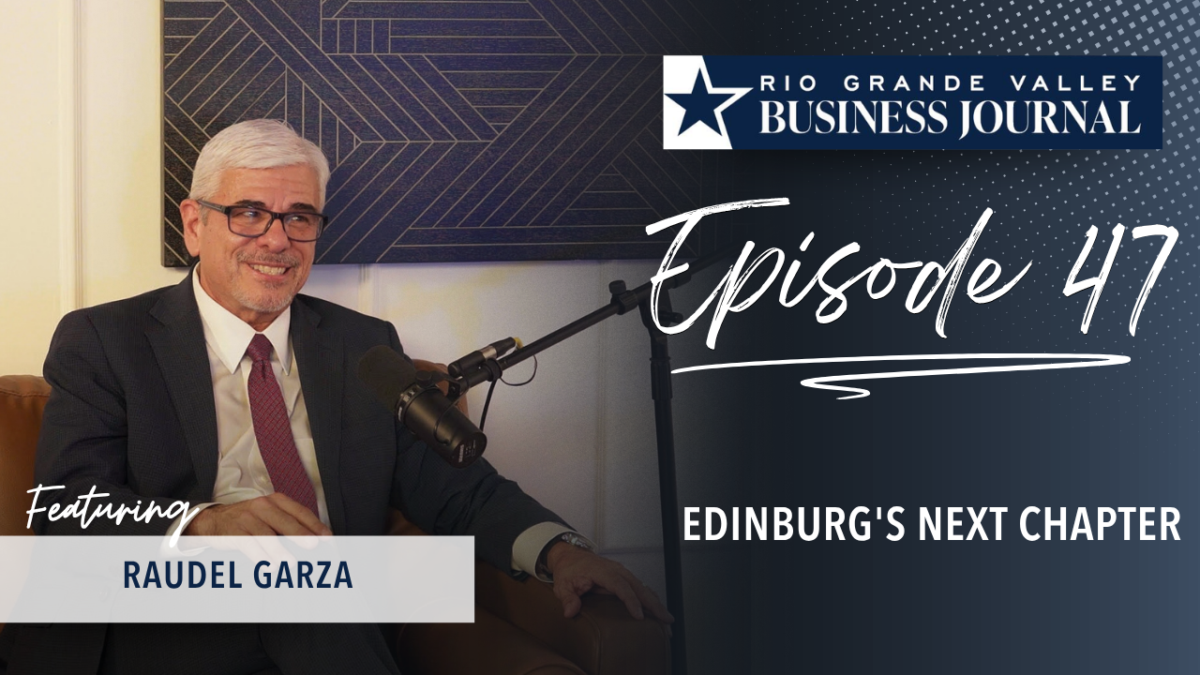
On the latest episode of the Rio Grande Valley Business Journal podcast, RGVBJ reporter Kristen Mosbrucker-Garza sits down with Raudel Garza, executive director of the Edinburg Economic Development Corp., to talk about the projects reshaping the city.
Garza said Edinburg has logged more than $1 billion in construction permits over the past three years, and its population has reached about 108,000. City finance officials are projecting 5.5% sales tax growth for the fiscal year that starts in October.
A centerpiece is Zoho Corp.’s redevelopment of the former Echo Hotel. The software company plans to move 80 employees from McAllen into the 44,000-square-foot main building and eventually hire hundreds more, Garza said, with an investment in the eight-figure range. Right behind it, the EDC is building a Workforce Resource Center above a renovated Ebony Hills Golf Course pro shop, with classrooms and a computer lab for the University of Texas Rio Grande Valley, South Texas College and other training providers.
Garza also discussed Las Almas Food Hall and other projects near the Hidalgo County Courthouse, a new downtown parking garage, drainage improvements planned along University Drive and three hotels in the pipeline, including a Courtyard by Marriott under construction near the Shops at Rio Grande.
The conversation also covers how the EDC uses AI agents to target aerospace companies, expansions at Azteca Milling and Bagley Produce, hangar development at the Edinburg airport, and an interest buy-down program with LiftFund that lets small businesses borrow up to $50,000 at 2.5% interest.
Watch the full episode below or read the complete transcript. Also available from your favorite podcast host.
The following is a rough, AI-generated transcript of Kristen Mosbrucker-Garza’s interview with Raudel Garza, the executive director of the Edinburg EDC. Minor errors and misspellings may appear. For the full conversation, listen to the episode above or through your preferred podcast platform.
Kristen Mosbrucker-Garza: Hey, y’all. This is Kristen Mosbrucker-Garza. I’m a news reporter here at the Rio Grande Valley Business Journal, and we have a fun edition of the Rio Grande Valley Business Journal podcast. My guest is Raudel Garza, the executive director of the Edinburg EDC. A fun fact is that we shoot a lot of these podcasts in the city of Edinburg, so it was a hop, skip and a jump to get over here and join us. Thank you so much.
Raudel Garza: Thank you for having me. It’s actually about two blocks away from our office. I could have walked, but it’s a little warm today. That’s our new office — we just recently moved in, and we’re going to have a ribbon cutting for that office space probably within the next 30 days or so.
Kristen Mosbrucker-Garza: Oh, interesting. Where were you before?
Raudel Garza: We were leasing some space off of Freddy Gonzalez and McColl, at the Edwards Abstract building out there. Now we’re in the building behind the transit center, which is just a walk through the McIntyre promenade, a block away from City Hall. It’s very convenient for us to be close to City Hall, but not at City Hall.
Kristen Mosbrucker-Garza: Very cool. Good to know. For folks who may not be very familiar, how would you describe what an EDC is? I’ve actually been getting that question on the internet recently: What is an EDC? What is your purpose, your strategic vision, how are you funded — if you could let people know in general.
Raudel Garza: There’s almost a 35-year history for economic development corporations in the state of Texas. Most of the existing economic development corporations started in the early 1990s. Edinburg was actually founded in 1990. It was really an effort by the state Legislature to level the playing field between smaller cities and larger cities in terms of attracting businesses to those communities.
What they did was allow the local community to hold an election to tax themselves an extra half cent in sales tax. That’s how we’re funded — through a half-cent sales tax that was voted on by Edinburg citizens back in 1989. In 1990, the corporation was created and got going.
Since then, our task has been very simple: create jobs, create an environment where private investment comes into the city and improve the quality of life for our citizens. That’s really the main gist of any public economic development corporation in Texas. We’re job creators — or actually, we’re the stimulus for job creation. We attract businesses, help existing businesses grow and try to improve the quality of life.
Kristen Mosbrucker-Garza: So you’re very much the connector — the in-between, the matchmaker, for either the workforce or businesses.
Raudel Garza: Sure.
Kristen Mosbrucker-Garza: Speaking of jobs and job creation, you all hosted an IT and STEM job fair today over at the Edinburg Renaissance Conference Center. I’ve been going to a number of these job fairs to talk to workers and to the next generation of leaders in our communities, and I was interested in this one in particular. When you look at the metropolitan statistical area job data — which officially doesn’t encompass everybody or everything, and there are always some errors or underestimates — the information sector is actually a really small part of our overall employment picture. But I imagine it’s probably growing. What inspired that event? Is it because we’re graduating a lot of people with engineering or software engineering degrees? What drove that?
Raudel Garza: We look at the different sectors in our economy and see who has demand for jobs. Workforce Solutions is the organization that helps promote those job openings to job seekers and works with local employers to try to get those positions filled. Every three months or so, we have a job fair. Sometimes we focus on the construction trades or on law enforcement, and this time we decided on IT and STEM because there has been demand for that type of position.
As you know, technology touches everything. There’s demand for people who can help prevent hacking, identity theft and everything else that happens online — the security of a system within a municipality, an educational institution or even a private business. You don’t want your information to get leaked because somebody had access to your internal network, and the IT folks are the ones who help protect that.
There is a large demand for cybersecurity experts here in the Valley, and I know UTRGV is working on filling that demand. We wanted to expose some of the opportunities out there. We had 22 employers today looking to fill a bunch of positions — well over probably 300 or 400 positions are available as we speak. That’s really why we focused on that one today.
Kristen Mosbrucker-Garza: That’s interesting. It seemed like several hundred job seekers showed up. There was even Blue Parrot, which I believe is a software company based here in Edinburg as well?
Raudel Garza: Correct. Blue Parrot is one of those companies that has a lot of potential for future growth. They continue to develop different programs for their clients, and they look forward to expanding. We look forward to helping them any way we can and supporting their efforts to expand here in the city.
Obviously, Blue Parrot is not the only high-tech company in Edinburg. We have Zoho as well, and there are some small startups. And of course, a lot of these IT folks go out on their own and work behind the scenes to help protect firewalls and other information technology systems.
Kristen Mosbrucker-Garza: Let’s talk about the Zoho Corp. that you mentioned. For folks who may not be very familiar, this is sort of a landmark project for y’all. It’s a new office of a company from outside the market, which is very much in the sweet spot of what a lot of EDCs work toward — attracting companies or helping build local companies. Do you remember roughly how much they’re investing in Edinburg and what they’re redeveloping? Because it’s the Echo Hotel, right?
Raudel Garza: Right. Zoho is a company very similar to Microsoft, Google and Oracle that has a platform of different suites available to individuals or businesses. They have a large presence in Austin, and they came down to the Valley several years ago looking for a location because they saw that a lot of their applicants were coming from the Valley.
Kristen Mosbrucker-Garza: Really?
Raudel Garza: They said, instead of having the applicants move up to Austin, why don’t we go down to the Valley? We found this out after the fact, but they did a search without reaching out to economic development organizations until they needed to. They had actually settled on working with McAllen on a 90-acre tract to build a campus there. For whatever reason, they decided that wasn’t the best location for them at that time, so they started looking at other options.
One of the options since the beginning had always been the Echo Hotel, because it provided them with meeting space and potential office space — those hotel rooms could be converted into offices. It also gave them a central location in Hidalgo County. Because of our location, with the courthouse, the university and everything else, it was very convenient for them to look at the Echo Hotel.
So they reached out to us — we didn’t know it was them at the time — and asked what was going on with the building and how they could get hold of it. The Economic Development Corporation had already tied up that building because we were working on a redevelopment project for the Echo Hotel. When we found out they were interested and they discussed their future plans, it fell in line with what we wanted to do as part of our downtown revitalization. They were turning an older building into something more useful than what it was being used for previously.
They have 80 positions filled right now. They’re working in McAllen, and those 80 positions are going to be transferred to the Edinburg facility. Then they’re going to continue hiring a lot more people. We don’t know exactly how many, but it will be in the hundreds of new positions that will open up over the next few years.
Their investment is undisclosed at this time, but it’s in the eight-figure range — so over $10 million — just to renovate that building and the grounds. They’re going to add a lot of beautiful landscaping, and they’re redoing the parking area. Yes, they tore down the bungalows — the rooms on the sides — but those weren’t very convenient for office development because they had 7-foot ceilings, which doesn’t work for most office spaces. They’re keeping the main building, which is about 44,000 square feet, and keeping the integrity and architecture of the building. They’re going to renovate the interior aesthetics to look like it used to — at least that’s what they’ve told us.
Kristen Mosbrucker-Garza: Like an art deco?
Raudel Garza: It’s more of a ’60s, ’70s feel. There’s actually one other hotel in Texas — in Nacogdoches, I believe — that’s very similar and was designed by the same architect, so they’re trying to keep that same feel. I think they’re keeping the sign that says “Echo,” but they’re going to add “by Zoho” underneath.
Kristen Mosbrucker-Garza: Oh, that’s cute. It’s like they’re building a tech campus. A lot of technology companies, because of the nature of the work — sometimes long hours, connecting with clients, depending on what kind of workforce they need — tend to build campuses. And I understand y’all are building on that investment with the workforce resource center and the new clubhouse. Talk about that, because geographically, for folks who may not be very familiar, you have the Echo Hotel with its famous buffet that is no more. So many people used to go there for lunch. It was always bumping, I remember.
Raudel Garza: They had Rotary Club meetings there, too. Yes, absolutely.
Kristen Mosbrucker-Garza: So it has a long history in this community. How do y’all’s plans connect into this downtown revitalization?
Raudel Garza: You’re looking at a revised building with the Echo, and then right next to it, where Teleperformance used to be — it was an Albertsons grocery store at one time, then converted into a call center — that’s now converting into the Hidalgo County Appraisal District’s new office. There will be well over 100 employees at the appraisal district office and well over 100 employees at the Echo, all a few blocks from the center of town and the courthouse.
In 2023, a committee went through a process of studying how to improve Ebony Hills Golf Course. That plan included a new clubhouse, because the old clubhouse — which wasn’t historic — had been demolished before and rebuilt. There were also plans for improvements to the sprinkler and irrigation systems. The city asked us to look at it as a quality-of-life project.
At the same time, we had some bonds we issued back in 2019 that included construction of a workforce resource center, so we could help employers and job seekers get together. One of the city council members made the suggestion: Why don’t you build it right behind the Echo? You’re going to have a major employer there, and it’s a convenient location near downtown. Renovate the pro shop and build the Workforce Resource Center on top of it. That’s exactly what we’re doing.
The Workforce Resource Center will have office space for Workforce Solutions — the folks who put on the job fair today. It’ll also have classroom space so educational institutions like STC, UTRGV and some third parties can use it. There are going to be three classrooms and a computer lab so they can bring people in for certification programs that upskill their current skill set, or for regular college classes that can count as extra credit.
It’s all going to be employer-driven as well, because we’re going to ask our employers what they need — like how we asked them about the need for more security techs. We know Zoho is going to be hiring, and they gave us a list of all the requirements those employees are supposed to have. A lot of certifications are necessary, and our higher ed institutions can provide those services right next to the Zoho building.
Kristen Mosbrucker-Garza: For folks who may not be very familiar, that’s a $6 million or $7 million investment for the Workforce Resource Center, which includes the clubhouse. I understand there’s also now a private management company, Troon, that’s going to help reimagine the Ebony Hills community golf course as well. There’s a lot of new life being put into existing spaces there.
Moving toward the courthouse area, I understand y’all helped bring the food hall to fruition as well — because Lord knows all of us love a good lunch deal. From my understanding, it’s something unique — not a food truck where you have to stand outside in 100 degrees, but more like an indoor, chef-inspired food court.
Raudel Garza: It’s almost like a restaurant incubator, if you will. Las Almas Food Hall — some local folks wanted to bring it to life — is really supposed to be a meeting place for a lot of people. There are a lot of people who come to the courthouse area: people airing their grievances, attorneys working for one party or another, people on jury duty, people getting married or filing paperwork. There’s a demand for more food service.
Las Almas is supposed to meet some of that need by having 10 different kitchens inside the same building, so there will be 10 different types of food to choose from. The eating area is common space, but the kitchens are separate. You can walk up to one kitchen and place your order, somebody else in your party can walk up to a different kitchen, and then you can all eat together. There’s also going to be a little meeting space, some retail boutique space and a bar. So after hours, if somebody had a long day at the courthouse, they can have some beverages to soften the day.
They’re not alone. Just to the north of them, a new place recently opened and revitalized that space. It’s called Botanical — it’s a kind of library, cafe and coffee shop, and it’s hitting it out of the park. Even on Sunday nights, I’ve seen it packed. Across the street from there, you’ve got Sidebar, the steakhouse, which has been there for a while. Next to them is a smaller building, about 7,000 square feet, that is going to be renovated. It’ll have some retail space available for lease and a whiskey and Scotch bar, so it’s going to have a different vibe. There are a lot of interesting things happening within that same block, and we’re excited to see it.
We’re also working on a parking garage that should hopefully be completed by the end of this calendar year. That will give folks more space to park and then walk a few blocks to the different destinations.
Kristen Mosbrucker-Garza: Everyone’s gone around the courthouse. I remember years ago when we were going through all the designs of that courthouse, and it’s really like a crown jewel — frankly, one of the newest buildings in the whole Valley. And then there was the recent demolition of the old courthouse. What’s going to go in that space?
Raudel Garza: In the area where the old courthouse was, if I remember right, the plans include green space with walking trails, a memorial to our veterans and some additional parking.
Kristen Mosbrucker-Garza: Oh, interesting. I try to keep track of everything that’s happening, but there’s so much construction and reconstruction. I remember 10 or 15 years ago, I helped cover Edinburg as a news reporter once in a while, and we used to get these tropical storms. There was a grocery store or something in the area, and I had to talk to a lot of the businesses because downtown flooded really badly. What has happened with the flooding situation? Does that just not happen anymore? Did y’all work with the drainage districts? As you’re building out all of this economic development and creating all this walkability and revitalization, I wonder how you’re helping, on the infrastructure side, to make sure these business investments can really come through.
I even looked at houses in that area, because I like to walk — I’ve lived in very large cities. Looking at the housing stock, I thought it might be more student housing. But from that infrastructure side, what’s been happening with drainage? Have y’all been partnering to make sure all this new investment can really flourish?
Raudel Garza: There is a plan for the reconstruction of University Drive — State Highway 107 — from the courthouse all the way to the expressway. That’s supposed to be let sometime late this year or early next year. Basically, they’re doing a large drainage improvement plan, so a lot of the water that used to hang around downtown will be shoveled into big pipes — box culverts underneath the existing roadway.
It’s going to be a fairly long project. When you’re tearing up an existing state road, you still have to have accessibility, so they’re going to have to coordinate how traffic comes in and out of that area while doing the drainage improvements. It’s probably going to take a couple of years to get done, but once it’s done, it’s going to be totally different for downtown in terms of drainage and the ability to push that water away from the downtown area as quickly as possible. That’s really the thing — to push it out as quickly as possible.
Kristen Mosbrucker-Garza: I don’t think I realized that was a state road. I think the average person thinks it’s just a city road and wonders why the city didn’t pave it better or fix the storm drains.
Raudel Garza: Both Closner, which is Business 281, and 107 are state roads. There’s not a whole lot the local community can do on a state road — that’s controlled by TxDOT. They have it programmed and budgeted. It’s just a matter of getting them to let it and get the work done.
Kristen Mosbrucker-Garza: So it’s on the road map?
Raudel Garza: Absolutely.
Kristen Mosbrucker-Garza: OK. I remember 10 or 15 years ago, there used to be UTPA, and then it became UTRGV. We’ve got the medical school, which has been around for 10 years now. I think a lot of people associate Edinburg with the university — it has very much a university-town feel. As technology accelerates and people learn new skills and work in new ways — we have a lot of remote workers, people who want to live closer to their families or realize they can work from anywhere — how will we change or reposition ourselves as communities, with higher education in flux?
Raudel Garza: Aside from the part of downtown on the east side of the courthouse, the west side of the courthouse is an area we call Midtown. That’s where we are now. In Midtown, aside from the parking garage and the amphitheater just behind this building, we also invested over $14 million in the ACE building — the Arts and Cultural Events Center. City Hall is adjacent to that, and beyond that is our transit center.
The Economic Development Corporation owns some other properties out there, and we’re looking at doing more construction — more buildings that will serve as incubators, if you will, for future retail and hospitality businesses. That connects to the university, which is right adjacent. There are well over 34,000 people enrolled at UTRGV now, and the idea is to make it more of a student-life campus, like some of the other major universities in the state, where there are more activities near campus.
We’re going to have those kinds of venues available near campus. We’ve also talked to the university about some of the properties they own adjacent to ours, in hopes that they’ll look at co-developing that property. There are a lot of opportunities for future student housing growth, mixed in with some entertainment, hospitality and retail.
Kristen Mosbrucker-Garza: That will be really interesting. I remember the performing arts center at UTRGV — I don’t remember if it was new construction or a reconstruction — and I took my suegra, my mother-in-law, to see the folklorico dancers. We’ve lived a lot of places, and you go to a show and it’s done at 9 p.m., and you’re feeling young. And I remember thinking, why is there nothing nearby? Why do I still have to get in my car and go through a drive-thru? I love me a raspa, but I’m already dressed up for the theater. Is there anything in that area, or is that the concept y’all are thinking about?
Raudel Garza: That’s not too far from the area we’re talking about — it’s basically across the street. The idea is to bring in that population, whether they’re going to see something at the performing arts center or a basketball or volleyball game at the Fieldhouse, which is just across the parking lot from that space. The idea is to have more student life and more activities outside of just the 8-to-5, if you will.
Kristen Mosbrucker-Garza: And it’s fall, so we have the Vaqueros football as well. Talk about the economic development strategy around that, because from what I remember, when it was opening season, the tickets were sold out — at all levels. We’re not just talking about the student section; we’re talking about suites and things like that. How do you capitalize on that influx of folks?
Raudel Garza: One of the things we’re working on, obviously, is increasing hotel rooms and dining options. On the hotel side, we have a few projects happening. One is a redevelopment of an old hotel into a Holiday Inn and Staybridge Suites — a dual-branded hotel. It’s a renovation of an existing hotel with some new construction that will add hotel rooms. On top of that, a Courtyard by Marriott is under construction right now, right off the expressway at the Shops at Rio Grande. That’s three hotels coming up in the next couple of years. I hope the Courtyard by Marriott will be open by next year.
We did a study showing there’s still demand for more hotel space, so we’re working with some other hotel companies that are interested in our area. We’d like them to look at downtown, but they’re also looking at sites off the expressway close to the stadium. That’s one of the side benefits of having the Vaqueros in Edinburg. Our city leaders knew they had to keep football in Edinburg, and they did everything they could to make that happen.
Right next to the stadium, the developer who has built many of the homes within Los Lagos Golf Club is now developing a $30 million commercial center that’s going to have a lot of retail and restaurant options. It’s adjacent to the football stadium as well.
So it’s really all coming together. We’ve already got the Bert Ogden Arena. We had soccer at that stadium, and now it’s football. The university continues to grow. The courthouse is finally open and almost completely done with all the renovations. Drainage issues are being addressed, and we’re really focusing on downtown and Midtown developments right now.
Over the next couple of years, the EDC will be spending at least $4 million in downtown, and we’ve had renovation programs for small businesses as well. It’s all to improve the quality of life in the center of town and to drive traffic — not just local traffic, but from outside the region as well.
Kristen Mosbrucker-Garza: I know y’all have had a lot of new subdivisions outside the downtown area, too. I was talking to somebody who said y’all permitted hundreds of new subdivisions — the city is longer than it is wide, as a lot of cities in the Valley are. I rented a U-Haul the other day off of Interstate 69, technically the Pharr location. They called me from their call center in Corpus Christi and said, “Hey, Kristen, would you consider helping out one of our other new dealerships just up the road?” I asked which direction and how many miles, and they said they’d reimburse the mileage, but they had a new U-Haul dealer in Edinburg. It was 6 miles on a 75 mph road. But that made me think it might be a key indicator of all these subdivisions — if a U-Haul dealer just opened up.
Raudel Garza: One of the things we’ve seen is a lot of new residential construction, both multifamily and single-family homes, and that continues to drive a lot of our growth. Our population is now about 108,000 people, which is a tremendous growth rate. You see a lot of folks moving into the area because of the university, the med school, the courthouse and everything like that, so we’re going to continue to see that kind of growth over the next few years. We’re excited about that.
We’ve actually had over $1 billion in construction permits in the last three years. That’s well over $300 million in construction every year for the last three years, and that trend is going to continue. We see that as a good thing, but it’s also a challenge to keep up with the infrastructure. We’ve been spending a lot of money on infrastructure: new water towers, new sanitary sewer lines, and we’re working on funding for a new water plant and water treatment facility. City leaders are doing a lot to make sure that as those residential subdivisions continue, there’s a backbone — a support system — to handle all the infrastructure that’s necessary.
Kristen Mosbrucker-Garza: How are your sales tax revenue dollars looking? I try to keep track of all 42 cities as best I can and pull them monthly, and I’ve seen modest growth for the most part year over year. With the advent of Amazon and a lot of online shopping, people’s buying habits have changed so much. And since we’re so close to each other as cities, the likelihood of someone living in Edinburg and buying something in McAllen, or living in McAllen and buying something in Edinburg or Pharr, is very high — sometimes we have the same stores, sometimes we don’t. What’s your sales tax revenue looking like, what’s your future budget looking like, and how can you reinvest that money in the community?
Raudel Garza: I know Edinburg generates well over $40 million in sales tax a year, and that’s been the trend for the last few years. For next fiscal year, which starts in October, the city finance department has projected our sales tax to grow 5.5% over the current fiscal year. That shows we’re growing not only at the rate of our population growth, but even more so. That’s an indicator of where the money is coming from — some of it is coming from people outside the city limits shopping in Edinburg.
But yes, there’s leakage in every community. It’s a regional economy, not a local economy. We’re not on an island by ourselves. Some of our residents go to neighboring communities, and people from neighboring communities come to Edinburg as well, and we’re going to continue to see that. But there are some new shopping experiences we’ve talked about in downtown, and new retailers are coming into the area as well. It’s all being driven by that residential growth and by the employment sectors that continue to grow.
We do try to focus on some of our bigger sectors — industrial, and hospital and medical. We can’t stop talking about health care. Driscoll opened a couple of years ago, and now they’re up to a thousand employees or so. They’re going to be expanding into some additional floors of their existing space. They continue to serve the community. DHR and the Women’s Center are cranking out, I think, an elementary school’s worth of babies every two months or something like that.
Kristen Mosbrucker-Garza: I’m looking at some of the demographic data in the census numbers, and somebody told me we’re still being undercounted. Sometimes we have to cobble together indicators, and honestly, even the MSA data isn’t all-inclusive in a lot of ways. We do what we can with the data we have. But you’re right: In terms of job numbers, the private education and health services sector is by far the largest employer, and I see them at every job fair.
We do have some growing logistics, and I know y’all have some manufacturing parks as well. This may or may not be on the radar, but what could happen in the redevelopment of the manufacturing park? Wasn’t there a manufacturer there from Brazil? Is there going to be a new manufacturer in there?
Raudel Garza: We’re still working on that. Santana still owns the building, so we’re working through that process. But Bagley Produce is under construction right now on a new facility. They still have a location right off of I-69, and they’ll be using two facilities for a while — I don’t know that they have plans to stop using it. That’s how big the demand is for their product.
Natural Produce, another existing local company, is expanding. They bought some property within our industrial park so they can grow. In our industrial park, a truck driving school opened recently. [COMPANY NAME UNCLEAR], an emergency vehicle servicer that serves the entire region, has located in our industrial park as well. RGV Tours, a bus company, started out with one bus, and now I think they have seven or eight, and they’re continuing to grow. FedEx is still in that industrial park. There are a lot of good companies coming in and building out our industrial park.
In addition to that, we still have 40 acres that we own and are marketing, and there’s additional private land available in our industrial park that we’re marketing as well. And then look at our airport — there’s a bunch going on there, and we have a lot of potential. There are 800 acres adjacent to the airport that are available, and the airport itself has over 600 acres of available property. We’re working with the airport to increase hangar development and bring in some logistics companies as well.
Kristen Mosbrucker-Garza: I had seen that even Azteca Milling is expanding.
Raudel Garza: Yes. We had to apply for an enterprise zone project designation. Over the next five years, they’re investing about $8 million in new equipment and renovations to the buildings and facilities. It just continues to show that food processing and food products are still a big deal here in Edinburg, and that’s one of our larger employers that continues to grow.
Kristen Mosbrucker-Garza: For sure. It seems like a pretty diverse economy, very much anchored by the higher education institutions. As I talked to a lot of job seekers at the job fair today, everyone was talking about AI. Some people have anxiety about the role of AI in our workforce — even people who work for AI companies. Other people are a bit more optimistic, and they see a lot of the AI tools, integration and automation as an amplification of what humans with critical thinking can accomplish — as your overzealous intern, which is what I like to use it for. How do you fit that into a lot of these conversations when you’re talking to companies? Where does AI fit?
Raudel Garza: I think there’s a role for AI. We’re actually talking with UTRGV right now about providing a course on AI and how to implement it in your business at the Workforce Resource Center once it’s completed. So a year from now, we’re going to be offering that kind of course so our local small businesses and entrepreneurs can learn how to adapt.
AI is not going to go away unless something wild and crazy happens. It can be a useful tool, just like our computers were, just like a sewing machine was when it first came out. Everything in moderation is great, so we’ve got to be careful with what we do. We use AI ourselves in some of the things we do — we’ve set up agents to whittle through some of that. You were talking about the plankton you’re taking in, right?
Kristen Mosbrucker-Garza: It’s a fun podcast, and as journalists, we like to use analogies. Something I had always dreamed of — I’m an old lady now — is why I taught myself computer programming, Python in particular. It’s a very word-based coding language, and it’s used in a lot of automation.
One of the things we do as journalists is maintain a sense of situational awareness, and a lot of that can feel like being a giant whale in the ocean. For folks who may not be very familiar, whales actually eat very tiny pieces of food — plankton. The largest species, the blue whale, will just swim through the ocean eating thousands and thousands of pounds of plankton. As journalists, we kind of do that with information.
In some ways, AI can be really helpful — not so much dictating anything, but building that web scraper to make sure I don’t miss anything, or alerting me when a document is filed. I cover SpaceX, obviously, and the growth at Starbase. Because of the type of company they are, a lot of their documentation comes through things like SEC filings. I can get an email that they filed an SEC filing — I’m still going to read it. Or they might file an environmental document with the federal government. Something I’m working on right now is that they’re going to build a new road, and that’s something of interest to our audience.
I think it’s very much about trying to stay on top of a world that’s moving so fast. Not everything you come across on the internet is worth pursuing. I try to balance our coverage. I do write about data centers, infrastructure and water, but I try to do it in moderation, because I understand our audience, just like you, are very busy people who may not have time to read a 5,000-word dissertation on whatever topic. That’s why we do these podcasts and videos as well. If you really want to dump the transcript into AI and read a good summary, you’re more than welcome to, because everyone deserves to learn the way they learn best.
Raudel Garza: Right. Different companies need to implement AI, and some of them do it for different reasons. At the Economic Development Corporation, we use it to filter through a lot of the information that’s coming in. When we’re targeting industries, we have specific targeted sectors we want to go after — aerospace, for example.
Within aerospace, there’s so much going on: unmanned vehicles, missiles, weapons being produced. There are so many different companies out there — some are growing, some are not — and there are different patterns for growth companies: an increase in sales, SEC filings that happen on a more regular basis. You can set up AI agents to help you filter through a lot of that, and that’s how you do some of the targeting. It’s not word of mouth. It’s very scientific and very precise. You build a list, then you go after those companies by reaching out, hoping they’re the right fit for this region.
I don’t think we’re the only economic development organization doing that. We’ve been doing it for many years. Even before it was called AI, there were a lot of ways to screen through that information, and we’re still doing it.
Kristen Mosbrucker-Garza: A number of years ago, when I lived in San Antonio, I used to cover technology, and I did an entire story where I interviewed six or seven companies that hire a lot of technology workers but that you don’t think of as tech companies. One of them was Labatt Food Service. They have a pretty strong presence here with school districts, prisons and so on, and they have warehouses and a logistics operation. Their CEO told me that in the late ’70s or early ’80s, he worked side by side with a computer programmer to build a logistics algorithm on a napkin. I think it was a Monte Carlo algorithm, something like that. He said, “I need to know the most efficient route for my trucks.”
Raudel Garza: Sure.
Kristen Mosbrucker-Garza: A lot of the issues industry wants to tackle are not necessarily new. It’s just the pace of innovation and acceleration — doing it in the cloud versus a server closet.
I used to cover data centers before data centers were a hot topic, with Rackspace and the colocation data centers. People may not fully understand that a data center used to be a server closet in your business — literally just a really cold room with computer servers in it. That was the original data center. It’s really just with the advent of the cloud and the acceleration of AI and generative AI that the compute power has quadrupled, or whatever figure you want to use, and that’s why you’re seeing it more visually.
But there has been dark fiber across the Valley since the ’80s or ’90s. Law enforcement agencies have needed fiber for their operations for generations. Chase Tower is where a lot of the internet comes in on dark fiber, and the same thing in Harlingen. So when people see these data centers pop up, we’re changing as communities.
I think there’s a lot to track with data centers, because they’re also different. We have all these wind farms. I interviewed a company called Soluna, and they’re in Willacy County and Cameron County — I don’t know if they’ve done any in Hidalgo County — and they’re actually co-located on wind farms. They don’t use very much water, and they’re not even connected to the power grid. They’ll probably have to get some more fiber out there. There’s a lot of nuance in all of this, and I hope people will be interested at some point as it becomes more visible in our communities.
Raudel Garza: There’s a lot of controversy over data centers, and the governor’s recent mandates have probably put a lot of that to rest. They’re telling the companies, if you want to build out there, you’re going to have to do it yourself and rely on your own resources. That’s not a bad thing. We’ve heard about people tire-kicking in the area, but we’re not working toward any data centers at this point. If they’re doing it, they’re doing it on their own.
Kristen Mosbrucker-Garza: Looking forward, what are some things on the horizon for Edinburg that people should keep an eye out for?
Raudel Garza: We’re going to continue to work on downtown revitalization. Like I said earlier, we’re looking at a $4 million investment over the next two years at the EDC level. We’re working on some incubator projects as well, because we know a lot of growth has come from smaller businesses and entrepreneurs who may not have the startup resources they need. We’re going to be working with tech companies like Zoho, helping them expand and making sure they grow properly.
We do quality-of-life projects every year. This last year, the Workforce Resource Center and Ebony Hills project is our quality-of-life project. A couple of years ago, we installed artificial turf on six baseball and softball fields to help draw sports tourism to the area. Next year, like I said, downtown will be the quality-of-life focus, so we’ll see some streetscaping projects and other projects associated with that.
We’re going to continue working on industrial. We’re working at the airport to bring in new hangar space. Infrastructure is a lot more expensive to get to the airport because it’s farther from the center of town, so we’re working on plans to get water, sanitary sewer and taxiways to that site so more land is available for private aircraft hangar development. That airport has a lot of government aircraft — DPS, the Air National Guard and others — but we’re also encouraging private sector companies that want to be in this area, close to their businesses, to get ready to develop hangars, because we’re going to expand the taxiways. We also received money from the state in the previous legislative session to expand our runway.
We’re working on all those projects, and what you see is kind of a hodgepodge of different projects, all for the betterment of the community. Some are industrial, some are commercial and retail, some are hospitality. We’re going to continue doing that and continue to focus on our small businesses as well.
We have a lot of programs. Over the last three years, we’ve spent $1.2 million on our FLIP program, which is a facade and lot improvement program directly for small businesses. We started a Kauffman FastTrac entrepreneurship program in conjunction with UTRGV, so there’s a lot of training, and we have some lunch-and-learn seminars coming up with different service providers. And we have an interest buy-down program through LiftFund, so small businesses can apply to LiftFund for a $50,000 loan, and because of our buy-down, they only pay 2.5% interest. It’s almost free money.
Kristen Mosbrucker-Garza: I’m going to hit pause, because for folks who may not be very familiar, LiftFund is a microlender. They used to be called Accion Texas. I used to cover the finance industry, too, and I wrote stories about them. They’re a nonprofit organization that works with a lot of small businesses and entrepreneurs — mom-and-pops, everybody under the sun.
Microlending is a really unique space. For the largest banks, it costs the same amount of money to underwrite a $100,000 loan as a $1 million loan, so there’s no real incentive for banks to work with the smallest of the small. They kind of outsource that to microlenders like LiftFund, which are very active here in the Valley and across Texas and other communities. They work directly with entrepreneurs on their business plans and help with a lot of that. I think that’s a key resource that’s very attuned to our communities. A lot of times, big banks will donate money to a loan fund or loan pool for an entity like LiftFund.
So that’s really cool that y’all are working with them. Everyone has their own opinion about interest rates and lending right now — the fed funds rate is even changing. Didn’t they vote to increase the rate to try to bring down some of the inflation we’re dealing with? On a $50,000 loan, if you’re looking at 8%, 10% or 15%, being able to buy some of that down can really give a business owner a lot of leverage.
Raudel Garza: We’ve been doing that for three years now, and this will be the fourth year in a row. We’re investing $100,000 a year to buy down those loans. On average, we probably see anywhere from eight to 15 loans a year, depending on the needs of that particular business. I’ve seen some as small as $10,000 and some up to the max, which is $50,000, and all different types of businesses — small mom-and-pop restaurants, little shops, trucking companies that need a little extra money at the time. There’s all kinds, and it’s exciting to see.
For us, it’s part of our work program to help those small businesses succeed. We don’t want to compete with our local lenders — whether they’re microlenders or more traditional conventional lenders — by creating our own loan program. But we can help the existing microlenders by buying down those loans.
Kristen Mosbrucker-Garza: Cool. Thank you so much for your time — I really appreciate it. It seems like there’s so much going on. Thanks again, and be sure to subscribe to the Rio Grande Valley Business Journal and stay tuned.