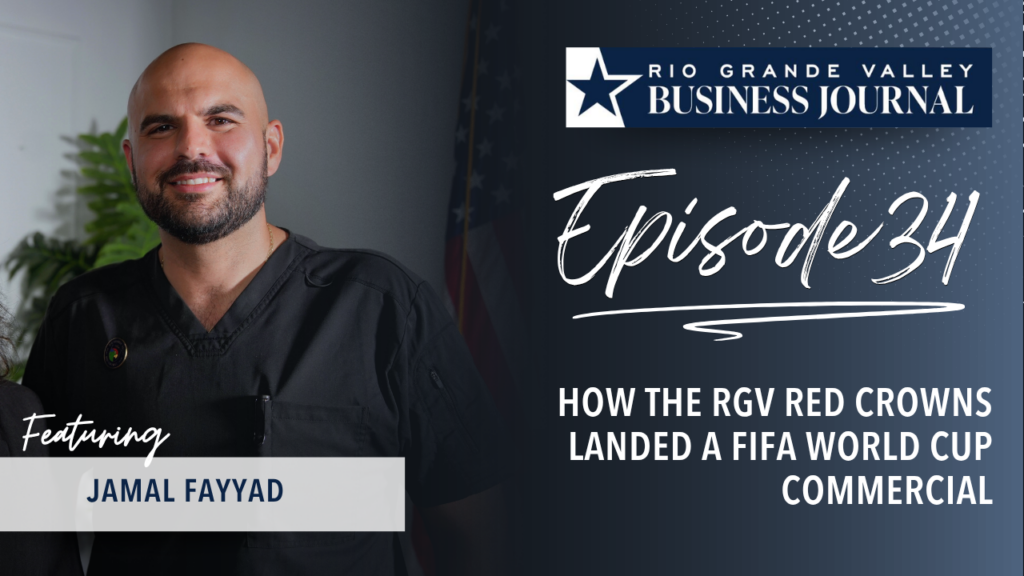
The RGV Red Crowns were built to be more than a soccer team.
In this episode of the Rio Grande Valley Business Journal Podcast, Naxi Lopez sits down with Jamal Fayyad, founder and president of the RGV Red Crowns, to discuss how a community-first semi-pro soccer club caught the attention of Bank of America as part of its FIFA World Cup campaign.
Fayyad explains how the team was shaped by Valley residents, from the name and colors to the red-crowned parrot mascot — a bird he says reflects the region’s ability to survive and thrive together.
The conversation explores how the Red Crowns are creating opportunities for local athletes, why the club chose Harlingen Field, and how the team is working with local restaurants, breweries, artists and businesses to build a Valley-wide identity.
Fayyad also discusses the economic impact of the commercial shoot, which he said pumped more than a quarter-million dollars into the local economy over two days, and why the project offered a different kind of national spotlight for the Rio Grande Valley.
The episode looks ahead at the Red Crowns’ second season, the possibility of eventually going pro, and why Fayyad says the club will only grow as far as the community wants it to go.
The following is a rough, AI-generated transcript of Naxiely Lopez’s interview with Jamal Fayyad, founder and president of the RGV Red Crowns. Minor errors and misspellings may appear. For the full conversation, listen to the episode above or through your preferred podcast platform.
Naxi Lopez: Hi, and thank you for joining us on this episode of the Rio Grande Valley Business Journal Podcast. I’m Naxi Lopez, and today we have Jamal Fayyad, founder and president of the RGV Red Crowns.
Jamal Fayyad: Hello. Thank you for having me.
Naxi Lopez: Of course. Welcome.
Jamal Fayyad: It’s great to be here. This used to be my go-to coffee shop in college, and it’s been a few years since I’ve been back, so it’s nice to return to my roots, so to speak. This is great. Thank you for having us.
Naxi Lopez: Awesome. Jamal, you came onto our radar because we heard Bank of America was filming a national commercial here in the Valley as part of its World Cup campaign. Talk to us about that.
Jamal Fayyad: Yeah. So, you know, the cat’s out of the bag. This is an exclusive, right? You’re the first to know. It is Bank of America. They’re the official sponsor of the FIFA World Cup, so they’re the main sponsor. Anything you see with the World Cup this summer, you’ll see Bank of America right under it or right next to it.
Long story short, Bank of America heard about our story — starting a team from scratch, from the ground up, getting the community’s input on the name, the colors, even the players, and providing an opportunity for local kids to play at the next level.
In just our first year, we had three local kids reach the professional ranks.
Bank of America heard that story and said, “Hey, in this World Cup campaign, we want to feature this story. We want to feature the Red Crowns and let people know what soccer can do for a community.”
Naxi Lopez: Before I let you go further, though, I want people who haven’t heard of the Red Crowns to understand what they are. Talk to us about that.
Jamal Fayyad: Okay. Part one.
Naxi Lopez: Part one.
Jamal Fayyad: Because there’s going to be like a three-part episode.
I worked with the RGV Toros. Before they dissolved, I had already left. I remember I was done with soccer. I just wanted to be a fan. There’s that saying about trusting the butcher’s word for it when you’re buying steak. That was kind of me. I didn’t want anything to do with the business side anymore.
About four years ago, I went to England. I’m a big Liverpool fan. I probably lost a few viewers right there, but I’m a massive Liverpool fan, and it was always my dream to go to Anfield.
So I finally grabbed all my savings, broke the piggy bank and went to England.
My luck? The game was canceled.
Liverpool versus Fulham. Canceled.
So I’m in England looking for something to do, and I decide to watch the level below the Premier League. In England there are something like 19 levels of soccer.
The cool thing about England is it’s merit-based. If you win, you get promoted. If you lose, you get relegated.
Naxi Lopez: Relegated. I learned that on Ted Lasso.
Jamal Fayyad: There you go.
So I go watch a fifth-division match: Wrexham versus Southend.
This was before all of it blew up. Ryan Reynolds had already bought the team, but it wasn’t the phenomenon it is today.
I remember sitting there amazed because Wrexham and Southend are about the size of San Benito or Donna. They’re not huge cities. But on game day everything shut down. Everybody went to watch football.
I was freezing, not used to that weather, but I was having this moment thinking, “Man, I think this could work back home.”
Wrexham reminded me so much of the Valley.
If you have a flat tire, somebody helps you.
I was invited by strangers to dinner. Invited for drinks. People wanted to talk and learn about each other.
There were so many parallels that I thought, “This could work at home.”
But it had to be community.
That’s what stuck with me.
Jamal Fayyad: Not used to that. But I was sitting there having this moment, like, man, I think this could work back home.
This community — Wrexham reminded me so much of the Valley, where if you have a flat tire, someone is going to come help you out. I was invited by strangers to go have dinner, to go have drinks, and just talk and learn about each other.
There were so many parallels where I was like, this could work back home, but it has to be this. It has to be community.
So I sat there and just kind of fantasized about doing something like this back home, after telling myself I was done.
Naxi Lopez: This is about four years ago, right?
Jamal Fayyad: About four years ago.
So that trip ends. I come back home and I said, OK, I think we’re going to do this.
But English soccer — or football — and American soccer are two different monsters, right? It’s not apples to apples.
So for the next three years, what we did was look at markets in the U.S. similar to the Valley that had thriving soccer teams.
It was like, why does it work here, but it didn’t work the first time in the Valley?
We used the next three years to compare and study. I took trips to Lubbock. I took trips to California, Napa Valley, North Carolina. I took trips to these markets that were thriving, and I just tried to learn as much as I could.
Naxi Lopez: And what did you find?
Jamal Fayyad: That it’s community first and foremost.
Think about it. When you think soccer, you don’t think North Carolina. You don’t think Spokane. You don’t think Madison, Wisconsin.
But these teams made the community feel like part of it. People were invested, even if it wasn’t monetarily. They had stories. They had memories with their children at the games.
So it wasn’t about the wins or the losses. What happens on the field was actually secondary. That’s what I realized with the really popular teams. It was more about what the club represented and being an identity, like it was in Wrexham and Southend.
So we studied, and when we were done, we knew what we wanted to do.
It was go time.
While doing all that studying, we had QR codes throughout the Valley, including next door, at coffee shops, libraries and the university. It was a QR code just asking people what made them think of home. It had nothing to do with soccer.
Nowhere did it say we were bringing a soccer team.
It said: What colors remind you of home? When you go to Austin, Houston, Dallas, do you say the Valley, 956, RGV? What do you think of when you think of home? What animals make you think of home?
It was a bunch of questions just about home.
We took all that information — myself, our design team — and that’s how we came up with the RGV Red Crowns.
Nobody said the red-crowned parrot. The red crown is a parrot that we see all around here in the Rio Grande Valley.
There was a really cool story. It was like an epiphany. Like, this makes sense.
The red crown is a parrot naturally found in northern Mexico and here in the Rio Grande Valley. Now, you’ll see them in San Francisco, Los Angeles, Florida. You’ll see them all around the place.
What zoologists realized was these birds were taken from us for the pet trade. But if they ever escaped, as long as they were with their flock, they thrived.
And I tell people, it’s like us, right?
We go through these hurricanes, through these freezes. But when the going gets tough, we forget about the different cities, the different high schools, the politics. We all get together like the red-crowned bird, and we survive as a flock.
I was like, this is it. This is the mascot.
Bird was the biggest feedback we got.
Naxi Lopez: Of course, the birding industry.
Jamal Fayyad: Yeah.
So we knew we wanted birds. We didn’t know what. We even hinted at the chachalacas. We could have been the RGV Chachalacas, right?
We took different birds, and full transparency, there were two finalists.
It was the Red Crowns, which ended up getting the name, and the kingfisher.
The kingfisher is a small bird that dives in the water, takes a fish and eats it. We have a big fishing community, the birding community. To me, it checked a lot of the boxes I was looking for.
The only reason we didn’t go with it is if you Google kingfisher, it’s the largest beer brand in India. India has a population of like a billion people. So I was like, Google will never own that.
But then again, we started thinking about the Red Crowns, the colors and the parallels to our community, and it was a no-brainer.
That’s how we came up with the name.
But I love today, I’ll talk to a fan and they’ll be like, “Hey, I helped name your team.”
And it’s like, what do you mean?
“It’s like we saw a QR code, and I said we should have been a bird and we’re the Red Crowns.”
But that was the goal. I want people to be invested, and I want people to tell that story: I helped name the RGV Red Crowns.
So everything we’ve done, including game day, concessions — everything is community-focused.
The beer we sell at the game is a branded, co-branded beer with Pluton Brewery in Brownsville. It’s a Red Crown Lager, so we truly are community-focused.
Naxi Lopez: And Pluton is a small microbrewery in Brownsville.
Jamal Fayyad: Yeah.
But back to the team. We started this team with the goal of providing opportunities for our local athletes.
When I was with the Toros, one of the biggest gray areas I saw was that there were a lot of kids who were maybe finishing high school or in high school who, for whatever reason, didn’t play college or didn’t make it to the pros.
They’re kind of stuck in limbo, like, where do I go from here?
The Toros had their academy, and then they had the pro team.
So we decided to join fourth-division American soccer so that an athlete can play with us.
Let’s say there’s a senior at Edinburg Vela. They can come play with us during the summer, get shown on a national level, but then when school starts, they can go right back to school and play for Edinburg Vela unaffected.
That’s what we love, because with the Toros, if you were to sign a professional contract, that’s it. You’re a Toros player.
Naxi Lopez: Oh, and you can’t.
Jamal Fayyad: And you can’t go back to school.
At a certain point, you realize we became the enemy for a lot of academies and high schools. They didn’t want their best players going over there because they would lose them.
Naxi Lopez: Yeah. I mean, it was an either-or type of situation.
Jamal Fayyad: Exactly.
With us, you can play with us, and we celebrate where you’re from. We celebrate your high school. We celebrate your academy.
We let people know Edinburg Vela brought us this player. Look at the amazing things he’s doing.
Then once we’re done, you go back unaffected.
We’re going to do our best to help you reach your goals, whether it’s playing college soccer or playing professionally.
Like I said, we had three kids go pro just in our first year.
But the goal is for the high schools around town and the academies around town. We want to be that ultimate goal for them, helping their students and athletes achieve their dreams.
As they say, it takes a village to move mountains.
That’s our mindset with all of this — getting the whole Rio Grande Valley involved with the Red Crowns.
Naxi Lopez: And what are you seeing? What kind of response are you getting from the local academies, the schools and the public?
Jamal Fayyad: It takes conversations like these, so thank you for doing this.
I think the soccer community specifically has been burned before, and I get it.
So it takes people seeing what we’re doing. Actions speak louder than words, right?
I think after our first year, people see it now. They’re like, OK, they really are just a semi-pro team.
We don’t have an academy. And I tell everybody this: I’ll never have an academy. That’s not my business.
We’re in a very educated market. There are plenty of academies out there. There are plenty of youth groups out there.
I don’t want to come in and bulldoze everybody out.
That’s how a lot of people put food on their tables. Their academy feeds a lot of families. It’s the main source of income for a lot of people.
So let us help you instead of competing with you.
And my business is selling tickets. Soccer fans probably don’t want to hear that, but that’s where I make my money.
Naxi Lopez: I mean, if nobody’s watching the game…
Jamal Fayyad: Exactly.
My business is sponsorships, ticket sales, group ticket sales, concessions and merchandise.
What I tell our staff is we play soccer three months out of the year.
The other nine months, we’re a fashion brand. We’re a merchandise brand. That’s how we survive.
I don’t make money by charging academy fees. I don’t make money by charging parents to put their kids in our camps.
We leave that to the academies, and we worry about the summer soccer season and providing opportunities.
At first it was, “We’ll see about that.”
And unfortunately for me, a lot of people remembered me from the Toros. They were kind of like, “I don’t know about this guy.”
But it took Year One for people to see a proven concept and a proven model.
Year Two has been great. The feedback has been great.
I think this commercial is also going to help catapult us to new levels.
But it’s nice getting those phone calls now where people say, “OK, I see what you’re going for. We’re in.”
That kind of makes my day.
It takes a while, but we’re getting there.
Naxi Lopez: Interesting.
How many seasons have you actually played?
Jamal Fayyad: One full season. This is our second.
Naxi Lopez: So this is your second season.
Jamal Fayyad: This is our second.
May 16 is our home opener. Tickets are on sale. Shirts are on sale. Everything is about ready to go.
May 16 will be the season opener for our second season.
Naxi Lopez: And where do you play?
Jamal Fayyad: We play at Harlingen Field.
If anyone remembers the Valley WhiteWings, we took over that stadium.
That’s a whole other story.
Again, we’re in a market with an educated fan base. You meet somebody and they love América, or they love Tigres because their grandparents loved América or Tigres.
When we were looking for a home field and starting this project, I didn’t think Harlingen was going to be where we ended up.
Personally, I liked Edinburg. I liked McAllen. I thought those made sense. Maybe even Brownsville.
But what Harlingen offered us that none of the other cities offered was a blank slate.
What I mean by that is, let’s say we played at Richard R. Flores Stadium in Edinburg. There are football lines there. There are football goalposts.
That’s the case for a lot of places.
Harlingen Field had been abandoned for nearly 15 years.
So when we went to the city, I said, “Hey, can we come in, dig everything up and put a soccer field in here?”
They said, “Sure. Why not?”
What I love about that is if I get a fan — let’s say an older gentleman — he’s already coming in with a bias, like, “This isn’t real soccer.”
When people see football lines and goalposts, they’re turned off.
When you come to our stadium, you see a proper soccer field.
I’m a little romantic when it comes to the sport. I feel like all soccer fans are.
One of the biggest compliments I’ve gotten — and I’ve had a few people tell me this — is, “That’s the closest thing I’ve been to a European match,” or, “That’s the closest thing I’ve been to seeing a match in Mexico.”
That’s what we’re going for.
Naxi Lopez: So you guys basically redid the whole field?
Jamal Fayyad: Yeah. It’s a soccer field.
Naxi Lopez: And that’s not an easy undertaking. Did you get help from the city or anything like that?
Jamal Fayyad: It’s still city-owned. We rent it out. It’s our home, and we’re the primary renters now.
The city helped out.
We learned last year — and not to throw anyone under the bus — but the wrong grass was planted.
You could see it when we played. It wasn’t the best grass.
We’re in the process of fixing that now.
So when you come to Harlingen Field this year on May 16, you’re going to notice proper soccer-playing grass — the same kind of grass used by FIFA for the World Cup.
The grass has its own ID. That’s how intense this is.
Naxi Lopez: My gosh.
Jamal Fayyad: So it’s a true soccer field, and we’re excited to open it.
Hopefully we’ll host an East vs. West High School All-Star soccer game and events like that for the community.
In my opinion, it’s Harlingen Soccer Fields now. It’s a soccer pitch, and we love it.
That’s how we ended up in Harlingen.
When we started this team, one thing I heard a lot — and this isn’t just with the Red Crowns — is that people have this misconception that because we’re in the Valley, and Mexicans love soccer, people will automatically love the team.
I argue with people all the time that it actually makes my life harder, not easier.
Let’s say tomorrow the NFL decided the Rio Grande Valley needed a football team.
Tomorrow they announce the Valley… I don’t know. Give me a name.
Naxi Lopez: I don’t know. I’m thinking of all the other names that already exist.
Jamal Fayyad: Exactly.
So let’s say we have an NFL team called the RGV Whatever.
Are you telling me all those Cowboys fans we see around town are going to adopt that team overnight?
Naxi Lopez: Yeah.
Jamal Fayyad: No, I don’t think so.
We’re in a market with such a heavy soccer fan base.
Naxi Lopez: They already have their likes.
Jamal Fayyad: Exactly.
That’s why I’m so persistent about looking authentic and feeling genuine.
I tell all of our fans the Red Crowns don’t have to be your favorite team. We just want to be your local team.
You can still go see Tigres once a month or however often you go.
But now you know there’s an option that’s more than half the price, and you can support your local team and your local economy.
Keep your favorite team.
I have my favorite team. I watch Liverpool every weekend.
But now you also have a local team you can root for.
We’re not trying to take over. We’re not trying to become your new favorite team.
Just your local team.
Naxi Lopez: Interesting.
OK, let’s switch to the commercial.
How the heck did Bank of America learn about you? Do you bank with them? How did this happen?
Jamal Fayyad: I do now.
We didn’t at first.
They’re the official bank of the Rio Grande Valley Red Crowns.
You’ll see signage at the stadium. I think you’ll see them in the commercial.
They’re our official banking partner.
We had been talking to them because we were looking for sponsors.
We initiated some discussions, but nowhere in those conversations did we think we’d be talking about a commercial.
Jamal Fayyad: This just proves that in the Valley, somos pocos.
Pedro Locos, one of the people handling that account for Bank of America, is from Harlingen.
He was basically our spokesperson inside the bank.
He was telling them, “What they’re doing down there isn’t normal. Getting three guys to go pro in their first year isn’t normal. Getting the whole community bought in isn’t normal.”
So the bank started thinking maybe there was a story there.
We were up against six other stories.
Going back to what you said earlier, one of the people we were competing against was tied to Ted Lasso.
We were competing against six stories, and we won — or at least we were given the opportunity to work with Bank of America.
We feel lucky, excited, blessed — all the words.
But ultimately it goes back to the Valley surviving as a flock.
Had it not been for a local Harlingen native speaking up for us, I don’t know if we’d be here today.
That’s how we are down here.
We support each other. We help each other out.
We got really lucky. Right place, right time.
But once they learned about us, everybody was kind of jaw-dropped hearing some of the stories and some of the struggles.
We take 25 guys when we travel for away games.
Our closest game is in San Antonio.
That means every weekend we’re driving at least four or five hours.
And as everyone knows, on that drive you stop at a checkpoint.
With everything happening right now, that’s a whole other story.
We had players who didn’t feel comfortable traveling on away trips, so they would only play home games.
Those are things we don’t really promote or talk about, but they’re struggles we deal with daily.
The bank heard stories like that and was fascinated.
I remember one of the directors saying, “When we’re done with this, maybe we should do some kind of documentary and just follow you guys because this is amazing.”
We had a player last year who drove from Mexico to practice every day.
Naxi Lopez: Wow.
And people do that all the time here. We don’t even blink at it anymore.
Jamal Fayyad: Exactly.
When I told them that, you could just see the look in their eyes.
I was like, “That’s normal.”
Go look at Brownsville. You see people doing it every day.
What makes me really proud is that a lot of times the Valley ends up at the top of every bad list.
Naxi Lopez: We may have dropped to second on some of those.
Baby steps.
Jamal Fayyad: Right.
But we’re also near the bottom of every good list.
What I loved about this story is that it wasn’t the same old thing you see on Netflix or whenever people talk about the Valley.
Like the Selena series where they put mountains in Brownsville.
Naxi Lopez: Oh my God, yes.
Jamal Fayyad: This was authentic.
This was authentic to the Valley.
From what we saw, it’s going to show the beauty of our little part of the world — our little slice of heaven.
Our goal was always to be an identity for the community.
I’m glad we got to show that to the world and tell that story because I think it needs to be shown.
There’s more than bad news happening down here.
There are amazing people, amazing stories and amazing things happening every day in the Rio Grande Valley.
Naxi Lopez: And aside from being a really good PR move for the entire region, it’s also an economic driver.
Having this commercial shot here in our area injected money into the local economy.
Tell our viewers a little bit about that. How much money was pumped into the local economy?
Jamal Fayyad: In just two days, more than a quarter-million dollars was pumped into the local economy.
Aside from that, this was the first union production we’ve ever had in the Valley when it comes to filming.
I’ll probably butcher some of the Hollywood terminology because I just learned all of this last week, but it was a Screen Actors Guild union production.
Everything was very organized and very intense. Lunch was at a specific time. Wrap was at a specific time. Call times were exact.
I remember some of the extras who do this kind of work all the time asking, “How did you get a union job down here?”
Naxi Lopez: I don’t know. You tell me.
Jamal Fayyad: Exactly.
It was really neat hearing things like that.
It was the first SAG production we’ve had in the Valley.
When they agreed to come down, I had one request: keep everything local.
We’ve had businesses that believed in the Red Crowns from the beginning, and this was kind of my thank-you letter to them.
Thank you for believing in us. Thank you for partnering with us when this was just an idea.
And to their credit, they did exactly that.
They kept everything local.
They stayed in local hotels. They brought people here instead of outsourcing things.
The shirts they needed were made locally instead of through vendors in California.
The props were sourced locally.
Everything they did was local.
On top of that, the production staff went out and spent money throughout the region.
I know they spent a ton of money at a print shop in Brownsville.
Every night they were out having dinner. Some of them came to McAllen. Others went to Brownsville.
They spread the love around.
My one ask was to keep it local, and they did.
So when you see the clothes in the commercial or the props in the commercial, just know those were sourced locally.
Even the truck they used came from a local resident.
They saw a green truck they liked and asked the owner if they could use it in the commercial.
They paid him. They rented the truck from him. He got a nice paycheck out of it.
Every business featured in the commercial got paid for the day.
They paid employees who weren’t able to work that day.
They didn’t force businesses to close.
So the business owners were happy because they were getting paid, staying open and their staff was getting paid too.
It was truly remarkable.
Sometimes you hear “Hollywood” and it sounds like a nasty world.
But they were amazing.
They kept it local. They paid everybody.
And we were happy to finally share that love with all the people who believed in us from Day One.
Naxi Lopez: Very cool.
So where did you guys shoot?
What locations did you use?
Jamal Fayyad: Primarily Harlingen and Brownsville.
We tried really hard to get McAllen involved.
One of the things we wanted to feature was a restaurant called Ramón Prosper in McAllen.
At every Red Crowns game, we invite a local restaurant to participate at no charge.
They don’t pay to be there. We don’t take any of their profits.
They keep everything.
What I get out of it is that season-ticket holders get a different culinary experience every game.
It’s not hot dogs every game. It’s not burgers every game. It’s something different.
For our first game, we invited Ramón Prosper on Main Street in McAllen.
They created this breakfast ramen dish that was almost like a ramen-Frito pie fusion.
It was incredible.
Everybody loved it.
We really wanted to feature them.
The problem was the production was massive.
There were more than 100 crew members and about 10 to 18-wheelers full of equipment.
Logistically, they couldn’t go from Harlingen to McAllen and then back to Harlingen.
That was the one shot that didn’t make it, and I’m still disappointed about it because it was such a cool concept.
Ramen at a soccer game is the last thing people expect.
But we tried really hard to make it happen.
Most of the filming ended up being in downtown Harlingen and downtown Brownsville.
In Harlingen they filmed around Van Buren Avenue, Jackson Street, Bandera Coffee and Uppercut Barbershop.
In Brownsville they filmed downtown at Jay’s and Rutledge Burgers, along with another restaurant whose name is escaping me right now.
They also filmed a lot of random street scenes around both downtowns.
Again, they took care of everybody who participated — businesses, actors, everybody.
It was nice to be able to provide that opportunity.
Naxi Lopez: For sure.
Before we started recording, you mentioned there were some pretty big names working on this project.
Bank of America brought in some seasoned professionals.
Talk to us about that.
Jamal Fayyad: I found out after the fact, which is probably a good thing because I would’ve been even more nervous.
The guy behind the camera was an Oscar-winning and Emmy-winning cinematographer.
Naxi Lopez: Cinematographer.
Jamal Fayyad: There you go.
My wardrobe person was funny.
She was dressing me every day, completely nonchalant about it.
On the last day she told me, “You’re going to wear this, this and this.”
I said, “Great. Where are you headed next?”
And she goes, “Bruno goes on tour tomorrow.”
I said, “Bruno?”
She said, “Bruno Mars. I’m his stylist.”
And I was like, “What?”
Naxi Lopez: So you got styled by Bruno Mars’ stylist. No big deal.
Jamal Fayyad: Right?
Maybe there was always a diva hidden somewhere inside me and this project finally brought it out.
But honestly, I had my own makeup team, stylist and wardrobe person.
The cinematographer and directors had worked on some really major campaigns.
The set designer is the same person who has worked on commercials with Messi.
He was telling me stories about Messi and the World Cup.
He came from Sweden.
The directors came from New York.
Most of the crew came from California.
Jamal Fayyad: We had people from Austin.
This was truly a global crew that came down to the Rio Grande Valley, and it was everyone’s first time here.
To see all the positive reviews and everything they loved about the Valley was just a nice reminder of how lucky we are to live where we live.
Naxi Lopez: Were any of them apprehensive, like, “Oh my God, the border,” or, “This is the U.S.-Mexico border?” That’s always the image we have to fight here in the Valley.
Jamal Fayyad: We struggle with it too, with players.
We have a 90-10 rule.
Ninety percent of our roster is local kids because we’re trying to be an opportunity for them to reach new heights.
But 10% are either out-of-town guys or guys who have played at a high level before.
We do that because that 10% teaches the 90% how to act, how to eat, how to train, how to stay in shape.
They’re kind of like the big brothers of the team.
Naxi Lopez: Seasoned veterans.
Jamal Fayyad: Yeah, seasoned veterans.
But we deal with that when we’re recruiting players.
They’ll say, “I don’t know if I want to go down there. I hear such bad news,” or, “I hear about the drug wars,” and all that.
I’m like, “Just come down here. Trust me.”
So we’ve started a series called “Our Slice of Heaven.”
We released the first one two weeks ago.
I feel like it’s our responsibility to show off why this place is amazing, so that when we’re recruiting these guys, they can go to our TikTok and be like, “Oh, man, that actually looks really nice. I want to go down there.”
I don’t know if there was any apprehensiveness with the production crew, because if there was, they didn’t tell me.
But I think it’s also one of those things where once you get here, you’re like, “Oh, why was I worried?”
Naxi Lopez: And I feel like if they’re Oscar-winning, they’re a little more open and have traveled. I don’t think this is the most dangerous place they’ve been to.
Jamal Fayyad: Yeah, exactly.
But I would say the one thing I heard was, “We’re coming back.”
Everybody loved the visuals of everything.
The set designer was telling me, “I love downtown Brownsville because I see old Mexico here. I can do so much with this.”
Then the next day he was like, “Oh my God, downtown Harlingen. That’s 1950s America. I can do so much with this.”
Anywhere we’d go, he would say, “Look at the colors.”
He was one of the people who said, “I need to come back here and shoot more. We need to do more here.”
Even the staff were saying, “The food is amazing. Everything has been amazing. We need to come back. We need to have a weekend at South Padre or have a weekend in Progreso.”
I was just standing there like, “Told you guys.”
It was really great to hear how much they loved the Valley, despite only being here for two days.
And 90% of that was just work, work, work. It was an intense schedule.
But when they did have that off time, they were impressed and they loved everything about it.
It was really heartwarming to see so many new people come down here and love it so much.
So it was kind of one of those, “Told you so” moments.
Yeah, it was great.
Naxi Lopez: Do you know what the commercial is going to look like?
I think you mentioned off camera that Bank of America is doing kind of a three-pronged approach for the community.
Jamal Fayyad: Yeah.
There’s already one with Diego Luna, a player for the U.S. Men’s National Team.
That commercial is already out, so you’ll see it.
Now that I said it, you’re going to see it on Facebook and Instagram.
There is a big name that I can’t say yet.
I think ours comes out first. I don’t know when that big name will come out.
And then we’re the other piece of that.
We’re the community piece.
The commercial is a quick story about how soccer impacts community.
I think we’re the prime example of that.
We’re working with local breweries and local restaurants. We invite them to every game. We provide opportunities for local players to go to the next level.
We truly are community-based in all aspects of this business.
We’re a business at the end of the day.
It’s challenging because you have 30 seconds to tell the story.
From the shoots, I think they’re going to do a good job.
But yeah, it was a quick 30 seconds to show how soccer impacts community and vice versa.
Naxi Lopez: Interesting.
Well, we can’t wait to watch it.
Jamal Fayyad: I can’t wait.
I know they say it adds 5 pounds, so we’ll see.
Naxi Lopez: Yeah, for sure. Definitely 5, 10, 15. It’s definitely very accurate here.
Jamal Fayyad: I might have looked for some Ozempic or something just to get ready.
But we’ll see how that goes.
We’re excited and nervous.
But ultimately, we’re just proud to put a spotlight on the Rio Grande Valley and show it off to the rest of the world.
It’ll be featured during every World Cup match. You’ll see it in English and in Spanish.
There are also digital commercials.
Everything we did that whole weekend, they’re going to make, I think, three or four digital spots for streaming platforms, Instagram, Facebook and YouTube.
So it’s truly going to be a Red Crown summer.
For everyone local, once you see us on TV, come to Harlingen Field and see the Red Crowns for yourself.
A little fun fact: Every game — and we didn’t plan this. There’s no way we could have planned this — around 7:50 or 8 p.m., a flock of red crowns flies over our stadium while we’re playing.
It’s the coolest thing.
I’ve been super annoying, I’m sure, with Sports Illustrated and ESPN, because I’m like, “Where else in sports does the actual mascot fly through?”
And they do it every single game.
I’ll never forget our last game.
We played FC Dallas. We were down 2-0, and it was like the 50th minute.
The crowd went nuts because the Red Crowns have become something we all expect now.
They flew right over. The crowd went nuts. And you could see the players like, “What?”
Naxi Lopez: Yeah, that bird.
Jamal Fayyad: But that kind of lit a spark, and we ended up winning 3-2.
It’s become a thing, and it’s really cool to see.
So if you see the commercial, just know you have a local team.
They don’t have to be your favorite team.
You can come see the Red Crowns both on the field and in real life.
Naxi Lopez: Is there any opportunity for businesses that want to sponsor or jump in on it?
What’s the best way to get ahold of you?
Jamal Fayyad: So, RGVRedCrowns@gmail.com.
There’s also marketing@rgvredcrowns.com.
That’s probably the best way.
But if it’s more of a quick question, use RGVRedCrowns@gmail.com.
We’re a small staff, so I try not to overwhelm everybody.
One person is in charge of the Gmail account. Another person is in charge of the marketing account.
Or just shoot us a message on Instagram.
We check every message.
If you’re interested, reach out to us. There are plenty of opportunities.
We’re making upgrades to the stadium, which includes a video board.
So we’ll be able to play commercials. We’ll be able to show your logo or whatever the case is on the screen.
Last year, we weren’t able to do that. It was all static.
We do have some sponsors we haven’t announced yet, some local sponsors we’re excited to announce, including some McAllen-based businesses.
Just because we play in Harlingen, we’re not a Harlingen team.
We’re the Valley team.
So we try to spread the word and spread the love.
One thing we did during the offseason is every other weekend we hosted Coffee with the Crowns.
We would go to a local business and watch soccer together.
We would open a tab, watch European soccer and have coffee on the Red Crowns.
We did that in Brownsville, Harlingen, McAllen and Edinburg.
We went to different coffee shops and different businesses at no cost to them.
We would open the tab at no cost to the fans, and we just tried to celebrate that local business.
But then it also gets us in front of the soccer fan.
Now we get to talk Red Crowns. We get to talk soccer.
Naxi Lopez: So visibility.
Jamal Fayyad: Visibility.
That was really fun.
Another thing we do — we’ve only done this in our first year — is every offseason we’ll go to a local artist and say, “Everybody has a different view of the Red Crowns, or what our logo should be, or how we should look.”
So we go to a local artist and say, “Give us your interpretation of the Red Crowns.”
Then they get a merch drop.
This year, we worked with Face to Face Art.
He came up with a collection. It was like, when I think of Red Crowns, I think of chisme y cotorreo.
Naxi Lopez: Oh.
Jamal Fayyad: So he drew that out.
He got a shirt and a hat that’s up for sale on our website.
Next season, when we’re done, we’re going to go to a different artist and say, “OK, now it’s your turn. What do you think of Red Crowns?”
Then they’ll get a shirt, a hat, and it’ll be out there for sale.
This Saturday — I guess it’ll be too late by then — but we have our Sip and Pick event.
We’re inviting everybody to Pluton in downtown Brownsville, and you get to try the new Red Crown Lager.
You get to sip it, try it out, and then we invited local artists throughout the Valley to draw a beer can design.
You get to go and pick your favorite beer can.
We’re going to pick the winner of that vote, and then that’ll be the official beer can for the Red Crown Lager.
Naxi Lopez: So fun.
Jamal Fayyad: It’s probably annoying, but we truly are that local.
From the beer cans to the beer itself, everything we do, we do with community involvement.
That includes our merchandise, everything.
Even our logo.
Our logo was made by the head designer for the Houston Rockets, and he’s a local kid.
Our coaching staff is local.
We truly want the Valley — from Rio Grande City and Roma all the way to Brownsville and the island — to feel like they have a piece or an investment in the Red Crowns.
Whether it’s money, buying season tickets, giving us a design or voting for what the name should be, we truly want to be an identity for the Rio Grande Valley.
Naxi Lopez: And you found that the buy-in is really important, right?
You can’t have a successful operation without that, it seems like.
Jamal Fayyad: Yeah, you definitely need it.
In soccer especially, you need buy-in not just from the players but from the fans.
It’s important for us that people feel they’re part of it in one way or another.
I never want this to feel corporate.
I never want people to feel like, “Yeah, I have season tickets, but I’ll never be able to tell the coach what I think.”
We truly want to feel as local as possible.
So much so that I’ll get a message on Instagram like, “Can I speak with the president? I think you guys should be doing this.”
And I’ll give them a call.
Like, “OK, what is it?”
It’s not always the most pleasant conversation, but ultimately it’s worth that nuance for the bigger goal or the bigger picture.
So if you want to talk to me, reach out to us on Instagram and I’ll give you a call.
We’ll talk, whether it’s about players or about what five years looks like from now.
Naxi Lopez: I was about to ask that.
What do you envision over the next five years?
Jamal Fayyad: I would like to go pro.
I would like to be where the Toros were before they dissolved.
But I tell everybody this: We don’t make that jump without the community wanting that jump.
There’s a world where we talk to our season ticket holders and our fans, and they say, “You know what? I actually like the $10 tickets. I like the $2 hot dog. I like the $4 beers. I don’t want to lose that. I love that you guys just bring local players and give them opportunities. Let’s keep it that way.”
Then we just don’t move.
We continue this, and we just become that team that helps kids reach the next level.
There’s also a world where people say, “You know what? We are ready for that jump. I’m OK that my season ticket goes up 30%. I’m OK that the beer that was $4 costs $9 now. I’m OK that my hot dog now costs $4 instead of $1 or $2. But now we have a professional team.”
Then we make that jump.
But we don’t do anything without the community’s buy-in first.
Those are discussions we’re already having.
At the end of the season, we’re going to have our season ticket holder wrap-up party, and we’re going to ask them, “How did you feel about this season?”
“What if I told you next year we’ll take the next jump up, but it’s going to come with higher costs and higher operating costs?”
If they say, “Nope, we’re good,” then we don’t move.
If they do want it, then the sky is the limit for us.
I think we’ve shown the soccer world that the Valley is a market that can not only be successful, but thrive.
I’m telling you this firsthand: When I was looking for investors for this club, a lot of people from out of town told me, “I don’t know if the Valley is a good market. Look what’s happened.”
And to me, that was just a challenge because I know what we’re capable of.
Look at UTRGV football, right?
That place is packed.
I know it’ll be packed for soccer.
People just need to be bought in, and they need to feel like it represents them.
We play in fourth-division U.S. soccer.
In our league, we led in attendance in our conference. We led in YouTube views. In Texas, we led in ticket sales. We led in merchandise sales.
So now I’m going back to those same people.
Keep it G-13.
I’m going back to those same guys like, “Hey, remember when you said this wasn’t a market? Look what we’re doing now at a shoestring budget with very little monetary help.”
This truly is a small team led by volunteers, led by people who still have their 9-to-5 jobs.
And we do this all out of passion.
But it showed the rest of the soccer world that there is something in the Valley.
We’re glad and proud to be that disruptor in the game.
Naxi Lopez: Awesome.
Jamal, any closing thoughts you want to leave our viewers with?
Jamal Fayyad: May 16 is the home opener.
We’re excited.
We have some really exciting announcements, both off the field and on the field.
We have some exciting players we’re going to announce soon, some familiar faces.
And again, we don’t want to be your favorite team.
We just want to be your local team.
We hope we make you all proud.
We hope you’re proud to wear Red Crowns merch.
Come out and support.
Without the community, we’re truly nothing.
Naxi Lopez: Awesome.
Congratulations to you. Congratulations to the team.
Obviously, this is something great for our community.
We’ll definitely keep an eye on you guys.
And you heard it: May 16 in Harlingen.
Jamal Fayyad: Thanks for the invite.
Naxi Lopez: Thank you so much.
And make sure to subscribe and continue watching.