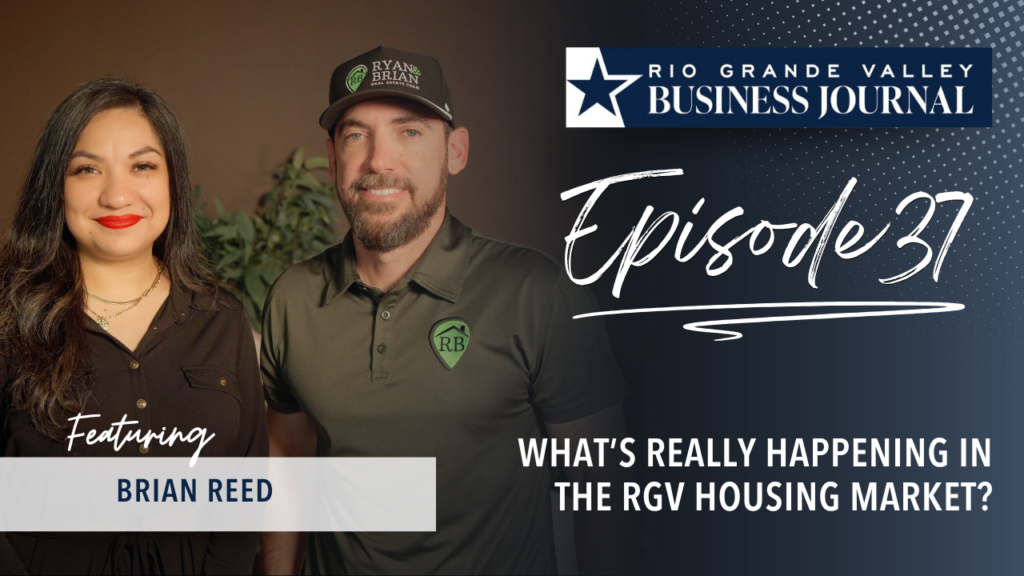
A recent national report labeled McAllen and Brownsville among the most overpriced housing markets in the country, but Brian Reed says the numbers don’t tell the whole story.
In this latest podcast episode, the Journal’s Naxiely Lopez-Puente sits down with the confounder of the Ryan and Brian Real Estate Team to unpack what’s really happening in the Valley housing market.
Reed explains why national pricing studies can be misleading, why today’s buyers have more negotiating power than they’ve had in years, and why he believes the current market may offer a rare window of opportunity before lower interest rates bring more competition.
The conversation also explores the growing divide between the McAllen and Brownsville markets, the pricing mistakes Reed sees sellers making, what first-time buyers should know, and why outside investors continue to pour into the Rio Grande Valley.
The following is a rough, AI-generated transcript of Naxiely Lopez’s interview with Brian Reed from the Ryan and Brian real estate team. Minor errors and misspellings may appear. For the full conversation, listen to the episode above or through your preferred podcast platform.
Naxiely Lopez-Puente: Hi, and thank you for joining us on this episode of the Rio Grande Valley Business Journal podcast. I’m Naxiely Lopez, and today we have a very special guest with us, Brian Reed from the Ryan and Brian real estate team. Brian, welcome.
Brian Reed: Thank you. Appreciate being on.
Naxiely Lopez-Puente: And you know, if anybody turned on the radio, you wouldn’t not know the Ryan and Brian real estate team. You all had a very successful marketing campaign.
Brian Reed: Thank you. Yeah, we are on quite a few radio stations and it’s been good to us.
Naxiely Lopez-Puente: Awesome. Well, talk to us about yourself.
Brian Reed: I’ve been in the industry for 23 years. I’ve been an agent here in the Hidalgo market for 20 years. We’ll have our 20-year anniversary Aug. 3. The Ryan and Brian Team 20-year anniversary — we’re going to have a big shindig for that. But we’ve been doing residential real estate for a long time.
Sold over 2,000 homes over that time period. We started off here in the McAllen-Edinburg area, and now we go all the way to Brownsville. So we work the whole Rio Grande Valley.
Naxiely Lopez-Puente: Wow. So over 20 years, I’m sure you have seen the market evolve. What can you tell me, starting from when you first started to where we are now?
Brian Reed: So I started off in appraisal. I was living in Houston, and I had a desire to come back to the Rio Grande Valley. Obviously, I knew the potential growth. I got my license — probably the worst time, 2006, because there was a market crash soon after that. And I had to either adapt or die.
Fortunately, I adapted. But in that time frame, I’ve seen everything. I’ve seen all different types of markets — from it picking up out of those difficult times, to slowly increasing a little bit every single year, to seeing in the COVID years where we just saw a major jump in pricing.
Right now it’s a little more leveled off. But it’s been a journey, and I’ve seen a little bit of everything. It’s been a privilege to be a part of the Valley’s growth. We always knew what the Valley was capable of, and I think we’re really seeing that right now.
Naxiely Lopez-Puente: And you mentioned that prices really went up during COVID. There was a recent report that put McAllen and Brownsville among the highest overpriced markets in the U.S. Is that a fair characterization?
Brian Reed: I think that’s very misleading. The Valley, for a long time, our pricing wasn’t going up very significantly. And then, yes, COVID did shoot it up drastically. But you’ve got to look at the Valley as a whole. Like Texas as a state, we’re closer to a $400,000 average price. So we’re at $260,000 — that looks pretty good.
I think they’re comparing that to county appraisals and so forth. As a Realtor, we use an RVM versus an AVM. An AVM is an automated valuation model that just uses public data. As a Realtor, we use a Realtor valuation model, which uses actual Realtor data. And those are very different.
So I think it’s a little unfair to say it’s an overpriced market. I don’t know where they get that. But as a whole, the Valley is pretty affordable compared to a lot of places in the United States.
Naxiely Lopez-Puente: Interesting. So what’s the difference between the AVM and the Realtor valuation model? You said the AVM uses public data — what does the Realtor model use?
Brian Reed: The Realtor model actually uses MLS data, which is actual sold data from transactions Realtors are handling. It’s much more accurate data. When you’re going on Zillow or these other sites, they use that automated valuation model — it’s highly inaccurate. It’s going off of public data, which doesn’t always use actual appraisal or sold data. So by speaking to a Realtor who has access to MLS data, you can get a much more accurate assessment.
Naxiely Lopez-Puente: OK. And I think the idea was that the appraisal value was lower in some cases than the actual sales price, right?
Brian Reed: Historically, that’s been the case — even going back 10, 15 years. It seems like the county appraisal price would be lower than the actual sales price. If everybody’s assessed price was at or above their actual sales price, you’d have people going to the county every day protesting their valuation. So it’s historically just been a little bit lower.
It keeps people from complaining too much. And to be honest, the way a general appraiser values a property versus how the county does it is not the same. So you really can’t compare them.
Naxiely Lopez-Puente: So what are you seeing? In our reporting, we’ve talked about how the McAllen market and the Brownsville market aren’t always moving in the same direction. What’s the picture like right now?
Brian Reed: McAllen county has a lot more inventory than Brownsville does. The price per square foot is actually higher in Cameron County. Crazy to think — if you’d told me six years ago that the average price in Brownsville would surpass McAllen’s, I wouldn’t have believed it. But they’ve got a lot going on over there.
Obviously, you’re reporting it all the time. I mean, it’s almost — I can’t even keep up with it. From SpaceX to unmanned boats — like, I don’t even know what all that involves — but there’s a lot of industry coming here. There’s obviously a lot of belief in the RGV and our community. We have a lot of workforce. So that has a lot of good things looking for the Valley.
Naxiely Lopez-Puente: And so that’s drawing attention, right? Because we know it, but a lot of outside people are also looking at the area. What are you seeing from outside investors?
Brian Reed: We constantly are getting calls from outside people. COVID was mind-blowing. We monitor our calls that come into our company, and I could kind of tell the state of the market just by the volume of calls on a weekly and monthly basis. During COVID, eight out of 10 calls probably weren’t local — just people who love our lifestyle, our cost of living.
They love our affordability in housing, and they want to move to this area. A lot of these individuals are also looking to open businesses here. And that’s continued. We just have a tremendous amount of calls and people interested in what’s going on. Obviously, when you’re seeing national headlines and seeing all these things coming here, it just attracts more and more businesses. It’s been awesome to see.
Naxiely Lopez-Puente: Right. And when you think about it, more people are going to come in for these jobs — they’re going to need homes.
Brian Reed: Absolutely.
Naxiely Lopez-Puente: OK. Lots of outside interest. Now, my understanding is that lenders are saying home loans are really down — like 70%. Is that something you’re seeing? Are people holding off on purchasing homes right now?
Brian Reed: Yeah, I do see that people are really just focusing on the rate right now, when there are so many other variables to take into consideration. Yes, rates aren’t ideal. We know that — they’ve been around the mid-sixes. But you’ve got to keep in mind: the National Association of Realtors said that if rates get closer to 6%, it’s going to open up homeownership to 1.5 million more people.
They say within 18 months, if rates stay around 6%, 550,000 people will get into the market. So that tells me: for people interested in buying, do it now — before all those people flood the market. Yes, rates aren’t ideal. We’re negotiating everything right now — negotiating closing costs, and using those closing costs not only to cover the cost of closing, but also to buy down your interest rate. At 6.9%, we’re often able to buy down that rate to about 5.5%, saving you thousands of dollars over the lifetime of the loan.
And you’ve got builders right now offering incentive packages — appliances, closing costs, interest rate buy-downs. There’s a lot you can get right now that when the market corrects, you won’t be able to get.
Naxiely Lopez-Puente: So it’s a buyer’s market.
Brian Reed: It is a buyer’s market. There’s inventory now — three or four years ago, everyone was complaining there was nothing to buy. Now you have things to look at, so you can be picky. You can be choosy. Sellers will fix things, sellers will repair things. They’re much more willing to negotiate. Now is the time to buy — if you’re in a position to do that.
Naxiely Lopez-Puente: Interesting. What’s the market like for first-time homebuyers?
Brian Reed: There’s a lot of new construction out there, and new construction is a good option because you don’t have a lot of expenses in terms of repairs. A lot of these builders are offering appliance packages, warranties and interest rate buy-downs. So if you’re not happy with the interest rate, you can buy that down.
And they’re affordable. They’re in the mid-$100s. So that’s kind of the price point where a lot of first-time homebuyers are. We’ve got options out there.
Naxiely Lopez-Puente: And I was going to ask about that, because a few years ago, $100,000 could get you a starter home. That doesn’t seem like the price point anymore.
Brian Reed: Unfortunately, no. We’re more in the mid-$250s to below $300,000 for that first-time homebuyer range. Yes, we can get some homes that are a little smaller in square footage in the low $100s, but it’s pretty hard to find something in the hundreds anymore.
Naxiely Lopez-Puente: So it’s not a “know where to look” type of thing — it’s just really not that available, right?
Brian Reed: I mean, you really need to sit down with a professional and talk about a payment. Don’t think about the price of the home — think about what you can afford on a monthly basis. By speaking to a lender, we can get you in touch with somebody and see what you feel comfortable with.
Naxiely Lopez-Puente: All right. For the next 12 months, what are you paying attention to?
Brian Reed: We’ll see how the economy goes in general. Hopefully interest rates go down. I don’t really see that happening anytime soon, just the way things look. At the beginning of the year, we were thinking rates would get closer to the low sixes — probably not happening until next year. There are a lot of people sitting on the fence right now.
Obviously, with a lot of people moving to the Valley, they’re kind of just learning the area and watching to see where the economy goes. But again — start putting your ducks in a row, start talking to a professional, so that when the time comes, you’re ready. Don’t wait until the last second and get in the market when everything gets hot and interest rates finally come down.
Naxiely Lopez-Puente: So are we kind of in a little lull right now, do you think?
Brian Reed: Yeah. For sellers, I know a lot of them are just waiting for things to pick up again. But if you bought your house anywhere prior to two or three years ago, you probably have a significant amount of equity in your property. So if it’s right, now’s the time to move. Let’s discuss it and see what you can do.
And if you price it accordingly, you can sell it. The one issue I see more than anything is overpricing. A lot of people think the market is like it was three years ago — my neighbor sold 20- or 30-thousand above asking price, so they’re doing the same thing. And there are agents doing that too. I read a statistic today that in May, homes sold were listed for 2.4% less nationally than they were last May.
People are finally coming to the realization that you just can’t overprice your house. Because the minute you do that, you’re taking eyeballs off your home. If you price it accordingly, you’re going to get showings, which will lead to offers — hopefully multiple offers. And you’re putting yourself in a better position.
When people say prices have sunk significantly below asking, it’s because they were listed higher than they should have been in the first place. It’s kind of misleading.
Naxiely Lopez-Puente: Right. And in some of our reporting, we have also mentioned that homes that have been on the market are coming down in price.
Brian Reed: It reminds me a lot of 2010 to 2013, when we did a lot of work with expired listings — properties listed with other agents that just weren’t priced or marketed correctly. We’re getting a lot of those listings now. People hear our marketing and sometimes they want to try it first with a family member who says, ‘Hey, I can sell it for this amount.’
We had already met with them and said, ‘That’s not realistic.’ They go try that strategy, they don’t use professional marketing, and it doesn’t work. So we come in, put it at the right price, and sell it quickly — sometimes higher than they had anticipated. They just didn’t start off right with the pricing.
Naxiely Lopez-Puente: Started too high.
Brian Reed: Yeah. Too high.
Naxiely Lopez-Puente: All right. You mentioned new construction. Our reporter has seen that there are a lot of people who have come in and flipped homes, and the prices have shot up. What does that do to affordability? And is that something you’ve been seeing a lot of — flipping?
Brian Reed: Yeah. You’re starting to see flipping happening again. It was very prevalent around 2010 to 2015. The problem right now is that a lot of people’s home values have increased, and there just aren’t the margins to make money on a flip. They’re asking too much already. So yes, you can flip, but you’re really going to have to hit the streets and find the right properties. It’s not easy.
I think a lot of people are not getting into the housing market early enough. When I got into real estate in my mid-20s, people were buying their first home in their mid-20s. Now, the average age of a first-time homebuyer is nearly 40. People are waiting to buy. And the average net worth of a homeowner versus a renter: a homeowner has a net worth, on average, 43 times greater than a renter.
So by getting into a home earlier, you’re building savings and equity as your home value increases. Yes, we’re not going to get 20% appreciation year over year like we did during the COVID years. Historically, we’re going to get 3 to 5%. So get into a house now. Don’t wait. The housing market, the real estate market, the Valley — I really believe in our market.
I think nationally the economy may not be the greatest right now, but the Valley has a lot to offer. We’re going to have a lot of businesses coming here, and our real estate market is going to be strong for many, many years to come.
Naxiely Lopez-Puente: All right. Awesome. So make sure to buy a home now.
Brian Reed: Get the right advice. Reach out to your local Realtor and, put your best foot forward. Get in the market if you can.
Naxiely Lopez-Puente: Awesome. Well, thank you so much, Brian — Brian Reed from the Ryan and Brian real estate team. Thank you so much. We really appreciate you coming and sharing your expertise with our viewers.
Brian Reed: Thank you for having me on.
Naxiely Lopez-Puente: Awesome. All right. Well, thank you so much, and we’ll see you next week. Make sure to subscribe.