McAllen is entering a new phase of growth shaped by international connectivity, retail expansion, and major development projects.
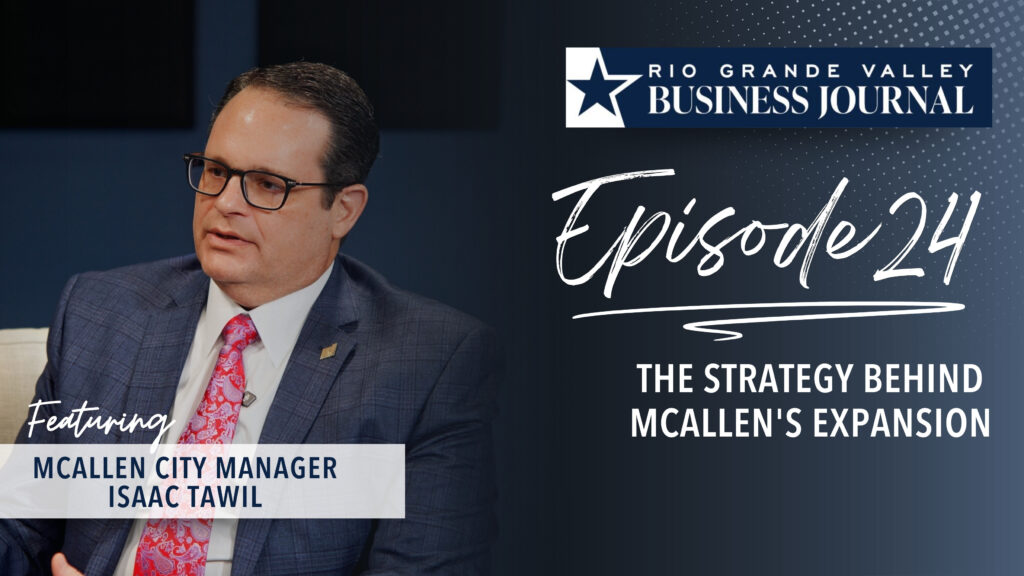
In this episode of the Rio Grande Valley Business Journal Podcast, reporter Kristen Mosbrucker-Garza sits down with McAllen City Manager Isaac Tawil to discuss the city’s newly announced nonstop flight to Monterrey and what it signals for business travel, tourism, and regional economic momentum.
Tawil explains how record-setting sales tax revenue is helping McAllen reinvest in economic development, infrastructure, and quality-of-life projects, while also supporting new retail opportunities and long-term planning across the city.
The conversation explores McAllen’s evolving development strategy, including projects like McAllen City Center and the proposed Bowie mixed-use development, airport expansion plans, efforts to restore nonstop service to Mexico City, downtown rezoning changes, and the city’s push to attract major new industrial investment.
The following is a rough, AI-generated transcript of Kristen Mosbrucker-Garza’s interview with McAllen City Manager Isaac Tawil. There may be slight errors in the transcription and possible misspellings of proper names. For the full, unabridged conversation, listen to the episode above or through your preferred podcast platform.
KRISTEN MOSBRUCKER-GARZA: The City of McAllen said earlier this week that there was going to be a new international flight. And so, in our office, we were actually taking bets. I actually won because —
ISAAC TAWIL: All right. We also know it’s important to the leisure travel community because people from Mexico love to come to McAllen and shop. Which is why, when we made the announcement this morning, I took advantage of the venue, the setting, to talk about our March sales tax numbers, which, again, were record-setting. Sales tax money goes to drive the special projects that we do and economic development here.
ISAAC TAWIL: We’ve got some really exciting announcements coming in the next week about some industry that’s coming to the Valley that hasn’t been here yet. But we know that with this first one, there are going to be more and more to come. And what we’re going to talk about next week will be one of the largest industrial investments in Hidalgo County.
KRISTEN MOSBRUCKER-GARZA: Welcome to the Rio Grande Valley Business Journal podcast. Thanks for joining us. We have a special guest today with Isaac Tawil, the city manager of McAllen. Thanks for joining us.
ISAAC TAWIL: Absolutely. How are you today, Kristen?
KRISTEN MOSBRUCKER-GARZA: I’m really good. Thank you. And so, initially when we booked this, we wanted to just talk about retail sales, retail growth in McAllen. But all right, y’all have some pretty big news today. And so I kind of wanted to hop on that for a second.
ISAAC TAWIL: So I’ll tell you where to buy a ticket. How about that?
KRISTEN MOSBRUCKER-GARZA: Yeah. So, the City of McAllen had said earlier this week that there was going to be a new international flight. And so, in our office, we were actually taking bets about which city it might be. And so at first I was like, San Luis Potosí. And then I was like, Monterrey — certainly not Mexico City, because we’re still sort of waiting on that one.
KRISTEN MOSBRUCKER-GARZA: But I actually won because —
ISAAC TAWIL: Monterrey. There you go.
KRISTEN MOSBRUCKER-GARZA: Yeah. And so how long did that deal take? Was it something that kind of fell into your lap, or is it something that was on your to-do list?
ISAAC TAWIL: Well, I hope it didn’t fall on my lap. The airplanes are pretty heavy. That would have hurt. But I wanted to fly here. They reached out to us. They’ve been reaching out to us for the better part of a year.
ISAAC TAWIL: They needed to secure assets to make sure that they had the capacity to service us daily, like they want to. And we think our travelers wanted it. But it was an easy deal to make. They’re a fantastic group of leaders running the airline, and they’ve got some strong incentives to use Monterrey.
ISAAC TAWIL: So, for our travelers, immediately, it’s the connectivity between McAllen and Monterrey and the business routes. The people looking for an easier connection between Monterrey and McAllen — and we have people making that trip by car — maybe they’ll make the drive and wind up having to stay a night in one city or the other. But for the person looking for the easier up-and-back, not having to worry about driving on the highways and getting here safely, concerned about activity along the border, it eliminates that hurdle.
ISAAC TAWIL: And so we know that’s important to the business community. We also know it’s important to the leisure travel community because people from Mexico love to come to McAllen and shop. Which is why, when we made the announcement this morning, I took advantage of the venue, the setting, to talk about our March sales tax numbers, which, again, were record-setting.
KRISTEN MOSBRUCKER-GARZA: Yeah. Historically, we’ve had a really long relationship with Mexican national shoppers, particularly in McAllen. I understand in 2025 y’all hit a pretty significant milestone — I think, if I’m accurate, almost $100 million.
ISAAC TAWIL: If you need the exact number, we were off by — you can watch the mayor’s clip from State of the City. He’ll remind you.
KRISTEN MOSBRUCKER-GARZA: Remind you. Yeah. It’s like $9,000.
ISAAC TAWIL: That’s like $18,000.
KRISTEN MOSBRUCKER-GARZA: Yeah. Short of $100 million. And so what does that mean to a city like McAllen? How can you maybe use that money to reinvest in economic development or improve quality of life?
ISAAC TAWIL: Well, we absolutely use all of that money to reinvest in economic development and quality of life. General fund money, which is raised by the ad valorem tax the city levies, in its totality is used to fund public safety, government services, and some of our culture and recreation.
ISAAC TAWIL: But the sales tax money goes to drive the special projects that we do and economic development. So some of the money from sales tax gets paid to the Development Corporation of McAllen, whose purpose is to drive economic development and provide incentives and other tools that we use to attract businesses, industry, retail, and services that support the growth of those to come to McAllen.
KRISTEN MOSBRUCKER-GARZA: Yeah. And it’s interesting because McAllen has had a really long history tied to the mall. And, you know, for folks who remember the malls of the ’80s, I think those floors are like Italian marble. There was a big investment in the retail experience in this region.
KRISTEN MOSBRUCKER-GARZA: But with all the online shopping and things like that, what do you think about McAllen retail has kept people coming to brick-and-mortar stores?
ISAAC TAWIL: Confidence. Trust. Especially with the international shoppers, they know that the products they’re buying are genuine. They know their money is going to purchase the products that they want. And the uniqueness of them.
ISAAC TAWIL: A lot of our local retailers have specialty items that aren’t available online. And if they are available online, they’re available online directly through the local retailers. So having those unique, high-quality products, things that people seek — the mall is incredibly comfortable, has diverse offerings, and is very popular with international shoppers.
ISAAC TAWIL: And knowing that the quality of the product and the genuineness of the product is going to be guaranteed.
KRISTEN MOSBRUCKER-GARZA: That’s really interesting. And it’s funny, when Ikea opened right there on the border between McAllen and Pharr, I remember asking them, don’t you think it’s a little too small? Just because we have so much demand, we have so much in-person shopping, we probably could fill the demand of a large Ikea.
KRISTEN MOSBRUCKER-GARZA: And it sounded like it was a bit of a pilot for them, that they were essentially going to test this out. And I’ve heard anecdotally that there are a lot of folks who come across the border and want to buy the floor model, basically because they are shopping in person.
KRISTEN MOSBRUCKER-GARZA: And the ability to — Ikea, for example, doesn’t ship internationally, right? If you buy at the store, they can’t send it to another address over the border. And I just thought that was really interesting. And I kind of wonder, maybe that might help the growth of us as a shopping mecca.
ISAAC TAWIL: It certainly doesn’t hurt. And it’s also not uncommon that when a new company is coming to a market, they will do exactly what you said, and that is open a smaller store, test the market, make sure they’re going to see the success they want, and then, depending on what the demand looks like, expand.
ISAAC TAWIL: I would anticipate that Ikea will be looking to do that. They will do well here.
KRISTEN MOSBRUCKER-GARZA: Yeah. And you all are also backing a lot of new retail development across the city. You have the McAllen City Center, which is where the former McAllen Civic Center was, which has been replaced by the performing arts center. And then you have the Bowie development.
KRISTEN MOSBRUCKER-GARZA: So how does that kind of fit into the city’s strategy when it comes to growing the retail space?
ISAAC TAWIL: I’m super excited about McAllen City Center and what the developer of that site is doing. I think that’s probably, in terms of retail opportunity, the best corner in McAllen. You’re on 10th Street and the expressway, blocks from the mall, blocks from what La Plaza will be.
ISAAC TAWIL: And so to see what the developer wants to put there in terms of hotels, retail, office space — not quite fully mixed-use, but that diverse offering — and some of what I think are going to be some very unique gastronomical and retail spaces there, that’s going to be a great development.
ISAAC TAWIL: And Bowie is really the next phase of what I think development in McAllen, in the Rio Grande Valley, looks like. It’s going to be our first time to support what is going to be a real mixed-use, walkable community that offers everything from retail, culture, recreation, and entertainment.
ISAAC TAWIL: We’ve got plans to put up to a couple of full-service, five-star hotels there. Residential housing, both condominium-style and single-family. So a real mixed-use development. And I think that will serve as a model for what developments around the area look like.
ISAAC TAWIL: I think it’s interesting to talk to the up-and-coming generation, my children, and how they like to live their lives. My kids — and I think it’s true for a lot of people — like living in urban areas where they have access to everything. They’re walking distance to restaurants, they’re walking distance to entertainment, they’re walking distance to shopping.
ISAAC TAWIL: Maybe they drive or commute to work. But living in that area where they can enjoy nightlife, enjoy their time at home in the evening, enjoy the weekends, and not be strapped to a car for transportation, I think is what people are looking for.
ISAAC TAWIL: And so we’ll see how that development turns out. What we as a city focus on is making sure that the infrastructure to support these developments is there and ready to go. And that’s where I think McAllen excels the most. We have consistently, and will continue to, invest and reinvest into the infrastructure we offer developers in terms of our roadways, our drainage, and our ability to provide water, making sure that the resources are there for the developments to be successful.
KRISTEN MOSBRUCKER-GARZA: And that Bowie development, I understand, will be probably about a $230 million project. I understand that the request for proposals went out, what, a couple months ago. Are y’all close to negotiating with a developer?
ISAAC TAWIL: We are negotiating with a developer. He took plans that were offered as potential development options in the RFP and worked those into what he thinks is a viable project. He’s in the process of polishing those up for a presentation to the commission.
ISAAC TAWIL: And if the visions align, then we look forward to executing a contract with him and getting started on that project.
KRISTEN MOSBRUCKER-GARZA: Wow. So it sounds like that is really on the horizon, something for folks to look forward to. And I understand that it’s actually near the airport, just to kind of —
ISAAC TAWIL: It’s right around the corner from the airport. It’s right around the corner from the mall. Yeah.
KRISTEN MOSBRUCKER-GARZA: And we have the FIFA World Cup coming to Monterrey. They mentioned that as one of the connectors. Now they do have connectivity from Brownsville to Monterrey and from Laredo to Monterrey. But they mentioned the McAllen flight was actually their first choice. And so they’ve been working for three years to try and secure that connection.
KRISTEN MOSBRUCKER-GARZA: I spoke with their CEO today, Javier Herrera, and he was just saying that some people may look at it on a map and they’re like, well, it’s like a three-hour drive, maybe a four-hour bus ride. But once you hit that international bridge, if it’s a high-traffic season like when they’re going to start during Semana Santa, you could be on that bridge waiting to be processed through customs for two to three hours.
KRISTEN MOSBRUCKER-GARZA: And so for that reliability and that consistency, it kind of sounded like they were really bullish on this direct, nonstop daily flight that I’m told is only 45 minutes in the air. Compared to hours and hours, or having to fly to Houston to fly back down.
ISAAC TAWIL: Well, think about it. It’s 45 minutes, and it accomplishes everything that you just mentioned and so much more because of their codeshare agreements. So you’re 45 minutes to a connecting flight to anywhere in Mexico, anywhere Mexico’s largest airline flies.
ISAAC TAWIL: So it’s a real golden opportunity for somebody — not only for the business traveler looking for easy connectivity between McAllen and Monterrey, but also the leisure traveler looking for connectivity to the resort destinations in Mexico.
KRISTEN MOSBRUCKER-GARZA: Yeah. And I know y’all lost the ability to have the Aeromexico flights that you had as a nonstop daily. I understand that the city is still pushing to essentially bring that back, petitioning the Department of Transportation, because you mentioned that it’s a pretty significant economic development driver. The airport generates, what, $1.2 billion?
ISAAC TAWIL: $1.2 billion of economic impact regionally. The flight to Mexico City performed extraordinarily well. Their load factors, the percentage of people on those airplanes, was in excess of 80% — 83%, 85% — which is great for jet service to Mexico City.
ISAAC TAWIL: It was a couple of hours, wheels up, wheels down, to Mexico City. Excuse me, it’s allergy season in the Valley. I know that the demand for that is still there. I know Aeromexico wants to fly that route. Our travelers were satisfied with what it looked like.
ISAAC TAWIL: I also understand what the federal government needed to do in making the decision they made in issuing the order. But the airline and Mexico, as a country, have worked diligently to address the issues raised by the American government.
ISAAC TAWIL: And as I understand today, two out of the three conditions placed by DOT on Mexico to have that order lifted have been satisfied. And they’re working through some of the complexities of the last element. But we continue to engage with our partners in the federal government to advocate for allowing that flight to resume.
ISAAC TAWIL: And we believe pretty strongly that if DOT will allow that to happen, Aeromexico will be back at the table.
KRISTEN MOSBRUCKER-GARZA: In the interim, once this flight starts here at the end of March, it sounds like we will at least have the opportunity. Because some people, if they’re going into Mexico City, they might try to go through the Reynosa airport. But sometimes it’s like, if you’re going to take your car, are you going to park it there? Or you’re trying to technically take an Uber ride from the U.S. side to the Mexican side, even though it’s very close. So it’s not like you couldn’t. It’s just a lot of times they won’t take you across the bridge.
KRISTEN MOSBRUCKER-GARZA: Right? So there’s a little bit of logistics there. But it sounds like with this route, you can essentially — let’s say you’re going to Mexico City — check into the McAllen airport, go through security, have your bag checked, and then stop in Monterrey, maybe take a couple days, and then head on to Mexico City. And they will actually transfer your luggage. So it sounds like, as an interim, there’s still that access.
ISAAC TAWIL: Absolutely. The opportunity for Aerus arose when Mexico City pulled out. We’re in the process of expanding, doubling the capacity of our terminal in McAllen. We’ve got so many slots that we can fill. We’ve got to find places to park airplanes when they’re here.
ISAAC TAWIL: And so we got to a time when this flight worked out. As we move forward, we’re working on plans to expand space for us to move aircraft between the gates and parking areas so that we can meet the demand of the travelers that’s there.
ISAAC TAWIL: And over the next couple of years, we will embark on a project to expand the size of our terminal, the number of gates that we have, and we look forward to continuing to expand the amount of service that we can offer there from the airport.
KRISTEN MOSBRUCKER-GARZA: Wow. And how much would a project like that potentially cost?
ISAAC TAWIL: Another couple hundred million. The nice thing is we’ve got support from the FAA, and they’re committed to about $85 million in funding toward that project. So it’s a very doable project for the airport, and we think it’ll be fantastic for our travelers.
KRISTEN MOSBRUCKER-GARZA: And the debt service from that would essentially be tied to the airport, right? It’s not coming from the general fund, just to confirm.
ISAAC TAWIL: That’s right.
KRISTEN MOSBRUCKER-GARZA: So something else I had seen — I don’t know if y’all had released renderings or if people are just using AI — the tunnels.
ISAAC TAWIL: I will confirm that those are AI.
KRISTEN MOSBRUCKER-GARZA: Okay.
ISAAC TAWIL: We have not released renderings. I’m not even aware that we have renderings. But I’ll tell you, I like some of the renderings that are floating around on social media. They look really, really nice.
KRISTEN MOSBRUCKER-GARZA: Okay. So tell us more about this proposed pedestrian tunnel. I understand it will be about $4.5 million. I want to say there were construction documents filed for it. I think that was sort of the kickoff when everyone reads The Talarico like their morning newspaper.
ISAAC TAWIL: So there are three potential sites for those. One to connect the convention center area to the other side. One to connect the golf course to what will be the new golf course. And another up on North 10th Street to make sure that there’s uninterrupted interconnectivity of the hike-and-bike trail that runs from Bicentennial, just north of Wisconsin, and then over to Edinburg and Second Street in McAllen.
ISAAC TAWIL: So there eventually will be three of those. We want to do what we can to support use of our recreation offerings. The connectivity between the two golf courses is going to be critical to moving people between Palm View and what will be the new golf course at La Vista.
ISAAC TAWIL: The connectivity between Westside Park and what eventually gets developed on the site of the old Parks and Recreation Administration building, and the offerings of the convention center — I anticipate more hotels across the street, more retail across the street.
ISAAC TAWIL: And so to allow connectivity between those two areas, and then, like I said, to make sure that we have unimpeded connectivity of the linear trail system, that’s important.
KRISTEN MOSBRUCKER-GARZA: That’s really interesting. Okay. So I will await the real renderings.
ISAAC TAWIL: And we will, too.
KRISTEN MOSBRUCKER-GARZA: But yeah, there are so many changes happening in the Valley, and there is a lot of push toward the live-work-play lifestyle. Y’all have Tres Lagos. That’s being developed out. I see more and more retail filings for that project.
KRISTEN MOSBRUCKER-GARZA: And I kind of wonder — the city went through some rezoning as well. I understand it was to kind of unify the code. So correct me if I’m wrong. We have these zones, right? And for some types of businesses in those zones, you needed a special use permit. And so now we’re back to conditional use permits. Is that right?
ISAAC TAWIL: Correct. So a couple of things happened. The codes that govern development in McAllen were developed in the 1970s and then modified throughout the years to meet the changing needs of the community that we live in.
ISAAC TAWIL: Recently, within the last 18 months, the city adopted a unified development code that is a modern take on what a development code will look like, which includes within it zones to help plan how industrial areas, mixed-use areas, residential areas, commercial areas, things like that, function.
ISAAC TAWIL: Under the old code, mixed-use, for example, was not available as a matter of right. If you wanted to develop a mixed-use development in McAllen, you had to come to the city commission and apply for a planned use development and then get special permission from the city to do a mixed-use development.
ISAAC TAWIL: Well, under the new code — much more user-friendly, development trends moving toward mixed-use — that’s now a zone available to a developer by right.
ISAAC TAWIL: And so when we adopted the unified development code, all of the zones affecting properties in the city got shifted a little bit to the right or a little bit to the left, and they all needed to be reestablished so that they aligned with the current code.
ISAAC TAWIL: So, for example, if you live in a single-family house in McAllen, that property will be rezoned under the new code to match the single-family zone under the new code. Why is that important for that landowner? Because that gives that landowner the rights to do on that property all of the things that the new code allows to happen, which in most cases are a little bit less stringent. They require less parking. The setbacks might be more friendly. And so it allows those landowners to take advantage of that.
ISAAC TAWIL: With the downtown area, that was rezoned to match what that area under the code was supposed to be. It allows all of the operations of the retail businesses, the restaurants, the bars — everybody who’s in that area — to continue to do what they were doing as a matter of right under the old code.
ISAAC TAWIL: Now, under the new code, what changes is the special use permit, which bars in the old entertainment district needed to apply for, no longer have to apply for that. The process for doing that was a little bit messy. Bar owners struggled to comply with the requirements and get information to the planning department so those permits could be reviewed and approved.
ISAAC TAWIL: What they will now have to do is what every other bar in the city was already doing, and that is apply for a conditional use permit to operate there. The requirements for a conditional use permit can be the same as what was required for a special use permit. The difference is there are clear deadlines for when things need to happen.
ISAAC TAWIL: So bar owners will now have the incentive to get information to the planning department so decisions can be made, and the planning department will be up against similar deadlines to get those applications to the Planning and Zoning Commission and then to the city commission for approval, because once applications under that process come in, they have to be moved through the system.
KRISTEN MOSBRUCKER-GARZA: That’s interesting. And I know there was some pushback from some bar owners saying they didn’t like that new process and all of that. But I had noticed —
ISAAC TAWIL: Well, the feedback I got was that they thought there was no plan, that it was just random rezoning. I want to make very clear to the residents and developers listening that rezoning was going to happen whether there was a redevelopment or reinvestment plan for downtown or not.
ISAAC TAWIL: Under the new code, every property within the city was going to be rezoned. We started at the south end of the city. We’re moving toward the north end of the city. It just so happened that we got to that part of the city when we were having conversations about what was going on downtown.
ISAAC TAWIL: Separate from that, we have engaged Main Collaborative to come down. They specialize in helping cities work with residents and stakeholders to invest in and reinvest in downtowns, and make sure that the plan — the partnership between the landowners and the city — is putting those properties to their highest and best use, because that’s for the benefit of the landowner, the business owner, and the city.
KRISTEN MOSBRUCKER-GARZA: Okay. And so that’s the consultant that y’all had put out the RFP for to help sort of re-envision downtown and kind of move that project forward.
ISAAC TAWIL: And that’s going to be a good collaborative process. Main is going to meet with city stakeholders individually so that there can be unfettered conversations. They’re going to meet with stakeholders without the city being present, so input can be shared freely without fear of judgment from the city.
ISAAC TAWIL: And then they’re going to compile the information and work with the various groups, and in combinations, to come up with a workable plan.
KRISTEN MOSBRUCKER-GARZA: What do you think is on the horizon? What do you envision the city of McAllen to be, in terms of economic development, in one year? I imagine maybe something like hitting that $100 million mark. You’ve mentioned the March sales tax allocation to the city was up 5%.
ISAAC TAWIL: Five and a half.
KRISTEN MOSBRUCKER-GARZA: Five and a half. Okay.
ISAAC TAWIL: So don’t short me a half a percent.
KRISTEN MOSBRUCKER-GARZA: Well, because it adds up, right? Because that 5% — to be clear — is like, what, $7.8 million? And so that’s a significant source of revenue.
ISAAC TAWIL: It’s a significant source of revenue. Look, what I don’t want to do is fall into the trap of saying that the only thing we care about is making money. That’s not what the focus is.
ISAAC TAWIL: The focus is making sure that we’re engaging in investments to create opportunities for our residents, for our businesses, for our investors to be successful. When they’re successful, we’re successful. And that allows us to reinvest in our infrastructure and expand our infrastructure so that they can be successful. That’s the name of the game.
ISAAC TAWIL: So where do I want to be in a year? I want to be, a year from now, in a place where I can do more than I’m doing today, that I can attract businesses and industry coming here and provide opportunities that we don’t have today. I want to be able to provide them tomorrow.
ISAAC TAWIL: How am I going to do that? I’m going to do that by continuing — and I’m going to say it again, and I’ve said it four or five times now — to invest in our infrastructure. I’m going to continue to invest in our public safety. We are very proud to be the third-safest city in the United States of America.
ISAAC TAWIL: I’m going to continue to collaborate with our education stakeholders and make sure that UTRGV, South Texas College, Texas A&M, and all of the technical schools here in the Valley are providing the best opportunity for our kids that want to learn a trade or earn a degree, so that they’re ready to meet the needs of the industry that we want to bring here.
ISAAC TAWIL: We’ve got some really exciting announcements coming in the next week about some industry that’s coming to the Valley that hasn’t been here yet. But we know that with this first one, there are going to be more and more to come. And what we’re going to talk about next week will be the largest industrial investment in Hidalgo County in decades.
ISAAC TAWIL: And so where I want to be a year from now is better than we’re doing today, providing more opportunity for our residents, for them to be successful.
KRISTEN MOSBRUCKER-GARZA: Is it a manufacturer, by chance?
ISAAC TAWIL: It is.
KRISTEN MOSBRUCKER-GARZA: Okay. Is it going to be off Ware Road?
ISAAC TAWIL: It is.
KRISTEN MOSBRUCKER-GARZA: Then I think we might have a story about that on the Rio Grande Valley Business Journal website already. So thank you so much for joining us. We really appreciate it. And stay tuned and subscribe to the Rio Grande Valley Business Journal. Thanks so much.