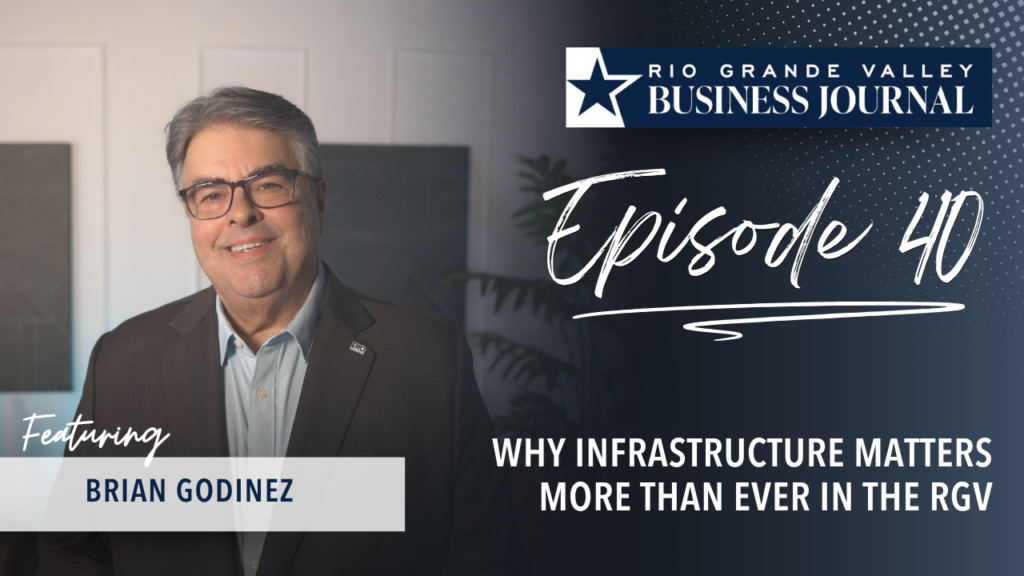
The Rio Grande Valley chapter of the Institute for Leadership and Capital Projects (I-LinCP) will host a luncheon Aug. 13 focused on two of the region’s biggest growth challenges: infrastructure and workforce development.
The event, “Powering Texas and Regional Growth: Infrastructure and Workforce Development Exchange,” runs from 11 a.m. to 1:30 p.m. at the Harlingen Convention Center. It marks the first time I-LinCP has partnered with an economic development corporation to co-present one of its events, with the Harlingen Economic Development Corporation joining as a co-presenter.
“We are the fastest-growing area in the state of Texas,” said Brian Godinez, principal at ERO Architects and president of I-LinCP’s RGV chapter. “The theme of this event is the challenges we have to endure, face and solve to provide the right infrastructure and workforce for attracting and recruiting economic development investment into our region.”
A keynote speaker from the Public Utility Commission will open the program, followed by two panel discussions. The first will focus on capital projects and will include speakers from AEP Texas and the RGV Desal South Texas initiative. The second panel will center on workforce development, featuring representatives from Workforce Solutions Cameron County, NextDecade LNG, Texas State Technical College and RGV LEAD.
Godinez said the region’s rapid growth — driven by projects such as Saronic Technologies, SpaceX and LNG development along the Gulf Coast — has intensified the need for regional collaboration on funding and planning.
Registration is $50 for I-LinCP members and $65 for nonmembers and is available at I-LinCP.org.
The following is a rough, AI-generated transcript of Naxiely Lopez’s interview with Brian Godinez, principal at ERO Architects and president of I-LinCP’s RGV chapter. Minor errors and misspellings may appear. For the full conversation, listen to the episode above or through your preferred podcast platform.
Brian Godinez: The RGV chapter has been doing a series of luncheon and evening events in various cities to raise awareness among architects, engineers and contractors about capital projects that are either ongoing or coming up, and to engage them in conversations with those making decisions on those projects. But the one on August 13th is going to be on infrastructure and workforce development. It’s called “Powering Texas and Regional Growth: Infrastructure and Workforce Development Exchange.” The theme of the event is the challenges we have to endure, face and solve to provide the right infrastructure and workforce for attracting and recruiting economic development investment into our region, because we are growing so fast — extremely fast. We’re the fastest-growing area in the state of Texas.
Naxiely Lopez-Puente: And thank you for joining us on this episode of the RGV Business Journal podcast. I’m Naxiely Lopez-Puente, and today our guest is Brian Godinez with ERO Architects and president of the I-LinCP RGV chapter here in the Rio Grande Valley. Brian, welcome.
Brian Godinez: Thank you. Thank you for having me.
Naxiely Lopez-Puente: All right, Brian. We’re here today to talk about a big event happening on August 13th. Talk to us about that.
Brian Godinez: We’re hosting a luncheon. The RGV chapter has been doing a series of luncheon and evening events in various cities to raise awareness among architects, engineers and contractors about capital projects that are either ongoing or coming up, and to engage them in conversations with those making decisions on those projects — whether they’re public institutions, private developers, real estate professionals, financiers or investors.
It’s an opportunity for us to talk about best practices, share ideas and learn about capital projects going up and down the valley, from Brownsville to Laredo. These events are designed to bring those individuals into the audience, and we pick a particular topic we think will be of interest. It might be economic development, workforce development or infrastructure — we’ve covered a variety of broad topics. But when we get more focused, like the event we had in Weslaco, we talk about Weslaco’s capital projects specifically. In Brownsville, we focused on the Downtown Renaissance Plan and the city’s downtown revitalization efforts.
The one on August 13th is going to be on infrastructure and workforce development. It’s called “Powering Texas and Regional Growth: Infrastructure and Workforce Development Exchange.” We’ve invited a keynote speaker from the Public Utility Commission — who is ahead of public engagement — to talk about the power grid and the challenges communities face in attracting and recruiting business and investment. A lot of companies have power requirements, some extensive, some not, so we’ll cover what’s going on both statewide and regionally, and how it’s affecting the Rio Grande Valley and South Texas. He’ll be our keynote.
Naxiely Lopez-Puente: I feel like there’s a lot of interest right now in the community. We’ve been covering a lot of the projects that are either announcing they’re coming or thinking of coming, and one of the questions that keeps coming up is power, especially when we talk about data centers — power and water. So you’ll be able to learn more about power if you come to this event.
Brian Godinez: Absolutely — that’s a perfect segue into what you just brought up. The focus and the theme of this event is the challenges we have to endure, face and solve to provide the right infrastructure and workforce for attracting and recruiting economic development investment into our region. Infrastructure — roadways, bridges, drainage and fiber — all have their challenges because we are growing so fast. We’re the fastest-growing area in the state of Texas, and Cameron County is growing in leaps and bounds with SpaceX, LNG, and now the autonomous boat manufacturing entity that could locate at the Port of Brownsville.
Naxiely Lopez-Puente: Not to forget the refinery.
Brian Godinez: And the refinery that’s coming. When you travel from Brownsville to South Padre Island on Highway 48, it’s a whole new landscape in terms of what’s being built. But our focus is going to be a bit more Cameron County and a little broader, and we’re thankful the Harlingen Economic Development Corporation is co-presenting this event. We’re going to talk about Harlingen EDC’s capital projects and economic development efforts, and about workforce development with the school district as well. We’ll also hear about what’s going on in Brownsville and about Cameron County’s economic development initiatives, including the desalination plant and the desal initiative underway in the county.
After our keynote speaker, we’re going to have two panels. The first will be moderated by Beverly Lopez, second-in-command at the Harlingen Economic Development Corporation. She’ll have three panelists: Gilbert Salinas; Dale Fuller, manager of economic development for AEP; and Albert Escobedo, government affairs director for the RGV Desal South Texas initiative. That panel will address what investors, real estate brokers and businesses are looking for when they consider coming to the valley. Gilbert Salinas, who is involved in the Saronic initiative — one of the biggest enterprises in the history of our region — can give us the economic development perspective, along with insight into water and power from AEP and the desal initiative as an alternative water source.
That’s panel number one, focused on capital projects that are coming to and currently underway in the region. The second panel will be on workforce development — our human capital side — and will be hosted by Rafael Vella, CEO of Workforce Solutions Cameron County. We’ve invited three panelists: Andrea Benton, director of community relations for NextDecade LNG; Dr. Montreal, provost of Texas State Technical College; and Marcela de Leon, who leads RGV LEAD. I love her perspective because she brings the high school career and technical education programs that link to our community colleges and universities that feed our business needs in terms of job creation.
We’ve never done a luncheon with two distinct panels that impact economic development in this region — one on the investment side with capital projects, and the other on human capital development. Having those two panels together is going to be fascinating in terms of listening to the challenges we have.
Again, the theme is that we need infrastructure improvements and stronger workforce development. What are we challenged with? Where do the opportunities exist, and how can we become more attractive than what’s referred to as the Texas Triangle — Dallas, San Antonio and Houston? That’s our number one competitor. RGV RioPlex has been talking for a long time about the need for us to be more regionally focused and work together.
Naxiely Lopez-Puente: Make it a diamond.
Brian Godinez: Exactly — turning it into a diamond between Mexico and South Texas. We would be the better alternative to the triangle. Eventually, the bottle fills up and can only get so full. They’re going to be looking somewhere else, and they’re already looking at us. Again, Saronic — that was huge for us.
Naxiely Lopez-Puente: Yeah, it is. They’re talking about bringing 10,000 jobs to the area, not to mention the construction. Look at Rio Grande LNG — they have crews working 24 hours a day, every day. So how do we make sure that we, as a community, can fill not just the trade jobs and construction jobs, but the high-paying jobs where the real money will be?
Brian Godinez: There have been some really interesting changes in our region over the last 10 years, from what I’d consider an economic development standpoint. One was UTRGV — when the UT System decided to create the one-campus UTRGV and invest more than $100 million into this area. I think that was a major wake-up call that we needed to take this area seriously. Then SpaceX came, and now Saronic. Those are huge shifts in attention and awareness for our region.
I applaud the work RioPlex is doing to create more awareness for our area, what CoStep is doing, and all the economic development organizations — led by Gilbert in Brownsville and his work securing Saronic, Orlando’s work at Harlingen EDC, and the work being done in McAllen and by all the smaller EDCs in this region. I’m hoping that at some point we work more collectively together as one, rather than competing with each other, because the Texas Triangle is taking a lot of business that I hope eventually lands here in the Rio Grande Valley.
But that, in essence, is what the luncheons are about — economic development challenges on the infrastructure and workforce sides. I think it’s going to be a fascinating conversation, and I’m hoping people who attend get real value out of it. We think they will.
Naxiely Lopez-Puente: And who should be attending these events?
Brian Godinez: I-LinCP — the Institute for Leadership and Capital Projects — started 16 years ago in Austin, then migrated to a chapter in San Antonio, then one in Houston, and now we’re in the Rio Grande Valley. Its principal focus has been architects, engineers, contractors and subcontractors, along with creating more awareness of capital projects by inviting developers, investors, decision-makers and public institutions to be part of the conversation. We create events where we’re all together in a room, sharing ideas, sharing thoughts, learning and announcing. So architects, engineers and contractors will be there.
We’ve also been focusing on developers, real estate brokers, financiers and bankers. This time, we broadened the audience to include more public officials and political subdivision leaders — from school districts, cities, counties and the state. We’ve extended invitations to our congresspeople here in the Valley, Monica and Vicente, along with officials who have already been elected or are likely to be newly elected in Cameron and Hidalgo counties.
I also want to mention why the Harlingen Economic Development Corp. is co-presenting this event. This is the first time we’ve actually gotten an EDC to be actively involved in the creation, development and participation of an event like this. They bring their own audience and network — mostly on the economic development side, with a lot of real estate professionals and developers — but they also bring other sectors that we think will be new to this kind of conversation because of their involvement.
We want to take this model — co-presenting and being involved in developing the conversation — and use it going forward. We’re already planning one in Mission. After the first year, we hope to do one in Pharr, eventually come back to McAllen, go to the Mid-Valley, and then head further west toward the Laredo area, with economic development organizations involved in developing programs that look at infrastructure and workforce — the two biggest challenges and opportunities for us to attract investment here.
We’re excited about that. Orlando and Beverly grabbed hold of this and said, ‘We’re in.’
Naxiely Lopez-Puente: They ran with it.
Brian Godinez: We wanted to participate not only in developing the program, but also in the logistics. They got us the convention center and helped us work out the logistics to pull off an event like this. We’re excited about this partnership — maybe one of many more we’ll do in the future.
Naxiely Lopez-Puente: So speaking of logistics — the event is next Thursday, August 13th, at the Harlingen Convention Center. Give us the time.
Brian Godinez: It runs from 11 a.m. to 1:30 p.m., and you can register at I-LinCP.org — that’s the acronym for the Institute for Leadership and Capital Projects. It’s $50 for members of the organization and $65 for nonmembers to attend.
Naxiely Lopez-Puente: And how do you become a member of I-LinCP?
Brian Godinez: You go to that same website, and there’s an option to join and become part of our chapter. When you become a member of the RGV chapter, you’re also a member of the San Antonio, Houston and Austin chapters — and hopefully a Dallas chapter is coming. So you can move from event to event; there are probably 20 events going on monthly around the state through I-LinCP. They just concluded, or are concluding today, a two-day forum on sustainability in San Antonio. I was pleased that Mayor Villalobos decided to participate on a panel with three other mayors to talk about sustainability programs their cities are doing to provide better service for their communities. He doesn’t know this yet, but he’s now an official member of I-LinCP. We always invite all the mayors to attend and be part of this, along with EDC board chairs, directors, presidents and CEOs, and generally they participate.
Naxiely Lopez-Puente: Wonderful. As you have these conversations, what have you found are the biggest challenges right now when it comes to infrastructure and workforce development?
Brian Godinez: Funding — being able to secure the funds. I think another sea change occurred when the MPOs joined forces as one in the region. That opened up more accessibility to funds and the ability to seek grants and funding as one, rather than two entities competing, Cameron versus Hidalgo.
But funding is always the biggest challenge to securing federal, state and other types of support. Unfortunately, I think a lot of people feel we’re overtaxed, and going out for bond elections — whether for a school district or a city — can be tough. But one district pulled off the largest bond election in the history of this region, $335 million, and it passed. That’s great, because $335 million is about to flow into the streets of the region, and when you multiply that by 10 or 11, that’s a lot of economic impact — direct and indirect jobs will come out of the construction to improve that school district. I think we’re going to see a lot more of that. I know all the cities right now are planning capital projects.
Naxiely Lopez-Puente: It’s the right time.
Brian Godinez: We’re talking about this right now — they’re in their budgets, and their fiscal year starts Oct. 1. So they’re out there, and I know they’re all looking for money. They’ve got their wish lists and needs lists, and they have to prioritize based on the availability of funds. The number one funding challenge and most urgent need is infrastructure — one could argue it’s roadways, or it’s drainage. There’s a lot of money being put into our ports and ports of entry, from the Port of Brownsville all the way to the ports of entry in Laredo. They’re always securing funds on both sides of the border, because if you’re building a bridge on one side, it has to happen on the other side as well, on the Mexican side.
It amazes me how many cities and school districts use grant sourcing or grant consultants to try to secure funds. Our school districts and public education system are having a difficult time right now. The state of Texas hasn’t been too friendly to school districts in terms of recent changes — our average daily attendance is down, enrollment is down, and charter schools are drawing students away. I think the biggest byproduct of COVID was homeschooling — parents decided to keep their kids at home and teach them there, and they qualify for vouchers to do that. So school districts are having a tough time finding funds, not just for education and curriculum development, but on the facilities side as well. But number one is always money.
Naxiely Lopez-Puente: Right. How do we get the attention of Austin and Washington and make sure that when they’re doling out that money, we’re top of mind?
Brian Godinez: It’s simple: act as one, think as one, be more regional, and work collectively together. It’s better for 40 cities to unite as one and go after money, creating a bigger pie instead of everybody fighting for smaller pieces of pie. That’s the only way we can do it. I love the message RioPlex puts out there, and it’s a message the RGV Partnership has been saying for over 80 years — that acting regionally is the only way we can compete with the Texas Triangle and the other markets we compete with. We have to think, act and ask as one.
Naxiely Lopez-Puente: And do you think we’re seeing progress on that?
Brian Godinez: I think so — going back to what I mentioned about the MPO. When UTRGV came together as one, and the MPO came together as one, I wouldn’t be surprised if, in the next 10 years, we become one MSA.
Naxiely Lopez-Puente: MSA — I know there’s been talk about that.
Brian Godinez: The benefit of that would be access to new funding and the ability to bring more money here. We’ve got to be more regional — speak more regionally and ask more regionally — to get the funds we need. As an architectural firm, I love it, because that means more public service, more facilities, more schools, more development. It means more people coming, more rooftops, more retail. On the infrastructure and logistics side along the border, it means more warehousing, more cold storage, and so on. It all connects.
Naxiely Lopez-Puente: All right, Brian, anything else you’d like to talk about or remind the audience?
Brian Godinez: I just want people to attend the event. I’m curious to see how this format works, with the focus on infrastructure and workforce as the primary points of both challenge and opportunity. What I hope happens in these conversations is that actual solutions come out of it, and maybe a few moments where we identify what we could be doing differently. I know they’re all going to say the same thing — that we need to be acting and speaking as one region. Everybody’s saying that.
Naxiely Lopez-Puente: Everybody’s saying it — we hear that all the time.
Brian Godinez: It’s important. A lot of people either don’t understand it or aren’t aware of it, but it’s the only way we’re going to secure the funding to attract investment and build a stronger community and economy. So please come August 13th, 11 a.m. to 1:30 p.m., at the Harlingen Convention Center, and register at I-LinCP.org.
Naxiely Lopez-Puente: All right, well, you heard it, folks — be there August 13th. Thank you so much. We expect to be there as well for a very interesting conversation, and hopefully, like you said, we’ll find some solutions to some of the infrastructure and workforce challenges we face as a community.
Brian Godinez: Jim Moore has a front-row seat waiting for him.
Naxiely Lopez-Puente: All right.
Brian Godinez: I hope he makes it — he’s been great to work with. And you all have been a great partner, by the way, in assisting with what we’re doing at I-LinCP. Thank you for the partnership and for helping us get the word out about events like this.
Naxiely Lopez-Puente: All right. Well, thank you, Brian, and thank you to those at home listening. Make sure to subscribe and keep watching, and we’ll see you next week.