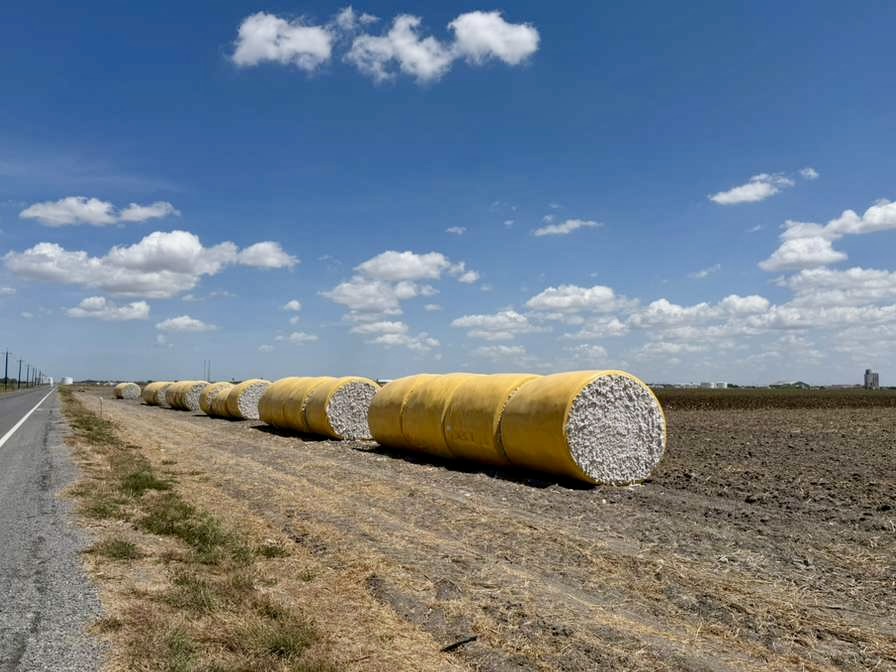
Weather conditions early last week were sunny, dry and fiercely hot: in other words, good weather to harvest cotton in.
That ideal weather blanketed Monday about 4,000 acres of cotton remaining to harvest in the Rio Grande Valley out of 65,000 acres of the crop carried to harvest, a crop that Edcouch-area farmer Brian Jones says produced about 10-15% above average yield despite growing long-term challenges and an overall reduction of scope in the industry.

Jones — who’s also a state director with Texas Farm Bureau — farms corn, grain sorghum and cotton.
This year Valley farmers planted about 105,000 acres of cotton, perhaps a third of which never sprouted, he said.
“Seed that didn’t come up. Too hot, too dry. And it just didn’t make it up,” Jones said. “But we got that Easter rain, so some of the later planted stuff did come up after that.”
The rest of the season was a mixed bag of factors that mostly leaned positive for local farmers.
Diesel and fertilizer costs remained exorbitantly high through most of the season, but pests were a minimal factor, according to Jones.
About a year ago, the cotton jassid — an invasive species of leafhopper that can devastate cotton crops — showed up in the Valley for the first time.
The pest showed up too late last year to threaten the Valley’s cotton harvest, though there were concerns it could have an impact this year.
Jones says the threat largely didn’t materialize. Jassids were detected by the middle of July this year, but the cotton plants were largely too far grown for the pest to significantly harm.
“Basically, for the most part, the cotton had already made what it was gonna make,” Jones said. “We just had to kind of wait for it to mature out, so we luckily got through this growing season without having to battle that.”
Water scarcity, the ever-present threat to all Valley crops, turned out to be something of a double-edged sword this cotton season. There was no water to irrigate with, which meant farmers didn’t have to buy water, keeping the crop fairly cheap, according to Jones.
August’s weather topped off the fairly successful season.
The Valley’s cotton harvest is often threatened by tropical showers or even the occasional late summer hurricane, which didn’t happen this year.
“The weather has held off and cooperated for us to get through the harvest season,” Jones said.
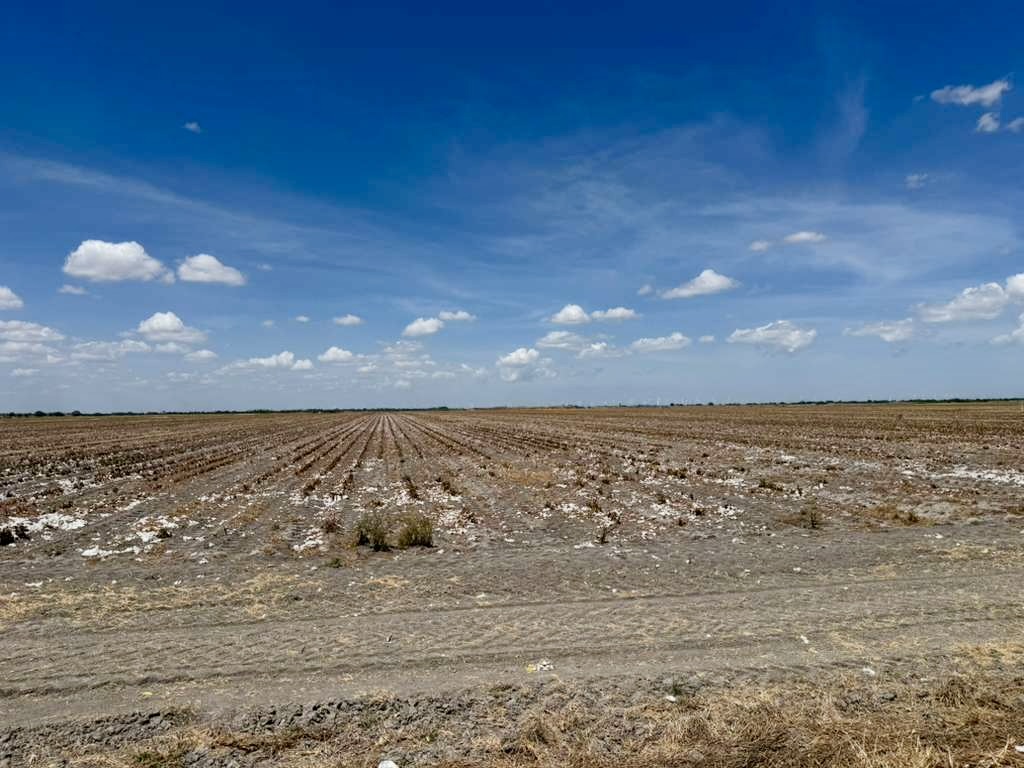
Despite an above-average yield on cotton planted in the Valley this year, the Valley’s cotton industry remains in decline.
The 100,000 or so acres of cotton planted by local farmers is only perhaps a third of what they would traditionally have planted.
Part of the problem is water.
Jones, for example, farms entirely within an irrigation district. For the last four years, however, he’s only been able to plant half that irrigated land.
Another part of the problem is economics.
According to Jones, Valley farmers would need to see sustained elevated prices in the cotton market to make a go at replanting their traditional acreage.
“We’d need to see the market really stay elevated,” Jones said on Sept. 2. “Last week the December market hit 90 cents. Some supply and demand, some of it’s been going up — the conflict over there in Iran, the Strait of Hormuz, has forced the cotton prices higher. But if we could see the cotton market stay in the high 80s or higher, that’s something that would really turn around the cotton industry here in the Rio Grande Valley.”
Jones says pressures in the industry have obliged him to rely on crop insurance and reduce his workforce.
“It’s definitely having economic ripples across the Rio Grande Valley,” he said.
The longer the industry stays reduced the less likely it is to regain its former size.
Smaller acreage means less infrastructure to process cotton.
About 74 years ago, there were more than 100 cotton gins in the Valley.
Three years ago, there were 11, and this year, only six of them operated.
“We’ve got half the gins in the Rio Grande Valley sitting idle. And once they sit idle for a few years, it’s gonna be really hard for them to get back cranked up again,” Jones said.
Water shortages have negatively impacted other South Texas crops — and the infrastructure around them — to the point of potential extinction.
The cotton industry isn’t in that position, and Jones says favorable conditions could lead to more gins operating, though he doesn’t know how much ground the industry’s infrastructure is ever likely to recover.
“If we pick back up in cotton planting, I think we could see a couple gins open back up,” he said. “But I don’t think we’ll ever be back up to even 11, where we were in 2023.”

Matt Wilson
Reporter
Matt Wilson is a Hidalgo County–based freelance reporter and contributor to the Rio Grande Valley Business Journal. He previously covered education and general assignment for The Monitor, frequently writing about the dramatic ways business changed during the coronavirus pandemic. Before that he worked as a reporter in rural Central Texas where he covered everything from house fires to school board meetings.
Most Read
- Is SpaceX quietly building a data center at Starbase? Job postings offer clues
- 25 Mexican businesses eye McAllen expansion after city pitches U.S. market entry program
- Developers begin $12M master-planned community near Rio Grande City
- Edinburg ISD rejects nearly $6M offer for prime land near La Sienna despite $15M budget deficit
- A little MySpace, a little AOL: Valleyites help grow new social media platform
Get the latest business news delivered to your inbox every morning for free.
Try 30 Days Free!
Get full access to award-winning journalism covering business, real estate, health care, economic trends, and the people shaping the Rio Grande Valley.
30 Days Free!
$9.95/month
Limited time offer
Subscription renews after your 30 day free trial at $9.95/mo.
Included Benefits
- Unlimited access to all articles
- Daily business news and analysis
- Subscriber-only content and features
Stories That Matter
- Mission’s first Small Business Expo puts $25K on the line for local entrepreneurs
- UTRGV lands $2.2M to fight screwworms with drones, thermal imaging
- Day of the Dead generates $7.3M in Reynosa economic activity
- McCoy’s gives $10K, tools to launch Mid-Valley construction academy
- UT Health RGV performs new digestive procedure for first time in the Valley
- TSTC bets on advanced manufacturing to meet RGV’s industrial boom
- Pharr’s cross-border business push earns international recognition
- Weslaco opens new pathway to healthcare careers for 25 residents
- Brownsville eases drought restrictions after nearly three years as Rio Grande reservoir levels improve
- Texas A&M’s $53.5M McAllen research center will tackle water, food security and Valley health