U.S. companies account for the largest share of Tamaulipas’ confirmed investment projects, while Asia represents the largest regional share of the potential pipeline
REYNOSA, Tamaulipas — Tamaulipas is attracting investment from companies across North America, Europe and Asia, with the United States accounting for the largest share of confirmed projects and Asia representing the largest regional share of the state’s potential investment pipeline.
The latest federal data show that Tamaulipas accumulated US$411.7 million in foreign direct investment through the second quarter of 2026, according to figures from Mexico’s federal Economy Secretariat reported by the state government. Manufacturing accounted for US$270.4 million, or 65.7% of the total, followed by financial services and insurance at US$66.8 million and transportation, postal and warehousing at US$46.6 million.
The United States, Spain, South Korea, Japan and Canada together represented 86.5% of Tamaulipas’ foreign investment through the first half of 2026, according to the state government’s report based on federal data.
That figure represents foreign direct investment already recorded. It is separate from the larger universe of investment projects the state is tracking.
The U.S. leads confirmed projects
Between October 2022 and June 10, 2026, Tamaulipas identified 173 confirmed investment projects, representing US$20.9 billion in announced investment and 58,515 jobs, according to the state’s June investment presentation.
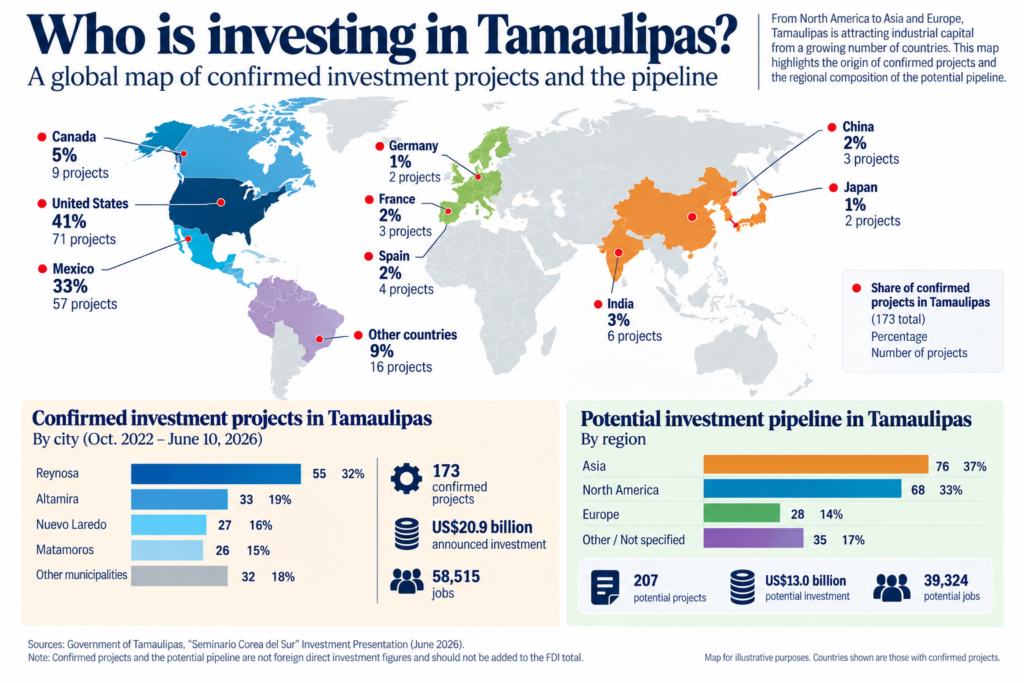
The United States accounts for 71 of the 173 confirmed projects, or 41%. Mexican companies represent 57 projects, or 33%, followed by Canada with nine, or 5%.
A separate state snapshot of 2025 FDI provides another view of the investment mix. The U.S. represented 47.5% of foreign investment that year, followed by Japan at 15.1%, South Korea at 9%, Canada at 8% and Germany at 7.6%.
The two datasets measure different things: FDI flows versus confirmed investment projects. They should not be combined.
Reynosa leads the project map
The geographic distribution of the 173 confirmed projects is equally important. Reynosa leads with 55 projects, or 32% of the statewide total, followed by Altamira with 33, Nuevo Laredo with 27 and Matamoros with 26.
The rest of the projects are distributed among Ciudad Victoria, Tampico, Ciudad Madero, El Mante, Río Bravo, Miguel Alemán, Tula, San Fernando and Mier.
Reynosa’s productive base includes foreign trade, electrical-electronic manufacturing, automotive and aerospace activity, while Matamoros combines foreign trade and manufacturing with medical, agribusiness, fishing and tourism. The state reports 1,395 companies and 236,414 jobs across its principal industrial sectors, with automotive and electrical-electronic manufacturing representing the largest employment bases.
Matamoros’ investment mix
Matamoros provides a local example of the investment activity represented in the statewide figures.
Enrique Salinas Garza, secretary of Economic Development for Matamoros, confirmed that the city’s 26 projects listed by the state are part of the broader statewide count. He said the municipality is also working directly on 11 projects involving both new investments and expansions, although some cannot yet be identified because of confidentiality agreements.
Asked which countries currently have the strongest investment presence in Matamoros, Salinas said: “One from Canada has arrived, but investments are mainly coming from the United States and Mexico.”
The statewide project data show U.S. and Mexican companies account for 74% of confirmed projects.
Salinas said the city is working with 115 established maquiladora companies and has identified 12 expansion projects. He described expansion by companies already operating in the city as a faster way to strengthen the industrial base than waiting for entirely new facilities to be built and staffed.
Two expansions were completed in 2026, while two more are projected for 2027, with approximately 500 jobs associated with each of those two planned expansions, according to Salinas.
Asia leads the potential pipeline
The most significant indication that the composition of future investment could become more diverse appears in the state’s potential project pipeline.
As of June 10, Tamaulipas had identified 207 potential investment projects representing US$13 billion and 39,324 potential jobs. These projects should not be treated as FDI already committed; they represent projects being tracked by the state at different stages of development.
By regional origin, Asia accounted for 76 of those projects, or 37% of the potential pipeline. North America represented 68 projects, or 33%, while Europe accounted for 28 projects, or 14%.
Asia therefore represents the largest regional share of the potential project pipeline.
The distinction is important. It does not mean that US$13 billion in Asian investment is coming to Tamaulipas. It means that, among the projects the state is currently tracking as potential investments, Asian-origin projects represent the largest share by regional origin.
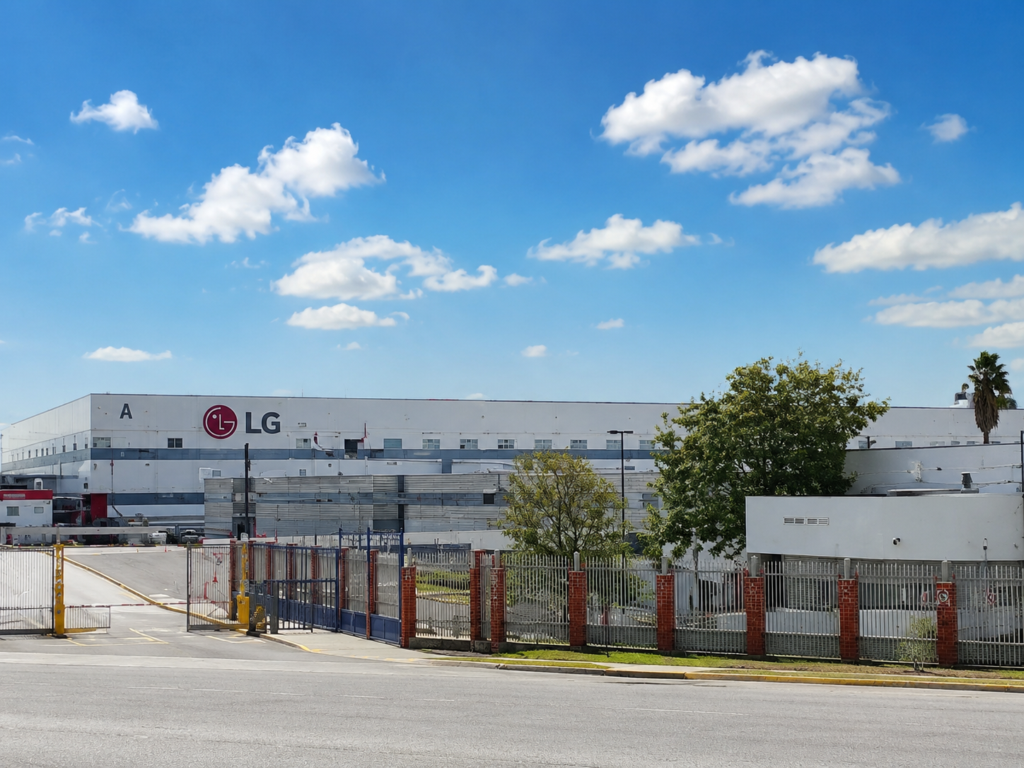
And Asian investment is already part of Tamaulipas’ industrial base. The state’s June presentation counted 28 South Korean companies and US$930 million in cumulative South Korean investment between 2006 and 2025, including LG in Reynosa and POSCO in Altamira.
South Korean companies are already part of Tamaulipas’ industrial base, according to the state presentation.
A more diverse investment pipeline
Tamaulipas’ confirmed investment projects remain led by the United States, which accounts for 71 of 173 projects, or 41%. Mexico represents 33%, followed by Canada at 5%.
The potential pipeline shows a broader geographic mix. Of 207 potential projects, 37% are associated with Asia, followed by North America at 33% and Europe at 14%. These projects represent US$13 billion in potential investment and 39,324 potential jobs.
The United States remains the leading source of confirmed projects, while Asia represents the largest regional share of the potential pipeline.

Anayancy Ulloa
Reporter
Anayancy Ulloa Luna is a contributor to the Rio Grande Valley Business Journal who hails from Reynosa in the Mexican state of Tamaulipas. Ulloa has a long history as a U.S.-Mexico region business expert in marketing, formerly the editorial director of Mexico Industry.
Most Read
- Edinburg ISD rejects nearly $6M offer for prime land near La Sienna despite $15M budget deficit
- What Toyota’s $3.6B San Antonio expansion could mean for the Rio Grande Valley
- Port of Brownsville approves $2M SpaceX pipeline deal, with millions more on the table
- New Texas Workforce Commission grant to help upskill 78 employees in the RGV’s manufacturing sector
- Texas LNG seeks 5 more years but remains bullish on Port of Brownsville export project
Get the latest business news delivered to your inbox every morning for free.
Try 30 Days Free!
Get full access to award-winning journalism covering business, real estate, health care, economic trends, and the people shaping the Rio Grande Valley.
30 Days Free!
$9.95/month
Limited time offer
Subscription renews after your 30 day free trial at $9.95/mo.
Included Benefits
- Unlimited access to all articles
- Daily business news and analysis
- Subscriber-only content and features
Stories That Matter
- DHR Health helps Valley veterans access specialty care close to home
- Longtime nurse at South Texas Health System named Veteran of the Year
- Greater Brownsville EDC CEO Gilberto Salinas earns international economic development award
- Mission’s first Small Business Expo puts $25K on the line for local entrepreneurs
- McCoy’s gives $10K, tools to launch Mid-Valley construction academy
- UT Health RGV performs new digestive procedure for first time in the Valley
- TSTC bets on advanced manufacturing to meet RGV’s industrial boom
- Pharr’s cross-border business push earns international recognition
- Willacy County data center seeks second round of economic incentives for $3.2B project
- Brownsville eases drought restrictions after nearly three years as Rio Grande reservoir levels improve