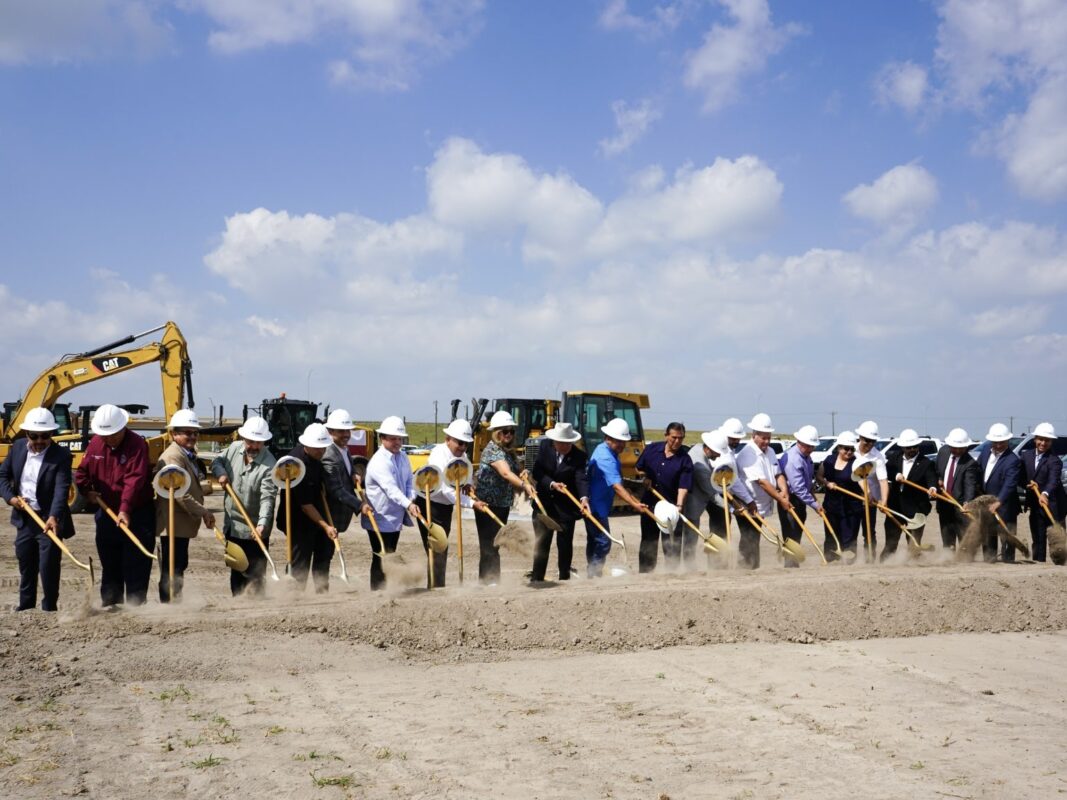
The Hidalgo County Regional Mobility Authority hopes to open the next leg of the county loop system to the public in about a year, according to a project report published last month that sums up the authority’s achievements in 2025.
The Hidalgo County Loop is the RMA’s main aim.
The loop, eventually, will arc around the urbanized parts of the county in a big circle.
The RMA has been moving toward the loop since its inception in 2005.
“These routes will not only provide end-users with the additional capacity necessary to alleviate congestion and improve mobility but will also create new opportunities for economic and commercial development along the corridors,” the RMA said in a report. “By expanding roadway infrastructure, establishing key connections to border facilities, and integrating multimodal transportation solutions, HCRMA’s initiatives are laying the foundation for
long-term growth and sustainable prosperity across the region.”
So far, comparatively little of the loop is completed, although it is underway.
365 Tollway
Perhaps the RMA’s most significant step toward the loop is progress on the 365 tollway, a road system that will wind from southern Pharr to southern Mission.
That roadway is currently being built westward.
The $19 million non-toll phase one of the project — which widened an existing section of Military Highway — opened to motorists in 2017.
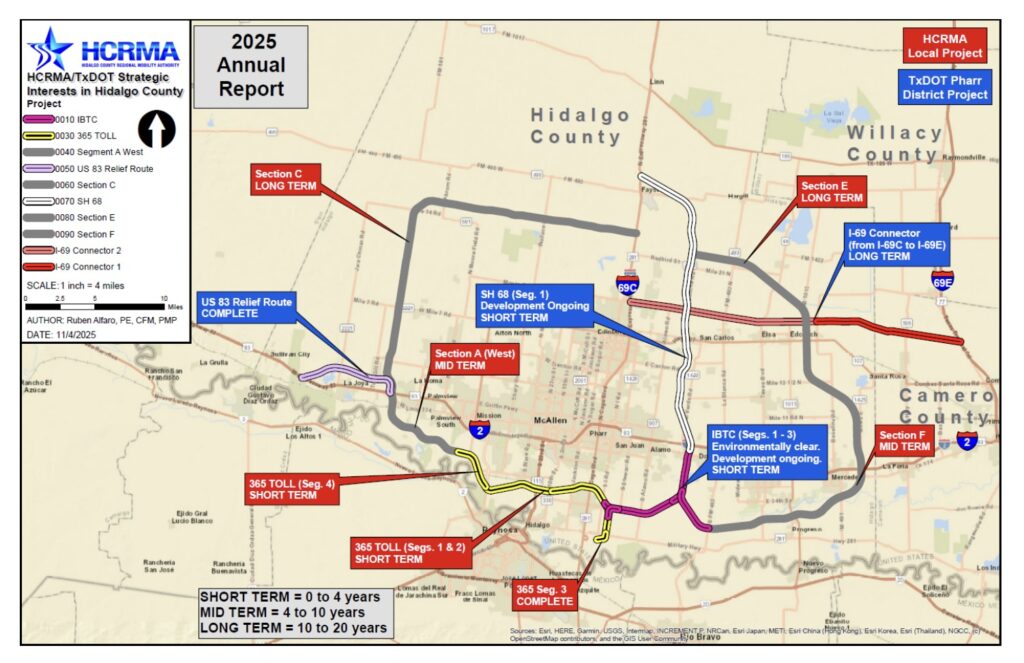
Construction on the $296 million second phase of the project is slated to finish in 2026, and the 12.22 mile road is supposed to open to traffic at the beginning of 2027.
In relation to the second phase of that project, the RMA completed a tolling server room that houses IT infrastructure responsible for processing toll transactions, managed a challenging floodway levee relocation, and installed its first tollway gantry.
“This milestone marks the beginning of the tolling infrastructure deployment and demonstrates
readiness for future integration of the toll collection system,” the report says.
As of last month, phase 2 of the 365 tollway was about 70% done.
The third phase of that project will add toll improvements and is “assumed to be built as toll viability increases within that segment as destinations come online to warrant developing this section of toll road.”
That phase is expected to cost about $141 million.
Funding for that phase isn’t yet determined, nor is a projected completion date.
That project is part of $3.16 billion in planned projects that will ultimately complete the loop but haven’t yet proceeded past study and environmental review work.
Mid-Valley plans
There has also been some progress on plans for Mid-Valley roadways.
This year, the RMA transferred the International Bridge Trade Corridor (IBTC) Project to TxDOT after achieving environmental clearance.
The IBTC is 13.2 miles of non-toll improvements south of Alamo that will connect with the 365 tollway and are aimed at “enhancing regional connectivity and supporting future international trade mobility within Hidalgo County.”
TxDOT fully funded the project, and construction is estimated to commence in 2028.
Ultimately, the IBTC will connect with State Highway 68.
State Highway 68 is a proposed new 22-mile road that will connect I-2 to I-69C, providing a route from the Alamo/Donna area to north of Edinburg.
Those projects make up the lion’s share of the RMA and TxDOT’s short-term strategic plan, which accounts for 48.9 miles of roadway improvements.
Permit sales
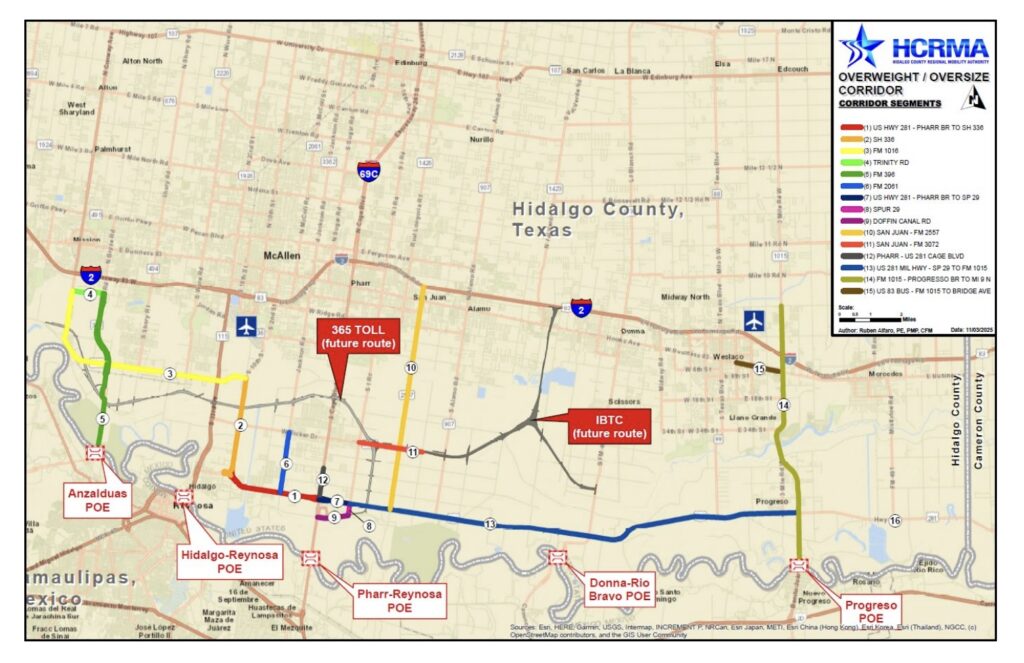
The RMA’s work is supported by permit sales for an overweight/oversize corridor made up of a network of roads in southern Hidalgo County, retaining 15% of permit fees issued.
As of the end of October, the RMA had issued 56,627 permits and collected about $11.5 million.
The RMA ultimately garnered about $1.5 million of those fees. The rest went to the permit system provider and to TxDOT.
“The OW/OS Corridor has amassed steady use by the agricultural, fuel and goods transporters who pay $200 for a one-way destination to cross larger legal loads that provides them a logistical edge in their shipping operations,” the report says. “The 365 Toll and IBTC projects are designed to carry overweight traffic and are intended to become the future backbone of the corridor system. From 2014 to present, TxDOT has received $66,320,073.05 from overweight fees to maintain the existing on-system roads that currently comprise the overweight network.”

Matt Wilson
Reporter
Most Read
- SpaceX is giving Brownsville $220M for water projects. In exchange, the city gave up zoning control of 444 acres near Starbase
- SpaceX seeks to take zoning control over nearly 450 acres from city of Brownsville as a ‘regional’ water deal takes shape
- Port of Brownsville could soon host Nodule City, a first-of-its-kind commercial deep-sea mining hub
- Cameron County is negotiating a $20M Fluidstack data center donation after Harlingen waffles on the same offer
- How much water does SpaceX need to operate near Brownsville? Nearly 20x its current use
Get the latest business news delivered to your inbox every morning for free.
Try 30 Days Free!
Get full access to award-winning journalism covering business, real estate, health care, economic trends, and the people shaping the Rio Grande Valley.
30 Days Free!
$9.95/month
Limited time offer
Subscription renews after your 30 day free trial at $9.95/mo.
Included Benefits
- Unlimited access to all articles
- Daily business news and analysis
- Subscriber-only content and features
Stories That Matter
- McAllen’s $204M water investment expects to seek construction bids in 2027
- Saronic lands Navy landing craft contract, first build at Brownsville’s Port Alpha
- The Rio Grande Valley’s tech industry is small but growing — meet some of the next-gen workforce
- Entrepreneurs enter Mission EDC’s ‘Shark Tank’ competition for $25K top prize
- Mission’s first Small Business Expo puts $25K on the line for local entrepreneurs
- Reynosa’s newest technical high school focuses on AI, semiconductors and bionics
- McCoy’s gives $10K, tools to launch Mid-Valley construction academy
- UT Health RGV performs new digestive procedure for first time in the Valley
- TSTC bets on advanced manufacturing to meet RGV’s industrial boom
- SpaceX reschedules Starship’s first flight around the Earth