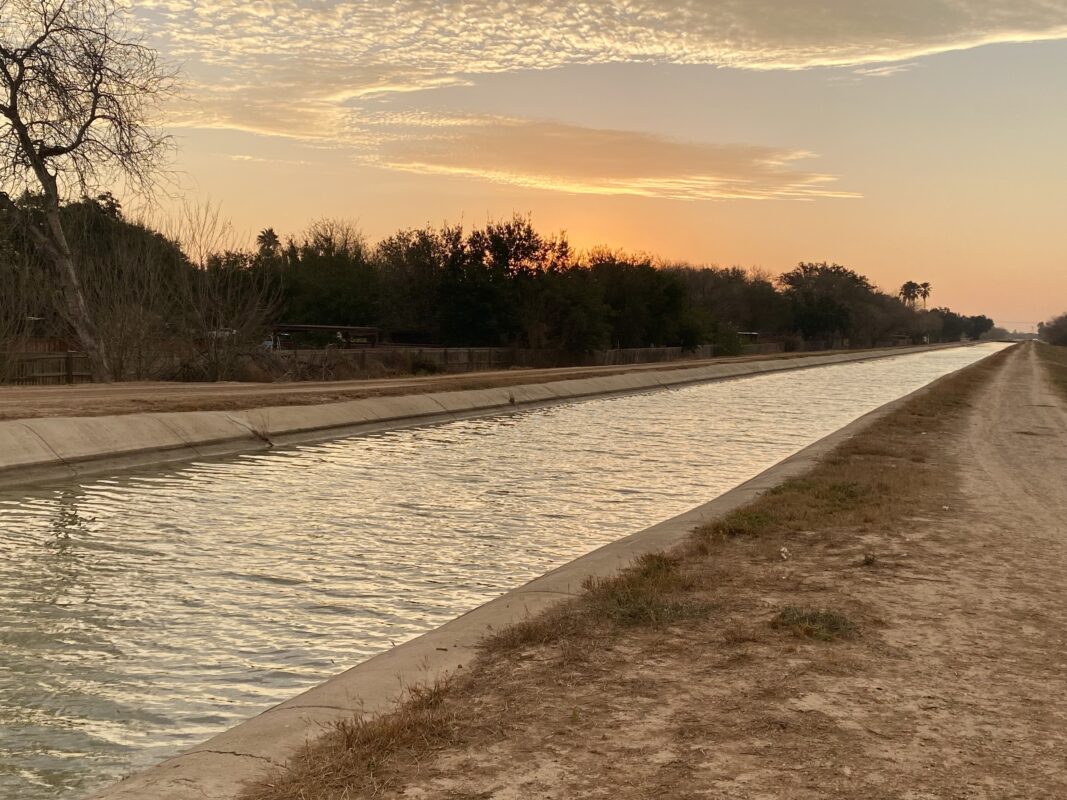
Projects in the Rio Grande Valley that could conserve enough water to meet the daily needs of roughly 600,000 residents are now competing for $400 million in financing as irrigation districts seek to modernize aging canals and reduce losses.
On Thursday, the North American Development Bank (NADBank) announced it received 21 project proposals from 13 Valley irrigation districts asking for a total of $225 million as part of the first round of applications for its Water Resiliency Fund.

“The overwhelming response to our first call for projects reinforces both the urgency of the challenge ahead and our decision to focus the first call on the Rio Grande Valley,” NADBank Managing Director John Beckham said in a news release.
NADBank’s initial call for projects, which opened in November and closed in January, focused on water conservation and improvement projects in Cameron, Hidalgo, Starr, and Willacy counties.
According to NADBank, irrigation districts in the Valley reported they had only secured about 20% of the funding needed for their proposed projects, leaving them with an estimated $180 million gap in financing.
Preliminary review indicates the proposed infrastructure improvements — primarily canal lining and canal-to-pipe conversions — could conserve more than 55,000 acre-feet of water annually.
That volume equals roughly 49.5 million gallons per day, enough to meet the drinking water needs of approximately 600,000 residents, according to NADBank estimates.
Using an estimated 150 gallons per person per day, the Valley’s residential and commercial demand totals about 210 million gallons daily. The projected savings would offset nearly 24% of that amount.
The calculation does not include agricultural, industrial, or environmental water use.
“By investing in infrastructure that conserves water and reduces losses, we are strengthening municipal water systems, supporting agriculture, and building long-term resistance to drought and extreme weather,” Beckham said.
NADBank staff are now evaluating the submitted proposals using Water Resiliency Fund priority criteria.
Initial results are expected in April or May, followed by detailed technical and financial due diligence for top-ranked projects.
A final funding announcement is anticipated in late summer.

RGV Business Journal Staff
Staff
Most Read
- SpaceX’s futuristic city of Starbase finalizes massive 7,100-acre annexation. Here’s what we know.
- 25 Mexican businesses eye McAllen expansion after city pitches U.S. market entry program
- Australian company plans to build a $607M lithium refinery at the Port of Brownsville. It’s a big bet on America’s battery future
- Starbase cancels meeting to consider annexing 444 acres relinquished by Brownsville
- SpaceX reschedules Starship’s first flight around the Earth
Get the latest business news delivered to your inbox every morning for free.
Try 30 Days Free!
Get full access to award-winning journalism covering business, real estate, health care, economic trends, and the people shaping the Rio Grande Valley.
30 Days Free!
$9.95/month
Limited time offer
Subscription renews after your 30 day free trial at $9.95/mo.
Included Benefits
- Unlimited access to all articles
- Daily business news and analysis
- Subscriber-only content and features
Stories That Matter
- Dickey’s Barbecue Pit to open new McAllen location inside Cambria Hotel
- NADBank opens $300M financing pipeline for water, energy projects along the border
- Engineering firm Garver opens $5M Harlingen office, plans up to 50 new jobs
- Is SpaceX quietly building a data center at Starbase? Job postings offer clues
- Mission’s first Small Business Expo puts $25K on the line for local entrepreneurs
- McCoy’s gives $10K, tools to launch Mid-Valley construction academy
- UT Health RGV performs new digestive procedure for first time in the Valley
- TSTC bets on advanced manufacturing to meet RGV’s industrial boom
- Pharr’s cross-border business push earns international recognition
- Brownsville eases drought restrictions after nearly three years as Rio Grande reservoir levels improve