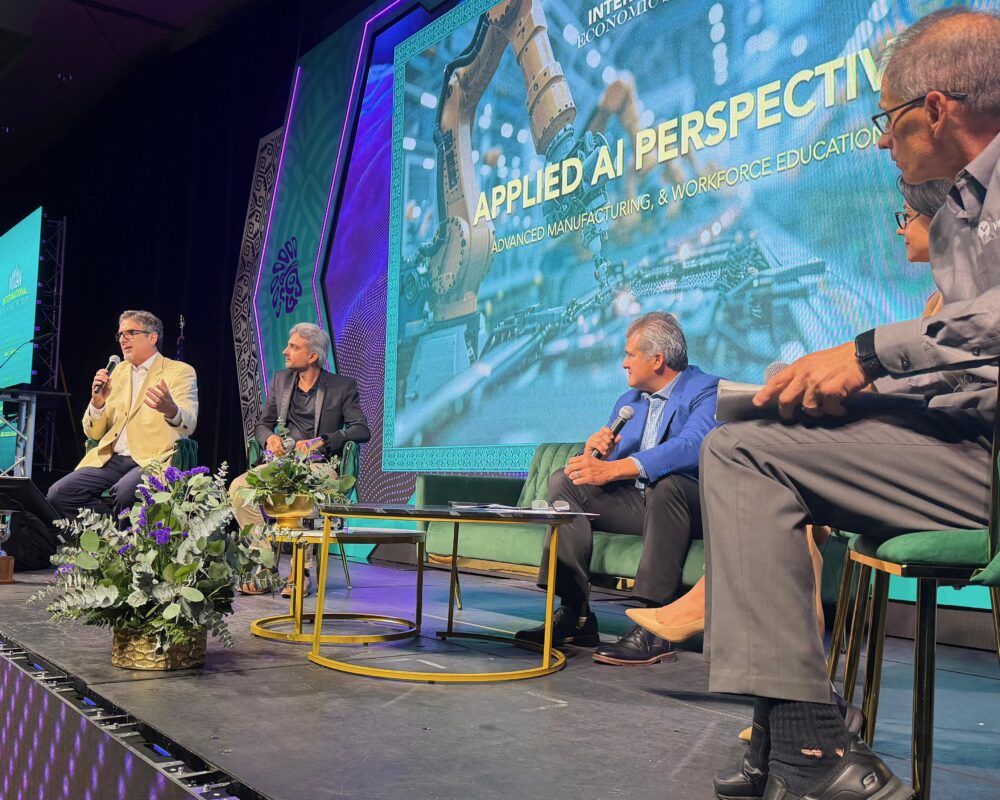
A manufacturing company in Reynosa is using artificial intelligence to build the equipment that powers and cools the massive data centers needed to run AI.
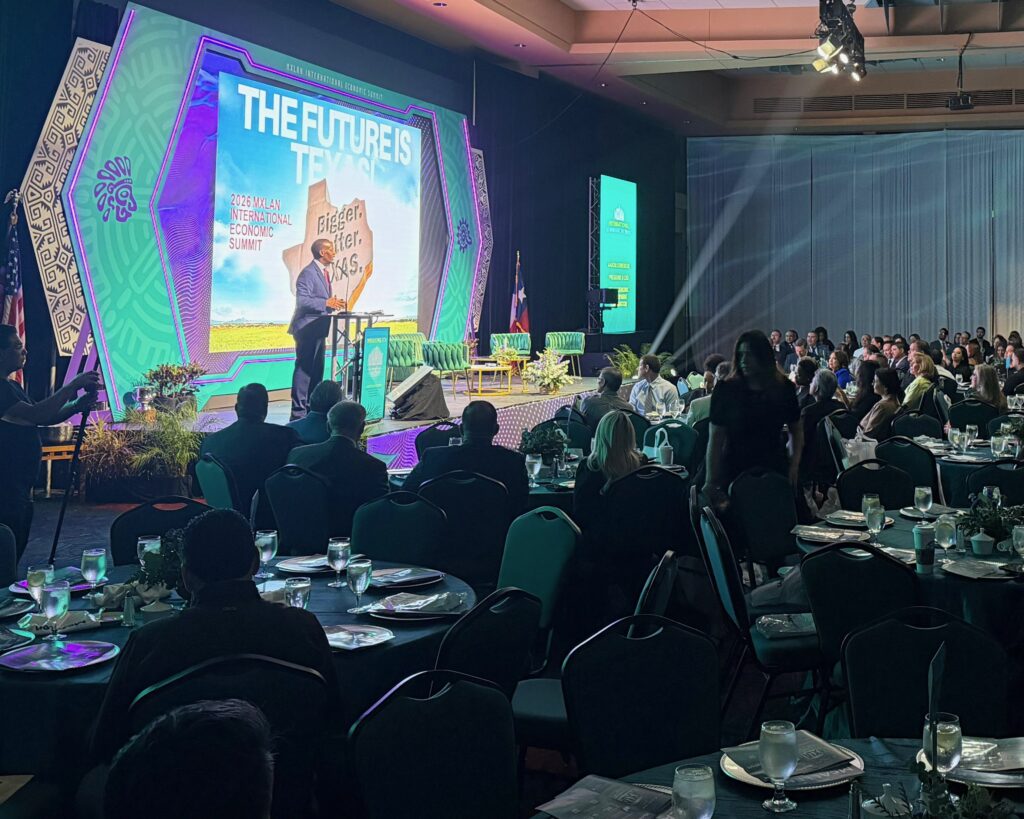
Photo Credit | Kristen Mosbrucker-Garza
It’s just one example of how companies across the binational region are increasingly putting the technology to work, company executives said Friday during the MXLAN Economic Summit in McAllen.
Vertiv, a Reynosa maquiladora that manufactures equipment that powers and cools data centers, uses AI to reduce errors in manual processes, Vertiv General and Plant Manager Patrick Cerroni said.
In some cases, humans work alongside robots, he said.
“We particularly have a lot of operators doing manual assembly, so we use AI to measure how an operator will put a screw in. Are they using the right angles?” Cerroni said. “We use a lot of robots and cobots that will actually test the units. It’ll tell you if there’s something wrong with the unit and where it’s wrong.”
And speed is increasingly important for manufacturers like Vertiv, which supply equipment for large-scale data centers.
The company has seen an uptick in demand for its electronic components, including uninterruptible power supply units, thermal management or cooling technology, and other key critical infrastructure tools that keep data centers running.
“Our biggest customers are all the hyperscales — all the people that are making the AI,” Cerroni said. “Our factory generates thermal cooling. The data center is very hot, they have to cool.”
The company also makes products that handle all the electrical power for the centers.
“We’re seeing significant growth,” the general and plant manager said.
Alps Alpine, another manufacturer in Reynosa with operations in McAllen, uses artificial intelligence to speed up production and reduce administrative tasks for employees. The company makes sensors, switches, wireless communication devices, semiconductors, and multi-control devices.
“What we found with AI is that it does a lot of the routine testing: it’ll check the bills of the material, provide the plans, automatic prints, and it’ll make it much quicker to implement standard procedures across the floor,” Bob Anderson, vice president of supply chain for Alps Alpine, said during the summit.
In the healthcare sector, another major industry in the Valley, there has been a shift toward using AI for routine tasks to enable workers to focus on patient experience — but it’s mostly been on the administrative side of the business.
“Even though there’s a lot of buzz around artificial intelligence and what it’s capable of doing, we’re not seeing a lot of it just yet on the clinical side,” said Dr. Maya Yiadom, an emergency room physician and associate professor at Stanford University. “A lot of where we’ve had gains is the back-end operation in addition to the administrative improvement.”

Photo Credit | Kristen Mosbrucker-Garza
For example, hospitals are using AI to estimate the busiest times of day in the emergency room and staffing the facility to account for potential peak use.
“That way, when you come to our ER, it doesn’t have to be a long wait time, and you don’t have to be stressed about having enough resources to be able to receive the care you need,” Yiadom said.
That caution is common in the industry, said Lance Ames, CEO of South Texas Health System Edinburg.
“Before we turn over all our bedside care to robots or algorithms, we really want to make sure that it’s safe,” Ames said. “It’s really used as a tool to assist our care providers at the bedside.”
South Texas Health System advertises on billboards across the Valley its average wait time inside the ER.
“It is usually below five minutes, and I know this because we’ve been able to use tools that help make sure our processes are smoother and that’s a benefit to everyone.”
The hospital system also uses AI to cross-check and alert medical providers when there are multiple medications prescribed to patients, which warns them about any potential drug interactions.
“We have automatic notifications and alerts that are brought up into the electronic medical system so the physicians, nursing team, and everyone can see,” Ames said.
In the coming weeks, an AI agent from Humanate is slated to be rolled out in a Weslaco doctor’s office. The startup’s CEO, Carlos Rodriguez, says his AI agent is used to contact patients for medical history intake or routine procedure conversations.
“When we first came up with this technology, we were concerned about the older population. The older population loves it; the fact that they can speak to you and you’re going to see the avatar; she speaks 100 languages, and she reads your face,” Rodriguez said about the AI agent that will be used at the front desk to check in patients. “If you’re confused, she’s able to ask you questions. It’s changing patient intake.”

Kristen Mosbrucker-Garza
Reporter
Kristen Mosbrucker-Garza is a versatile multimedia news reporter who lives and works along the Texas-Mexico border in Hidalgo County. Mosbrucker-Garza is a news reporter for the Rio Grande Valley Business Journal. During her career she's worked for the McAllen Monitor, San Antonio Business Journal, The Advocate Newspaper in Louisiana, Phoenix New Times, and public media outlets in Baltimore and Philadelphia.
Most Read
- SpaceX’s futuristic city of Starbase finalizes massive 7,100-acre annexation. Here’s what we know.
- SpaceX reschedules Starship’s first flight around the Earth
- How much water does SpaceX need to operate near Brownsville? Nearly 20x its current use
- Could apartment-to-condo conversion help make $100K homeownership in the McAllen metro more affordable? One investor says yes.
- Crunch Fitness is expanding and struggling in the Valley. Here’s why
Get the latest business news delivered to your inbox every morning for free.
Try 30 Days Free!
Get full access to award-winning journalism covering business, real estate, health care, economic trends, and the people shaping the Rio Grande Valley.
30 Days Free!
$9.95/month
Limited time offer
Subscription renews after your 30 day free trial at $9.95/mo.
Included Benefits
- Unlimited access to all articles
- Daily business news and analysis
- Subscriber-only content and features
Stories That Matter
- Frost Bank is investing in Harlingen, a cement lab coming to Brownsville, City of Hidalgo apartments, plus Terra-Gen’s new offices
- Mission’s first Small Business Expo puts $25K on the line for local entrepreneurs
- Reynosa’s newest technical high school focuses on AI, semiconductors and bionics
- McCoy’s gives $10K, tools to launch Mid-Valley construction academy
- UT Health RGV performs new digestive procedure for first time in the Valley
- TSTC bets on advanced manufacturing to meet RGV’s industrial boom
- Pharr’s cross-border business push earns international recognition
- Pharr doubles bridge capacity as data centers and produce drive new trade demand
- Brownsville eases drought restrictions after nearly three years as Rio Grande reservoir levels improve
- Texas A&M’s $53.5M McAllen research center will tackle water, food security and Valley health