
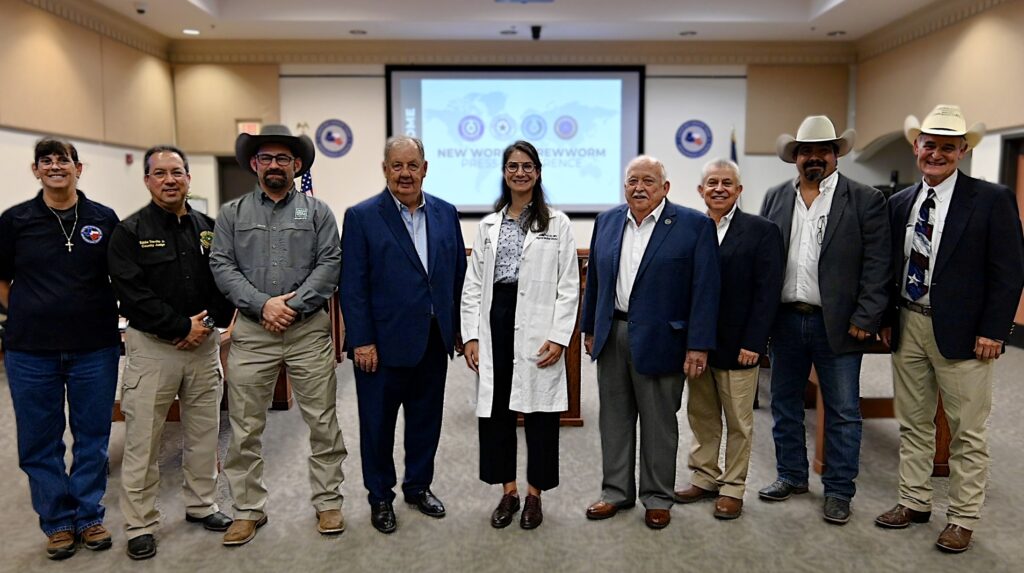
WESLACO — For what may be the first time since the coronavirus pandemic, the threat of a new epidemic prompted all four of the Rio Grande Valley’s county judges to band together Monday to take a stand against the New World screwworm.

Courtesy of | Hidalgo County
The screwworm fly is a pest that lays its eggs in the open wounds of any warm-blooded animal — eggs that hatch into flesh-eating maggots.
Despite being eradicated from the United States in the 1980s, screwworms have recently crept north through Central America and Mexico.
Screwworm detections in Mexico have increasingly sounded alarm bells, particularly for the cattle industry.
Late last month, the Texas Department of Agriculture reported a confirmed case of screwworm in Nuevo León about 60 miles from the U.S.
On Monday, officials said there are now 1,857 active cases in Mexico, including one roughly 80 miles from the U.S. border.
In February, a U.S. Department of Agriculture inspection found a screwworm case in an imported horse in Florida. And though Texas hasn’t seen its first case, it’s been described as the probable “ground zero” for the U.S.’s fight against the pest.
Until Monday, local elected officials had largely left screwworm awareness to state, federal and industry officials.
But Cameron County Judge Eddie Treviño Jr. said he and his fellow county judges decided to step in, partially, because of lessons they learned collaborating during the Valley’s response to the coronavirus pandemic.

“That experience proved and showed us that when working together we can make sure that the people we’re tasked to protect are well-guarded and provided for,” he said.
Treviño said the threat isn’t likely well understood by the general public.
In part, that’s because the public — and even experts — hasn’t dealt with screwworms in the U.S. on a significant scale in a generation.
Screwworms are also hard to understand because there’s so much about them to understand.
There’s been a flurry of efforts to address them, cobbling together existing, converted and future facilities that span multiple countries.
They’re a pest that’s particularly nasty for a host animal, though they don’t actually pose a food safety threat.
Courtesy of | Hidalgo County
Screwworms are usually talked of in terms of cattle, but they can infest any warm-blooded animal — that includes pets and strays, wild animals, and humans.
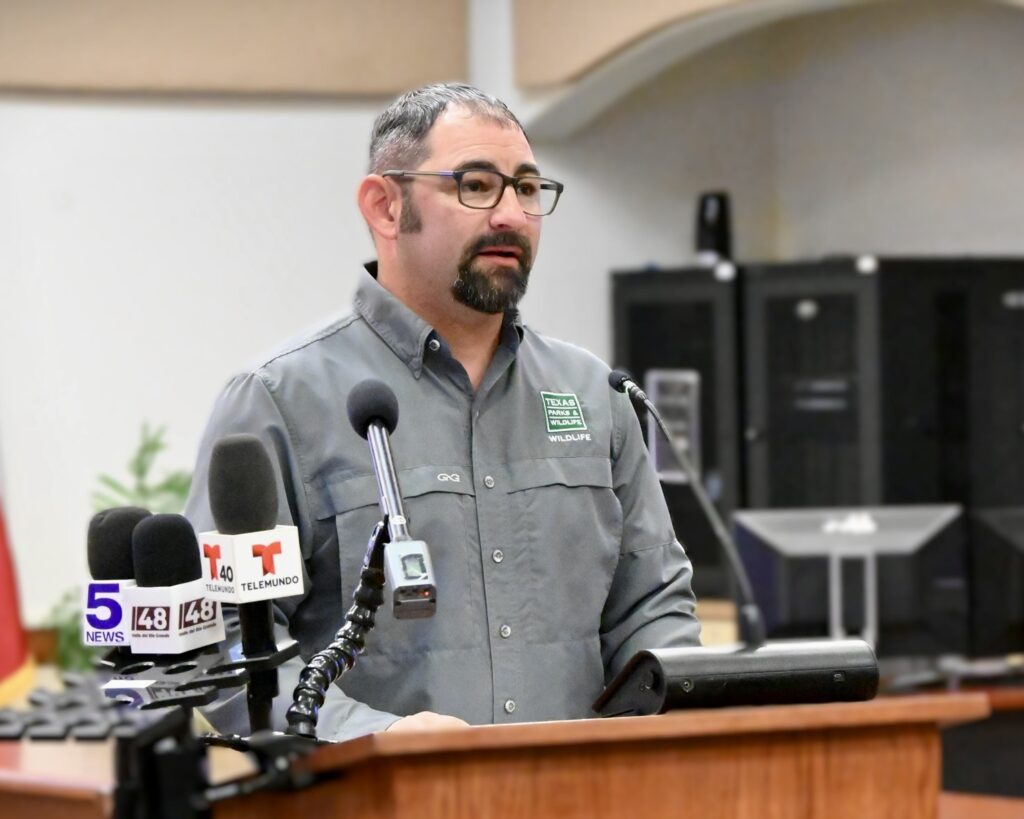
Adequately addressing the threat Monday took a panel of experts, including a public health official, a rancher, a wildlife expert and a veterinarian, among others.
It’s a lot to take in.
“We’re not here to scare the heck out of everybody,” Treviño said. “That’s not at all what we’re trying to do. We want everybody to know that all of the agencies — federal on down to local — are doing everything they possibly can to make sure that we’re doing everything we can to protect our livestock, protect our animals, protect our people.”
Still, Treviño and the other judges said locals should learn about screwworms and be vigilant about them. They warned the public to avoid misinformation, be proactive, and report potential sightings.
There’s some reasons the Valley is especially in the crosshairs of the screwworm: its climate is conducive to them, it’s close to Mexico, and it has thriving livestock and wildlife industries.
“We have residents that have livestock in their backyards — perhaps even in their frontyards,” Willacy County Judge Aurelio “Keter” Guerra said. “And then we have big ranches. Not only hundreds of thousands of acres, but thousands of acres, and then some that are smaller.”
Guerra said it’s an issue that will affect the economy.
Speakers Monday were hopeful vigilance will reduce the impact of screwworms, but it’s dubious that vigilance alone will be enough to eliminate the threat.
The only way to eradicate screwworms is to interrupt their breeding cycle by producing and distributing sterile flies that breed with wild ones on a massive scale.
Right now, through a facility in Panama, there are 100 million sterile flies being produced per week. Those flies are being dispersed over the U.S.-Mexico border to form somewhat of a protective shield.
It’ll take another year-and-a-half to construct production facilities capable of boosting that number to 500 million sterile flies per week.
Courtesy of | Hidalgo County
The last time the U.S. eradicated screwworms from its borders and pushed them as far south as the Darién Gap, it took about 30 years, and the effort could rely on a production capacity of 700 million sterile flies per week, Freddy Nieto, a director for Texas & Southwestern Cattle Raisers Association, said Monday.
Nieto, the general manager of the HP El Sauz Ranch in Willacy County, said even vigilance will cost money for South Texas’ ranches.
Fifty years ago, he said, the HP El Sauz might’ve employed 30 cowboys. Now there’s five, because of new technology and other innovations.
That’s a problem.
“You know, we don’t check our cows every day under normal operations — [only] a couple times a week. Now we have to. So, that sucks up a lot of time,” he said. “Then you have chores that you’re used to tending to, that you can’t, because you’re doing surveillance. So then you gotta add people — payroll. Your economics change.”
Nieto says delays related to shipping are expected. Ranches have had to build entirely new management plans.
“But you either move forward, be part of the solution, or you get out of the way,” Nieto said.

Matt Wilson
Reporter
Most Read
- SpaceX’s futuristic city of Starbase finalizes massive 7,100-acre annexation. Here’s what we know.
- SpaceX reschedules Starship’s first flight around the Earth
- How much water does SpaceX need to operate near Brownsville? Nearly 20x its current use
- Could apartment-to-condo conversion help make $100K homeownership in the McAllen metro more affordable? One investor says yes.
- Crunch Fitness is expanding and struggling in the Valley. Here’s why
Get the latest business news delivered to your inbox every morning for free.
Try 30 Days Free!
Get full access to award-winning journalism covering business, real estate, health care, economic trends, and the people shaping the Rio Grande Valley.
30 Days Free!
$9.95/month
Limited time offer
Subscription renews after your 30 day free trial at $9.95/mo.
Included Benefits
- Unlimited access to all articles
- Daily business news and analysis
- Subscriber-only content and features
Stories That Matter
- Tamaulipas is rethinking how it sells its cattle. A $44.5M project would keep more of the business at home
- Brownsville is changing its drainage fee. Businesses could pay more as the city looks to raise $6.2M a year
- Mission’s first Small Business Expo puts $25K on the line for local entrepreneurs
- Reynosa’s newest technical high school focuses on AI, semiconductors and bionics
- McCoy’s gives $10K, tools to launch Mid-Valley construction academy
- UT Health RGV performs new digestive procedure for first time in the Valley
- TSTC bets on advanced manufacturing to meet RGV’s industrial boom
- Pharr’s cross-border business push earns international recognition
- Brownsville eases drought restrictions after nearly three years as Rio Grande reservoir levels improve
- Texas A&M’s $53.5M McAllen research center will tackle water, food security and Valley health