Artificial intelligence at South Texas College is moving beyond computer labs and into some unexpected places — construction sites, auto repair shops, police training and even cosmetology.
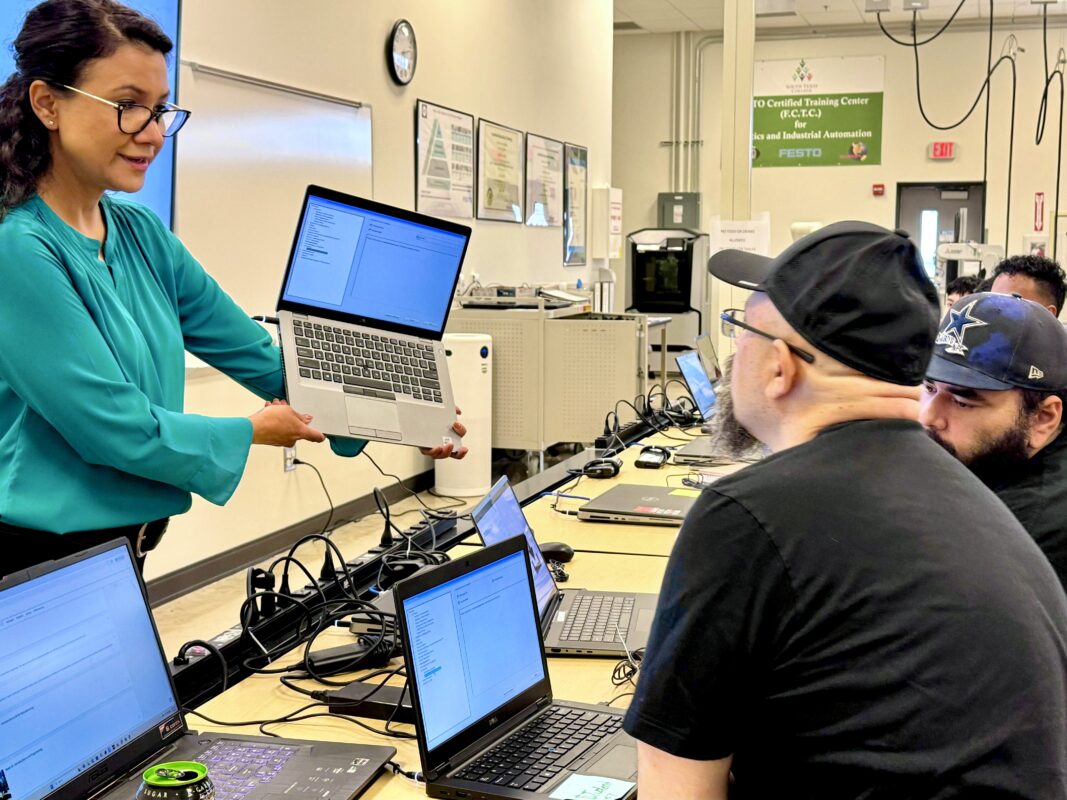
The college’s Division of Business, Public Safety and Technology now has 33 faculty members incorporating artificial intelligence into 55 courses across 15 departments, part of a push to prepare students for workplaces where the technology is increasingly becoming another tool of the trade.
But the approach differs considerably depending on the career.
An automotive student might use the technology to diagnose a vehicle’s driver-assistance system. A construction management student could use it to schedule workers and materials. Architecture students can turn early sketches into realistic models, while law enforcement instructors are using AI to help students work through complicated legal concepts.
That range is intentional.
“They have made some tremendous progress in incorporating AI into their programs,” said Joe Vela, interim dean of the division. “They are getting really innovative on different approaches and things we could do, which is exactly what we wanted.”
From one manufacturing course to 55 courses
The broader effort grew out of South Texas College’s AI in Manufacturing course, which was developed with grant support from Intel.
The college has since expanded the effort across programs including Business Management, Automotive Technology, Law Enforcement, Construction Management, Architecture and Cosmetology. Faculty have identified 10 general-purpose AI tools and 18 industry-specific applications already being used as part of instruction.
Erika Guerra, Advanced Manufacturing Technology program chair and the division’s AI liaison, said that does not mean every student is simply being taught to use a chatbot.
Some departments are using generative AI, while others are teaching students to work with specialized technology already appearing in their industries.
The common rule, she said, is that the technology should support human expertise rather than replace it.
“That’s one of the main things we are stressing throughout this initiative,” Guerra said. “This is not going to replace instructor expertise, research or any kind of verification.”
What AI looks like on the job
The applications become more tangible inside individual programs.
South Texas College’s Automotive Technology program, for example, is preparing students to work on advanced driver-assistance systems used for automatic emergency braking, adaptive cruise control, lane-keeping assistance, blind-spot detection and pedestrian recognition.
This fall, the program plans to introduce a new training system that will allow students to diagnose problems, analyze sensor data and calibrate those systems.
In Construction Management, faculty member Israel Medrano is showing students how AI-supported platforms can help supervisors schedule workers and materials, monitor costs, improve job-site safety and communicate with contractors.
“When we use AI, we schedule our lumber, we schedule our materials, our labor and our workforce,” Medrano said. “AI is just something we cannot do without anymore.”
Law Enforcement instructor Jennifer Rosillo is using the technology differently. AI can help simplify difficult legal concepts, generate scenarios and adjust test questions for different learning needs, but students are expected to verify AI-generated information against Texas law and authoritative sources.
Teaching students when not to trust AI
That verification component is also being emphasized in business courses.
Jose Cruz, a Business Administration faculty member, has students use AI to analyze data, spot patterns and develop recommendations for a hypothetical company in his Communications in Management course.
AI can help produce the analysis, but students remain responsible for deciding whether the information is accurate, weighing possible decisions and explaining their conclusions.
“It’s the human element that we still need to teach our students,” Cruz said. “It’s about knowing the culture, knowing the context and knowing the environment.”
That distinction is central to South Texas College’s broader strategy as employers increasingly incorporate artificial intelligence into jobs that might not traditionally be considered technology careers.
Rather than preparing students to compete against AI, the college is trying to make sure graduates know how to work with it in their respective fields.
“The idea is not necessarily to replace the careers they have,” Vela said. “It’s how do we enhance what we can do and make us more efficient.”

RGV Business Journal Staff
Staff
Most Read
- SpaceX’s futuristic city of Starbase finalizes massive 7,100-acre annexation. Here’s what we know.
- SpaceX reschedules Starship’s first flight around the Earth
- How much water does SpaceX need to operate near Brownsville? Nearly 20x its current use
- Could apartment-to-condo conversion help make $100K homeownership in the McAllen metro more affordable? One investor says yes.
- Crunch Fitness is expanding and struggling in the Valley. Here’s why
Get the latest business news delivered to your inbox every morning for free.
Try 30 Days Free!
Get full access to award-winning journalism covering business, real estate, health care, economic trends, and the people shaping the Rio Grande Valley.
30 Days Free!
$9.95/month
Limited time offer
Subscription renews after your 30 day free trial at $9.95/mo.
Included Benefits
- Unlimited access to all articles
- Daily business news and analysis
- Subscriber-only content and features
Stories That Matter
- Starbase leaders approved a 45-year land deal with SpaceX for 166 acres, but what will be built there remains a mystery
- Two Valley businesses turned mangonadas into a school-friendly popsicle. Now they want to take it nationwide
- Pharr doubles bridge capacity as data centers and produce drive new trade demand
- Mission’s first Small Business Expo puts $25K on the line for local entrepreneurs
- Reynosa’s newest technical high school focuses on AI, semiconductors and bionics
- McCoy’s gives $10K, tools to launch Mid-Valley construction academy
- UT Health RGV performs new digestive procedure for first time in the Valley
- Construction begins on Saronic’s $3.2B Brownsville shipyard. Here’s what’s being built first
- TSTC bets on advanced manufacturing to meet RGV’s industrial boom
- Pharr’s cross-border business push earns international recognition