Researchers inside the Dallas Federal Reserve found that a slowdown in immigration of foreign-born workers may be affecting the growth of the statewide labor market.
About one in five businesses across Texas employs foreign-born workers, and a recent business survey conducted by the Dallas Federal Reserve found that about 13% of those companies experienced a negative impact from policy changes on immigration.
About 60% of the Texas employers surveyed said that they were unable to hire qualified workers because individuals lacked legal work permits, while 38% said that employees missed work due to fear of immigration enforcement. Nearly half of employers told researchers that the shortage of immigrant labor has led to longer hours for existing workers, and one-quarter have decided to outsource the work.
But two key industries that have long relied on foreign-born workers in the U.S. were not included in that research or in surveys: agriculture and construction.
As such, researchers estimated that the results underestimate the severity of the situation. The job growth rate in Texas has now dipped below 2%—something not seen since 2020.
Machine versus hand-picked
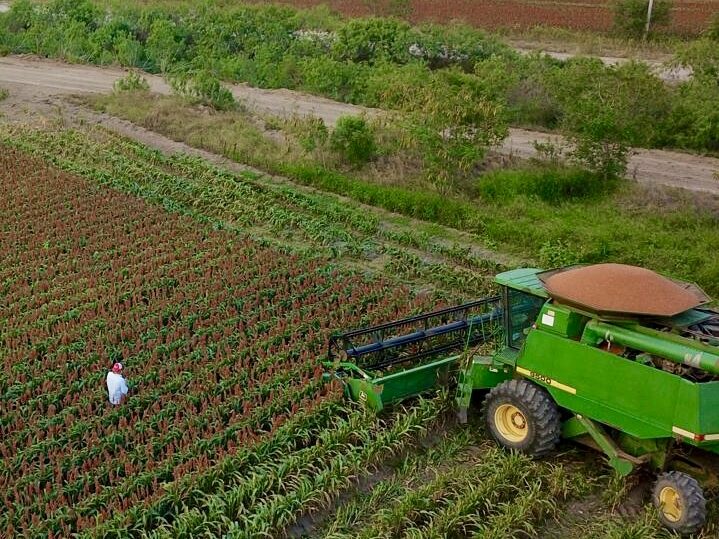
In some crops, machines are the dominant harvesting method, as with cotton across the Rio Grande Valley and even across the border in Northern Mexico.
“We’re buying bigger and bigger machines so we don’t rely on so much labor,” said Webb Wallace at the Cotton and Grain producers.
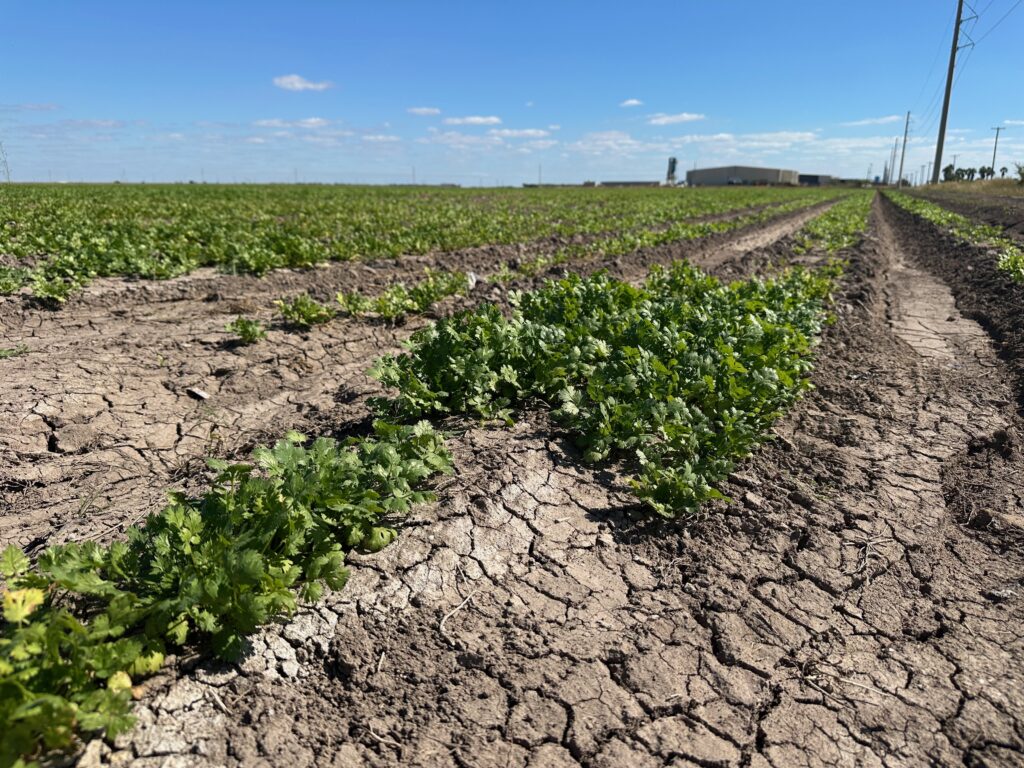
But that’s not the case with the vast majority of produce crops – only beets and carrots are typically harvested with machines, said Dante Galeazzi, president and CEO of the Texas International Produce Association.
“We have pressure on the ag system in Texas, and that pressure has been very difficult to grow and sell fresh produce in the U.S. at a consistent profit margin,” Galeazzi said.
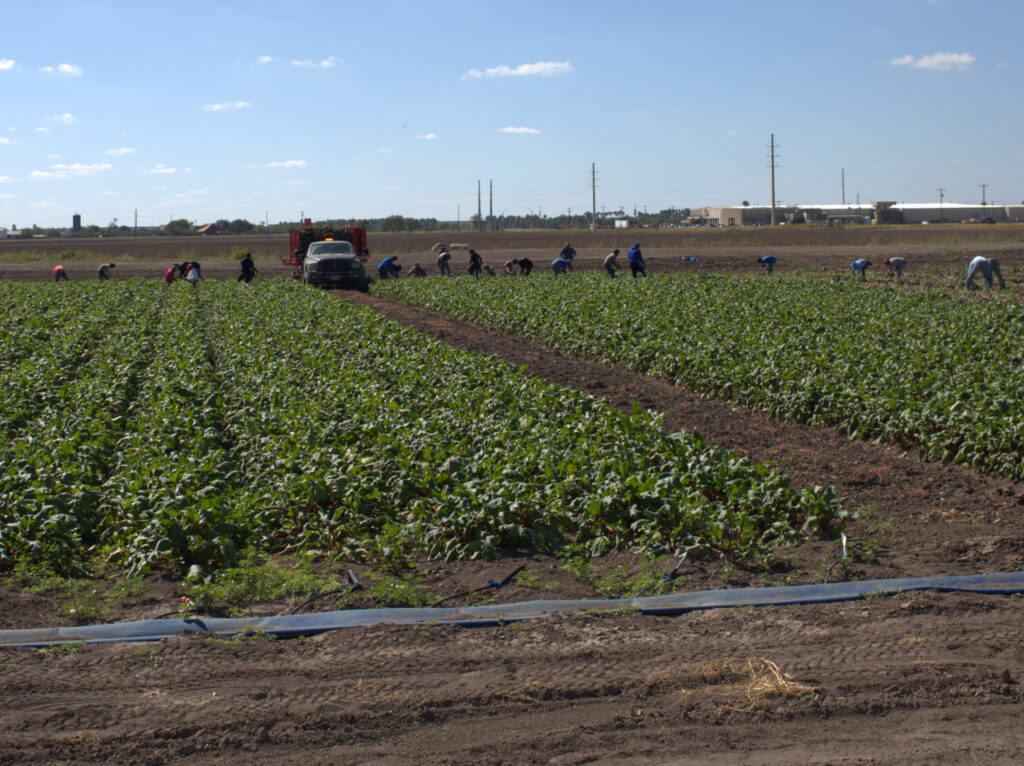
Whether that’s increasing labor costs, a shrinking supply of labor due to immigration policy changes, lack of water, or suburban sprawl – it’s an uphill battle. About two-thirds of the fields are lying fallow because it’s not profitable enough to grow crops in the Rio Grande Valley.
“We didn’t experience those same levels of [immigration] enforcement targeted in agriculture this summer, as we begin our harvest season down in the Rio Grande Valley, where about 70% of the state’s fruits and vegetables are grown, we’ll see what happens,” Galeazzi said.
The goal is that farmers are well-prepared and that even if immigrant raids target any workers in the fields without legal work authorization, there’s a plan to ensure production levels don’t falter, he said.
“If enforcement is such that it really does prevent the necessary supply of workers to be available for agriculture, then the impact is going to be disastrous. Because you’ll leave fruits and vegetables in the fields past maturity because you couldn’t get to them in time, and that’s a lost investment that the farmer cannot realize,” he said.
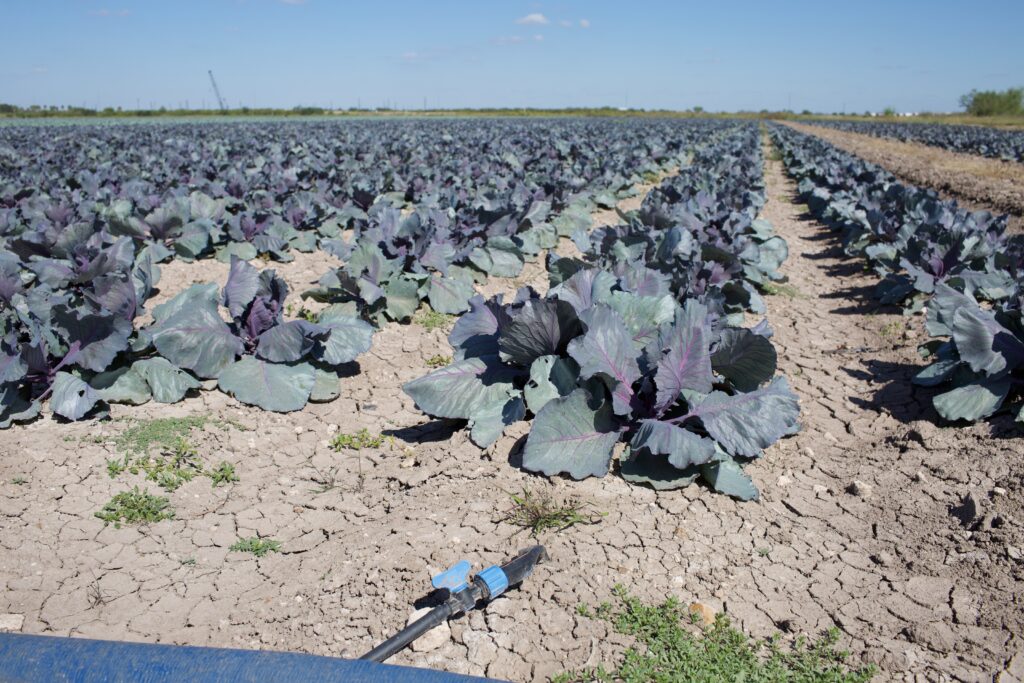
There’s already a growing cold storage industry in the Rio Grande Valley, where fruits and vegetables grown in Mexico are imported on trucks licensed in Mexico, then transferred in refrigerated warehouses to U.S. trucks, cutting into Texas farmers’ potential market share.
The legal work permit system
Farmers growing produce in Texas often rely on the H-2A visa program, a highly regulated guest-worker program designated for farmworkers.
For example, Chapa Global Contracting Inc. in McAllen posted jobs for farmworkers and laborers to work from late September to late March at $15.79 an hour, working with citrus fruits—mostly grapefruits and oranges, records show.
Citrus orchards still require hand harvesting, and the job advertisement stated that the work is compensated on a piece rate basis, but that workers are paid no less than the prevailing wage.
Another hitch is that the federal department that handles H-2A visa applications has been closed during the shutdown.
“So for a month, they have not been processing applications for H2A workers,” Galeazzi said. “Those kinds of things are incredibly impactful when it comes to immigration.”
Immigration enforcement efforts are not just targeting individuals without work authorization paperwork; temporary work visas, once expired, are increasingly challenging to obtain, and license renewal for individuals with legal work permits is increasingly difficult.
In Texas, Deferred Action for Childhood Arrivals (DACA) recipients, who often hold college degrees and specialized skills —from teaching certifications to truck-driving CDL licenses —are no longer eligible for those work permits once their existing visa expires.
For 2025, earlier estimates of net migration were upwards of 1.3 million residents; a recalculation based on U.S. policies reduced that estimate to 525,000, indicating fewer individuals immigrating to the U.S. and more leaving, according to the American Enterprise Institute, a conservative think tank in Washington, D.C.
Construction sites are increasingly empty
The Rio Grande Valley construction industry has been hard hit. Some builders are facing higher prices for existing building trades work, from framing to foundations to electrical work.
“It’s going to take them longer to build because they can’t pop out a home in six months, it might take 9 to 12 months,” said Bruno Zavaleta III, president of the Brownsville-South Padre Island Board of Realtors and founder of Zavaleta Realty, “They’ve actually had to go and get a couple of builders come together and say hey, let’s put your framer and my framer together and let’s figure this out. Because if not, we’re all going to be at a standstill.”
In June, more than two dozen immigrants without work authorization were arrested between two construction sites in Brownsville and South Padre Island, according to U.S. Immigration and Customs Enforcement, which worked in collaboration with the Texas Department of Public Safety and the U.S. Marshals Service.
The move was described as a targeted worksite enforcement operation, and officials said the arrests were meant to continue upholding the “integrity of our immigration system and protecting our nation’s workforce.”
The individuals detained by ICE were citizens of Mexico and Honduras.
“There was like one crew working. All the workers have either been picked up or they’re not showing up for work,” he said about the Shores of South Padre Island development. “As realtors, now our price is going to continue to go up because the builder’s cost is going up. Will the market support it?”

Kristen Mosbrucker-Garza
Reporter
Kristen Mosbrucker-Garza is a versatile multimedia news reporter who lives and works along the Texas-Mexico border in Hidalgo County. Mosbrucker-Garza is a news reporter for the Rio Grande Valley Business Journal. During her career she's worked for the McAllen Monitor, San Antonio Business Journal, The Advocate Newspaper in Louisiana, Phoenix New Times, and public media outlets in Baltimore and Philadelphia.
Most Read
- SpaceX is giving Brownsville $220M for water projects. In exchange, the city gave up zoning control of 444 acres near Starbase
- SpaceX seeks to take zoning control over nearly 450 acres from city of Brownsville as a ‘regional’ water deal takes shape
- Port of Brownsville could soon host Nodule City, a first-of-its-kind commercial deep-sea mining hub
- Cameron County is negotiating a $20M Fluidstack data center donation after Harlingen waffles on the same offer
- How much water does SpaceX need to operate near Brownsville? Nearly 20x its current use
Get the latest business news delivered to your inbox every morning for free.
Try 30 Days Free!
Get full access to award-winning journalism covering business, real estate, health care, economic trends, and the people shaping the Rio Grande Valley.
30 Days Free!
$9.95/month
Limited time offer
Subscription renews after your 30 day free trial at $9.95/mo.
Included Benefits
- Unlimited access to all articles
- Daily business news and analysis
- Subscriber-only content and features
Stories That Matter
- McAllen’s $204M water investment expects to seek construction bids in 2027
- Saronic lands Navy landing craft contract, first build at Brownsville’s Port Alpha
- The Rio Grande Valley’s tech industry is small but growing — meet some of the next-gen workforce
- Entrepreneurs enter Mission EDC’s ‘Shark Tank’ competition for $25K top prize
- Mission’s first Small Business Expo puts $25K on the line for local entrepreneurs
- Reynosa’s newest technical high school focuses on AI, semiconductors and bionics
- McCoy’s gives $10K, tools to launch Mid-Valley construction academy
- UT Health RGV performs new digestive procedure for first time in the Valley
- TSTC bets on advanced manufacturing to meet RGV’s industrial boom
- SpaceX reschedules Starship’s first flight around the Earth