By José Luis Martínez
Road blockades in Mexico are now in their third day as agricultural and transportation worker alliances continue to protest issues including violent incidents targeting drivers, increasing operating costs and proposed water legislation.
The full impact of the blockade remains to be seen, but some U.S. freight brokers issued client advisories this week noting risks in transit delays and disruptions.
If the nationwide blockade prolongs, it’s set to have broader effects across both sides of the border given that nearly 12 million trucks crossed into the U.S. through ports across the Texas border through October of this year. One in five of those trucks crossed through a port in the Rio Grande Valley area, U.S. federal data shows.
Rising security threats on freight corridors
These pressures have been rising long before this week’s blockades, as shown by publicly available federal data.
Among the various concerns, robberies are a major one for freight drivers. Since 2015 there have been over 102,000 documented robberies against freight drivers, most of them violent, according to data from the Mexican Executive Secretariat of the National Public Security System. Yearly robberies against freight drivers peaked at 13,000 in 2018 and have dropped to 5,200 through October of this year so far.
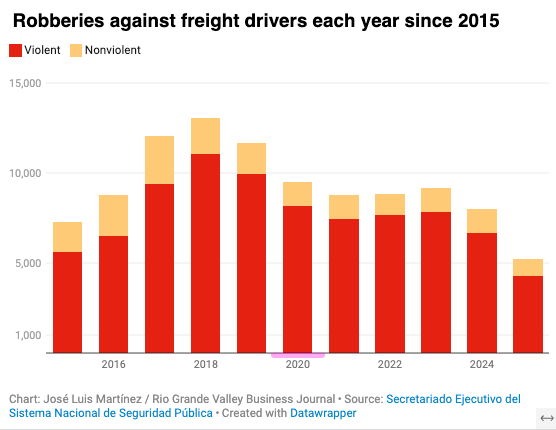
In a press conference on the second day of the blockade, Mexico President Claudia Sheinbaum questioned the blockades and noted that the daily average of violent robberies against freight drivers dropped 54% since 2018, from about 30 robberies a day in 2018 to 14 in 2025 so far.
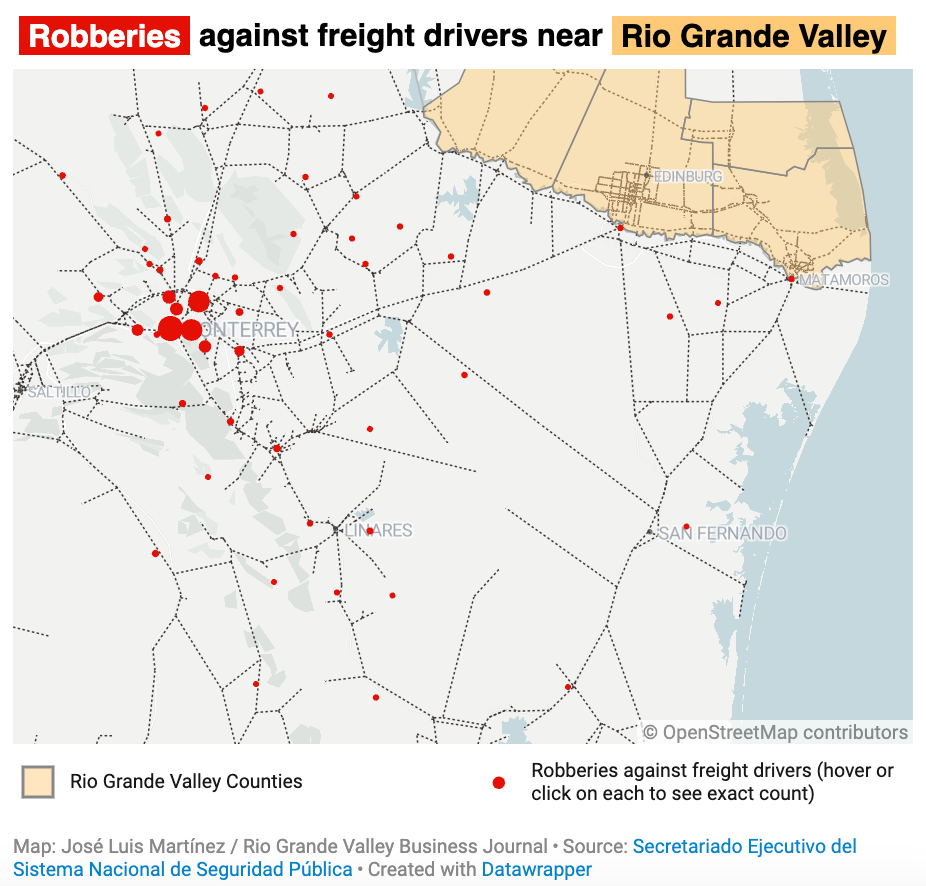
While most of the robberies against freight drivers over the past decade were concentrated around Mexico City, thousands also occurred in Mexican states near the U.S.- Mexico Border.
In Nuevo León, where the manufacturing hub of Monterrey resides, robberies against freight drivers exceeded 6,000 since 2015 with 123 recorded this year so far.
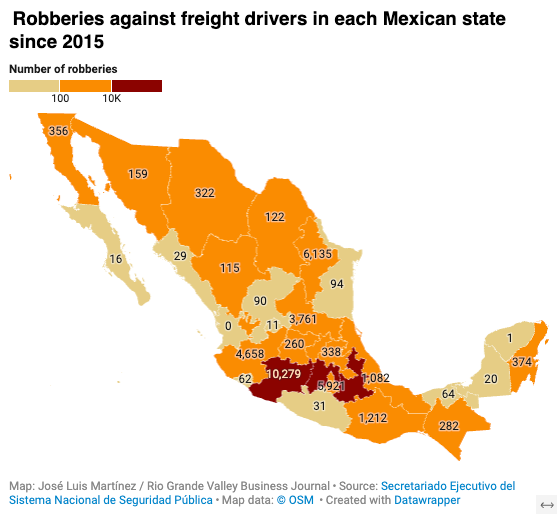
Some robberies occurred on roads in cities near the Rio Grande Valley. Matamoros and Reynosa, for example, had a handful of robberies, but most were clustered around Monterrey.
Mounting costs: diesel, tolls, and production expenses
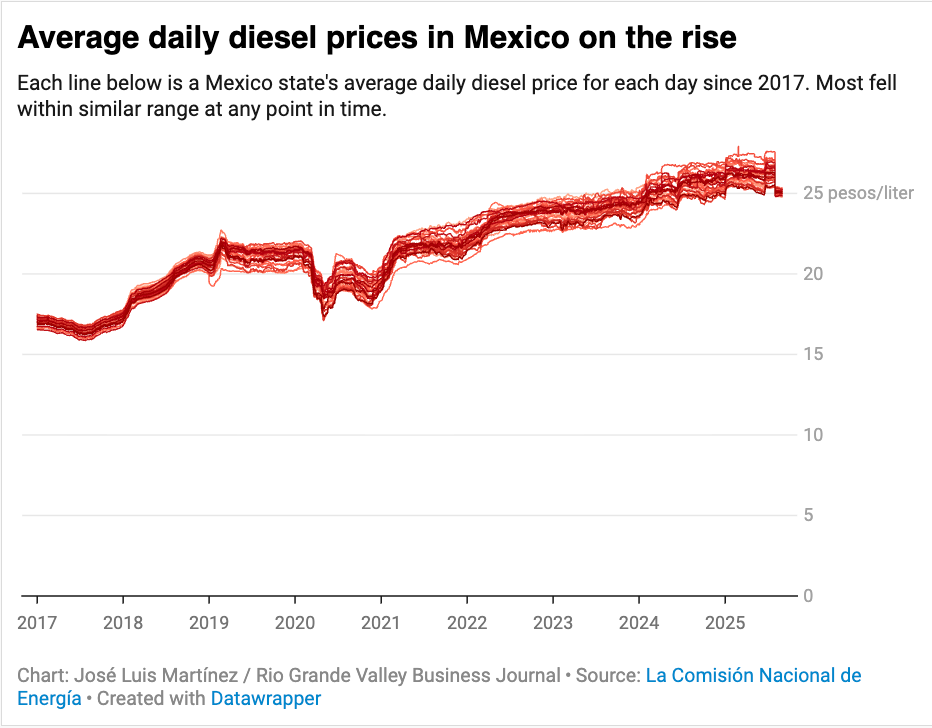
An additional concern among drivers is the price of diesel. Fuel price data reported to the Mexican National Energy Commission by gas stations show that diesel prices have increased across all Mexican states in the past several years. The average daily price of auto diesel reached around 24 to 25 pesos per liter at the end of August this year, compared to around 16 to 17 in 2017.
Toll prices were another concern for freight drivers, and federal data show increases across multiple major routes.
For example, toll prices for trucks at the Torreon – Saltillo route used to be anywhere from 270 to 380 pesos back in mid-2015, but prices now range anywhere from 446 to 623 pesos.
At another toll crossing in the Lagos De Moreno-San Luis Potosí route, maximum toll prices for trucks went from 350 pesos ten years ago to 563 this year. Even at international bridges such as the one in Reynosa, toll prices went up from 50 to 65 pesos in the last decade. Further comparisons can be seen here.
Meanwhile, farmers are calling for additional government support. Current government programs in Mexico include the distribution of fertilizer and financial support along with price guarantees for farmers depending on crops grown and farm size.
The Organisation for Economic Co-operation and Development (OECD) noted in a report last month that from 2022 to 2024, government support in Mexican agricultural production made up 11.9% of all farmer revenues, down from 25.2% from 2000 to 2002.
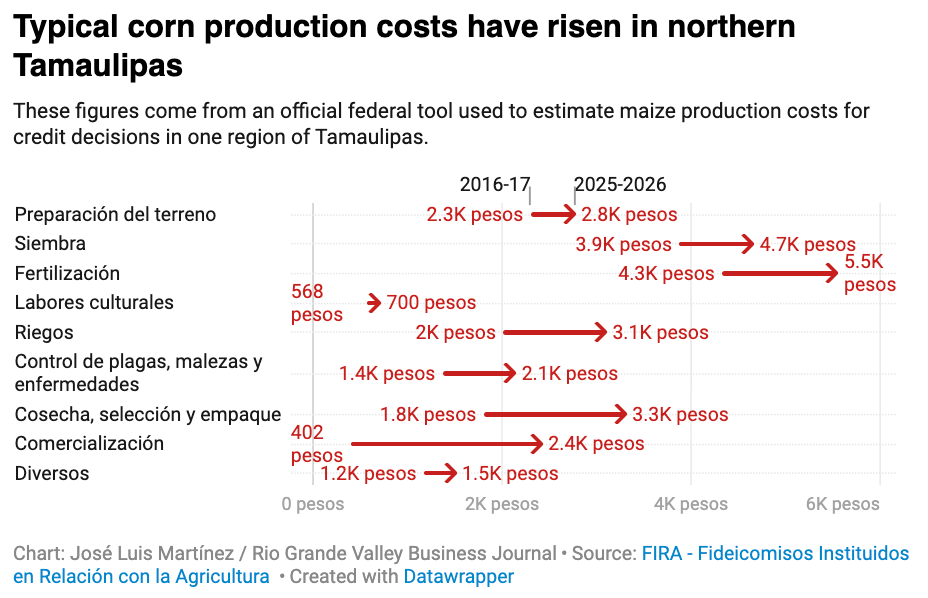
Farmworkers also cite higher expenses. Estimates from FIRA, Mexico’s federal agricultural financing agency, show that typical production costs increased by several thousand pesos from 2016 to 2025.
In northern Tamaulipas, for example, corn production costs were estimated to be about 26,000 pesos this fall-winter season. Years earlier in 2016, estimated costs didn’t even reach 18,000 pesos. Further comparisons for different regions in different seasons can be seen here.
Water-policy tensions and cross-border implications
Another grievance from the farmworkers deals with the proposed National Water Law, which aims to strengthen state oversight of water use by prohibiting the sale of concessions and adding stricter rules, reviews and penalties. Stakes are high since the agricultural sector in Mexico uses about three-quarters of the country’s water supply, according to federal data.
At the same time, Mexico is feeling pressure from the U.S. to comply with an international treaty in which Mexico has pending water obligations to the Rio Grande River. The U.S. Department of State on Tuesday announced that they had met with Mexican counterparts to find a solution, days after Texas Gov. Greg Abbott made demands to Mexico to comply with the treaty.
The Rio Grande Regional Water Planning Group also recognized the uncertainty of water deliveries from Mexico in its final 2026 water plans released last month. The Rio Grande Valley already relies heavily on the Rio Grande for its water. In 2023, irrigation made up 64% of water-use in Hidalgo County, 93% in Willacy County, 73% in Cameron County and 11% in Starr County, according to Texas government data.
Most Read
- SpaceX is giving Brownsville $220M for water projects. In exchange, the city gave up zoning control of 444 acres near Starbase
- SpaceX seeks to take zoning control over nearly 450 acres from city of Brownsville as a ‘regional’ water deal takes shape
- Port of Brownsville could soon host Nodule City, a first-of-its-kind commercial deep-sea mining hub
- Cameron County is negotiating a $20M Fluidstack data center donation after Harlingen waffles on the same offer
- How much water does SpaceX need to operate near Brownsville? Nearly 20x its current use
Get the latest business news delivered to your inbox every morning for free.
Try 30 Days Free!
Get full access to award-winning journalism covering business, real estate, health care, economic trends, and the people shaping the Rio Grande Valley.
30 Days Free!
$9.95/month
Limited time offer
Subscription renews after your 30 day free trial at $9.95/mo.
Included Benefits
- Unlimited access to all articles
- Daily business news and analysis
- Subscriber-only content and features
Stories That Matter
- McAllen’s $204M water investment expects to seek construction bids in 2027
- Saronic lands Navy landing craft contract, first build at Brownsville’s Port Alpha
- The Rio Grande Valley’s tech industry is small but growing — meet some of the next-gen workforce
- Entrepreneurs enter Mission EDC’s ‘Shark Tank’ competition for $25K top prize
- Mission’s first Small Business Expo puts $25K on the line for local entrepreneurs
- Reynosa’s newest technical high school focuses on AI, semiconductors and bionics
- McCoy’s gives $10K, tools to launch Mid-Valley construction academy
- UT Health RGV performs new digestive procedure for first time in the Valley
- TSTC bets on advanced manufacturing to meet RGV’s industrial boom
- SpaceX reschedules Starship’s first flight around the Earth