Transport carriers and farmers launched a series of blockades on highways and strategic access points in Reynosa on Monday, including in areas near international bridges, in protest over insecurity, corruption in government procedures, and rising operating costs that, they say, have pushed the logistics and agricultural sectors to their limit.
Although there was no official confirmation of a full shutdown at international crossings, operators reported delays and widespread uncertainty amid the possibility of intermittent blockades.
“There are too many problems: truck thefts, driver kidnappings, cargo being stolen, corruption in the paperwork, and diesel that can no longer be afforded,” one transporter said, warning that the situation “has already exceeded the breaking point.”
Insecurity and corruption
Carriers report increasing thefts, roadside assaults, and vehicle seizures, as well as temporary disappearances of drivers.
The lack of license plates for new trucks and delays in procedures with the Ministry of Communications and Transportation (SCT) have further fueled discontent.
According to operators, obtaining a federal license can take up to two months due to administrative backlogs and alleged acts of corruption in laboratories authorized to conduct medical exams.
“An exam that should cost 500 pesos gets raised to 10 or 12 thousand if you want it quickly. And the license is the same: if you don’t pay extra, it takes months,” the transporter said. He added that there are currently no available labs in Reynosa, forcing drivers to travel to Matamoros.
Rising operating costs
The price of diesel — which has reached 26 pesos per liter — is another major concern.
“A truck holds a thousand liters. Just filling it is 26,000 pesos. If you have ten trucks, that’s more than 200,000 pesos at once,” the operator explained. Diesel in the United States, he added, averages the equivalent of 18 pesos per liter, making cross-border operations “less and less competitive.”
Additionally, increases in taxes and social security contributions — stemming from the rise in the minimum wage — have further tightened margins for carriers.
No official communication
Although transport associations often issue alerts through internal channels, by mid-morning there were no formal announcements confirming customs closures or specific road shutdowns. However, units had already begun gathering at several points on the highway network.
“If we don’t get a response today, many are considering an indefinite blockade,” the operator warned.
Sorghum producers join blockades
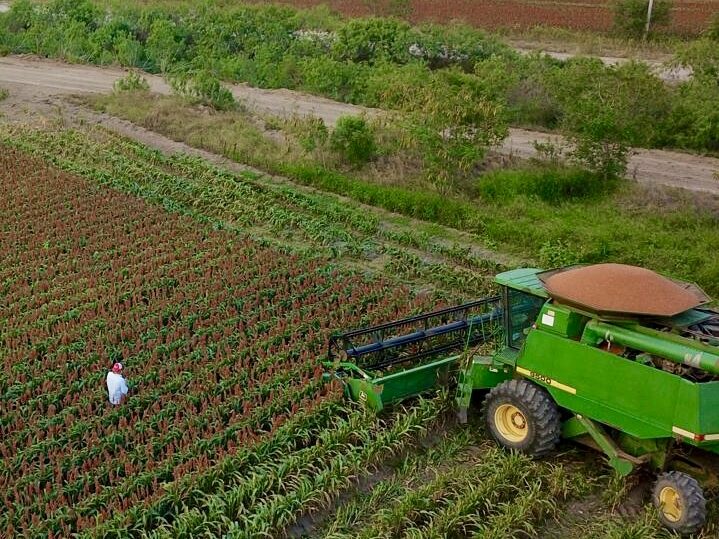
Blockades across the state intensified with the participation of agricultural producers, particularly from the sorghum sector, who argue that the crisis in the countryside “has not been addressed” and worsens each year.
Jorge Luis López Martínez, president of the National Union of Sorghum Producers, said the mobilization stems from frustration and a lack of government response.

Courtesy of | La Ribereña Dice_RD Noticias
“There is a real problem in the countryside that has not been addressed. And the importance of addressing it has not been valued,” López Martínez said in an interview. “I think a deep solution is needed. People have problems and are trying to mobilize so they will be heard.”
López Martínez noted that several highway closures were reported on Monday.
“Today I understand they closed the Ribereña highway in Tamaulipas,” he said. “They also have the Progreso customs office closed… It’s the Progreso bridge where most of the people are, and a highway that connects the north of the state with Ciudad Victoria.”
According to the leader, blockades are concentrated mainly at the Progreso International Bridge, as well as in San Fernando, in the area known as La Y, and at the Díaz Ordaz junction.
Agricultural crisis
The national leader reiterated that the underlying issue is of great economic concern.
“Many fields have been left unsown. Right now, expected prices don’t cover production costs. People don’t know whether to plant or not to plant,” he said.
The sorghum sector — key in northern Tamaulipas — faces growing uncertainty due to low prices, rising input costs, and a lack of direct support.
Water shortage and international treaty tensions
López Martínez said that the region is also being hit by a water shortage.
“In our case, it also hits us with the water problem that has been delivered under the treaty, which has left the region without water,” he said.
Urgent attention needed
He insisted that the protests aim to force authorities to respond to a crisis that has developed over several years.
“They need to address the problem. It is a very serious problem they haven’t wanted to address. It’s been several years, and every day it becomes more complex,” he said.
As transporters and farmers continue blocking key access points in Tamaulipas, producer organizations remain in coordination and await a government response.
Blockade at the Reynosa-Pharr International Bridge
Two producers participating in the blockade at the access point to the Reynosa-Pharr International Bridge said the demonstration is part of the National Front for the Rescue of the Countryside and that they plan to remain on-site until receiving instructions from their leaders.

Photo Credit | Anayancy Ulloa
“We are supporting the National Front for the Rescue of the Countryside, and we are waiting for a call to let us know that there has been a response from the federal government,” said Miguel Ángel Ávalos, president of Irrigation Module 3-1 of District 026 in Río Bravo. “Only some local authorities came by to say they were at our disposal, but nothing has stopped here. Nothing has happened; there has been no response.”
Ávalos explained that the blockade began at around 10:30 a.m. “This is the information they’re sending us through WhatsApp, telling us that unless there is contact from a federal or state authority, we should not move,” he added.
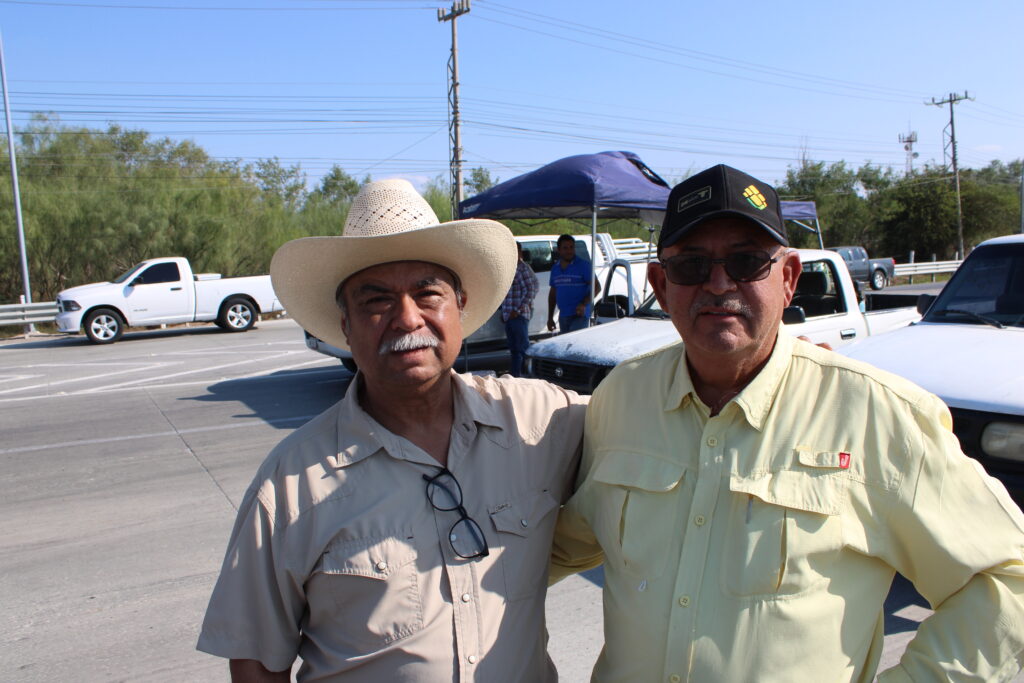
“But we really don’t know until the authorities or our leaders tell us what we’re going to do.”
Arturo Cortés, a producer from Río Bravo who is also participating in the protest, confirmed they will remain at the site until further instruction.

Anayancy Ulloa
Reporter
Most Read
- SpaceX is giving Brownsville $220M for water projects. In exchange, the city gave up zoning control of 444 acres near Starbase
- SpaceX seeks to take zoning control over nearly 450 acres from city of Brownsville as a ‘regional’ water deal takes shape
- Port of Brownsville could soon host Nodule City, a first-of-its-kind commercial deep-sea mining hub
- Cameron County is negotiating a $20M Fluidstack data center donation after Harlingen waffles on the same offer
- How much water does SpaceX need to operate near Brownsville? Nearly 20x its current use
Get the latest business news delivered to your inbox every morning for free.
Try 30 Days Free!
Get full access to award-winning journalism covering business, real estate, health care, economic trends, and the people shaping the Rio Grande Valley.
30 Days Free!
$9.95/month
Limited time offer
Subscription renews after your 30 day free trial at $9.95/mo.
Included Benefits
- Unlimited access to all articles
- Daily business news and analysis
- Subscriber-only content and features
Stories That Matter
- McAllen’s $204M water investment expects to seek construction bids in 2027
- Saronic lands Navy landing craft contract, first build at Brownsville’s Port Alpha
- The Rio Grande Valley’s tech industry is small but growing — meet some of the next-gen workforce
- Entrepreneurs enter Mission EDC’s ‘Shark Tank’ competition for $25K top prize
- Mission’s first Small Business Expo puts $25K on the line for local entrepreneurs
- Reynosa’s newest technical high school focuses on AI, semiconductors and bionics
- McCoy’s gives $10K, tools to launch Mid-Valley construction academy
- UT Health RGV performs new digestive procedure for first time in the Valley
- TSTC bets on advanced manufacturing to meet RGV’s industrial boom
- SpaceX reschedules Starship’s first flight around the Earth