Las pequeñas empresas siguen siendo uno de los motores más potentes de la economía regional, y la Administración de Pequeñas Empresas de EE. UU. afirma que su función es ayudar a los emprendedores a utilizar las herramientas de las que ya disponen.
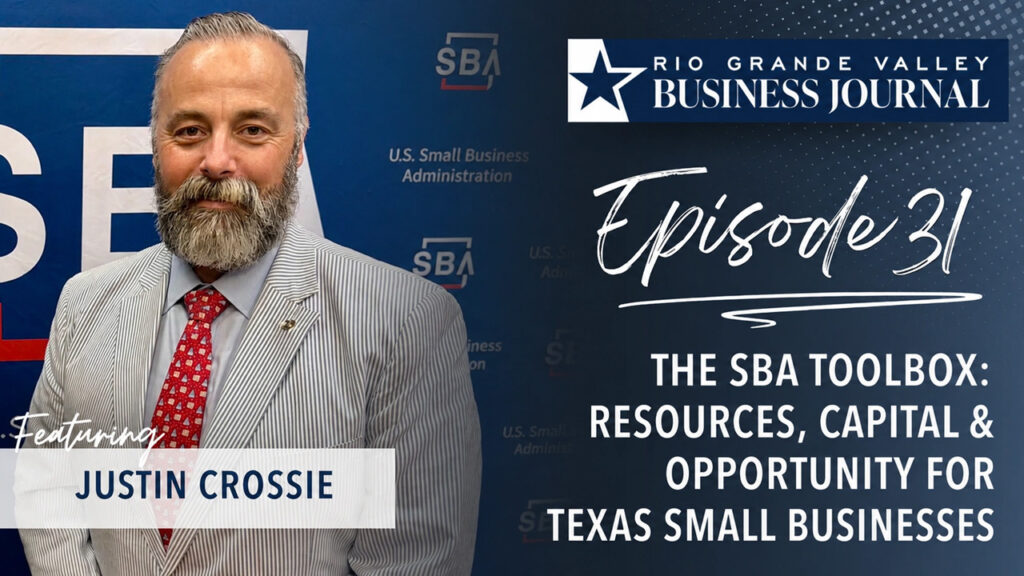
En este episodio del podcast del Rio Grande Valley Business Journal, Naxiely López-Puente conversa con Justin Crossie, administrador regional del centro-sur de la Administración de Pequeñas Empresas de EE. UU. (SBA), para hablar sobre la Semana Nacional de la Pequeña Empresa, los recursos de la SBA, el acceso al capital y los retos a los que se enfrentan las pequeñas empresas en todo Texas y en toda la Región 6.
Crossie explica cómo la SBA apoya a los emprendedores más allá de los préstamos, incluyendo asesoría, mentoría, Centros de Desarrollo de Pequeñas Empresas y contactos con entidades crediticias.
La conversación también aborda el crecimiento del sector manufacturero, la relocalización de la producción, el emprendimiento de primera generación y las razones por las que Crossie afirma que los empresarios deberían buscar apoyo antes de creer que ya lo tienen todo resuelto.
The following is a rough, AI-generated transcript of Naxiely Lopez-Puente’s interview with Justin Crossie, South Central regional administrator for the U.S. Small Business Administration. Minor errors and misspellings may appear. For the full conversation, listen to the episode above or through your preferred podcast platform.
NAXIELY LOPEZ-PUENTE:
Hi, and thank you for joining us on this episode of the Rio Grande Valley Business Journal Podcast. I’m Naxiely Lopez-Puente, and today we have Justin Crossie, the South Central regional administrator for the U.S. Small Business Administration.
Justin, thank you so much for joining us.
JUSTIN CROSSIE:
Thank you for having me today. I appreciate the opportunity.
NAXIELY LOPEZ-PUENTE:
It’s a big week for the SBA — National Small Business Week. Tell us about that.
JUSTIN CROSSIE:
One week out of the year, we at SBA want to spread the message to the rest of the country about what we already know takes place, and that is the amazing things small businesses do on a daily basis.
This is our week throughout the year where we get to go around the country and highlight those small businesses in our community — the mom-and-pop restaurant, the locally owned Ace Hardware.
We get to recognize the incredible work they do supporting the communities that we all call home.
NAXIELY LOPEZ-PUENTE:
Wonderful.
For those at home who are not familiar with what the SBA does, I know a lot of people hear SBA and think loans, but I know the organization does a lot more than just loans.
Talk to us about the role the SBA plays for small businesses.
JUSTIN CROSSIE:
I guess what I would refer to is a toolbox.
The SBA is the big toolbox, and within that toolbox, you have all the tools that make it possible to start a small business.
We do counseling. We do mentorship. We help with access to capital. There are all kinds of things the SBA does to support your local small business.
What I would call it is the one-stop shop for resources.
Within that toolbox, we have our resource partners — the Small Business Development Center, Women’s Business Centers, Veterans Business Outreach Centers.
Again, tools that the SBA has put together to support entrepreneurs as they build their small businesses, as they scale their small businesses, as they chase their version of the American dream.
NAXIELY LOPEZ-PUENTE:
Right.
You’re visiting us from Louisiana, and you don’t just oversee Texas. Tell us about the region you cover.
JUSTIN CROSSIE:
The region I cover is Region 6 of the SBA. It includes Louisiana, Arkansas, Texas, Oklahoma, and New Mexico.
And I just want to say that very specific order is the order in which the states were admitted to the union. So no alphabetical order — a little bit of history there.
NAXIELY LOPEZ-PUENTE:
No favoritism there.
JUSTIN CROSSIE:
It doesn’t hurt that I get to start with Louisiana. But no favoritism at all.
NAXIELY LOPEZ-PUENTE:
As you travel the region, I know this is a big week for you guys.
What are you hearing from small businesses, especially right now in this climate, where we see gas prices going up and rising costs?
JUSTIN CROSSIE:
What I hear from the small businesses I’m meeting with is optimism.
They see that there’s an administration that understands small business is the backbone of the economy, and that when we as the federal government can get out of the way of small business, they grow, they expand, they excel.
Part of what Administrator Loeffler is doing is following through on the president’s commitment to cutting regulations.
We are actively looking at regulations that impact small business. How can we scale those back? How do we ensure that the regulations on the books are not cumbersome to small businesses and don’t prevent them from growing?
NAXIELY LOPEZ-PUENTE:
I know one of the deemphases of the administration has been to pull back funding for things like minority-owned businesses and veterans. How do you manage that now to serve those clients?
JUSTIN CROSSIE:
What I’d say is the funding is not being pulled back from small business.
A small business is a small business.
If you are a woman-owned small business, if you are a minority-owned small business, if you are a service-connected disabled veteran who owns a business, the business of small business is small business, and the funding is still there.
The opportunities are there for any small business to apply.
Get with one of our SBA lenders. Get with a local district office, like we have with Angela Burton here in the Lower Rio Grande Valley office area, and speak with a counselor. Speak with a team member from the SBA and say, “Here’s what I have going on. Here’s the funding that I think I need.”
Let us walk you through that and see what it looks like.
Again, there has been no stoppage of funding for any small businesses.
NAXIELY LOPEZ-PUENTE:
South Texas right now is at a point where we’re seeing a lot of industrial growth. We’re seeing nearshoring.
What are you hearing about the economy and small business here in South Texas specifically, if anything?
JUSTIN CROSSIE:
Let me maybe branch out a little bigger and talk about Region 6.
What I’m seeing is that we’ve got small businesses saying, “You know what? I make that piece of whatever it may be. Let me step up and provide that service here locally.”
Rather than going across the pond or to China to source things, we’ve got many manufacturers here in the U.S. that make the widgets that small businesses need to grow their business and take that business to the next level.
What I am seeing is a manufacturing resurgence.
I am seeing people looking at opportunities that maybe they didn’t think were there before and saying, “You know what? I can fill that need for this small business.”
Or small businesses looking locally and saying, “I’m going to support another small business here in my community by filling the needs through that supply.”
NAXIELY LOPEZ-PUENTE:
I know you honored a handful of businesses today. Talk to us about that.
I saw there was quite a mix in the types of businesses. What does that say about our area?
JUSTIN CROSSIE:
I think what it says is that no matter where you are in the country, you have people following what I refer to as their American dream.
Your ideal American dream may differ from mine, but we see these entrepreneurs chasing their version of the American dream.
Whether it is a soil company that mitigates soil damage, a company that paints vehicles, or a company that provides services to elderly or disabled individuals, they are all filling a niche in the community that is needed.
They’re building a stronger community through the services they provide.
I don’t have to go to Houston to have soil mitigation done. There’s somebody right here I can talk to about that.
I don’t have to go to El Paso to find quality health care services for my disabled grandmother who is at home. Those services are available here.
What I see is the American spirit of: Let me find a way to make this work.
They’re making it work right here in their local communities.
NAXIELY LOPEZ-PUENTE:
If you’re a small business owner or thinking of becoming a small business owner, at what point should you reach out to the SBA?
Do you wait until you’re established? Or do you go as soon as you have an idea?
When is the right point to talk to somebody at the SBA?
JUSTIN CROSSIE:
I don’t think there’s a wrong point. I think you could possibly wait too long to speak with us.
If you are just starting your business, I would encourage you to reach out to local SBA offices and our resource partners, like the Small Business Development Centers, and speak with counselors.
Say, “Here’s my idea. This is what I want to do.”
There are counselors there who can walk you through that and say, “Well, a snowplow business in South Texas is probably not exactly what we’re looking for. What if we shifted to hurricane recovery and debris removal? Maybe that’s more appropriate.”
We have the expertise through our local offices and resource partners to coach you.
Again, go back to that toolbox analogy. If I’m changing the oil in my truck, I flip it open. I don’t need a giant pipe wrench. I need a small socket and driver to pull that wrench.
Open up that SBA toolbox and take a look inside.
What I would encourage everybody in the entrepreneurial world to do is reach out. You don’t know what you don’t know, and we have the resources that are there to support the American entrepreneur.
NAXIELY LOPEZ-PUENTE:
One of those tools in that toolbox is helping get access to capital.
For small businesses, especially first-generation entrepreneurs, that can be a very difficult thing to do.
Is that something that is changing? Are we seeing more opportunity there when it comes to first-generation entrepreneurs?
JUSTIN CROSSIE:
Through our local district offices, we can provide a list of lenders within the community that are participating in what I call the SBA legacy programs.
We have a list of those lenders. We can take a look at your project.
We’re not going to recommend one lender over another, but we can certainly take a look at your project and say, maybe you need to go talk to the SBDC and flesh some of this out if it needs a deep dive.
That may include taking a look at your business plan.
Access to capital is there for the entrepreneur. We have programs through the SBA. We have training available through the SBDC networks where we can help make your project bankable.
SBA loan guarantees don’t make bad projects or bad loans good.
What we do is help small businesses find the access to capital they need through traditional lending, but with that government guarantee on the back side.
NAXIELY LOPEZ-PUENTE:
Got it.
If there was one thing you could leave our audience with, what would that be?
JUSTIN CROSSIE:
If you are thinking about starting a small business and it’s a brand-new concept to you — the idea of being your own boss — I would encourage you to reach out to our resource partners and district offices.
Make an appointment. Come in. Have a conversation.
When I was in the Marine Corps, the drill instructors always told us the only dumb question is the unasked question.
We don’t know what we don’t know. If you’re brand new to building a business, there is probably a ton of stuff you’re not aware of and wouldn’t even think of.
If you’re in that world, it makes sense. But if you’re new to it, reach out to the resources we have.
The staff in the district offices and the staff at the resource partners are here to help you be successful. By reaching out to them, you exponentially increase your chances of being a successful entrepreneur.
NAXIELY LOPEZ-PUENTE:
Justin, anything else you would like to add that maybe I didn’t ask?
JUSTIN CROSSIE:
The one thing I would like to say is thank you to every small business entrepreneur listening to your podcast.
Thank you for what you do.
Thank you for stepping out and being part of the American economy, providing jobs for your community neighbors, and bringing quality-of-life things to the community in which you live.
It is not an easy thing, being your own boss or running your own business.
To those entrepreneurs who have stepped out, I just want to say thank you.
I would encourage you to reach out to the SBA. Use us. We are a resource here to help you be successful.
NAXIELY LOPEZ-PUENTE:
Justin, thank you so much for joining us.
We really appreciate you coming down to the Valley to visit.
For those at home, stick around. Remember to subscribe.
JUSTIN CROSSIE:
Thank you.