From border security and ICE enforcement to SpaceX’s defense role and AI-powered data centers, Valley leaders unpack what rapid change means for South Texas.
Two top Trump administration officials. Billions in local economic impact. And a wave of AI and data center projects reshaping South Texas.
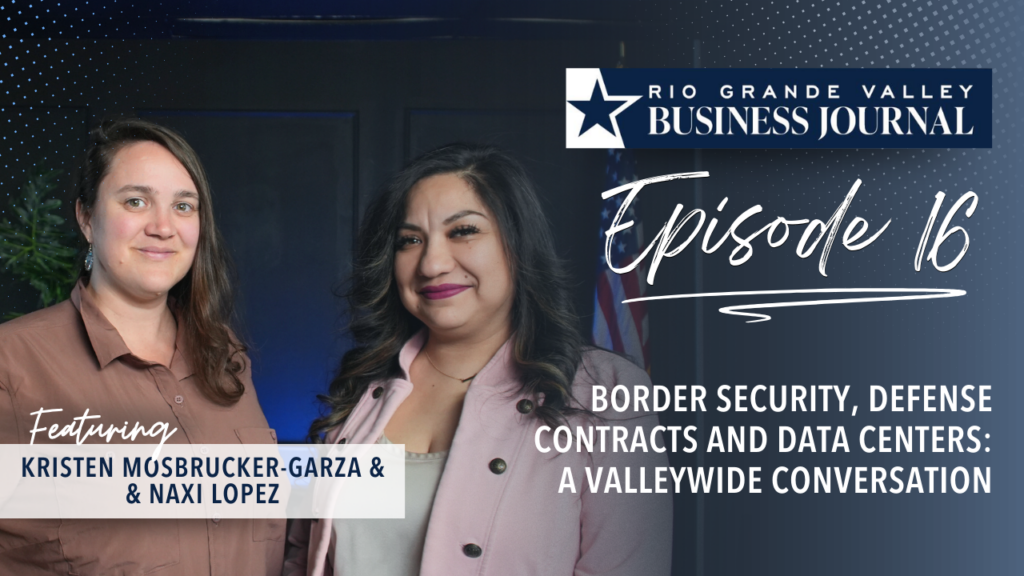
On Episode 16 of the RGV Business Journal Podcast, Managing Editor Naxiely López-Puente and reporter Kristen Mosbrucker-Garza break down two recent high-profile visits from top Trump administration officials and what they signal for the Rio Grande Valley.
They unpack what it means for the region — from border security and workforce concerns to SpaceX’s growing defense role and the rise of renewable-powered data centers in Cameron and Willacy counties.
Listen now for context, on-the-ground reporting, and why these developments matter for the Valley’s economy.
The following is a rough, AI-generated transcript of Episode 16 featuring Naxi Lopez and Kristen Mosbrucker-Garza. There may be slight errors in the transcription and possible misspellings of proper names. For the full, unabridged story, take a listen above, or get the episode from your favorite podcast host/provider!
Kristen Mosbrucker-Garza
We had the U.S. Secretary for the Department of Homeland Security or DHS, Kristi Noem. And then we had the U.S. secretary for the Department of War. I that. I thought that was really interesting, that people don’t really think of Space-x as a defense contractor, but they very much are. There’s only so much, you know, when it comes to the contract.
Kristen Mosbrucker-Garza
So you don’t know exactly what they’re doing. But it’s it’s very much about, you know, detecting threats and it’s satellites and missile tracking. And AI. Yes.
Naxi Lopez
And, you know, they put out information that they estimate that they have injected or will have injected about $13 billion into our local economy.
Kristen Mosbrucker-Garza
Yeah. And economic impact of $13 billion, is massive.
<music/graphic>
Naxi Lopez
Hi. And thank you for joining us on this episode of the Rio Grande Valley Business Journals podcast. I’m not Naxi Lopez Fuente, and today we have our ace reporter, Kristen Mosbrucker-Garza. And together we are going to unpack some of the biggest headlines that the Rio Grande Valley has seen recently. So Kristen, thank you so much for joining us.
Kristen Mosbrucker-Garza
Of course.
Naxi Lopez
All right, Kristen. So let’s start with two high profile visits to the Rio Grande Valley from two top Trump administration officials tell us who were, who was here, and what they were here for. And, of course, you know, you covered both events for us.
Kristen Mosbrucker-Garza
Absolutely. So we had, the US Secretary of the Department of Homeland Security or DHS, Kristi Noem. And then we had, the US Secretary of the Department of War, previously known as the Department of Defense, Pete Hegseth. And, it happened basically one week after the other. You know, I got to be on the ground, with, DHS secretary, and they actually both went to Cameron County as well, which I thought was interesting.
Kristen Mosbrucker-Garza
So we we started in Brownsville, with, Secretary Noem. She first addressed a roundtable of farmers and ranchers, you know, local people in our community, everybody from, you know, a rancher in Stark County who, essentially had, a cattle operation. And they she kind of talked about, you know, the concept of border security and what it was like to try to run a business during a time when, you know, there was just a lot of, influx of of migrants crossing a lot of people seeking asylum.
Kristen Mosbrucker-Garza
And then what it’s like now, under the Trump administration. So what it was like under Biden was like under Trump. There were some other folks. There was a farmer from San Juan, and there was even, the sheriff of, of Berks County. So it was a really interesting discussion. And it actually happened on, a ranch, outside of Brownsville, like, actually on the on the other side of the, the border wall.
Kristen Mosbrucker-Garza
So something that I actually learned, that I didn’t quite realize and I don’t think most people realize. Is that so, the border wall is not actually right up against the Rio Grande River. Right?
Naxi Lopez
For a lot of reasons. Right.
Kristen Mosbrucker-Garza
It’s actually more or less follows the, the old levee system. And part of that is because I was told that, if they were to build it, like, right up against the river, it would actually push, rain water into Mexico and we wouldn’t get as much water like, on our crops. Okay.
Naxi Lopez
That’s not good.
Kristen Mosbrucker-Garza
Yeah, right. And farmers wouldn’t get as much water either. That it would essentially like change to the whole, floodplain as well. And so that’s one reason, and, you know, the other reason is of course, like permissions and stuff. And, and so like, it’s just something that people don’t quite realize is that, you know, there’s a lot of properties that, extend on both sides of the border wall and you’re actually still in the U.S, so you’re.
Naxi Lopez
Between the river and the border wall pretty much. Yes.
Kristen Mosbrucker-Garza
And so it’s it’s it’s an interesting thing because typically unless like it’s your property wouldn’t be there. Right. So it was just like an interesting experience, like being, routed to the directions of this ranch. You know, and I’m like, wait a minute. Like I’m supposed to go through the border.
Naxi Lopez
Wall, you know.
Kristen Mosbrucker-Garza
Like it’s a. Yeah, you kind of double check.
Naxi Lopez
Your your, like, my passport.
Kristen Mosbrucker-Garza
Right? Because. Yeah, if you were to, for whatever reason, cross into Mexico, you would have to go back through the port of entry like that’s, you know, the rules. Sure. But yeah. So, it was, like a dove hunting and agriculture ranch. You know, in sort of the rural parts of Brownsville. And, the owners of the ranch were there, too, and they’re kind of talking about what it was like before and after the wall as well.
Kristen Mosbrucker-Garza
So, you know, it was interesting that she brought a lot of essentially small business owners to, you know, the table to kind of like hear their concerns and, and kind of like, get feedback about what they need, in our community.
Naxi Lopez
And so what were some of those concerns? Because, you know, what I’m hearing, right, is that, they brought people who basically said, you know, during the Biden administration, there was, some chaos, right? And now they’re seeing, those numbers decrease. But what are those concerns that they still have today?
Kristen Mosbrucker-Garza
I’d say that, they still see illegal activity. Right. Like that. It’s not that a potential cartel activity has been eliminated. But I really got the sense that they felt like when there was an issue that they saw on the ground, that there was just, like a stronger relationship between the landowner and Border patrol. You know, CBP and DHS that like, someone was there to pick up the call, someone was there to like, you know, come to the scene and, and help them with whatever it was like.
Kristen Mosbrucker-Garza
They definitely felt a stronger sense of security. And I think that that really made a difference for them. So I, I kind of got the sense that they wanted more of, you know, the kind of the service that they’ve been getting, you know, more attention. Definitely. And you know that, otherwise, like, I think it’s just, feeling heard.
Kristen Mosbrucker-Garza
Naxi Lopez
And so, did anybody mention, you know, we’ve heard time and time again that agriculture. Right. Farmers, these immigration raids, are having an effect on their workforce. Did anybody mention that at this event?
Kristen Mosbrucker-Garza
No. They didn’t mention that. I mean, I will say primarily people in agriculture tend to use the, H-2a agricultural visa program.
Naxi Lopez
There are some avenues right, for that industry as opposed to other industries that, you know, that that is a very good point.
Kristen Mosbrucker-Garza
Yeah. So I mean, there were there were definitely some fears about potential Ice raids on agriculture, especially during harvest season. But I haven’t heard from the agriculture industry or produce industry, that that has come to fruition. Now, on the construction side, you know, we have heard that we’ve seen all the videos of, you know, Ice agents coming on to construction properties.
Kristen Mosbrucker-Garza
And so, during the round table, like, we weren’t really allowed to interact or ask questions, but, she ended up doing, a tour, on a horse, actually. So they did, you know, apparently Border Patrol has, like, mounted horses, so they do. And so it’s, it’s part of, their, you know, system. And so she, she took a tour of the border on a horse.
Kristen Mosbrucker-Garza
And, you know, they had the, the boats in the water and all of that. And then, we actually went to go see, some guys that they’re, essentially putting in the water. I believe it’ll be about 500 or so. Boys, there is some concern locally that the boys may affect, like the flow of water and like the flow of, like any, like, you know, legitimate, business activity as well.
Kristen Mosbrucker-Garza
So, you know, they’re not necessarily, you know, they were a little controversial, I guess. But, we got a chance to see the boys, and they’re actually made by a Texas company to, I think they’re out of Burnett, Texas. Gibraltar, I believe, is the name of the company. And so, you know, they’re it’s also like this kind of like, American manufacturing, you know, to, to build the fence and then to, you know, build the boys.
Kristen Mosbrucker-Garza
So it it was very much focused, I would say on like, you know, look at how much investment that we’re making, a priority for the southern border. You know, the, the idea that there aren’t nearly as many people, if anyone really crossing, as compared to, you know, when there was just a lot more focus on processing, all of the people seeking asylum like that just seemed like it took up all of the time of Border Patrol.
Kristen Mosbrucker-Garza
When, you know, they could have been responding more. To the community. So I thought that was really interesting. But during that time when, they were unveiling the, the Bui, we were allowed to ask questions. So them, surprisingly, somewhat, fortunate enough to be, you know, called on. So, I, I asked a question that, you know, we’ve been hearing a lot in our communities about the ICE raids and, you know, basically said something to the extent of, you know, people are telling us that it’s hurting our economy, that, you know, because of the aggressiveness, of the, the raids that there are actually people who have
Kristen Mosbrucker-Garza
legal work status who are being swept up, in this, this process and essentially, like, you know, there’s, some projects being delayed or some projects being slowed down, either from, you know, lack of workers or, or, people just literally being taken off the job. And, you know, what she would say? As DHS secretary to those business owners, it’s like, you know, what is her response to them?
Naxi Lopez
And what did she say?
Kristen Mosbrucker-Garza
Well, I, I don’t think she has heard the same stories, on the ground. She definitely, you know, deflected that, you know, she didn’t think that that was very much the case. And, you know, really reiterated that if you are, you know, if you have legal status, whether, you know, as an employer or as an employee that, you know, you really have nothing to worry about, and that employers who are doing everything right, you know, also, you know, should not be concerned essentially.
Kristen Mosbrucker-Garza
So, you know, I think it was just one of those situations where Washington can be a very, isolated place. Right? And and they’re not hearing the same things on the ground.
Naxi Lopez
And so, we actually spoke to the leaders of two of the valleys builder associations, and one of them, you know, really spoke about. Yeah, exactly what you’re talking about. Right. South Texas builders Association really rang the bell when it came to, the industry and construction and the ice enforcement. And so if you haven’t watched those two podcasts, they’re available on our website.
Naxi Lopez
But yeah, this is you know, this is a big issue for our community. And I’m surprised that, well, maybe not surprised. Right. But, this is kind of the typical response that we get from Washington. And I covered a lot of these events myself. Right. When we have top administration officials, they’re usually here at the border to talk about border security.
Naxi Lopez
Right. That’s really that’s really the only time that we hear from them, except for this most recent visit from Pete Hegseth. Right. Talk to us about that. How does that visit differ from what we’re usually accustomed to hearing here in the Rio Grande Valley?
Kristen Mosbrucker-Garza
Yeah. You know, I was I was really surprised, just how much time he spent down here in the valley. He came and did sort of a a whirlwind tour of Texas. So he went to Fort Worth to visit a, Lockheed Martin, facility there. So, so more of a legacy defense contractor. You know, talking to some of the workers about, really how the military is trying to speed up its not just procurement process, but also, you know, getting whatever they purchase from defense contractors in the field to the warfighter, like as soon as possible.
Kristen Mosbrucker-Garza
Basically not waiting years and years for a perfect project like you know, like being okay with something that’s just a really strong prototype, you know, like really trying to, I think, change the way the, the military functions. And, you know, there was a little bit of a similar message, when he came to Starbase, but it was also markedly different.
Kristen Mosbrucker-Garza
Right. So he first got a tour of Space-x, you know, of their manufacturing facility because that was kind of the other thing. It was this like, Arsenal of Freedom kind of tour was the concept is that he was looking at the capabilities that the U.S. military has around the country. And, you know, I, I don’t think as many people think of Space-x as a defense contractor.
Naxi Lopez
Right. But they are rockets.
Kristen Mosbrucker-Garza
What will you do? But right before the visit, we noticed that SpaceX had gotten, a like $700 million contract from the Department of War, out of, like, a total of, like, $7 billion that they’ve gotten over the years with a B. Yes. That, you know, that is the second largest, sort of tranche of contracts that they’ve gotten from the federal government.
Kristen Mosbrucker-Garza
Number one, of course, being from NASA, at like, you know, 17 billion, something like that. You know, and I just I thought that was really interesting that people don’t really think of SpaceX as a defense contractor, but they very much are, you know, they just got this, missile tracking, it there’s only so much, you know, when it comes to the contract.
Kristen Mosbrucker-Garza
So we don’t know exactly what they’re doing, but it’s it’s very much about, you know, detecting threats and, and satellites and missile tracking, so and I. Yes. And so there’s a facet of that too. So at this, you know, after the tour by Elon Musk, himself. Right. You know, he came down and, and word on the street is that he does, have his voter registration in the city of Starbase because he’s so proud of it.
Kristen Mosbrucker-Garza
Right. You know, he recognize the employees, like, you know, just really how far that they came, you know, going from essentially what he described as nothing to, you know, this rocket launching manufacturing town, essentially, because, you know, I think the government very much, is, interested in domestic, military manufacturing capability. And that’s something that they’re doing there, at Starbase.
Kristen Mosbrucker-Garza
And so, you know, Hexa actually took, I think a longer speech time at SpaceX than he did at Lockheed Martin. And that was kind of surprising to me. And he didn’t mention the missile contract. He kind of, you know, talked a little bit about, SpaceX and what they’ve built in terms of the rockets and rocket ship building, and all the testing.
Kristen Mosbrucker-Garza
But he actually use that as an opportunity to introduce, a new contract with another company that’s run by Elon Musk, which is called X. I, so X’s formerly Twitter that Musk’s Musk acquired a number of years ago and, his AI venture is, this tool called grok, which is essentially an alternative to like Google’s Gemini or ChatGPT very similar concept.
Kristen Mosbrucker-Garza
You might see it reply to X threads, on social media. But essentially the Department of War. So inside of the Pentagon networks, their computer networks, on both the classified system. So that is like top secret stuff and the unclassified, you know, civilian level, information is going to be opened. AI, specifically grok, so Elon Musk’s AI product is now going inside the Department of Defense’s networks.
Kristen Mosbrucker-Garza
And that’s a really big deal because the only other company that, you know, had that level of access was Google, with their Gemini product. And so I thought that was really interesting. And he also made a number of like, statements about how they’re like bringing down essentially any impediment to AI being able to crawl around and find answers and synthesize whatever it needs to do, with the exception of any like, congressional statute.
Kristen Mosbrucker-Garza
So essentially they have free rein with, with any with the exception of anything that is like explicitly not allowed, you know, by Congress. And that’s a really big change, right? Because, you know, the Department of Defense, like I used to cover them to their.
Naxi Lopez
Chest, right? I mean, to open up not just, you know, they’re they’re, you know, under or what is it, unclassified. But to open up their classified, records to, to to AI nonetheless. Right. I mean, I hope they know what they’re doing.
Kristen Mosbrucker-Garza
Yeah. And I think it’s really about speed. Right. And I think that is kind of what it comes down to. And interestingly, and maybe this is why they didn’t mention it. So you know, the government is all about, you know, getting whatever they purchased, like to the warfighter or the product being delivered. But just a couple months ago, we had, the, the former head of NASA, you know, chiding Space-X, basically saying, hey, you said you were going to build starships for a lunar mission, and we’re losing out to China.
Kristen Mosbrucker-Garza
Like, you know, you’re actually kind of behind schedule, like it was to the point where they publicly threatened to reopen that contract and give other companies a chance to bid on it. Now that top administrator has, you know, left office. So, you know, there has been a bit of a change there, but it was just interesting to me that, you know, they talked so much about speed, and yet SpaceX had you know, previously been called out for not building what they promised they were going to build fast enough.
Naxi Lopez
Sure. Right. And so, bottom line, these contracts, these defense contracts that star, not Starbase, I’m sorry, SpaceX is being awarded. How is that going to impact what’s happening here regionally? You know, our do we know if any of the things that they’re manufacturing or. Oh, to the, to the US government if they are going to be built here, if, you know, if it’s going to play a part here in this region.
Kristen Mosbrucker-Garza
So there’s a lot that we don’t know yet. I will say anything having to do with the, the Space-x, rockets with, you know, rocket testing. Absolutely. That will probably happen within, the city of Starbase. You know, they’re building a second launch pad right now. They have the the Giga Bay, manufacturing facility, $250 million facility that’s under construction.
Kristen Mosbrucker-Garza
That’s supposed to, manufacture in mass these starships. Right? These rockets. But in terms of the AI portfolio and that contract, we just don’t know, you know, very much about, like, whether their workforce is, is at Starbase or not. And same thing with the missile tracking. You know, I’m not quite sure. But it was awarded to SpaceX, and SpaceX’s headquarters is now in Starbase.
Kristen Mosbrucker-Garza
Right. Boca Chica, Brownsville area. So, you know, it’ll be remain to be seen. But separately, honestly, we do expect the number of employees at SpaceX to continue to grow, because of existing contracts and because of their, original plans. You know, they have about 3000 some employees right now. They expect to hire at least a thousand or so more.
Kristen Mosbrucker-Garza
And so, you know, you see job postings, you see that kind of momentum.
Naxi Lopez
And, you know, they put out, information that, they estimate that they have injected or will have injected about $13 billion into our local economy, since they started all the way to the end of 2026, which, you know, is a big amount, right?
Kristen Mosbrucker-Garza
Yeah. An economic impact of $13 billion, is massive. I mean, it really has changed. Cameron County has changed. The Brownsville area. I mean, everything from the job market to, you know, housing to new restaurants and retailers. Like there is definitely a resurgence. And that honestly doesn’t even include, the number of visitors that come.
Naxi Lopez
The indirect, I guess, the economic impact. Right. Because when we’re talking about 13 billion, is that direct or indirect impact? Do we know I.
Kristen Mosbrucker-Garza
Believe that’s total economic impact. Okay. But you know, I, I do think that it’s notable that like, basically every time they have a proposed rocket launch because it’s not guaranteed. Right? Testing. You know, I think it’s something like 10 to 12,000, visitors from outside of that community come to Brownsville. And so, I mean, what other event that regularly occurs brings that many people to the Rio Grande Valley?
Kristen Mosbrucker-Garza
Like, I can’t think of a single one.
Naxi Lopez
And if there if there are, it’s an annual thing, right. But this is, you know, ongoing because these test flights are happening, you know, with more and more frequency, I believe there’s going to be one, at the end of this month. So, yeah, a lot of attraction, a lot of tourism, a lot of economic impact in that area.
Kristen Mosbrucker-Garza
Yeah. And it’s really shining a spotlight, I think, on the Rio Grande Valley that, you know, I mean, I heard some people because, you know, they all come from Washington and and they’re like, never heard of Brownsville before. And you know, they have.
Naxi Lopez
Yeah. Wow. And so that area. Right, Cameron County, Willacy County, they’re going through major redevelopment when it comes to data centers. Right. That’s been kind of the hot topic on, you know, in our internet circles here in the Rio Grande Valley with, some opposition. Let’s switch gears and talk about those data centers that are coming to, Cameron and Willacy County.
Kristen Mosbrucker-Garza
Absolutely. So I think it’s really interesting because when people think of an AI data center, they think of like, you know, the the $1.5 billion massive structure that Meta or Facebook is building in El Paso, right? You know, something that is just a giant building, sucks up a lot of water and electricity and needs like really fast internet.
Kristen Mosbrucker-Garza
But actually, when you look at some of the projects that are being proposed, and they’re under construction right now, they look very different. And so, for example, Willacy County is essentially, becoming a data center hub, like they’re building a cluster and they’re doing it in interesting ways. So typically, you know, and there’s a lot of data center construction all across Texas.
Kristen Mosbrucker-Garza
So it’s not just the valley, but it’s coming to us. And I think it’s coming to us because we have the all the wind farms. Right. Because that’s been, a really sticky issue is that communities worry about, you know, the how much electricity costs. You know, we don’t have a very strong transmission line network in the valley.
Kristen Mosbrucker-Garza
And so we’re very much a little bit at the end of the line when it comes to you know, the existing capacity to, you know, just operate our communities. And so if there were, you know.
Naxi Lopez
Another rain.
Kristen Mosbrucker-Garza
Yeah. Extra strain like coming online like that would potentially make a difference. Right. But in Wilsey County, all of the, essentially two major data centers are being built or it’s by a company called So Luna. They’re out of New York, and their whole model is that they’re green data centers or renewable data centers, and that they’re also modular.
Kristen Mosbrucker-Garza
So they’re they’re not that like really big building. They’re actually smaller buildings, and they’re using all of the excess wind power that is already being generated in Wilsey County, because what happened over the past decade is essentially everyone discovered that it’s really windy in Texas. We have the migratory, you know, bird, pathways. And so a bunch of companies all the same time picked very, similar locations to build their wind farms.
Kristen Mosbrucker-Garza
Or what happens in Texas is that when you go to sell that electricity to Ercot, which is like the market operator, you know, if you’re all going in at the same time, the chances of you actually getting negative pricing on the market is really high. And so that’s what was happening is that there was too much power trying to be sold into the grid from the same place.
Kristen Mosbrucker-Garza
We don’t have the transmission network to, like, sell it other places very quickly. We don’t have a lot of battery storage either, so it’s just it would essentially be lost. Or they would have to sell it at a loss. So the wind farms found the data center company and was like, hey, data centers require a lot of electricity, we are wasting a lot of electricity come to us.
Kristen Mosbrucker-Garza
And that’s essentially what happened. So Salina is building Project Katie. You know, so, the first version, it’s under construction right now. It’s about $50 million. And, you know, essentially near the county line of we’ll see in Cameron County, and like, farm to market, 1420, something like that. So it’s nowhere near like Raymond Ville or, you know, I guess the closest community is Lyford, which, honestly, it’s all very rural.
Kristen Mosbrucker-Garza
Anyway, you know, on the middle of a, of a wind farm, you know, it’s very desolate. And they’re building a data center there. And then just this week, they are building a second data center. So the first data center is going to be primarily for cryptocurrency mining. And then the second data center is going to be primarily for artificial intelligence.
Kristen Mosbrucker-Garza
So you know, it’s very much following the pattern of, you know, the types of things that data centers, you know, why they’re being built, but slightly different in the way of how they’re being built, is what I would say. And then I just found out that, that same company is actually building two data centers in Cameron County.
Naxi Lopez
Also following the same method, right? Finding wind farms, existing wind farms to be able to purchase that energy from those wind farms.
Kristen Mosbrucker-Garza
Yes. I still haven’t figured out which wind farms they are because they don’t, like, disclose that right away. But it’s interesting because that would actually be the third data center that would be built in, Cameron County. The other one would actually connect to the electric grid, and that one has faced, I would say, the most opposition so far.
Kristen Mosbrucker-Garza
You know, people going to the city of Harlingen, city Commission and basically saying, hey, you know, let’s like slow down a little bit, like, let’s make sure before we approve, you know, whether it be water, resources, like, so, for example, like Harlingen Waterworks is, you know, negotiating a deal with this company.
Naxi Lopez
I thought they had already signed that deal. They had already executed the deal to provide the the water. What the, what’s the word?
Kristen Mosbrucker-Garza
The effluent water. Yes. Yeah. So we have, Harlingen Water Works. Their board did meet, and I believe it’s a like, like, almost like an MOU. I don’t think it’s like a definitive contract. You know, because the the project has not been built yet. Right. And so I think the company was just kind of making sure the infrastructure was in place.
Kristen Mosbrucker-Garza
So this company in Cameron County, it won’t actually be within the city limits of Harlingen. It will be in the county, but it will be right next to the, Valley International Airport. There’s a lot of like, industrial land there. So that’s the the, proposed one. It’s called Aeneas Energy. They’re out of Scotland.
Kristen Mosbrucker-Garza
And I haven’t seen many other projects that we can point to that they’ve completed. So, you know, it’s definitely does feel like kind of an early stage project for them, though I did notice, when I looked at the Cameron County deeds that they have essentially an option to purchase all of that land from, some, farmers in Will Sea County, the Stone brothers, and basically, they have to make a decision by April about whether or not they’re going to move forward.
Kristen Mosbrucker-Garza
So.
Naxi Lopez
Yeah. So everything it seems like they’re lining up, you know, their ducks, right. Making sure that everything that they need to actually operate is in place. But it’s not a done deal yet. Correct. Would that be the right way to frame it?
Kristen Mosbrucker-Garza
Yeah. They do. I think they’re doing their due diligence. Right. Making sure that the infrastructure’s in place because they filed a document with the Public Utility Commission. Right. Essentially the the state regulators, and they said, hey, you know, we want to build this project in Cameron County. You know, but just like solar energy, they specifically said that they were interested in waiting for the infrastructure to essentially catch up, that they would do it as, like 16 data center halls rather than that massive building as well, building it out module early to make sure that they’re not building something that they can’t connect to the grid.
Naxi Lopez
Interesting. Okay. Yeah. Because then, you know, I’m thinking, like, if you wait to build, the cost of building is going to go up. And how does the company how do we keep the company to its word? You know, they could say this, right? And then, you know, if it doesn’t make financial sense for them, right. What’s to stop them from actually moving forward in a way that is profitable or more profitable for them?
Naxi Lopez
Right. So still a lot of questions left, I suppose. And then is there any way that, like, I know that a lot of residents are going to they’re like to the county, to the city, you know, trying to see if they can maybe, postponed this or stop this. Do they have that power? You know.
Kristen Mosbrucker-Garza
I mean, I do get the sense that the company, will be seeking economic incentives, for example, in Wilson County. So Luna did get a tax abatement, for its project. And so I imagine that maybe something similar will be sought, in Cameron County. And so, you know, at some point it is going to have to probably go before an official.
Kristen Mosbrucker-Garza
Now, whether it’s on the city or the county level or just the EDC level is really remain to be seen. I mean, I don’t get the sense that, there’s really like, like an off switch to all of that.
Naxi Lopez
Because they can’t just say, oh, no, they could deter by maybe not incentivizing, right, but being able to outright stop it. I mean, that just seems like it’s not.
Kristen Mosbrucker-Garza
It’s also.
Naxi Lopez
Yeah, government to do.
Kristen Mosbrucker-Garza
It’s also, you know, I mean, it’s the land is a private deal, right? It doesn’t it’s not government property. It’s private property. And so, you know, for them to buy the land is private. You know, for them to negotiate the water is also a contract, right. That has already, you know, been at least somewhat hashed out in terms of water, requirements.
Kristen Mosbrucker-Garza
You know, they are trying to get, what’s called effluent water, right? And so that’s not potable water. That’s not drinking water like, that’s not groundwater like, that is not even from the Rio Grande. They river raw water. It is actually wastewater that, has been treated to the point that it can be discharged into the Arroyo Colorado, River.
Kristen Mosbrucker-Garza
And so like this would essentially just be water, you know, that would be put back out into the environment. And, you know, companies would typically have to like build some kind of filtration system for them to use it on an industrial level. Anyway, and I was at an event earlier today where they were discussing water in the Rio Grande Valley, and I was asking, some folks about, like, whether the valley has enough water for data centers.
Kristen Mosbrucker-Garza
And, you know, I was told that essentially, if they are looking for that effluent water that, you know, some of the bigger, bigger cities like do have it available, that it would not actually be a strain on their system. Now, some of the smaller cities, probably not, because they’re not, you know, processing as many million gallons per day, but, you know, 4.5 million gallons of effluent water from a city as big as Harlingen.
Kristen Mosbrucker-Garza
Like, that’s actually probably pretty doable.
Naxi Lopez
And yet, you know, we’re not just seeing this, apparent opposition from residents. Now, we’re also hearing from people like Sid Miller. Right. You know, saying, hey, Texas, let’s kind of pause a little bit and make sure that, you know, that the water that our resources, you know, we account for them for what we really need them before kind of giving them away.
Naxi Lopez
And then after that, we saw Cameron County also put out a statement saying that, you know, that they are going to do their due diligence. So, it’s not just residents, right? I think everybody’s kind of, looking at this as far as really the big issues, water and energy. Right? And making sure that, that there’s enough for, you know, residents.
Naxi Lopez
Right. And businesses that are already established. So that that’s an interesting kind of take, right from, from our state officials as well.
Kristen Mosbrucker-Garza
You know, for sure. And, you know, I think so. So Sid Miller, the agriculture commissioner, came out with this concept that he’s pitching. It’s called like, freedom agriculture zones or agricultural freedom zones. And that would be really interesting in, communities like the Valley, because, you know, we have so much agricultural land that is being developed.
Kristen Mosbrucker-Garza
And I and it kind of sounded like what he was interested in is enticing more companies to develop on what are called, like, brownfields or greenfield, something that, you know, maybe is a redevelopment project or maybe, you know, the soil has never been used, for, you know, something that requires agriculture, like, you know, ranching or farming.
Kristen Mosbrucker-Garza
But, you know, I mean, taking land that is already situated near an irrigation canal that has been, you know, used for harvest after harvest, after harvest, whether it’s citrus or, you know, leafy greens for, for generations. And then turning that into a data center, like, is, is just a very different proposition. So, you know, it does sound like there’s, some movement on the agricultural front that, you know, probably farmers are saying, like, is this really how we want to develop our land that we’ve preserved?
Kristen Mosbrucker-Garza
Naxi Lopez
And you know, I think there was a quote in his, in Sid Miller’s press release that, I really we heard, from our citrus industry when we were covering that earlier on, and it’s, basically to the point saying that once you pave over agricultural land, there really is no going back. You know, no one’s going to come in there and break that cement.
Naxi Lopez
And, you know, plant things again. So, something to keep in mind, right? As, as they move forward and then, the solution, right, that they’re proposing to, to build on these, what are they called, brown sites or brownstone.
Kristen Mosbrucker-Garza
Brownfield.
Naxi Lopez
Brownfields. Okay. Brownfield. I imagine it would be a lot more costly for businesses to, you know, redevelop it because, you know, they’re obviously have pollution. You know, they’re they’re marked that way for a reason. But there are a lot of grants out there that these companies can also apply for that would help cover the cost of redeveloping that, you know, those areas.
Naxi Lopez
So just something to think about as well.
Kristen Mosbrucker-Garza
Yeah. I think that, you know, this concept of how we’re developing land as the Rio Grande Valley, like suburbanites is and urbanize is, is definitely going to come to the forefront. So, you know, whether it’s for data centers or whether it’s for something else, like I think that, you know, it’s a conversation that we’re going to have.
Naxi Lopez
All right. Well, we went through a lot of things today, a lot of headlines. Anything else that you’d want to add that maybe I didn’t ask that you think, you know is important to cover.
Kristen Mosbrucker-Garza
You know, like I said, I feel like the demand for AI, generative AI is really only projected to grow. And, you know, the concept that, you know, we’re going to be some kind of bubble with no data centers, like I just don’t think is going to happen. And so it will be interesting to see how, use of cities and edcs and cities kind of negotiate.
Kristen Mosbrucker-Garza
Okay. Like what is the most sustainable way for this to happen, right. Like, how do we make this a win win situation? And maybe, you know, the answer is the co-location with the wind turbines, because that is electricity that, you know, is otherwise being wasted. And it’s a different model than what I think a lot of people think of when they think of a data center.
Naxi Lopez
All right. Well, thank you so much, Kristin, for helping us unpack these headlines. Please head to our website. Subscribe. You can read so much about all of this and more. But thank you for watching and we’ll see you next week.