By Kristen Mosbrucker-Garza and Anayancy Ulloa
Rising diesel prices tied to tensions involving Iran and shipping risks in the Strait of Hormuz are beginning to squeeze trucking companies that rely on fuel to keep freight moving between northeastern Mexico and South Texas.
For many carriers, diesel is already one of the largest operating expenses. When prices climb, transportation companies often have little room to absorb the increase — particularly smaller fleets operating on tight margins.
“Trucking is a high-volume, low-margin business. When diesel jumps, those costs hit immediately while rates take time to adjust,” said Eli Camargo of C4 Transport, LLC, who has worked in trucking and transportation for more than three decades.
“In the short term, the trucking company is the one absorbing that hit. Some contracts include fuel surcharges, but those usually lag behind the price at the pump, so for a while it comes straight out of our bottom line.”
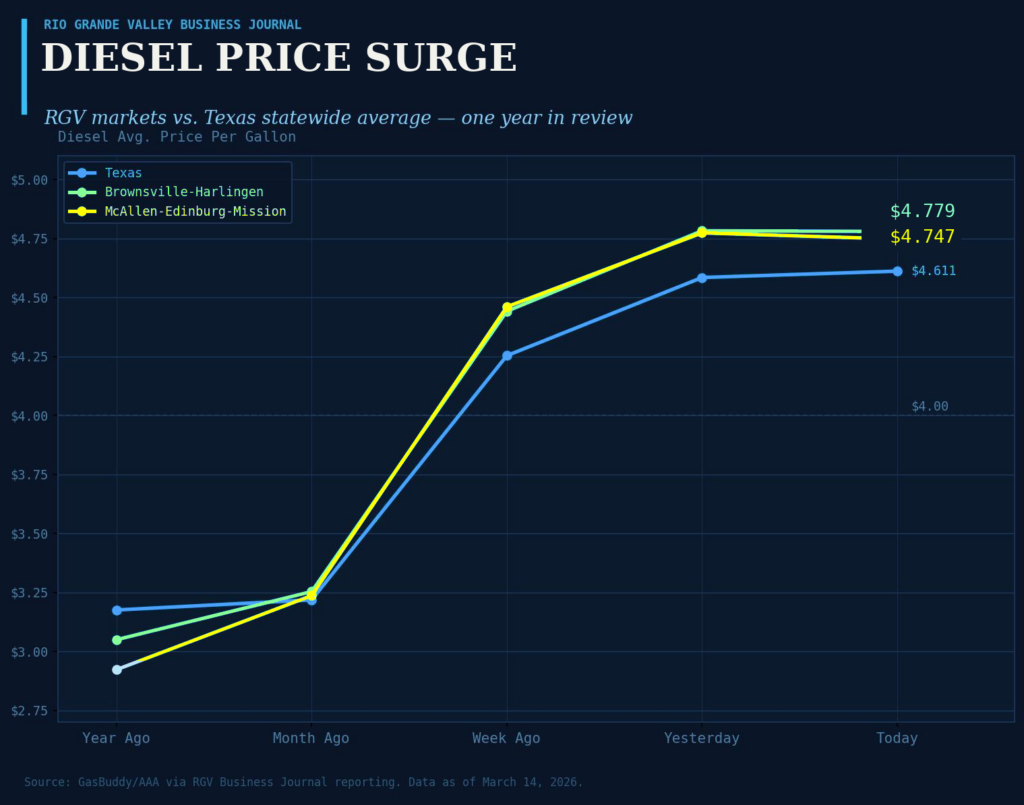
Diesel is one of trucking’s biggest costs
Fuel costs play an outsized role in trucking economics.

“For transport operators, diesel is one of the main expenses. It is essentially what moves the units, along with the tires,” said Jorge Antonio Chico Martínez, commercial manager at Global FWD International, a logistics and freight forwarding company.
Camargo said fuel costs are second only to equipment.
“A working truck can easily burn 80 to 120 gallons a day,” he said. “So when diesel jumps more than a dollar per gallon, the added cost can reach thousands of dollars per month per truck.”
For most trucking companies, fuel usually falls somewhere around 35% to 40% of total operating costs, he said.
“But when prices spike, it can get very close to half of the entire operating budget. When that happens, the math on every load starts getting very tight,” Camargo said.
Fuel price swings quickly affect trucking economics
Diesel prices can vary widely across the border.
Along Mexico’s northern border, diesel can cost around $1.50 per liter, while prices in parts of South Texas are closer to about $1.11 per liter, depending on exchange rates and market conditions, Chico Martínez. That translates to roughly $5.68 per gallon in northern Mexico compared with about $4.20 per gallon in South Texas.
Those price differences can significantly affect operating costs.
For example, a long-distance route inside Mexico — such as Reynosa to Tampico — may require roughly 500 liters of diesel.
At U.S. prices, that trip could cost about $556 in fuel. Purchasing the same amount of diesel in Mexico could raise the cost to around $750, according to industry estimates.
Across a fleet of trucks, those costs multiply quickly.
Logistics operators estimate a small group of transfer trucks operating along the border may consume roughly $2,500 in diesel per week, while a fleet of about ten tractor-trailers can spend roughly 100,000 pesos — about $5,500 — weekly on fuel.
Contracts delay the impact of fuel increases
Even when diesel prices rise quickly, trucking companies cannot always pass those costs along immediately.
Many transportation agreements lock in freight rates for six months to a year, limiting how quickly carriers can adjust prices.
Fuel surcharges are sometimes included in contracts, but operators say they often lag behind the actual cost of diesel.
That delay means trucking companies frequently absorb higher fuel costs until rates can be renegotiated.
Owner-operators often feel the impact first
Independent drivers and owner-operators tend to feel fuel price increases most quickly.
Unlike large fleets, owner-operators must often pay for diesel upfront before receiving payment for completed jobs.
Payment cycles in trucking can stretch 30 days or longer, tying up thousands of dollars in fuel costs while drivers wait for payment.
“They’re paying for fuel out of pocket before they get paid for the job,” Camargo said. “When diesel spikes, they may have thousands of dollars tied up just to keep their trucks moving.”
Many drivers rely on fuel cards or credit programs to cover those costs, which can add interest expenses on top of rising fuel prices.
Rising diesel costs can ripple through the economy
Sustained increases in diesel prices can eventually affect more than just trucking companies.
If fuel costs remain elevated, transportation companies often raise rates to cover operating expenses — and those increases can move through the broader supply chain.
“When the fuel increase becomes too large or lasts too long, trucking and transport companies simply have no choice but to raise their rates,” Camargo said. “At a certain point it’s not about profit anymore — it’s about covering the cost of just operating and trying to stay afloat.”
Because trucks move the majority of freight across the United States, rising transportation costs can eventually show up in the price of everyday goods.
“When it becomes more expensive to move freight, that cost eventually shows up in the price of groceries, construction materials, and everyday consumer goods,” Camargo said.
“At the end of the day, diesel prices don’t just affect trucking companies — they affect the cost of living for everyone.”

RGV Business Journal Staff
Staff
Most Read
- Is SpaceX quietly building a data center at Starbase? Job postings offer clues
- 25 Mexican businesses eye McAllen expansion after city pitches U.S. market entry program
- SpaceX’s futuristic city of Starbase finalizes massive 7,100-acre annexation. Here’s what we know.
- McAllen metro keeps selling more homes as Brownsville-Harlingen market sees 17% drop through August
- Rio Grande LNG moves closer to getting even bigger at Port of Brownsville
Get the latest business news delivered to your inbox every morning for free.
Try 30 Days Free!
Get full access to award-winning journalism covering business, real estate, health care, economic trends, and the people shaping the Rio Grande Valley.
30 Days Free!
$9.95/month
Limited time offer
Subscription renews after your 30 day free trial at $9.95/mo.
Included Benefits
- Unlimited access to all articles
- Daily business news and analysis
- Subscriber-only content and features
Stories That Matter
- McAllen’s job market keeps climbing while Brownsville loses ground
- Mission EDC launches search for new CEO with salary up to $190K
- Texas transportation leaders to discuss Rio Grande Valley infrastructure at Mission summit
- Mission’s first Small Business Expo puts $25K on the line for local entrepreneurs
- McCoy’s gives $10K, tools to launch Mid-Valley construction academy
- UT Health RGV performs new digestive procedure for first time in the Valley
- South Texas College plans $4.7M makeover of cosmetology, security facilities in McAllen
- TSTC bets on advanced manufacturing to meet RGV’s industrial boom
- Pharr’s cross-border business push earns international recognition
- Brownsville eases drought restrictions after nearly three years as Rio Grande reservoir levels improve