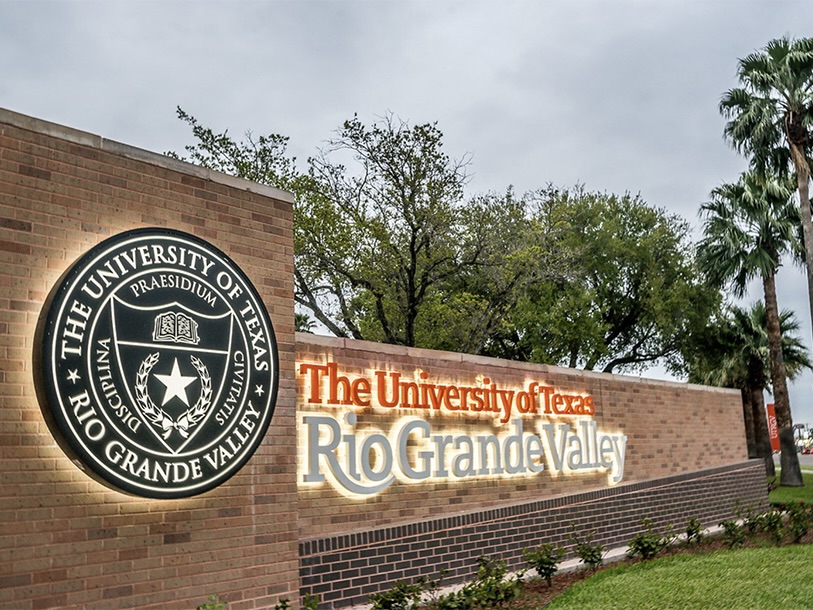
The University of Texas Rio Grande Valley has landed among the nation’s top five universities in a college ranking that looks beyond prestige to measure how much value schools deliver to their students.
UTRGV ranked No. 4 nationally in Washington Monthly’s 2026 “Best Colleges for Your Tuition (and Tax) Dollars” ranking and No. 1 in Texas for the fourth consecutive year.

Unlike college rankings that lean heavily on selectivity, institutional wealth, or reputation, Washington Monthly considers who universities serve, what students pay, how much debt graduates carry, whether students graduate, and their economic outcomes after college. Public service also factors into the ranking.
For UTRGV, the results reflect a combination that has become central to the university’s growth: enrolling students with significant financial need while keeping the cost of earning a degree comparatively low.
“UTRGV is the Valley’s university, and this recognition belongs to the entire Rio Grande Valley,” UTRGV President Guy Bailey said in a news release earlier this week. “Our students and families deserve access to an exceptional education without having to leave home or take on overwhelming debt.”
UTRGV first earned Washington Monthly’s No. 1 ranking among Texas universities in 2023 and has held the position every year since.
Affordability and access stand out
UTRGV’s No. 4 national finish was backed by strong rankings in several measures tied to affordability and access.
Among public universities nationally, UTRGV ranked No. 2 overall and No. 2 among four-year Hispanic-serving colleges. It also ranked No. 6 in the number of Pell Grant recipients, No. 11 in the number of Pell Grant graduates and No. 12 for lowest graduate student debt.
South Texas College also appeared in the rankings, coming in at No. 6 nationally among two-year Hispanic-serving colleges.
UTRGV performed particularly well against other Texas public universities. It ranked No. 1 in the state in the number of Pell Grant recipients, Pell recruitment, the number of Pell Grant graduates and lowest graduate student debt. It ranked No. 2 for lowest net price.
Pell Grants generally help undergraduate students with significant financial need, making those measures particularly relevant to Washington Monthly’s emphasis on whether universities provide access to lower- and middle-income students.
“We continue to create new opportunities for our students while protecting the affordability that makes those opportunities possible,” Bailey said. “Our responsibility is to ensure that students in the Rio Grande Valley have access to an education and experiences that can compete with those available anywhere in the country.”
What the ranking measures
Washington Monthly has ranked colleges since 2005 as an alternative to systems that place greater emphasis on selectivity, institutional resources, and reputation.
Its 2026 ranking evaluates universities in four broad areas: access, affordability, outcomes and service.
Access considers how effectively universities serve students from lower- and middle-income families, including Pell Grant enrollment.
Affordability looks at the net price paid by students from families earning less than $75,000 after financial aid as well as graduate debt.
Outcomes include graduation rates, differences in graduation rates between higher- and lower-income students and graduates’ early-career earnings compared with their peers.
Service measures contributions through programs such as AmeriCorps, the Peace Corps and ROTC, along with enrollment in service-oriented fields and civic participation efforts.
The recognition comes just 11 years after UTRGV opened its doors. During that time, the university has expanded its academic programs, research, health education and services across the Rio Grande Valley.
UTRGV now serves about 35,000 students across nine communities and has schools of Medicine, Podiatric Medicine, and Optometry.
The university also launched the Rio Grande Valley’s first Division I football program last year. Its inaugural season contributed an estimated $144.3 million in economic output through construction, operations and game-day activity, according to UTRGV.
For Bailey, the ranking is ultimately about what those investments mean for students in the region.
“That is what it means to be the Valley’s university, and it is central to our mission as The Future of Texas,” Bailey said.

RGV Business Journal Staff
Staff
Most Read
- Is SpaceX quietly building a data center at Starbase? Job postings offer clues
- 25 Mexican businesses eye McAllen expansion after city pitches U.S. market entry program
- SpaceX’s futuristic city of Starbase finalizes massive 7,100-acre annexation. Here’s what we know.
- McAllen metro keeps selling more homes as Brownsville-Harlingen market sees 17% drop through August
- Rio Grande LNG moves closer to getting even bigger at Port of Brownsville
Get the latest business news delivered to your inbox every morning for free.
Try 30 Days Free!
Get full access to award-winning journalism covering business, real estate, health care, economic trends, and the people shaping the Rio Grande Valley.
30 Days Free!
$9.95/month
Limited time offer
Subscription renews after your 30 day free trial at $9.95/mo.
Included Benefits
- Unlimited access to all articles
- Daily business news and analysis
- Subscriber-only content and features
Stories That Matter
- South Texas College plans $4.7M makeover of cosmetology, security facilities in McAllen
- Mission’s first Small Business Expo puts $25K on the line for local entrepreneurs
- McCoy’s gives $10K, tools to launch Mid-Valley construction academy
- UT Health RGV performs new digestive procedure for first time in the Valley
- Edinburg ISD rejects nearly $6M offer for prime land near La Sienna despite $15M budget deficit
- TSTC bets on advanced manufacturing to meet RGV’s industrial boom
- McAllen’s nonstop Mexico City flight is back
- Pharr’s cross-border business push earns international recognition
- Brownsville eases drought restrictions after nearly three years as Rio Grande reservoir levels improve
- Texas A&M’s $53.5M McAllen research center will tackle water, food security and Valley health