Río Bravo is redefining its role in northern Tamaulipas’ industrial economy, not by competing with larger neighbors like Reynosa and Matamoros, but by positioning itself as a supplier within the region’s existing manufacturing network.

That strategy is being led by Minerva Cornejo, the city’s secretary of economic development, who said Río Bravo is focusing on its strengths — workforce, location, and existing industry — to integrate into the broader regional economy.
“We aim to supply an already established industry. We cannot compete with cities like Reynosa or Matamoros because we lack the necessary infrastructure, but we do have the location, workforce and conditions to integrate,” Cornejo said.
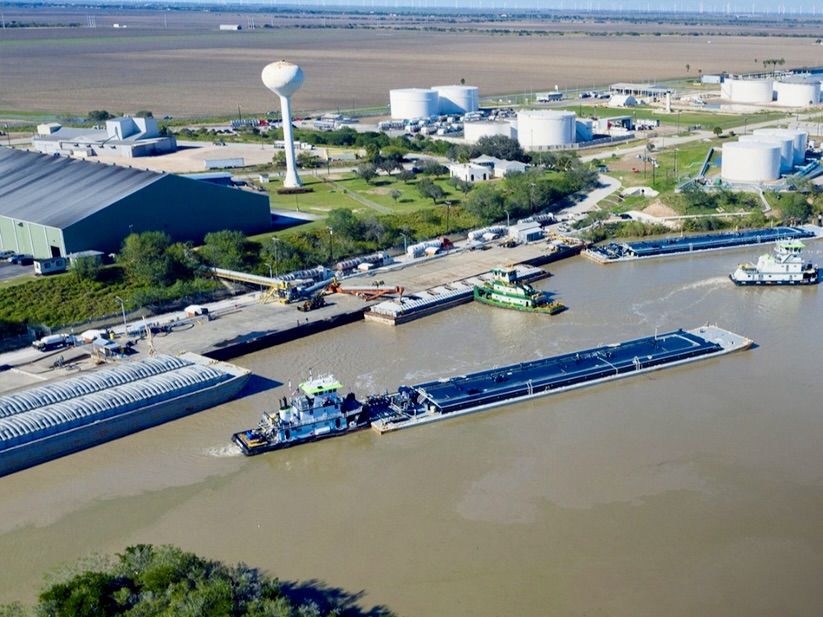
Río Bravo is not starting from zero. The municipality already has an industrial base, with companies including Woodcrafters Home Products, Valeo, DHP Novolex, Grupo Gruma, Papelera Industrial Alfa (PIASA), Sigosa, Welmex Industries, STC Mex Industrial Solutions and Trancasa operating in an established industrial zone. That existing footprint gives the city a foundation to expand rather than build from scratch.
At the center of the strategy is labor.
Cornejo said about 40,000 workers commute daily between Río Bravo, Reynosa and Matamoros to support manufacturing operations across the region — a dynamic that underscores both the city’s importance and what she described as a loss of local economic value.
“40,000 workers commute daily between Río Bravo, Reynosa and Matamoros to supply labor to the industry,” she said. “Why not stay in Río Bravo and keep that money here?”
City officials are now working to retain that workforce by attracting complementary industries and services that allow residents to work closer to home.
The effort is part of a structured development plan that runs through 2034, with a focus on attracting new maquiladoras, improving road and energy infrastructure, expanding logistics capacity along the border, and eventually developing industrial parks for small and mid-sized companies and a technology cluster.
“You can create many plans on paper, but without comprehensive planning… nothing happens,” Cornejo said.
Río Bravo is also looking beyond manufacturing to sectors that can build on its location. Logistics is a natural fit given its proximity to key international crossings, while officials are also exploring medical tourism by trying to replicate the model seen in Nuevo Progreso.
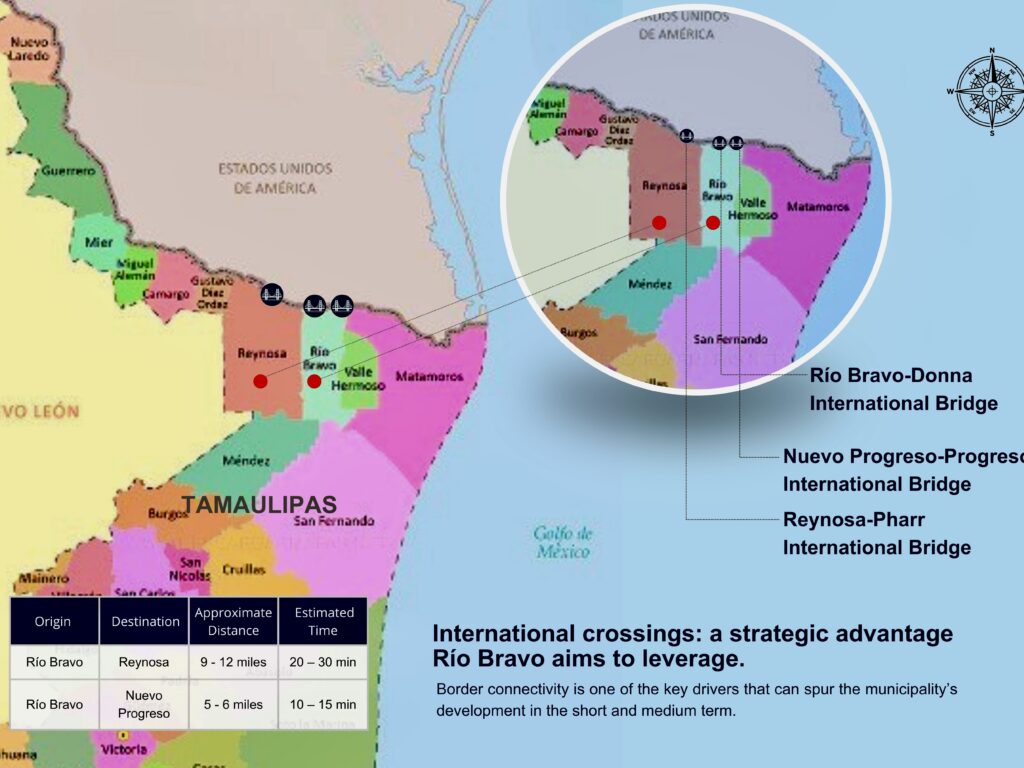
“We want to replicate that model in the city center. The Donna bridge is five kilometers away (about 3 miles). There’s no reason not to activate it,” Cornejo said.
Border connectivity is a core part of the city’s pitch. Río Bravo sits minutes from the Donna International Bridge and within close range of the Pharr International Bridge, the region’s primary cargo corridor, as well as the Progreso–Nuevo Progreso International Bridge, which serves as a hub for services and medical tourism.
“We have location, connectivity and flow,” she said. “The next step is structuring how to leverage it.”
While Río Bravo does not have the same concentration of universities as larger cities, Cornejo said its proximity to Reynosa and Matamoros provides access to specialized talent. The city also has existing industrial infrastructure, hotel capacity for business travelers, and expanding urban services that support growth.
Rather than competing directly for large-scale investments, officials describe the approach as one of regional integration.
“We are not trying to take jobs away from Reynosa. We’ve been a metropolitan area since 2015, and we must grow together,” Cornejo said.

Anayancy Ulloa
Reporter
Most Read
- How much water does SpaceX need to operate near Brownsville? Nearly 20x its current use
- Could apartment-to-condo conversion help make $100K homeownership in the McAllen metro more affordable? One investor says yes.
- SpaceX’s futuristic city of Starbase finalizes massive 7,100-acre annexation. Here’s what we know.
- Cameron County is negotiating a $20M Fluidstack data center donation after Harlingen waffles on the same offer
- Fluidstack breaks ground on $4 billion Cameron County AI data center
Get the latest business news delivered to your inbox every morning for free.
Try 30 Days Free!
Get full access to award-winning journalism covering business, real estate, health care, economic trends, and the people shaping the Rio Grande Valley.
30 Days Free!
$9.95/month
Limited time offer
Subscription renews after your 30 day free trial at $9.95/mo.
Included Benefits
- Unlimited access to all articles
- Daily business news and analysis
- Subscriber-only content and features
Stories That Matter
- What we know about Zoho Corporation and what could be built at its 1,000-acre campus
- SpaceX bought some water rights from the Rio Grande River. Here’s what we know.
- Foreign-Trade Zone No. 12 expands into Willacy County
- Mission’s first Small Business Expo puts $25K on the line for local entrepreneurs
- Reynosa’s newest technical high school focuses on AI, semiconductors and bionics
- McCoy’s gives $10K, tools to launch Mid-Valley construction academy
- UT Health RGV performs new digestive procedure for first time in the Valley
- TSTC bets on advanced manufacturing to meet RGV’s industrial boom
- Pharr’s cross-border business push earns international recognition
- Brownsville eases drought restrictions after nearly three years as Rio Grande reservoir levels improve