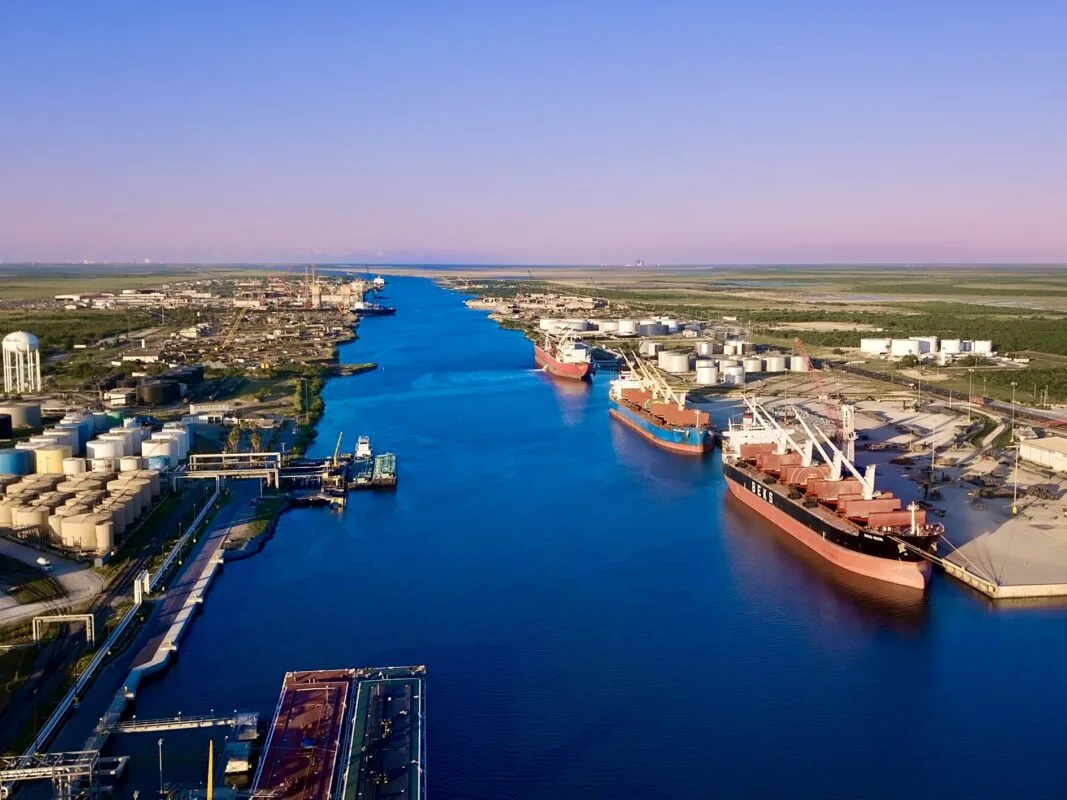
For most of the last century, the only people who came to the Port of Brownsville on purpose were the ones who worked here: the shrimpers, the ship-breakers, the men who cut apart decommissioned Navy hulls in the heat and sold the steel by the ton. Politicians came south for photographs at the river, not at the turning basin. The port was infrastructure. Infrastructure does not photograph well.
That has changed with remarkable speed.
Vice President J.D. Vance is scheduled to speak at the port Tuesday, Aug. 4. Brownsville Mayor John Cowen said the Vice President is expected to take the stage around noon and address the industrial buildout taking shape on the ship channel. An event flyer circulated by the campaign of congressional candidate Eric Flores puts the doors at 10 a.m. Federal officials have released little else — no itinerary, no security posture, no clear word on public access.
He will be the third act in five months.

In March, President Trump announced from Truth Social that America First Refining would build a 168,000-barrel-per-day refinery at the port, a project valued in the announcement at $300 billion and underwritten in part by Reliance Industries, India’s largest privately held energy company. It would be the first major new American refinery in roughly half a century. The President called it what American energy dominance looks like.
In July, Gov. Greg Abbott announced from Saronic Technologies’ Austin headquarters that the autonomous-vessel manufacturer had chosen the Port of Brownsville for Port Alpha — a $3.2 billion shipyard on 835 acres with room to grow toward 4,400, projected to employ 10,000 people at full build-out and to begin operations in 2028. Abbott called it the most advanced shipyard in the entire world. The state sweetened the deal with an $80 million Texas Enterprise Fund grant. Saronic’s Corsair drone boats had, days earlier, been used in the first combat deployment of unmanned surface vessels by American forces.
And on Thursday, the White House issued a presidential permit clearing Cameron County to own and operate the B&M International Bridge.
Nobody in South Texas needs a chart to read that pattern. Money arrives, and the motorcades follow it. The Valley has spent generations as the place national politicians visited to talk about what was wrong — the crossings, the cartels, the counting of things coming north. It is now, abruptly, a place they visit to be photographed in front of what is going right, standing at a deepwater channel that has always been here.
The port is not complaining. It shouldn’t. Brownsville Navigation District officials have called Port Alpha one of the largest economic development projects in the history of the region and the state, and the projections attached to it — $160 billion in economic impact for Cameron County, $264.5 billion statewide — are the kind of numbers that make a county judge’s hands shake.
But the numbers deserve the scrutiny that follows any number this large. The refinery has been announced before, under other names. Jupiter Brownsville applied for permits in 2017; Element Fuels took the project over in 2024; America First Refining took it over in December 2025. The Texas Commission on Environmental Quality has granted three construction-start extensions, the most recent pushing the deadline to October 2027 and described by staff as the third and final one allowed under state law. ProPublica reported in June that energy investors familiar with the project remain skeptical it gets built. Ten thousand shipyard jobs and a greenfield refinery are, for now, promises with excellent lighting.
Six days before the Vice President’s arrival, and about an hour up Expressway 83, a different crowd gathered at the Brookhaven Event Center in Pharr.
The South Texas Builders Association called it Rally the Valley — its third community meeting on what federal policy is doing to the people who actually build things here. There was a mariachi group and folklorico dancers. There were also several dozen seats reserved for elected officials that stayed empty.
STBA CEO Mario Guerrero did not pretend otherwise. Immigration enforcement has moved onto job sites, and crews that framed half the subdivisions in Hidalgo County are not showing up. “When families are afraid to go to work, businesses struggle,” Guerrero told the room. He named the region’s weakness plainly, and gestured at the vacant chairs.
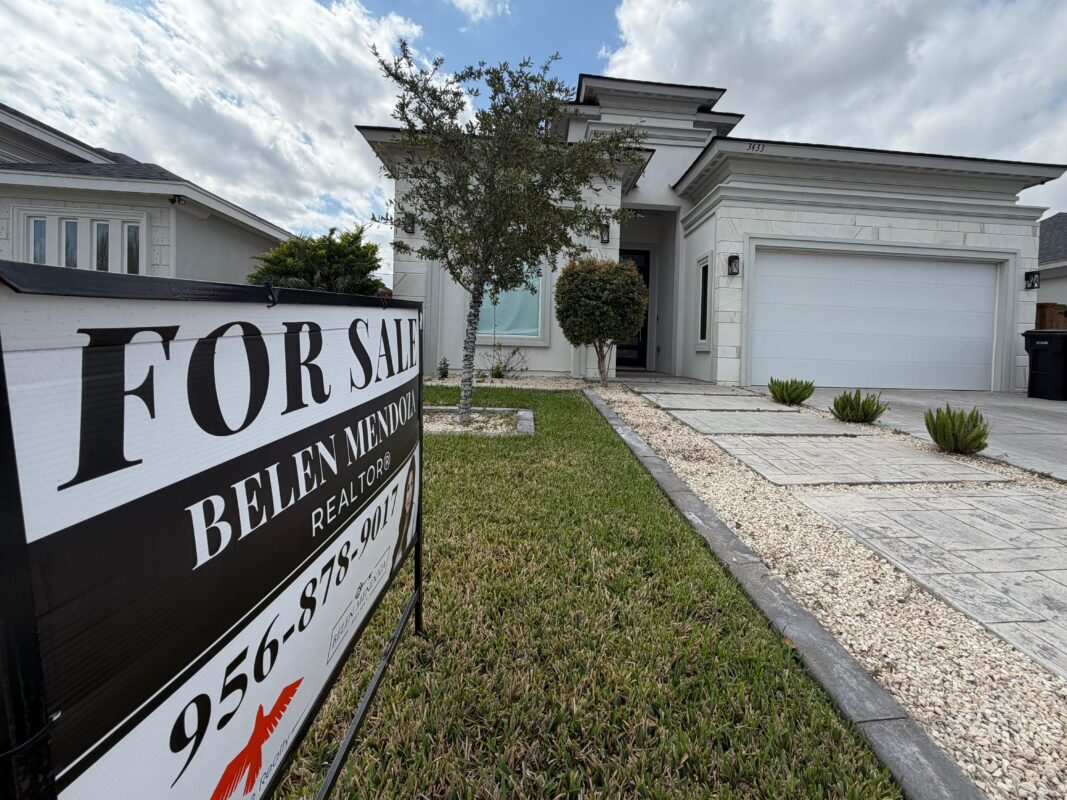
The labor squeeze arrives on top of a cost squeeze. The National Association of Home Builders puts the typical tariff-driven cost effect at roughly $10,900 per home. Duties on Canadian softwood — some 85 percent of U.S. softwood lumber imports — climbed from 14.5 to 35 percent last year, with a 10 percent Section 232 tariff stacked on top. Steel, aluminum and copper carry 50 percent. Cabinets and vanities escalated again in January. The construction materials producer price index hit a record in March.
So the arithmetic in the Valley right now runs in two directions at once. On the ship channel, a shipyard that needs welders, pipefitters and advanced manufacturing technicians by the thousand. Forty miles inland, an industry that cannot keep the tradesmen it already trained, buying lumber and copper at tariffed prices, watching starts slip.
The same administration is authoring both columns.
Tuesday at noon, the Vice President will stand at the port and describe the first column. It is a real column, and it is worth describing. The question the Valley’s builders are asking — the one they filled a hall in Pharr to ask, and could not get their own representatives to come hear — is whether anyone in the motorcade intends to read the second one.

James Moore
jmoore
Most Read
- SpaceX is giving Brownsville $220M for water projects. In exchange, the city gave up zoning control of 444 acres near Starbase
- SpaceX seeks to take zoning control over nearly 450 acres from city of Brownsville as a ‘regional’ water deal takes shape
- Port of Brownsville could soon host Nodule City, a first-of-its-kind commercial deep-sea mining hub
- Cameron County is negotiating a $20M Fluidstack data center donation after Harlingen waffles on the same offer
- How much water does SpaceX need to operate near Brownsville? Nearly 20x its current use
Get the latest business news delivered to your inbox every morning for free.
Try 30 Days Free!
Get full access to award-winning journalism covering business, real estate, health care, economic trends, and the people shaping the Rio Grande Valley.
30 Days Free!
$9.95/month
Limited time offer
Subscription renews after your 30 day free trial at $9.95/mo.
Included Benefits
- Unlimited access to all articles
- Daily business news and analysis
- Subscriber-only content and features
Stories That Matter
- McAllen’s $204M water investment expects to seek construction bids in 2027
- Saronic lands Navy landing craft contract, first build at Brownsville’s Port Alpha
- The Rio Grande Valley’s tech industry is small but growing — meet some of the next-gen workforce
- Entrepreneurs enter Mission EDC’s ‘Shark Tank’ competition for $25K top prize
- Mission’s first Small Business Expo puts $25K on the line for local entrepreneurs
- Reynosa’s newest technical high school focuses on AI, semiconductors and bionics
- McCoy’s gives $10K, tools to launch Mid-Valley construction academy
- UT Health RGV performs new digestive procedure for first time in the Valley
- TSTC bets on advanced manufacturing to meet RGV’s industrial boom
- SpaceX reschedules Starship’s first flight around the Earth