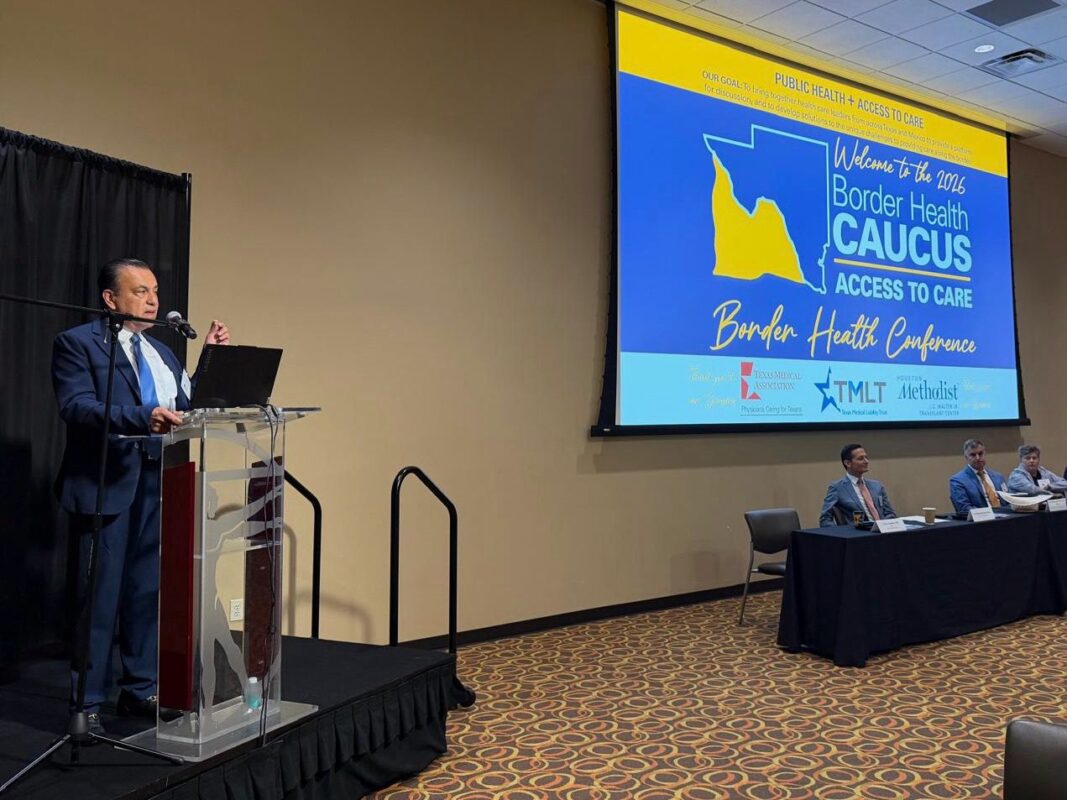
There’s no shortage of healthcare industry challenges along the Texas-Mexico border, leaders of the Austin-based Texas Medical Association recently told its members during a Border Health Caucus conference in Edinburg, but there’s a multi-faceted approach to tackle each one, from changing laws to workforce development efforts and grant funding opportunities.
“The list [of priorities] is long, but I think it’s very easy to start with just children,” Dr. Victor Gonzalez, an ophthalmologist in McAllen and chair of the Border Health Caucus told the Rio Grande Valley Business Journal in a recent interview.
For example, Gonzalez mentioned that roughly 15% of children along the Texas-Mexico border are uninsured, that’s higher than the Texas average of 11%, according to U.S. Census estimates provided by the Border Health Caucus.
That data point appears to be the average of several counties along the border from Cameron County to Presidio County. For example, the uninsured rate for individuals 18 and younger was 13.9% in 2024 in Cameron County and 21% in Presidio County in West Texas.
It was 14.2% in Hidalgo County, 14.6% in Starr County, and 12.6% in Willacy County in 2024, according to the Small Area Health Insurance Estimates data most recently available from the U.S. Census. Statewide, about 13% or roughly 1 million residents didn’t have health insurance in 2024.
In the Rio Grande Valley, that meant roughly 56,000 individuals 18 and under who were uninsured as of 2024.
But in January 2026, increased premiums for the Affordable Care Act plans and further restrictions on Medicaid eligibility reduced the number of insured residents in Texas.
To help tackle the uninsured patient population and ensure residents have access to healthcare, including a primary care doctor to reduce chronic disease progression, there’s a new nonprofit which is starting its statewide work in the Rio Grande Valley.
The Texas Partnership for Health Access is a nonprofit supported and created by the American Heart Association and American Cancer Society Action Network.
It’s led by Lisa Madry, a consultant who lives in El Paso but has been hosting events in the Rio Grande Valley to evaluate why so many residents are uninsured and where they may seek healthcare, often across the border in the Mexican cities of Nuevo Progreso, Reynosa and Matamoros.
In Texas, roughly 19% of all residents are uninsured compared to the national average of 9.8%. One major reason: Texas did not expand Medicaid after the federal Affordable Care Act was passed.
Roughly 28% of residents overall in Hidalgo County lack any health insurance. Nearly 26% lack it in Cameron County, almost 29% in Starr County, and nearly 24% are uninsured in Willacy County. In Presidio County, about 33% of residents are uninsured. By comparison, about 17% lack it in Nueces County, 16% in Bexar County, 20% in Harris County, 21% in Dallas County and 12% in Travis County.
“The challenges include the fact that we don’t have enough coverage for Medicaid. We never expanded it, but we have a lot of working poor,” Gonzalez said. “That means individuals are working, but they earn too much to qualify for any assistance — but do not have enough money to pay for even the Affordable Care Act marketplace accessible programs. In a state where we have a $24 billion surplus and a $28 billion rainy day fund and we do not have a solution for that 15% [of the uninsured children] in the state, I think that would be a good place for us to start: trying to address primary care at least for the children.”
Some pediatric patients with health insurance through Medicaid may not even qualify to receive healthcare from the state’s premier cancer hospitals, Gonzalez said.
“I can’t refer patients [with pediatric tumors] even to MD Anderson because of insurance, usually Medicaid,” he said about the Houston-based cancer research hub. “We may not think of it as a barrier, but if you think that having Medicaid is enough, it’s not. Because even when I try to send children up to MD Anderson for cancer care, they quite often don’t accept them because they don’t have the right insurance. Now I’m left with the ethical necessity for me to figure out where I can send them to, and it’s a challenge. If we can provide it all here locally, that would help.”
For example, MD Anderson does accept “traditional Texas Medicaid” plans, but it does not accept all managed Medicaid HMO plans. It’s only contracted with Texas Children’s Health Plan STAR and CHIP. The hospital, however, may accept some patients on a case-by-case basis, according to its website.
For example, in November 2024 Blue Cross Blue Shield notified the University of Texas MD Anderson Cancer Center that it no longer has a contract for its Medicare Advantage and Texas Managed Medicaid services. That means any children with Texas Blue Cross Blue Shield managed Medicaid plans may not be in network for MD Anderson cancer care. In addition, the commonly used Medicaid managed plans in Hidalgo County are Superior HealthPlan, Driscoll Health Plan and Wellpoint, which do not appear to be in-network with MD Anderson as of Aug. 24.
Gonzalez, who hails from the Los Angeles area, said he relocated to the Rio Grande Valley from Boston in the 1990s. He had options nationwide to practice.
“My primary office could have been in Beverly Hills, that was one of my job offers, but it’s not what I wanted,” he said. “It’s been a challenge [in the Valley] but the satisfaction of being able to maximize your skills to people who really need them has been priceless. We’re headed in the right direction. There’s no doubt it’s been an uphill battle but there’s a lot of very committed individuals in this community and very interested individuals outside our community helping us, and that collaboration is very necessary. We’ve got great momentum and we can’t take our foot off the pedal.”
He’s hopeful that the decade-old University of Texas at Rio Grande Valley medical school will help curb the projected physician shortage in 2036 of more than 40% in the Valley.
“Access is also a challenge along the border because we don’t have enough physicians to cover all the needs of the population from primary care to subspecialty care. We’ve certainly taken some steps to move forward, like having a medical school in the Rio Grande Valley, but it’s not just about training them, it’s trying to do everything we can to retain them,” Gonzalez said. “We lose them to other big cities or other states. The fact is the [patient] payer mix continues to be a challenge down here, not having enough people insured and having medicaid reimbursements being so low and not increasing much to keep up with the cost of living.
“When a new physician with a high debt from investing in their education has to make a decision, it’s very hard for them to not look at a place where they’re only going to be able to have a little extra income due to the fact that not only will they be able to take care of Medicare, Medicaid but have private insurances to supplement their revenues.”
While Hidalgo and Cameron counties are not typically designated as rural, aside from colonias, Starr County healthcare services could qualify for a slice of the $1.4 billion healthcare transformation fund allocated to Texas from the federal government.
That could make a big difference for communities in West Texas too, said Adrian Billings, a physician in Alpine near Presidio County just outside of Big Bend National Park.
In the Big Bend region today, a lone courier picks up blood samples that need testing from several different laboratories, driving countless hours through difficult desolate terrain during unpredictable weather conditions, and delivers them to an airport hangar in El Paso, where a jet is flown daily to a central lab near Dallas.
“Usually, the next day those laboratory results are embedded within our electronic health records,” Billings said.
He envisions the next generation of rural healthcare transformation to include perhaps drones used for pick up and delivery of such samples, which would free the courier to be trained for a higher-skilled and better-paying role in the healthcare clinic itself.
Billings is also an associate academic dean for rural and community engagement with the School of Medicine at Texas Tech University Health Sciences Center at the Permian Basin.
But technically, because the state has such a large rural population compared to other states — just under 5 million people — Texas received less on the dollar per rural resident than its counterparts, Billings calculated. Also, the $1.4 billion would be less than how much Texas Medicaid and Medicare reimbursements could drop as a result of changes to the federal programs.
“We’re very appreciative of this federal investment in rural Texas, but more investment is needed to improve that access to care,” he said. “It’s not only an important public health initiative but it’s also an economic initiative. The reality is, that right now — and has been for a long time — is that a rural zip code is a risk factor for one’s health and longevity of one’s life. And the way that we change that is to enable these rural communities to be able to grow their own rural healthcare workforce.”
Billings said he recognizes that many rural communities will never be able to sustain a local hospital as many have seen closures of healthcare facilities in recent years. But that there’s other options to bridge the gap.
“The reality in West Texas and I’m sure for many rural facilities in South Texas is that we’re lacking the entire team. The best healthcare is done by a team of healthcare professionals, all the way from the receptionists to the physicians,” he said. “We need to build that bench. We saw during COVID-19 that there’s no calvary coming to save us because the [workforce] bench is empty [in rural communities].”

Kristen Mosbrucker-Garza
Reporter
Kristen Mosbrucker-Garza is a versatile multimedia news reporter who lives and works along the Texas-Mexico border in Hidalgo County. Mosbrucker-Garza is a news reporter for the Rio Grande Valley Business Journal. During her career she's worked for the McAllen Monitor, San Antonio Business Journal, The Advocate Newspaper in Louisiana, Phoenix New Times, and public media outlets in Baltimore and Philadelphia.
Most Read
- SpaceX’s futuristic city of Starbase finalizes massive 7,100-acre annexation. Here’s what we know.
- 25 Mexican businesses eye McAllen expansion after city pitches U.S. market entry program
- Australian company plans to build a $607M lithium refinery at the Port of Brownsville. It’s a big bet on America’s battery future
- Starbase cancels meeting to consider annexing 444 acres relinquished by Brownsville
- SpaceX reschedules Starship’s first flight around the Earth
Get the latest business news delivered to your inbox every morning for free.
Try 30 Days Free!
Get full access to award-winning journalism covering business, real estate, health care, economic trends, and the people shaping the Rio Grande Valley.
30 Days Free!
$9.95/month
Limited time offer
Subscription renews after your 30 day free trial at $9.95/mo.
Included Benefits
- Unlimited access to all articles
- Daily business news and analysis
- Subscriber-only content and features
Stories That Matter
- Edinburg looks to attract new franchise businesses with matchmaking event
- $10M apartment complex planned in Hidalgo
- A Brownsville startup wants to deliver water in space. First, it needs $7M
- Mission’s first Small Business Expo puts $25K on the line for local entrepreneurs
- McCoy’s gives $10K, tools to launch Mid-Valley construction academy
- UT Health RGV performs new digestive procedure for first time in the Valley
- TSTC bets on advanced manufacturing to meet RGV’s industrial boom
- Pharr’s cross-border business push earns international recognition
- New Harlingen airport CEO eyes Mexico flights, cargo expansion and more development
- T-Mobile plans fiber-optic internet expansion in Mercedes