
Order threatens Rio Grande Valley projects, including a $4 billion campus now under construction near Harlingen
AUSTIN — Gov. Greg Abbott on Monday ordered the Texas Commission on Environmental Quality to stop issuing permits for data centers, an escalation that closes the main loophole in his earlier freeze and marks a sharp reversal for a governor who less than a year ago cast Texas as the nation’s home for the industry.
In a letter to the state’s environmental agency, Abbott directed TCEQ to withhold permits for data center projects until the Electric Reliability Council of Texas finishes auditing large facilities seeking to connect to the state power grid. He also said no other state agency may move forward with regulatory approvals tied to data center development until that information is in hand.
“Simply put, Texans must come first,” Abbott said in a statement. “Data centers must pay their own way, protect our grid and water, and complete the ERCOT and TWDB audits. Until they do, TCEQ will issue no permits sought by data center projects.”
TCEQ must report back to the governor’s office on its compliance by Oct. 19.
In the Rio Grande Valley, this means data centers that have already obtained permits may proceed, but any in planning and development phases are on hold. For example, the 1,000-acre Fluidstack data center in Harlingen is already permitted and under construction, while the 1,800-acre Eneus Energy data center does not immediately appear to have those permits or construction on the site yet. Some of Soluna Holding’s off-grid data center projects are already constructed in Willacy County and have permits, while others were in the planning phase in Cameron County.
Closing the off-grid loophole
The order matters most for developers who tried to route around Abbott’s August freeze on new grid connections by building their own power plants and electrical infrastructure. Those projects never needed ERCOT’s approval, but facilities that burn natural gas to generate electricity on-site, discharge wastewater or disturb large tracts of land generally need air or water authorizations from TCEQ. The state’s standard air permit for natural gas electric generating units is authorized under Title 30 of the Texas Administrative Code.
By freezing those approvals, the order effectively stops new data center construction that depends on state environmental permits. After Abbott’s August directive, ERCOT said its verification process would not be finished until December — after the Nov. 3 election. Abbott is running for re-election and is on the ballot.
From ‘epicenter’ to moratorium in 10 months
The move is a stark turnabout. On Nov. 14, 2025, Abbott stood beside Google CEO Sundar Pichai in Midlothian to announce a $40 billion investment in three new data center campuses. The governor called it “a Texas-sized investment in the future of our great state” and declared Texas the epicenter of AI development. He also said Texas would be the centerpiece for Google’s AI data centers. The governor’s office noted it was Google’s largest investment in any state.
About 10 months later, Abbott has issued four successive orders reining in the industry:
- June: He directed regulators to make data centers pay the full cost of the electrical infrastructure they require and called for phasing out tax incentives.
- August: He ordered ERCOT and the Public Utility Commission of Texas to pause new large-load grid connections pending an audit. At the time, ERCOT was weighing about 474 gigawatts of new connection requests, roughly 90% of them from data centers — about five times the state’s record power demand.
- Sept. 14: He directed the Texas Water Development Board to enforce water-use reporting requirements, including possible criminal referrals and permit disqualifications. Roughly 80% of data centers required to report water use had failed to respond, according to sources cited by Texas Scorecard.
- Sept. 21: The TCEQ permit freeze.
Abbott also said Monday he will ask the Legislature next session to eliminate all financial incentives for data centers — the kind of incentives Texas used to court the industry.
Under the new standards, data centers must cover all electrical infrastructure costs, lower residential electric bills, avoid using water needed by local communities, report electricity and water use, and follow setback requirements meant to protect nearby residents.
Rural backlash and campaign politics
The shift follows mounting anger in rural communities over water use, power demand and land consumption. A Gallup poll released in May found more than 70% of Americans oppose construction of an AI data center in their area.
The issue has also landed in the governor’s race. Abbott’s Democratic challenger, state Rep. Gina Hinojosa of Austin, has argued the pause is timed to expire after the election and has called on Abbott to summon lawmakers for a special session. “He’s called for a temporary pause, which most of us believe goes away the day after the election,” Hinojosa told CBS News in early September.
Abbott also faces pressure from his own backers. A Hearst Newspapers analysis found several of his most generous donors are investing in the data center boom, including real estate executive Ed Roski Jr., who gave $1 million in April, and energy executive Kelcy Warren, who gave $500,000 in June.
Rio Grande Valley projects in limbo
The order lands as the Rio Grande Valley — a drought-stressed region that depends on the Rio Grande for water — has become one of the state’s most contested data center frontiers.
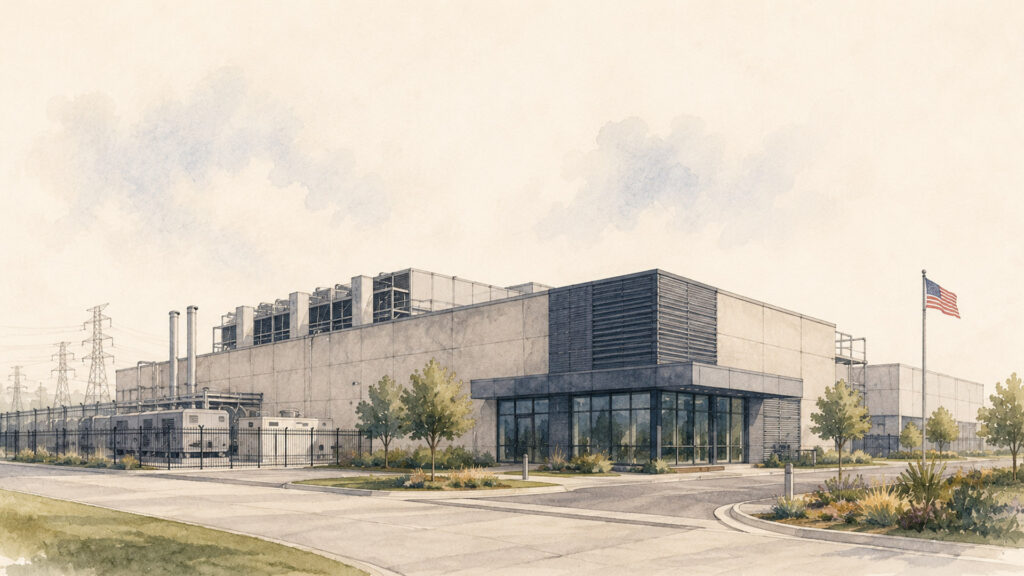
The largest active project belongs to New York-based Fluidstack, which announced Sept. 10 it had begun the first phase of a $4 billion campus in unincorporated Cameron County. The site covers more than 1,100 acres east of Valley International Airport and west of the Port of Harlingen near Rio Hondo, and the company projects more than 2,500 construction jobs and several hundred permanent jobs. Its website says first-phase construction is scheduled to finish by mid-2028. Anthropic is Fluidstack’s largest disclosed customer.
Fluidstack has said it will supply its own power and water and take no tax breaks. The company says it pays its own way for energy, infrastructure and water and builds to the governor’s standards. Company representatives told Harlingen commissioners the campus would use about 50,000 gallons of potable water daily during construction, dropping to about 7,000 gallons once operating.
But the project has cleared only its first local hurdle. Cameron County issued a worksite permit allowing clearing, grading, utility installation and stormwater infrastructure, and said future permits will be required before building construction begins. If the company’s self-supplied power involves on-site generation, it would also need state air authorization — now frozen. Whether Fluidstack has any TCEQ applications pending could not immediately be confirmed Monday.
Fluidstack also does not appear on the list of companies the governor’s office has publicly identified as complying with his directives through August, a list that includes Amazon, Google, Microsoft, Meta and Anthropic.
In a notable twist, Hinojosa praised the Fluidstack project this month. She said the company was voluntarily meeting a higher standard than the law requires and called its approach responsible growth the Valley could support.
A second, larger proposal is also in play nearby. UK-based Eneus Energy has pitched a more-than-$14 billion, 2-gigawatt campus on roughly 1,785 acres east of Valley International Airport — a project that would connect to the grid and is already subject to Abbott’s August freeze. An entity linked to Eneus holds an option to buy the land through July 3, 2027. Harlingen WaterWorks agreed last year to potentially supply as much as 4.6 million gallons of treated wastewater a day to the project, with a clause requiring it to sell potable water if effluent isn’t available. Eneus is also suing Cameron County and Attorney General Ken Paxton to block the release of records about the project.
Local officials had already moved to slow growth. Harlingen became the first Texas city to adopt a 120-day moratorium on considering data centers, and commissioners moved in August to extend it to 180 days, the maximum allowed by law. The Cameron County Commissioners Court adopted a resolution calling for public reporting of electricity and water use and opposing high-volume potable-water cooling.
Elsewhere in the Valley, a developer has proposed converting a former 265,000-square-foot Walmart on a 32-acre lot near the Port of Brownsville into a data center. In Willacy County, Soluna Holdings broke ground last year on Project Kati, a wind-powered data center planned for 166 megawatts of capacity, with its first phase slated to come online this year.

Most Read
- Edinburg ISD rejects nearly $6M offer for prime land near La Sienna despite $15M budget deficit
- Port of Brownsville approves $2M SpaceX pipeline deal, with millions more on the table
- What Toyota’s $3.6B San Antonio expansion could mean for the Rio Grande Valley
- McAllen’s nonstop Mexico City flight is back
- 5×5 Brewing plots $2.5M comeback with new Edinburg brewpub near UTRGV
Get the latest business news delivered to your inbox every morning for free.
Try 30 Days Free!
Get full access to award-winning journalism covering business, real estate, health care, economic trends, and the people shaping the Rio Grande Valley.
30 Days Free!
$9.95/month
Limited time offer
Subscription renews after your 30 day free trial at $9.95/mo.
Included Benefits
- Unlimited access to all articles
- Daily business news and analysis
- Subscriber-only content and features
Stories That Matter
- Port of Brownsville details SpaceX agreements worth more than $125M in potential revenue
- SpaceX makes history with first Starship catch at Starbase
- Mission’s first Small Business Expo puts $25K on the line for local entrepreneurs
- McCoy’s gives $10K, tools to launch Mid-Valley construction academy
- UT Health RGV performs new digestive procedure for first time in the Valley
- TSTC bets on advanced manufacturing to meet RGV’s industrial boom
- Pharr’s cross-border business push earns international recognition
- Brownsville eases drought restrictions after nearly three years as Rio Grande reservoir levels improve
- Texas A&M’s $53.5M McAllen research center will tackle water, food security and Valley health
- STC puts AI to work across 55 courses — from construction sites to car repair