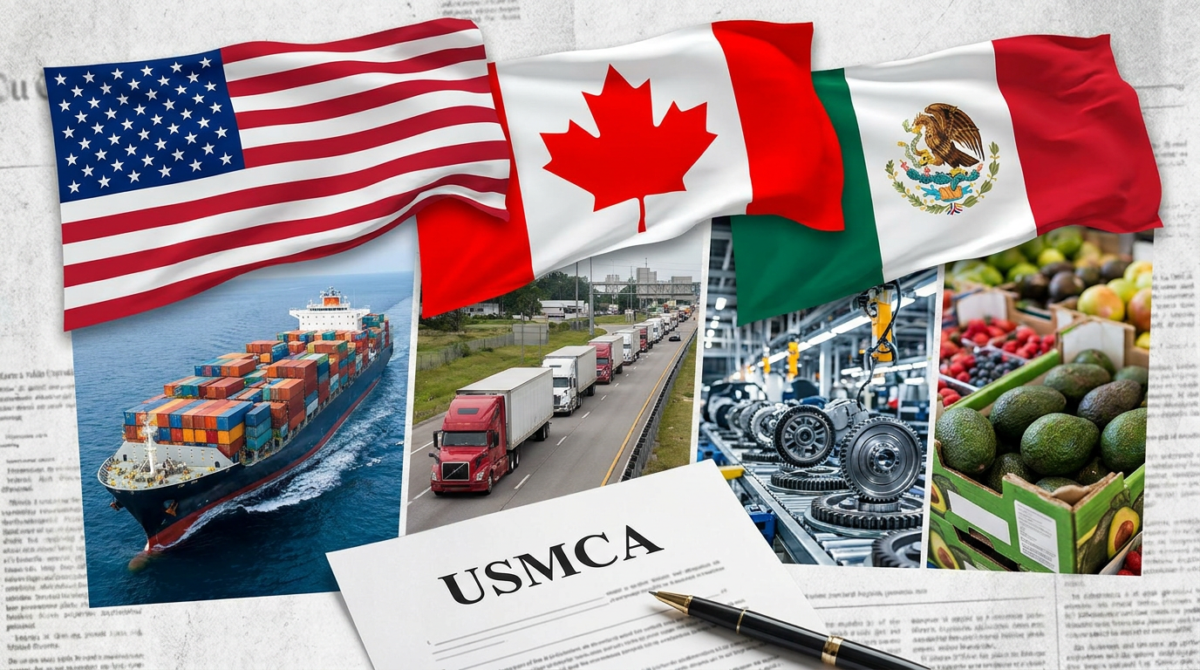
The U.S.-Mexico-Canada Agreement isn’t going away. But after the United States declined this summer to lock in another 16 years of the deal, the pact that underpins trillions of dollars in North American trade has entered uncharted territory — one defined by annual reviews, ongoing bilateral negotiations and a level of uncertainty that is already reshaping business decisions in the Rio Grande Valley.
That’s the assessment of Jorge Torres, president of Interlink Trade Services and a licensed customs broker, who discussed the state of USMCA in a recent episode of the RGV Business Journal podcast with host Naxiely Lopez-Puente.
“It’s not that it ends; it just triggers that yearly revision process,” Torres said.
USMCA took effect July 1, 2020, replacing NAFTA, and included something no prior U.S. free trade agreement had: a mandatory joint review on the pact’s sixth anniversary, followed by a decision on whether to extend it for another 16 years. That review took place July 1, 2026, and it did not go the way Mexico and Canada had hoped. In a statement issued after the review, U.S. Trade Representative Jamieson Greer said the United States did not agree to renew USMCA in its current form, and as a result, the agreement was not renewed.
The decision does not cancel the agreement. Under its terms, USMCA remains fully in force, and the 16-year extension is not foreclosed — it stays available at any point through written confirmation by the three countries’ heads of government. What the U.S. decision does trigger is a rolling annual review process that will continue each year until the parties agree to extend the deal or it expires on its own in 2036.
For Torres, the mechanics matter, because so much of the confusion around USMCA’s future has come from people assuming the deal simply ended. It didn’t. “USMCA will be here with us until 2036,” he said, adding that the review process itself was something U.S. officials had pushed for during the original 2018 negotiations, over objections from Mexican and Canadian counterparts who warned it would create exactly the kind of uncertainty now playing out.
That uncertainty has been compounded by a wave of tariff actions that have little to do with USMCA’s review clause and everything to do with the Trump administration’s broader trade agenda. Torres pointed to reciprocal tariffs, Section 232 tariffs on steel and aluminum, and Section 122 and Section 301 actions that have shifted rapidly — sometimes with only a weekend’s notice before taking effect. He estimated the federal government collected roughly $166 billion under tariff provisions that were later struck down in court, and said only a fraction of that is likely to be refunded, in part because many importers have concluded it isn’t worth the cost or exposure of filing a claim.
“If they tell me 10% today, 15% tomorrow … that creates commotion within our supply chain and our pricing structures with our customers,” Torres said.
The negotiations that will determine USMCA’s longer-term shape are continuing largely outside the public eye. Washington has been holding bilateral talks with Mexico rather than trilateral sessions, and negotiators have covered economic security, labor, agriculture, steel and aluminum, and automotive rules of origin. Ambassador Greer and Mexican Secretary of Economy Marcelo Ebrard met in Mexico City in July alongside Mexican President Claudia Sheinbaum and agreed to hold a fourth round of talks in Washington in September, according to a USTR statement. Ebrard has said Mexico is prepared to accept a 10-year continuation with periodic reviews rather than insist on the full 16-year term, while ruling out any scenario in which the agreement is scrapped outright. One sticking point has been a U.S. push for a fixed domestic-content requirement in the automotive sector, which Mexican industry groups argue would depart from USMCA’s existing regional-content standards.
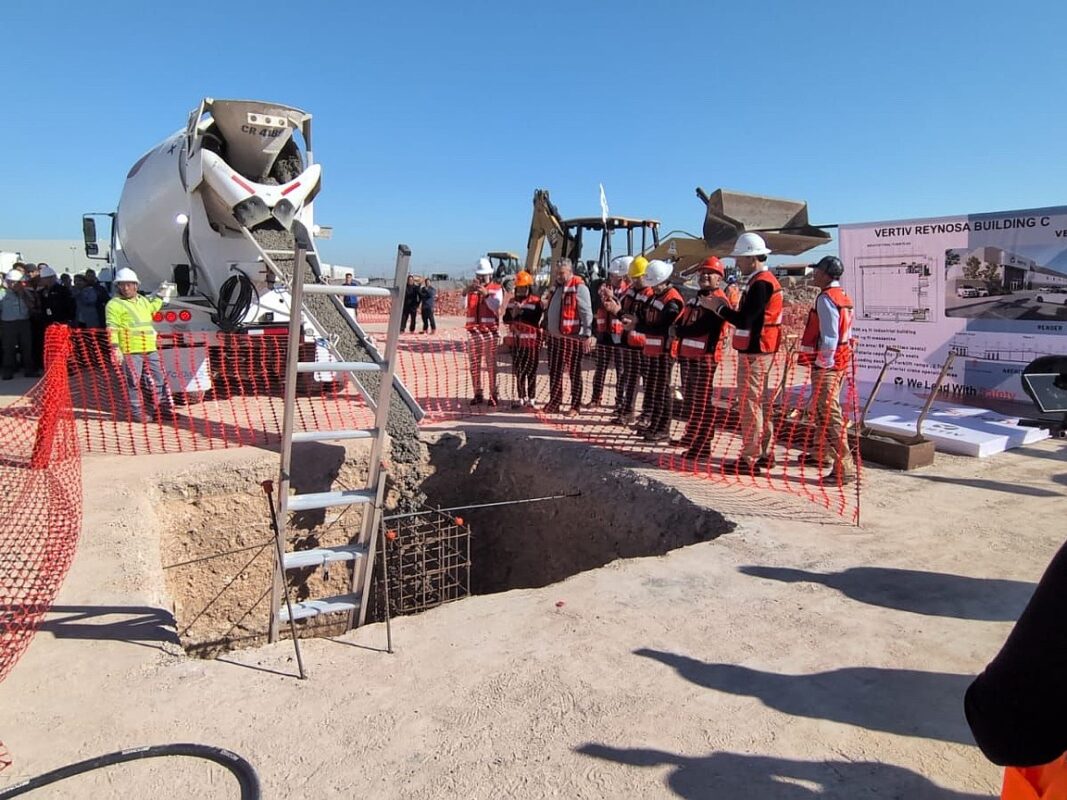
Despite the back-and-forth, Torres said he sees the Rio Grande Valley positioned to benefit from the very uncertainty rattling other regions. He pointed to continued investment at the Port of Brownsville, the region’s proximity to Mexico for dual production, and growth in medical device and data center-related manufacturing across the border in Reynosa. He also argued the Valley should stop measuring itself against Laredo’s raw trade volume and instead focus on building out its own industrial base. “We don’t see Laredo as competition,” Torres said. “We need to see ourselves as our own competition, and make sure we grow.”
Torres said Mexico’s long-term leverage in the relationship depends on how it positions itself in Washington’s eyes — not simply as a low-cost exporter, but as a strategic partner on national security and reshoring goals that matter to the current administration. Until that shift happens, he said, the annual review cycle is likely to remain the new normal for North American trade.
The next round of U.S.-Mexico talks is scheduled for September in Washington. USMCA’s next hard deadline — barring an earlier agreement — is 2036.

RGV Business Journal Staff
Staff
Most Read
- How much water does SpaceX need to operate near Brownsville? Nearly 20x its current use
- Could apartment-to-condo conversion help make $100K homeownership in the McAllen metro more affordable? One investor says yes.
- SpaceX’s futuristic city of Starbase finalizes massive 7,100-acre annexation. Here’s what we know.
- Cameron County is negotiating a $20M Fluidstack data center donation after Harlingen waffles on the same offer
- Fluidstack breaks ground on $4 billion Cameron County AI data center
Get the latest business news delivered to your inbox every morning for free.
Try 30 Days Free!
Get full access to award-winning journalism covering business, real estate, health care, economic trends, and the people shaping the Rio Grande Valley.
30 Days Free!
$9.95/month
Limited time offer
Subscription renews after your 30 day free trial at $9.95/mo.
Included Benefits
- Unlimited access to all articles
- Daily business news and analysis
- Subscriber-only content and features
Stories That Matter
- SpaceX bought some water rights from the Rio Grande River. Here’s what we know.
- Foreign-Trade Zone No. 12 expands into Willacy County
- Mission’s first Small Business Expo puts $25K on the line for local entrepreneurs
- Reynosa’s newest technical high school focuses on AI, semiconductors and bionics
- McCoy’s gives $10K, tools to launch Mid-Valley construction academy
- UT Health RGV performs new digestive procedure for first time in the Valley
- TSTC bets on advanced manufacturing to meet RGV’s industrial boom
- Pharr’s cross-border business push earns international recognition
- Brownsville eases drought restrictions after nearly three years as Rio Grande reservoir levels improve
- Texas A&M’s $53.5M McAllen research center will tackle water, food security and Valley health