A little over a year ago, the city of McAllen and downtown entertainment businesses clashed over how to balance municipal zoning enforcement, rowdy crowds, and underage drinking on public streets.
Businesses saw city leaders take court action, revoke operating permits, and even shut off utilities for local storefronts in the entertainment district last year.
Now McAllen city commissioners are reviewing draft recommendations from an outside consultant on how to foster a healthier public-private partnership for downtown revitalization.
The first draft of the new plan was shared with city commissioners on Monday and was conducted by Mend Collaborative, an urban planning business with offices in Minneapolis, Austin and Richmond, Virginia. Nearly 450 people responded to the online survey about the plan, including an online mapping comment section.
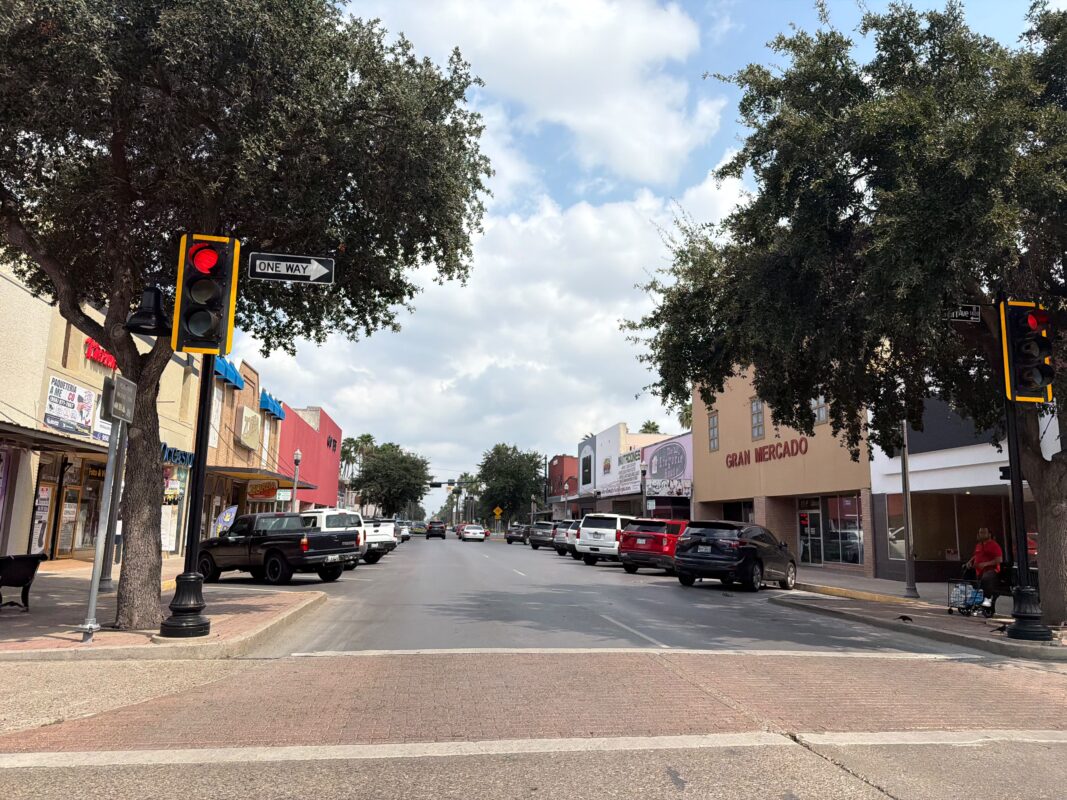
The new master plan covers downtown from U.S. Business 83 south to Jackson Avenue, and from Bicentennial Boulevard east to 10th Street.
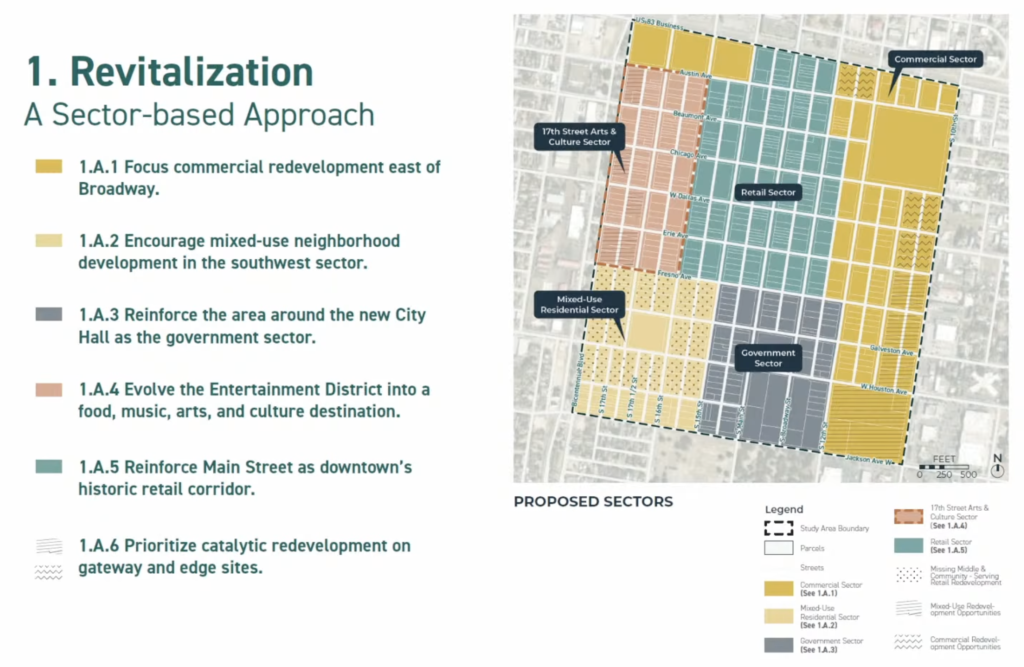
“The goal was to really envision an active, economically vibrant future for downtown,” said Kari Spiegelhalter, a landscape architect with Mend Collaborative. “Downtown remains one of McAllen’s most important commercial, historic, and cultural destinations. It performs well as a daytime shopping destination and late-night entertainment destination, but activity drops substantially during the early evening. The entertainment district has generated economic and cultural activity while also presenting ongoing challenges related to safety operations and an overconcentration of late-night uses. Additionally, vacant buildings, underutilized properties, and publicly owned sites really create opportunities for reinvestment downtown.”
That new relationship between local businesses and the city, with a still-developing strategic plan, could mean more business taxes collected to reinvest in the downtown commercial districts.
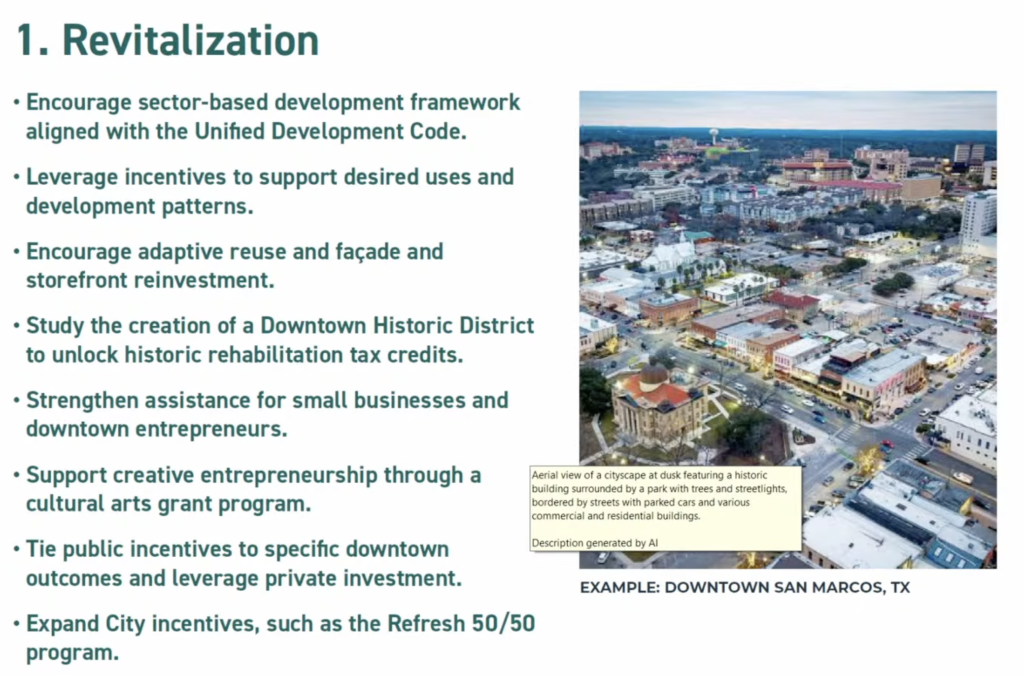

At least that’s one recommendation that appears to have some traction — a municipal management district — that’s a special taxing area that collects from businesses with the purpose of reinvesting the tax money into the specific zone.
A similar concept already exists in downtown Harlingen, known as the Downtown Harlingen Public Improvement District. It was created in 1989 during the revitalization of Jackson Street in its urban core.
“I think [the municipal management district] has the potential to be immediately successful if we could partner with the downtown landowners and property owners and business owners to create one because one year to the next it starts to really create money,” said Michael Fallek, McAllen City Commissioner for District 5 and a real estate developer by trade. “The TIRZ, you’re talking about a very long-term process that doesn’t really generate money in a short-term setting. So personally I would love to see concentration on the potential for a municipal management district. We do already have set up the system for a parking benefit district as well with our garage and the parking meters, but we need some formalization.”
Less popular appeared to be a Tax Increment Reinvestment Zone, or TIRZ, a long-range tool for large master-planned projects by a single developer.
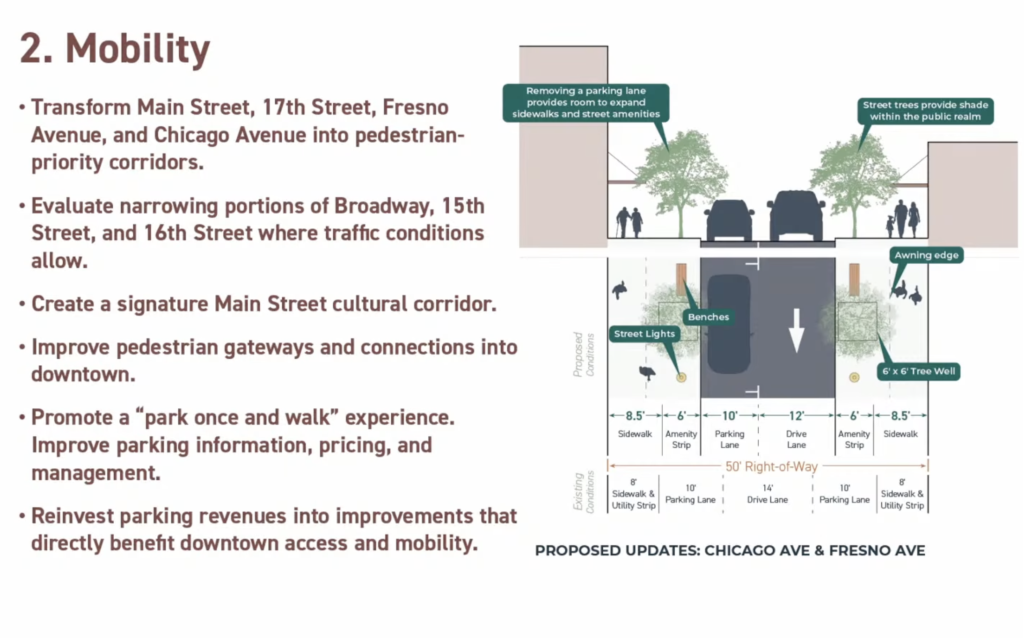
“What we heard overall is folks want to see more variety in restaurants, retail, entertainment, a safer, more walkable downtown with more shade, public spaces, family-oriented activities, preservation of historic culture and a stronger arts and cultural activity,” Spiegelhalter said.
That means the city of McAllen will likely continue with its rezoning efforts to encourage mixed-use neighborhood zoning. The plan includes a mixed-use residential sector, a government sector near the new city hall, an entertainment district, and Main Street as downtown retail.
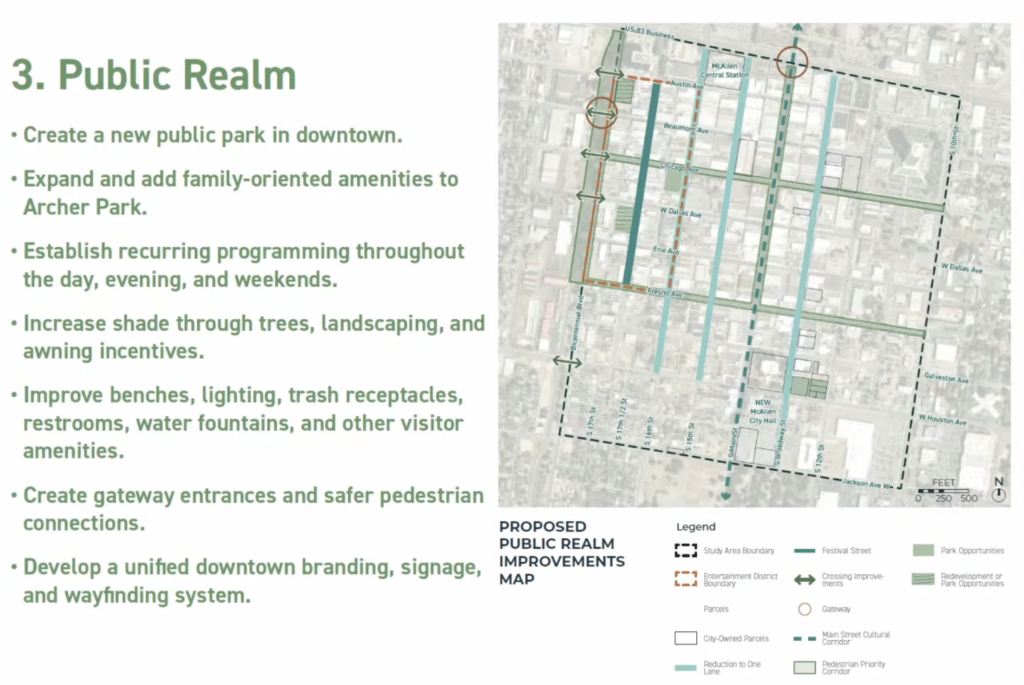

Plans could include narrowing some one-way streets and creating pedestrian-only corridors, including a Main Street cultural corridor. Archer Park could be expanded, and more city-owned land could be turned into park space.
There’s some land near 10th Street which could be turned into more residential and mixed-use retail, McAllen District 1 Commissioner Tony Aguirre said.
“There’s potential to do a lot of things if we concentrate on those areas,” Aguirre said. “It helps to have housing and people living in that area to go in and eat and spend.”
He said the city is likely to apply for grants to help reinvest in the area and potentially make more recreational spaces.
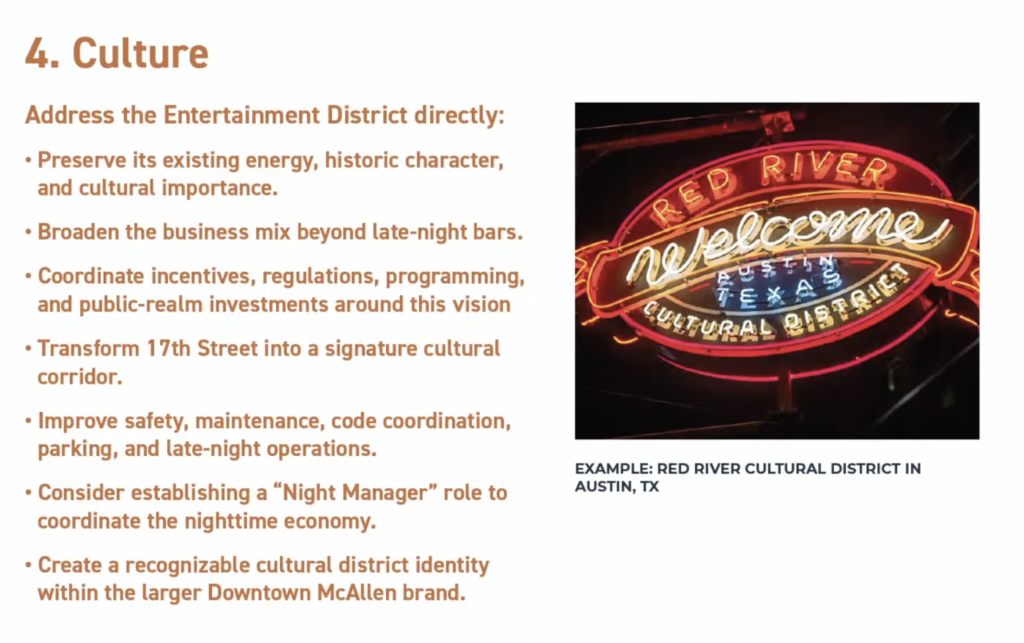
The concept is to offer a “park once and walk experience,” Spiegelhalter said. The Mend Collaborative is also recommending hiring a night manager, a city liaison to help foster and encourage safety in entertainment districts.
“We would also want to look at demographics and who we are designing to attract? You know, working with community partners thinking through what public improvements are appropriate and what private investment is willing to go into the zone that makes sense,” McAllen City Manager Isaac Tawil said during the meeting.
The city of McAllen already offers a matching storefront revitalization grant, known as Refresh 50|50, for when private property owners invest in more vibrant commercial corridors. More than 100 projects through the program have already received $1.37 million in investment.
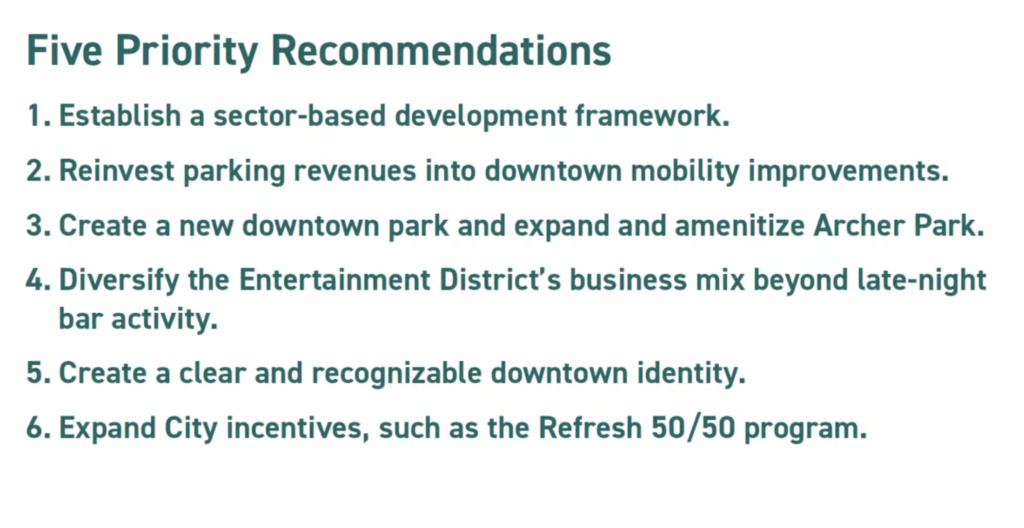
Some McAllen entertainment businesses worried that this new master plan would push them out, so they formed the HeART of McAllen business association and have been active in the draft report’s public process.
The group’s name is borrowed from the last time the city had a master plan. It was known as the Heart of the City McAllen master plan, dating back to 2004, which envisioned several new districts to revitalize downtown, including an entertainment strip on 17th Street.
Organizers have been skeptical of the city’s plans and are worried about being replaced.
“We have seen leadership come and go. And some care [about downtown] and some don’t,” Bert Guerra, co-owner of Cine El Rey, a historic theater in downtown McAllen, previously told the Rio Grande Valley Business Journal. “The HeART of McAllen formed to remind our city leaders, especially the residents, that promises made to us were not kept. We hope that the city can finish what it started. Any business plan with longevity is a 10- to 20-year investment, but when the city changes the rules, it leads to vacant properties.”
The Mend Collaborative expects to keep seeking feedback from the business community and the public, in addition to the city, before issuing a final report in the coming weeks.

Kristen Mosbrucker-Garza
Reporter
Kristen Mosbrucker-Garza is a versatile multimedia news reporter who lives and works along the Texas-Mexico border in Hidalgo County. Mosbrucker-Garza is a news reporter for the Rio Grande Valley Business Journal. During her career she's worked for the McAllen Monitor, San Antonio Business Journal, The Advocate Newspaper in Louisiana, Phoenix New Times, and public media outlets in Baltimore and Philadelphia.
Most Read
- Edinburg ISD rejects nearly $6M offer for prime land near La Sienna despite $15M budget deficit
- Port of Brownsville approves $2M SpaceX pipeline deal, with millions more on the table
- What Toyota’s $3.6B San Antonio expansion could mean for the Rio Grande Valley
- McAllen’s nonstop Mexico City flight is back
- 5×5 Brewing plots $2.5M comeback with new Edinburg brewpub near UTRGV
Get the latest business news delivered to your inbox every morning for free.
Try 30 Days Free!
Get full access to award-winning journalism covering business, real estate, health care, economic trends, and the people shaping the Rio Grande Valley.
30 Days Free!
$9.95/month
Limited time offer
Subscription renews after your 30 day free trial at $9.95/mo.
Included Benefits
- Unlimited access to all articles
- Daily business news and analysis
- Subscriber-only content and features
Stories That Matter
- Port of Brownsville details SpaceX agreements worth more than $125M in potential revenue
- SpaceX makes history with first Starship catch at Starbase
- Mission’s first Small Business Expo puts $25K on the line for local entrepreneurs
- McCoy’s gives $10K, tools to launch Mid-Valley construction academy
- UT Health RGV performs new digestive procedure for first time in the Valley
- TSTC bets on advanced manufacturing to meet RGV’s industrial boom
- Pharr’s cross-border business push earns international recognition
- Brownsville eases drought restrictions after nearly three years as Rio Grande reservoir levels improve
- Texas A&M’s $53.5M McAllen research center will tackle water, food security and Valley health
- STC puts AI to work across 55 courses — from construction sites to car repair