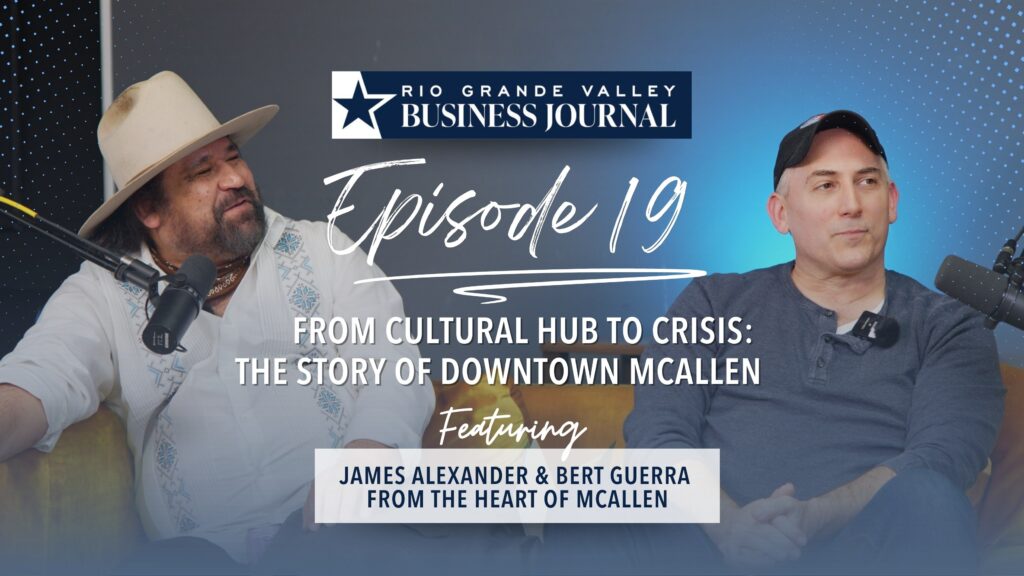
In this episode of the Rio Grande Valley Business Journal podcast, reporter Kristen Mossbrucker-Garza sits down with downtown McAllen business owners Bert Guerra, of Cine El Rey, and James Alexander, of The Flying Walrus, for a candid, wide-ranging conversation about the future of the city’s historic core.
Both founders helped shape McAllen’s entertainment and arts ecosystem, investing years of labor into venues that became launching pads for regional musicians and cultural events. Now, they say that legacy is under threat following intensified city enforcement actions, rezoning proposals, and what they describe as a long pattern of neglect toward downtown infrastructure.
Guerra and Alexander walk listeners through the original “Heart of the City” revitalization vision, what they believe went wrong, and how recent crackdowns have impacted local businesses. They also outline the newly formed Heart of McAllen organization and share practical proposals aimed at improving safety, lighting, coordination with city leadership, and long-term economic development.
From music culture and historic preservation to zoning policy and civic accountability, this episode explores why downtown McAllen matters — not just to business owners, but to the entire community.
The following is a rough, AI-generated transcript of the interview between James Alexander, Bert Guerra, and our host, Kristen Mosbrucker-Garza. Please be aware that there might be slight spelling errors for proper nouns and other “misheard” sentences. For the full experience, click the link above, or listen on your favorite podcast provider.
JAMES ALEXANDER:
The vision originally was a culture of entertainment choices. 56 years old to. To family orientated events. Ultimately ended up with a race to the common. To the lowest common denominator. A lot of people doing the same thing.
BERT GUERRA:
We’re at a 40 year low of crime rate in McAllen. What I saw and what I invested in is not what we got as founders of the heart of legality. We don’t want people to say, listen, the plan is there.
JAMES ALEXANDER:
We need to invest here. There’s something worth protecting here.
KRISTEN MOSSBRUCKER-GARZA:
So. Welcome, everyone. My name is Kristen Mossbrucker-Garza. I’m a news reporter here at the Rio Grande Valley Business Journal. And welcome to our podcast. Today we have some really special guests. We have Bert Guetta of Cine El Rey . And, James Alexander with the Flying Walrus. They’re both business owners here in downtown McAllen, and they’re part of the board of a new business association, called the heart of McAllen.
KRISTEN MOSSBRUCKER-GARZA:
And so I kind of just wanted to get a better sense. You know what inspired this group? And, you know, for folks who aren’t very familiar, how would you describe downtown McAllen today?
JAMES ALEXANDER:
I guess you’d have to. You’d have to, clear that up. And I think the best way to answer that, actually, is, more in, like, in two part because I think the best way to talk about it, honestly, is what was the vision for downtown McAllen, and then what did you ultimately get? So, the vision originally was bars, restaurants, venues, mixed culture, entertainment choices that, what, what appeal to really every level within, the community.
JAMES ALEXANDER:
56 years old to to family orientated events. Unfortunately, over time, left to its own devices and without kind of a real direction or oversight. I want to point fingers so early in the in the conversation, but really. No, no, the city direction. Right. It was just kind of left to its own devices for about 10 to 12 years.
JAMES ALEXANDER:
You ultimately ended up with what I, I don’t want to be too damning of it, but, a race to the common to to the lowest common denominator. A lot of people doing the same thing, and they’re all doing the same thing now. They’re undercutting each other, price gouging and everything else there. There’s, 20 bars where the total capacity, if you add up all of the things of 4000 going after the same 1500 people.
JAMES ALEXANDER:
It’s not not what the city originally envisioned. It’s just what they ultimately ended up with.
KRISTEN MOSSBRUCKER-GARZA:
And that’s primarily on 17th Street.
JAMES ALEXANDER:
Well, 17th Street is the corridor really from Austin to Dallas. And technically, it goes further. If you look at the city maps and stuff like that. But the core area is from Austin to Dallas, up and down 17th Street, arguably the entertainment district. Also includes, like the Gremlin, which is technically not on 17th Street. It’s on 16th, but it’s still part of that same ecosystem.
JAMES ALEXANDER:
Of interwoven bars, venues, nightclubs that that comprise what anybody from the outside looking in is going to call the entertainment district. In a larger sense, that entertainment district also includes, businesses and restaurants along old 83. When you talk about house wine and, La La La Bandera, and there’s several other bars in that Austin. I believe it’s about 14th Broadway, but, and that area and arguably that is a part of that whole McAllen downtown in the larger entertainment scene for downtown McAllen.
JAMES ALEXANDER:
Nobody nobody would say that 17th. But when you talk about downtown McAllen, I think you would include those as well.
BERT GUERRA:
Yeah. I’m going to want to clarify that the heart of McAllen basically is just covering with the heart of the city was and still is. If you look at the the maps of what McAllen is should be covering or said they were going to cover in their original business plan that we invested in because we understood that’s what they were going to do.
BERT GUERRA:
So this is what we did. And like James pointed out, this was not just about the entertainment district. This is also about the retail. This is also about residential. This is also about land owners and stakeholders. Plus, you know, people that operate the their, properties because there’s a disconnect between sometimes what people do that run the business versus the stakeholders that own the business.
BERT GUERRA:
So unfortunately, what happened? And I guess gets straight to the point, it was very like a viral video, that really set this thing off. It wasn’t based on fact. You know, because if you look at the facts, you’re going to have the police chief of McAllen County. Now, we’re at a 40 year low of crime rate in McAllen.
BERT GUERRA:
So we were very disheartened by the way certain city leaders led this, especially the mayor of McAllen, because I think the mayor should have taken a tone of, we want to look out for the police officer, but we want to look out for this kid. This kid’s part of our community. We as a community look at need to look out for each other if they’re on the wrong track.
BERT GUERRA:
I personally wrote an email to the mayor and to the commissioners to let them know that there was a bill in 2023 that passed, called SB 1819, that did away with curfews. And so this problem that we’re having about minors, and I’m talking about people under 17 legally can be out on the street at any time, not in a bar.
BERT GUERRA:
They can just be out in the street. And that is it’s a problem that we’re seeing in all states. That needs to be repealed.
JAMES ALEXANDER:
All cities within the state. It’s so that’s that’s statewide. That’s statewide.
KRISTEN MOSSBRUCKER-GARZA:
Interesting. Okay. So just to catch the audience up, so in, you know, the downtown, district is essentially, a, a zoning and planning, mechanism. So all of the, businesses operating, you know, mostly bars and nightclubs, obtain the special use permit. Right. And so there’s fees associated with these permits, whether you have parking or not.
KRISTEN MOSSBRUCKER-GARZA:
You know, this was, a curated, effort by the city of McAllen to revitalize their downtown, right? And, they, they put a plan into place. You know, it was called heart of the city. McAllen. That was back in 2004. And so they kind of had this vision, and, you know, business owners, like Bert, and, like James kind of invested in that vision.
KRISTEN MOSSBRUCKER-GARZA:
Right. And so y’all got involved it, seeing every day in like mid 2000, right?
BERT GUERRA:
Well, they’re written that we bought it from we got involved with him in 2006, and we took it over officially in 2007, in March. So the first concerts they started doing, there was a concert series that the city would do. There was a lot. We used to host dinners that would recognize people in the city. So the theater was being used a lot by the city, and we did this for free.
BERT GUERRA:
We weren’t getting paid. We did this to contribute because of the revitalization that they promised us to have. That was coming. And it wasn’t just because we were worried about us. We wanted it to be very diverse. You know, the plans involved parks. They involved an STC. They involved more of a arts, type of incubator place for people.
BERT GUERRA:
So what I saw and what I invested in is not what we got. And so, as founders of the heart of McAllen, we want people to say, listen, the plan is there. Everything is there. We just need to get back on track. And now we realize things change when you get commissioners. I’ve seen four mayors change. I can’t count how many commissioners have changed since I’ve been there for the 20 years.
BERT GUERRA:
But you realize when they get off track and we don’t remind them, then they really get off track to the point where we can have meetings with them and they’re like, I don’t I don’t even know what you’re talking about because they don’t know they weren’t there. They weren’t even in office. And I’ve never experienced that because I’ve always been, you know, a business owner just working on my business, never worrying about the bigger picture.
BERT GUERRA:
And unfortunately, and it’s not that they don’t care. They just don’t know. So once they know, I think they understand us now. And so that’s why I realized we didn’t want to be just a bunch of bars, even though most of our stuff that we do is art. It’s live entertainment. We invest a lot in the regional, stages that people could provide, that we could provide for, that.
BERT GUERRA:
Regional artists become more, you know, some of the bands that have gone on to don’t do certain things started that scene already. And so I’m very proud of that. And that historically has been the case when you look at call, excuse me on Freddy Fender, Wally Gonzalez, a lot of these structural people, pioneers before Freddy was Freddy, you know, they started on that stage.
BERT GUERRA:
So that’s why it’s very important to keep it at all ages venue and let people know it’s if it’s historically that some of the older business owners that pioneered McAllen that are rooted economically came from 17th Street. So whether you’re a gardener like sherry or coca leaf, some of these people are 38. Should not be worried about their properties getting ripped now because nobody wants to rent them.
BERT GUERRA:
So it’s ironic that, the McAllen leadership right now is not paying. A lot of that has to do because the McAllen mayor and the city manager, they’re not from here. So they don’t understand the history of the families, of the people that contributed to make it. And so I think there’s a disconnect in that and in a lack of respect, actually.
JAMES ALEXANDER:
KRISTEN MOSSBRUCKER-GARZA:
And y’all started, flying walrus sweat in 2013, 20 2012.
JAMES ALEXANDER:
OKAY. MAY 2012.:
KRISTEN MOSSBRUCKER-GARZA:
And what inspired y’all to start the business? How would you describe it for folks who aren’t very familiar? And what was your initial vision?
JAMES ALEXANDER:
So we, what’s it what’s interesting about about having Bert and myself here is, is really the, you know, like the longevity, the longevity of the two businesses. They’ve kind of seen it since the Corps beginnings to what we all have now. Ultimately, what he does and I do our very much, in a related because there’s a lot of emphasis on culture and music and stuff and such.
JAMES ALEXANDER:
The Warriors that a little bit different. He started off at theater, right? We we were a small little bar, smaller than about the size of this studio. We added a patio, then to then went to the adjacent building and then expanded our patio and kind of grew with, with our clientele. But, for one reason or another, music was just kind of like a core part of that vision from the get go.
JAMES ALEXANDER:
And we started off with trios and and solo artists and such and, and to what you see now where we’ve got halls, shows and, various tribute acts and touring artists and everyone else like that.
KRISTEN MOSSBRUCKER-GARZA:
In two stages.
JAMES ALEXANDER:
Yeah. And two stages. Yeah.
KRISTEN MOSSBRUCKER-GARZA:
BILLIARDS.:
JAMES ALEXANDER:
And. Right. We’ve, we’ve expanded, we’ve grown. And it’s, that’s where it’s for me and a particular. Is that my love for what we’ve done downtown in this community. And what we’ve grown into has really come with time, blood, sweat and tears. There’s virtually no part of the modern flying walrus that I didn’t build myself with my own hands or directly oversee, the work of it.
JAMES ALEXANDER:
If you go to the back door of the stage in the back, I believe about more than half of that with my own hands. The stage is in the front I built entirely myself. Hired a worker to help me, but got it done. So it just. It means a lot when you talk about years of investment, years of blood and sweat, years of community building, it’s not something that happened overnight.
JAMES ALEXANDER:
When I talked to it, when I left out earlier, I talked about the music ecosystem, which, I mean, I wish Tony from the drummer was here because he’s really a part, a part of it as well, a big part of it. These artists, the they depend on these stages, they depend on these stages as jumping points.
JAMES ALEXANDER:
We are very well known for, a really we’re blessed, by our, to have our host, Julian David Ramirez, every Wednesday with, with our open mics, traditionally, most places, they’ll have their open mics and, I mean, it’s you’re lucky if you got a host. It’s usually a gatekeeper, and he’s giving you a mic and you got maybe two speakers up there, and he’s just like, okay, you want to do something?
JAMES ALEXANDER:
Good luck, have fun. And, that’s not what we do. We provide, lighting and tech support. Sound support. There’s usually so many people in the audience that will have, like, a solo acoustic writer and come up. He’ll come up with his guitar, we’ll keep guitars on the stage and say, if you didn’t bring a guitar, just borrow one of ours.
JAMES ALEXANDER:
But that would usually bring their own and they’ll more times than not, and I’d say like far more at times a night, a bassist from the audience will be, hey, can I can I just tell me what chord you’re in? I’d like to join in. And a drummer would be like, oh, you know, I, I dig what you’re doing.
JAMES ALEXANDER:
Like, let me join in and jam sessions will break out every Wednesday. An unplanned, like I say, organic. At this point, we have just within this music community now about ten that I can count off the top of my head that are actively playing at venues, various venues throughout, the RGV and are starting to tour Texas wide.
JAMES ALEXANDER:
That all started where at our at our open mic, really. And, I mean, I could name off some of them if, if you’d like. Currently right now it’s Street Reed, take out rogue Vertigo. In the past, there was, an all female band, and sadly, they split up. But, brag they were there. It’s their first show ever.
JAMES ALEXANDER:
They were the dead lilies. They. But they played the flyways can be came back and a number of others PSA, etc. and honestly, I could for sure I wouldn’t be able to count them all. And I, it might seem to sound like bragging, but it’s I’m proud of it. And I think, he’s proud of it, too.
JAMES ALEXANDER:
And I believe Tony would be as well. And it is something to be proud of because you’ve provided something that’s. I mean, we’re not operating from government funds. We’re private and really, I don’t want to ever. I don’t want to turn this into some sort of bashing of the city thing. In fact, with the heart of McAllen, we, I think that we could both agree that we’re at least cautiously optimistic about the conversations that we’ve had so far.
JAMES ALEXANDER:
I, we both believe that. Don’t let me speak for you, but I but we’ve spoke before now, obviously. And, we both believe that that when there is a clear exchange that, that we can build something great together and that it it can’t just be like a one sided investment. And unfortunately, up until recently, it really has just been us kind of driving the ship against a lot of obstacles.
JAMES ALEXANDER:
But these I just I’ll, I’ll wrap it up because I guess maybe I had veered off these venue spaces, these stages, they mean more than just a bar or a theater or whatever. These are the birthplaces of of your upcoming, your new culture. And he just had, Freddy Fender and some of the older Tejano artists.
JAMES ALEXANDER:
Well, what about the 1920 and 21 year old artists? Now they’re saying, where’s my stage? Where do I go to be discovered? How do I develop my art? And that’s, something that we do. Downtown McAllen has always kind of been that, like, go to point, like, oh, that’s where I meet. If I’m a young DJ, how do I get my music heard?
JAMES ALEXANDER:
Well, I’m gonna have to go to these clubs and they’re going to have to give me a chance. And so that’s always been so important, but unfortunately, it’s my feeling that the city, McAllen largely hasn’t understood or that you can give voice to it. You can tip your hat to it in a in a snappy little media, quote.
JAMES ALEXANDER:
But that that ecosystem is valuable, deserves protection and deserves direct investment. Much like you’ll do in Austin when they’re when they’re diverting into their cultural programs and their concerts and their live events and, and a little recognition, both Bert at El Rey and ourselves at the Flying Loris were both recognized last year by the Texas Music office, through the TMI, our, Texas Music Incubator rebate program, as official music venues, worthy of a tax rebate.
JAMES ALEXANDER:
In recognition of those efforts. And, unfortunately, that’s not been our experience with the city of McAllen. It’s never really like, hey, y’all are valuable. We need to invest here. There’s something worth protecting here. Unfortunately, following that incident, August 24th of a police officer in the street, the entire conversation has been negative. And that’s what Bert was talking about.
JAMES ALEXANDER:
And, where I can say that. And by the way, you kept calling us board members. Well, we’re founders. We’re founders. Okay?
BERT GUERRA:
We’re still working our way through what the heart of because it includes the historical district of Holmes. It includes some people that have very deep investments in McAllen that I want to respect. That we were trying to get them on our advisory board because they were here when these plans were implemented. And I know they’re disheartened that all the work that they went to planning these plans just got discarded, you know?
BERT GUERRA:
And so they were like, okay, guys, we need to come up with a new plan. I think we just need people to realize. And that’s why I sent you the document, because I realize people like yourself in the public have never seen these documents. I’ve seen them, so I understand them. What I got to remember is that the public does not understand what got me, and it didn’t get me upset.
BERT GUERRA:
I was just very disappointed because they say they don’t want to go back to the past, meaning these plans, but yet they just said, we’re going to do, the Bowie Reservoir project. Well, that’s phase two of these plans. How can you cherry pick phase two and not finish phase one? And we are suffering because if you look at these plans, it’s like an architect.
BERT GUERRA:
The foundation has to be a certain way at a certain time. There was supposed to be three parking garages. You only got one, which was for the entertainment district. But the retail suffered because they never got their two parking garages. So when you blame retail for their problems, I don’t really blame them as much as you didn’t do the part that was supposed to help them.
BERT GUERRA:
Now, it’s debatable. The problem with Art as being a businessman and being on both sides, a musician first and probably a businessman second. The dividends not come at the end of the day is that 9 to 5? You’re not just going to end up getting all this money at the end of the month because you hosted a bunch of young artists.
BERT GUERRA:
But I tell you what, the dividends comes when we come back to you and they say, hey, we went to the Grammys or, hey, I’m toying with with this person or that person. I’m not a big name rapper. I’m sorry for them, but I can assure you that the work, what’s unique about Clay and I only have the baton.
BERT GUERRA:
I don’t even treat it like it’s mine. In fact, people recognize James at the at the coffee shop.
JAMES ALEXANDER:
YEAH.:
BERT GUERRA:
I’m very much behind the scenes. I really don’t want it to come out. But a few times I’ve come out and spoke on things that I think the city went away. We were able to overcome them. And when those decisions, whether it was saving the Roosevelt School or implementing the 21 and over thing that they tried to do in 2015, and, you know, Freddy Fender wasn’t Freddy.
BERT GUERRA:
Freddy when he performed his, his originally was Baltimore. What? That he lost every contest, that scene away from what they told me he hated me because he didn’t feel people respected his art form. Although in the lower Valley, he’s very popular. And he was a big hit on the radio. And and then he used to perform at another thing in Huntington when every contest and I think that’s so ironic that I’ve worked with him.
BERT GUERRA:
When I used to do production, I used to do tours and do sound. I never I wish I would have known that. I would have loved to have asked him, you know, because sometimes people have good experiences at venues and sometimes they have bad experiences at venues or cities. And so those are the type of stories I think are interesting to our culture because, you know, Ray’s the only national landmark in America for Hispanic culture that’s still privately owned.
BERT GUERRA:
We’re not owned by the city, county, federal, government. So that responsibility of having that baton, you know, because it was the mayor of the city manager, I keep saying it was one of them, but they said profits before people. That’s all we heard about. That was like a headline. And to be honest, that broke my heart because during Covid, we had an offer from Live Nation to buy the theater, to sell it.
BERT GUERRA:
And I if I would have sold, I could live off interest. I never been in that point in my life thinking about just myself, because that’s just not me. But for them to say that really hurt me because they don’t know the sacrifices that we have made, whether it’s building the stage or or staying up later because a band needs a load out, or going earlier because they want to do a sound check, all that stuff, we do it because we love what we’re doing, and people might think, what does that mean?
BERT GUERRA:
It means the world. To some kids, it means the world to somebody that’s going to become something else. One of the most moving stories I ever heard was a kid. I say a kid, but he came with his wife and his kids to say thank you. I don’t remember him, but he told me, and this is when he told me that he got caught smoking in the restroom smoking pot.
BERT GUERRA:
Our security company policy is to call the police. That’s their policy. Somehow they asked me, what did you want us to do? And I said, listen, let me talk to the kids. And so I told them, listen, I’m going to kick you out, but you’ll come back tomorrow. Just back another day. But if you want to stay, this guy has to call the police.
BERT GUERRA:
Of course. The right man to the left. Well, ten years later, he comes with his wife and his kids, and he’s a make out peace officer now. And he said, if I would have got a record, I would never got into the military. That decision that I made really was to protect us, but it was also to protect somebody that makes a mistake.
BERT GUERRA:
So we’re going to have issues with people, but if we’re going to be hard on them, they may they may not be able to get into the military. They might not be able to become a police officer or get married and have kids. We don’t know. So ambiguously, we’re, we’re we’re really raising a society and a community when they come to these values.
BERT GUERRA:
And we take that very seriously. I don’t remember that incident. I’m glad you brought it up to me. I cried when he told me because seeing his kids and seeing his wife happy, not knowing what they’re talking about, but him say thank you because he remembered that meant a lot when he’s getting hot water or getting recognized. So I admire when people come back to us and thank you for us.
BERT GUERRA:
20 years has been a long time. It seems like it was just yesterday, but I do wish with the time that I got left, because at my age and the time that I put it to the theater, I want the city to get back on track to the heart of the city plans, and hopefully the heart of McAllen will help identify and take responsibility and in ownership of who made mistakes.
BERT GUERRA:
But let’s move forward. You know, I’m not about blaming people, but a lot of the the communication that I had with the administration has been behind the scenes emails. I’m I’m not trying to go to the media and stuff like this, but I realized we have it just being me and James. It has to be the stakeholders, the the residential people in the downtown area.
BERT GUERRA:
We just we’re here in Edinburg and we took a little tour of what y’all got going on here. And what’s so ironic is Brownsville, Orange and Edinburg was all inspired by McAllen from 2004 2005, and now we’re a footnote of it. We’re behind or whatever everybody else is doing in their downtown area. And so for me to invest 20 years and be in last place, as far as a community, it’s very disheartening, you know, because we’re giving it all every day, you know, so to to work with a different city administration or a different commissioner, you know, God bless our commissioner.
BERT GUERRA:
But it took him six years to get my lights on. In back of our alley. We had over 300 streetlights out, and that took a long time to get done. Now, a lot of that has to do with AP and stuff, but we haven’t had Christmas decorations downtown McAllen since 2015. Unfortunately, there’s not a single flag anymore in downtown, and most people that are McAllen residents remember going downtown on Christmas.
BERT GUERRA:
It was a big deal for a young kid to see Christmas lights, and it was a big deal to see the 4th July parade. And I just think those type of bring it back to downtown, to McAllen easily be revisited. It is why did simple things like that, and I compared it to growing up in a home. You go up and home and it’s Christmas time.
BERT GUERRA:
You don’t see a Christmas tree. There’s this function in the family. There seems to be no spirit of that type of Christmas for a young kid, right? Or a father or mother to show that the kids that there’s love in this home. I feel like that as a community. There’s a disconnect of neglect to the downtown area. McAllen, specifically, the heart of McAllen, the thing that is rooted in the economic system that built McAllen.
BERT GUERRA:
It has unfortunately been neglected.
KRISTEN MOSSBRUCKER-GARZA:
It’s interesting. I remember, so for folks who aren’t familiar, you know, so this, that they called an ECOG, but it’s like this, these special permits, the special district, you know, they’re supposed to be, like, different cultural, representations. Even at one point, the city of McAllen had an office, right there, they had, like, a downtown manager of sorts.
KRISTEN MOSSBRUCKER-GARZA:
And it’s interesting because, the city of Brownsville and the city of Harlingen right now have downtown managers, like someone who works for the city, and their entire job is to essentially promote economic development in, you know, that part of the community. I don’t believe that there is someone in that exact role at this time at the city.
KRISTEN MOSSBRUCKER-GARZA:
I think there’s like a perhaps like a retail manager of sorts is what I saw. But not the same focus is not the same concept. And, you know, basically for folks who aren’t familiar, you know, there was a video that came out in August of, McAllen Police officer, being, you know, assaulted is what the police said, by, someone that they identified as a minor on the street at night.
KRISTEN MOSSBRUCKER-GARZA:
On a weekend. And, you know, city officials essentially said, well, this is the last straw. We’re concerned about minors. You know, being served alcohol or or having drinks, in this area, you know, it’s a safety issue. And, you know, they, we’re very much taking a lot of, different strategies, to regulate that or, or attempt to regulate that mostly in the civil realm.
KRISTEN MOSSBRUCKER-GARZA:
But really for potentially, criminal activity. So since August, like, I had even gotten down to downtown McAllen and, you know, you saw code enforcement, on the street, questioning business owners during, you know.
JAMES ALEXANDER:
Yeah, I, I wanted to be clear. I know you’re telling your part, but. So August 24th, that was this Saturday, going into Sunday. Monday city meeting. That’s what they they emergency city meeting and that weekend. And you were there that weekend. You saw the immediate aftermath, right. Yeah. Okay. So I just wanted to timeline it and because you told us before we got started about that.
JAMES ALEXANDER:
So what do you tell your audience about exactly what you saw? So honestly, I’m I quickly.
JAMES ALEXANDER:
When if if we defend ourselves and we kind of say, hey, this is what happened, it always sounds like defensive. So I, I would appreciate it. I know that that you spot interviewing us, but what did you see that weekend? I, I would hope you would just share that with your audience.
KRISTEN MOSSBRUCKER-GARZA:
Yeah. So, yeah, the city had held a meeting and, you know, a lot of the business owners had kind of talked about their experiences with downtown. And essentially the end of the meeting was the city was concerned and they wanted to increase regulation. Right. And so, they were certain that there was, underage drinking happening. And so they wanted to, essentially, you know, this is a way that or, you know, keep that from happening.
KRISTEN MOSSBRUCKER-GARZA:
So that is typically like, like a criminal issue. But their strategy, appeared to be very much on the civil side of it. Because if y’all remember, these are all, businesses operating within a specific district. And so they have these special use permits. There are other, regulatory permits that are required at the city, whether it’s, you know, your grease trap has to be a certain size if you are serving any kind of food, or have any type of organic matter in the facility, you know, and, also like occupancy and, you know, fire suppression and, and just kind of like basic, public health and safety.
KRISTEN MOSSBRUCKER-GARZA:
So, you know, the, the city for whatever reason, you know, that weekend during, you know, the peak of people walking down the street and looking to have a good time and partying, you saw code enforcement alongside them, like in small groups, like in their uniforms with their, they they weren’t what are they called?
BERT GUERRA:
The clipboards.
KRISTEN MOSSBRUCKER-GARZA:
They weren’t clipboards. They were like tablets or something. Right. So. So they’re out there with their tablets and, you know, they they were asking business owners to come out and, and, you know, give proof of, of licenses or, you know, if they didn’t, they, would want to issue citations. And then, you know, the city came out and they were like, hey, like, you know, we cited x number of bars and nightclubs, during this time frame and, they, you know, we could potentially raise $11,000 from, the value of these citations that these businesses will have to pay.
KRISTEN MOSSBRUCKER-GARZA:
You know, because they, they aren’t following our civil code, basically. And you know, it was it was pretty unusual. I’ve never actually seen anything like that before. And it kind of went on like this, to my understanding, for, you know, several weeks in a row to the point where, some bars that, I’m told were trying to, become compliant with the city’s orders, were apparently, like, not doing it fast enough or not doing it in the time frame or in the way that they wanted to.
KRISTEN MOSSBRUCKER-GARZA:
Or maybe they didn’t have enough money for, you know, the fines, in addition to having to remodel, and something that I’ve never seen before, is that the city actually cut off electricity to, some of these businesses. And so 12 and yeah, it happened to you as well.
JAMES ALEXANDER:
No, the irony there I’m going to pass on that did happen to work, but.
BERT GUERRA:
They cut the power lines so you can cut power by telling AEP to electronically cut it off. You can take off the meter, which is back. Most people used to do that sometimes, but to actually physically cut the power lines, that’s usually only assigned to the fire marshal’s decision, especially when there’s several buildings on fire. They might do that in an emergency to make sure that the fire is carried on.
BERT GUERRA:
From what I understood, that was illegal. There’s no doubt that it something that we could probably do legally. But by the time you win, you lose. You’re throwing good money at bad money. And I think that was another disheartening thing that the city put us business owners in. So was, you know, they put us in a situation where they intentionally did something that’s wrong.
BERT GUERRA:
And there’s a certain term that you could use that I wish I would know the law enough, but you can take the.
JAMES ALEXANDER:
Job in this in this point. And I’m just oh yeah. So so we to the fund was recently put up a GoFundMe for legal representatives. Then the danger for me is that I can’t get to particular, but but what he’s alluding to is his basic principles, sense of justice and due process. Typically, if there’s anything wrong with any business, specter comes in, notifies you this is out of order, gives you a set amount of time to correct, which is called, opportunity to cure, then follows up.
JAMES ALEXANDER:
If you have not come into compliance, then cites you. This is typical business practice for any city in the country. And McAllen had always been that way in this instance because, and you, you skated around it a little bit too. You have said event, you have automatic, very obvious escalation and enforcement. You were unwilling to say that they’re related.
JAMES ALEXANDER:
It sounded like, when you were talking. But the timeline is that undeniable. That night you talked about all the, inspectors out there. There was also a presence of 25 plus police officers out there. There were probably 12 squad cars. There were 6 or 7 fire marshals. The fire chief was out there. The chief of police was out there in it in no uncertain terms.
JAMES ALEXANDER:
It was a parade. It was an obvious show of force. It just kind of retaliatory reactive politics. Now, I don’t want to spend too much time delving into that because we both feel that mistakes were made. Wow. The city’s probably never going to make a public statement. Mistakes were made. There has been some progress behind the scenes of at least the tacit acknowledgment that it could have been done better without saying we did something wrong.
JAMES ALEXANDER:
You see the difference? But it’s still a step in the right direction. So I don’t want to get too focused on mistakes that have been had. For me personally. Just don’t feel like I didn’t skate over it completely. I mean, I’m still in court. I’m still facing, charges for things that were absolutely cured. And you talked about our our power was cut.
JAMES ALEXANDER:
Actually, they cut 12 different venues. I remember the night I walked out, I had actually talked to them that guys, I do, they cut our power. It’s like, what? And I walk. We went out there. We had our show that Friday night and the whole street was back. We we our power was not cut. Every permit was up to date at, the Flying Walrus.
JAMES ALEXANDER:
We we’ve always tried to, do things the right way and work with the city. And things have popped up over the years, just like any other business. But honestly, we have a 14 year history of compliance. And that’s why it was so upsetting when we were so immediately cited for things that we were either actively curing or could easily be cured in under 24 hours.
JAMES ALEXANDER:
It was it was kind of like a throw the baby out with the bathwater mentality. And, and up until now, this now I’m going to make it personal. I’ve been hesitant in my willingness to start, and I was asked by several people, hey, we could just start an organization if you if you recall it all back in September, I was very vocal in defending the Flying Walrus and what was going on and really calling the city out on some of the things that I saw that were wrong.
JAMES ALEXANDER:
I then began defending myself pro se, I’ve been defending myself pro se for over four months. I filed letters everywhere. Department of Justice, Texas Civil Rights Project, ACLU. I’ve really kind of tried to do things the right way, forming a record and not blasting on the internet and everything. So when I most recently posted about we’re Hot Stuff now, what’s going on?
JAMES ALEXANDER:
I think that the confusion for a lot of people has been that we’ve been fighting silently for the last 4 or 5 months. I’ve, I’ve been told maybe that was naive. I’ve been told. Maybe you should have fought more loudly. We should have launched a GoFundMe. Then you should have done this or whatever. Hindsight’s 2020, right?
JAMES ALEXANDER:
I mean, I was raised to, to to try to be civil and to try to use the system and to try to articulate and try to work with people and try to be cooperative. As my grandmother used to tell me when I was growing up, you don’t have to like everybody, but you should be civil with everyone.
JAMES ALEXANDER:
I mean, this was this was hard core put into my into my system as a child. But I don’t I felt like that that needed to be explained. But this is we’re also here to talk about the heart of McCown. We’re here to talk about the future. The future, collaboration moving forward so that these things don’t happen again.
BERT GUERRA:
But I think a lot of it has to do with getting the right people in office. I yeah, there’s not a lot of people that vote and make our organization will probably have enough people to to decide every election, you know, in McAllen. You know, so we’re not just going to be, a force for the bars, you know, let’s just you know, anyone heard of what we’re working with as far as what to make it?
JAMES ALEXANDER:
Only about 17.
BERT GUERRA:
BECAUSE.:
JAMES ALEXANDER:
About 17, we.
BERT GUERRA:
Want people to realize that McAllen was on track, and we’re just trying to get it back on track. And I think when people take accountability for that, they go out, whether they’re in office knowing whether they’re not in office anymore, that’s going to determine the people that we put in office. Because. I can call every commissioner on the phone right now and have a great conversation with them.
BERT GUERRA:
The people that don’t return my calls, like they say, you’re in the city manager, of course, are 2 to 2 people. So there’s something there that’s not right. That’s delegating the commissioner court because everybody knows what they did was underhanded or wrong. I don’t know, for the for the record.
JAMES ALEXANDER:
And everybody knows.
BERT GUERRA:
That. Well, at least other people feel that.
JAMES ALEXANDER:
Way for sure.
BERT GUERRA:
Well I’ve heard it from them personally. But you know, they don’t want to go on the record because they’re scared. I have no idea what’s going on with it, to be honest with you. But I do know this. I think commissioners come and go, so this is going to come and go in at least my lifetime that I’ve seen.
BERT GUERRA:
So I’m looking towards the future as this organization. But firstly, when the mayor took to social media and said, we’re going to make this 21 and over, and he wanted to enforce that, I sent him an email letting him know that’s illegal under the state law, you’re going to get sued by the attorney general.
JAMES ALEXANDER:
I had a similar conversation.
BERT GUERRA:
He did not know as an attorney that that law had passed. Luckily, he did not do that. Luckily, somebody stopped him. I’m not sure who, but I sent him an email and so we had a meeting I’m not going to name who with. And there we said, we’re grateful to you. You would have made the city look like a fool.
BERT GUERRA:
But instead of them saying thank you and talking about the minors and trying to solve that on a state level, we get our power turned off without any warning, without any due process, you know. Now, could they technically, legally do that? You got really been the rules to have made that work with anybody. If you get this in front of a judge, my whole point is I don’t want to spend the next two years fighting that legally.
BERT GUERRA:
I rather invest that money in the future of McAllen, in the community that I’ve given with one third of my life. I mean, I’ve been in the entertainment business 44 years. In 20 years I’ve been there. I it all right. And I’m proud of the work we’ve done. Have we made mistakes and stuff that could be better?
BERT GUERRA:
Yes. You know, but we’re not here to not take responsibility for things that the water could have showed us. We’re here to look forward to the future, and we’re willing to work with anybody from the city that thinks like that and not keep wanting to talk about a viral video. That’s not the truth, because the truth is, it’s the police who said, we’re at a 40 year low of crime, the level of being dropped in McAllen.
BERT GUERRA:
You can’t have it both ways. And say that to be the child of McAllen, the mayor is saying, don’t come to McAllen and don’t come to downtown. But yet tout that we’re one of the safest cities. It doesn’t jive.
JAMES ALEXANDER:
That’s a whole other that’s a whole other thing right there.
KRISTEN MOSSBRUCKER-GARZA:
Yeah. You know, so something I thought was interesting, too. Is that so? The city, McAllen put out a request for proposals. Right. So an RFP seeking a consultant, essentially for a potential design, or revitalization of McAllen downtown and, you know, I’m told that they will have meetings and that they’ll include, voices of.
JAMES ALEXANDER:
There’s a workshop scheduled for February 12th. I would invite you or anybody else that wants to be a part of it or feels like a stakeholder. I think the city sometimes this gets missed, and it and it’s something that we’ve discovered as we build the heart of McAllen. At first everybody wants to say pigeonhole. It is 17th Street.
JAMES ALEXANDER:
This is Barb and, you know, the stakeholders with the vision to include it. Right now, they’re they’re proposing rezoning, but they’re not proposing rezoning for 17th Street. They’re proposing they’re actively and have been doing it for the last two years. Rezoning all of McAllen up on the table next, this next week. Is this what you would consider the historic downtown?
JAMES ALEXANDER:
The proposed rezoning will affect. And this is not in no uncertain terms. I’ve seen the maps. I’ve been presented with the maps, from Bicentennial to 10th, from old 83, well beyond old 83 to up to basically the expressway. So there’s a large geographic area that’s got to be talked about, and it’s important that people be there on February 12th.
JAMES ALEXANDER:
And when I say about stakeholders, retail, office, apartment, a venue owner, property owner or artist or otherwise invested person, you don’t have to own a bar or, own, shop or even be living there. If you feel like that part of me counts. Part of your life and your history, you too are a stakeholder. And so I would say that is February 12th.
JAMES ALEXANDER:
And if you don’t mind, I think that’s where this conversation needs to go. The three of us, we’ve spent so much time talking about the past. I don’t want to live there. I don’t think that what we’re doing within the organization wants to live there. That being said, that when you see, like, my Go Fund Me and stuff like that and stuff, he said it was the reason that I’m fighting those things.
JAMES ALEXANDER:
It’s not about vengeance or gaping accountability or getting out of something or something like that. It’s I find fighting that and also hoping for a proactive future completely on the same page. And it’s because what what I’m fighting really is like, let’s remember that this happened and make sure it doesn’t happen again so we can all move together forward so that we can understand.
JAMES ALEXANDER:
Let’s let’s do this with process. Let’s do this with intent. Let’s do this with with honest, collaboration. Honest conversation, clear intent. This is what we want. And he’s going to do it. Due process, time, fairness, those type of things. And that’s a much broader thing. But now to get back this zoning, the zoning is important. The way that it’s laid out now is that there are seven different kind of or multiple overlay districts.
JAMES ALEXANDER:
You’ve talked about them. And it’s not just the ecard. The ecard is what what you keep talking about. And it stretches out over through what’s known as seven. There’s a 17th Street district that’s kind of whatever. But then there’s the whole ecard that kind of goes out, I think, to hackberry or whatever, the.
BERT GUERRA:
Know, who knows? Yeah, but I would I, you know, it doesn’t matter.
JAMES ALEXANDER:
The particulars don’t matter. But there’s several overlay districts. While the new proposed zoning is very blanket, it lacks direct, distinct overlay districts.
KRISTEN MOSSBRUCKER-GARZA:
Oh, really?
JAMES ALEXANDER:
This is, an issue that I plan on bringing up personally to the city commission. I’ve already begun a paper that’s mostly written that I’ve shared with others for their insights. The final the final paper will be, presented on Monday. I’ve called it, McAllen at a crossroads. Nobody’s saying that rezoning isn’t the city’s right to do so.
JAMES ALEXANDER:
Cool. You need to. Nobody’s against regulation. Nobody’s saying like that. But regulate with intent and with a purpose. Just throwing a blanket zoning proposal over an area that has traditionally been known to have key districts within it that deserve recognition, are talking about a cultural overlay. We’re talking about historic preservation. We’re talking about retail. We’re talking about office.
JAMES ALEXANDER:
We’re talking about, business district. We’re talking about like, and the city’s own writing, which was provided to us by the city. And I have it in the car now. I’m sorry I didn’t bring. Is that to be prepared? Proposes seven or talks about seven different districts. Yet the plan, as far as I’ve seen it says boom. One uniform code, that lacks and that that that’s a problem.
JAMES ALEXANDER:
Not because we’re defensive about the bars. I even if they pass this, they’re not going to walk in the next day. Okay. We rezone shut down. No, there would have to be conversations about certain bars being grandfathered out. That would be a conversation about, you know, basic rights as a business. Like, sure, you’ve changed the zoning and will comply, but you’re not going to come in, shut it down.
JAMES ALEXANDER:
It’s not that.
BERT GUERRA:
I think it’s a it for you to note that. I’ll let you note it is the grant money the city’s not going to be able to get because it. Right. And just to get straight to the point.
JAMES ALEXANDER:
Okay. Well that the biggest the biggest. Well no, there’s so much.
BERT GUERRA:
About it but there’s.
JAMES ALEXANDER:
So much about it. And I mean, that’s the point of a podcast would rather rather than just having a five second conversation like, here’s the bullet points. The one of the biggest things that’s popped up in my mind as I put together this paper and it’ll all be relevant then, is when you don’t take the time to be intent for about development within your community, specifically in a culture, in the arts, when you move forward.
JAMES ALEXANDER:
And I think the and this paper is not like, hey, hey, I gotcha. What it is is it’s it’s got to be hey, calm down. Nobody’s saying you can’t change things, but here’s a few things that you might have overlooked. Namely, if you don’t designate areas and the overlay, you’ve now tied the hands of yourselves and future administrations as a as it goes for federal and state funding, that means you won’t be able to be involved with the Texas Cultural districts project.
JAMES ALEXANDER:
You won’t be able to get, arts specific funding, both federal and also because those programs usually give to districts. And with a concerted effort like this is our arts district, this is where we’re going to use the funding. This is how it’s going to get used. Well, this new overlay that they are not it’s not overlay. But this new proposal ignores all of those distinctions.
JAMES ALEXANDER:
So by accident or just because, you know, sometimes the obvious escapes people, you could be potentially tying the hands of not just yourselves, but the incoming administration. And that’s something that needs to be guarded against. It needs to be guarded against quickly. So we’ve been having conversations. We’ve alerted through our, private meetings. The, the we’ve been pretty careful about saying who we’re talking to.
JAMES ALEXANDER:
We’re not to the.
BERT GUERRA:
Liaison or we’re letting brewery liaison that we’re communicating once a week.
JAMES ALEXANDER:
Yeah, we’re trying.
BERT GUERRA:
And we’re going to have that advocated throughout our organization as long as we’re going say we want to meet with the city once a week, we have found that it helps keep everything in order. I think me and James met with the city. Both the city manager and assistant city manager last year. We thought we had a great year ago.
BERT GUERRA:
Yeah, great conversation and then everything went crazy. Like, so what? I realized we got to almost keep meeting with these people because they give you the feeling like we got you, we’re going to help you. And I guess that’s a politician way to do business. But we realize you almost have to keep them in check because they do get so many things they’re worried about.
BERT GUERRA:
And even though we fell hard in, McAllen was very important to the city of McAllen. There’s all kinds of growth in McAllen, and we want all those people to be represented. But we also want people to remember that we have been neglected for whatever reason, and we just want them to get back on track. And that’s our main focus because the heart of the city, the original fence, phase one and phase two, and like you talked about, they talked about this new plan.
BERT GUERRA:
It’s not a new plan. It’s an old plans over 20 years old. It’s a plan that was handpicked for some reason. But they’re ignored in phase one. And I think it’s very important for them to say or somebody to say and investigated, reported, perhaps. How can you go to phase two when you never finish phase one?
JAMES ALEXANDER:
First band on not finishing phase one he’s talking about in the original heart of the city planning. When he was talking about the parking lots that never came, the cultural investment, they were talking about bringing in, college or TCC campuses and having them downtown or talking about expanding and building another library downtown. They were talking about further investment of arts.
JAMES ALEXANDER:
They were talking about upgrades within the roads, the alleys, security lights, etcetera, downtown signage, wayfinding, rideshares. I mean, the list really is quite extensive, but the whole thing, for whatever reason, we don’t know it. The ball got dropped and it got dropped 15 years ago. And and in the danger of going back to saying, let’s not talk about the past, what you saw after August 24th was kind of like a reaction to, hey, nothing.
JAMES ALEXANDER:
This has been allowed to run amok, but it got loud to be run amuck because there was no city involvement, there was no commitment, there was no let’s go work on the next project. Oh well, downtown still needs to get fixed. No, let’s go build a theater. Off where? Road? Well, downtown still needs money. It needs to be developed.
JAMES ALEXANDER:
Oh, well, let’s go work on the next project. So there hasn’t been a concerted effort in upgrading and developing the core of McAllen. And it’s really just something that’s super obvious to everyone for 15, maybe even 20 years. Not real. Not real substantial. Kind of like this needs to be upgraded. This needs investment, this needs our intention.
JAMES ALEXANDER:
And so when he talks about the Bowie Reservoir and about that being the second phase of it and not finishing the first phase, he’s talking about, how are you working on yet another project? Here’s your downtown, where your city hall is, right next to your Chamber of Commerce, where most of your city, officials have their offices. Yet you’ve neglected and you continue neglected.
JAMES ALEXANDER:
And now you’re on to your next project. And so that’s a concern. And now I’m now I get a little bit fired up. But it’s really the reason, I would say with a little more emotion and I can get concerned is because it’s something I believe residents of all of McAllen should ask, hey, when are you going to actually own and take care of this and not make another like he’s talked about?
JAMES ALEXANDER:
He’s I talked to this person or I, we had this conversation or whatever, and they pat on the back and said, we’re going to get to that, but we’re going to take care of it. No, and not placate, but an honest, clear Plan dialog. Hey. And then concerted effort to invest and say, we want this, we’re going to build this, we’re going to own this.
JAMES ALEXANDER:
Because what happened really post August 24th and I’ll call it what it is. Nobody was owning 17th Street for over a decade. Nobody was doing really doing the job you would want them to do. So God bless the city of McAllen for forgetting on it. Now, I’m not going to fight about how mad I am or not mad I am for coming in and trying to fix it.
JAMES ALEXANDER:
But you can’t. You haven’t finished fixing it. You haven’t that that that big regulatory punitive. Yes. It looked you got on and you went to the monitor and you went to the SA times and you got on channel five and you said, hey, the community wanted us to do something. So we did it. There has been a culture of disregard for too long is a direct quote.
JAMES ALEXANDER:
We went because they were demanding it. Direct quote. Cool. Big political awesome. Gets people fired up on the internet. Job not done, job not done. That was the start.
KRISTEN MOSSBRUCKER-GARZA:
You know, I understand that the business organization has gone to the city with essentially like a ten point.
JAMES ALEXANDER:
Proactive solutions moving forward.
KRISTEN MOSSBRUCKER-GARZA:
Yeah. If you could highlight maybe some of those, for the public that, you know, y’all are sort of proposing as, you know, ways to improve the area from the business community.
JAMES ALEXANDER:
Number one on that list, you already talked about was the downtown liaison coordinated effort, the city’s own paperwork. And I and I say the city’s on probably because they only recently said, hey, look at this. They handed it to us, digested it talks about bids, which is, business and direct investment, like kind of a group that would do exactly what you’re talking about.
JAMES ALEXANDER:
A downtown manager of sorts. We also talked about what we did with our ten points, ten proactive points when we presented with Zazie Showery, who introduced the heart of McAllen to to, the city a week before last. And, he’s a great guy, by the way. But he was introducing and said. But by the way, I’m not just here to say, hi, guys.
JAMES ALEXANDER:
Here we are. Let’s get this ball rolling. Here’s some ideas. Now we’ve got far more ideas to throw into the plan. That’s what we’ve been talking about in our in our closed meetings. But the ten proactive points were just like ten things that you could do tomorrow. And talking about liaisons, rideshares, improving security, lighting, specifically along like bicentennial in the alleys behind the area when they talk about crime.
JAMES ALEXANDER:
Yes. That viral video was on the street that most of the crime you hear about is happening where dark corners, dark alleys off the actual street. It’s happening around the corners, the periphery. So let’s light it up. Let’s clean it up. At least people tend to do shady things in shady spaces, right? That’s that’s just goes without a doubt.
JAMES ALEXANDER:
So if you want, I can provide you with that list as well. And I’ll, I’ll gladly hand it over to you. Did you want to expand on any of that?
BERT GUERRA:
No. I think, you know, I’ve always I’m always being facetious about the lighting, but it just shows us neglect. And there’s a broken window theory, and it goes to any community. If there’s a broken window, there’s going to be another broken window. It could be a lot more broken windows. I think that same theory can go to lighting.
BERT GUERRA:
Now. These lights are paid for by the city of McAllen. They’re just not on by AEP. All the city needs to do is, is let them know when these lights go off. So there’s no designated person to keep track of these lights that are off. So I’m the guy that always reports the light that are off in.
JAMES ALEXANDER:
The whole whole big paper. You turned in one time with every single light marked on it. It was.
BERT GUERRA:
Amazing. I turned it in the first time with John Ingram and they didn’t get done. So I went to social media that got our commissioner in and basically showed people. Now it wasn’t that John’s a bad guy, you know, or anything like that. He wasn’t not representing our era. He never noticed how many lights were out because he never visits our area.
BERT GUERRA:
A commissioner is going to represent us, needs to know our area. They need to be there on the ground every now and then to understand our area or understand our businesses. Now, we did get our lights on, but it took six years, you know, so I do cities. And how many commissioners does it take to get a light bulb now?
BERT GUERRA:
It’s like, how many years as a commissioner need to get a light bulb screwed on? Of course, I was being facetious. I appreciate that, you know, I do know he’s running for an election. You know, he’s trying to get our approval or whatever. But my whole point was six years later, it’s not going to help us as businesses because then the the broken window theory starts kicking in.
BERT GUERRA:
And so when you’re going to let a downtown area, every alleyway except for mine, right now, lights have been out since 2015. I’m just estimating because that’s when I started noticing them out. Oh, you can call 311. You can call McAllen, but it’s AEP is saying that the city, a designated person for the city needs to call him.
BERT GUERRA:
I can’t call a P to get those lights on because they’re not they’re paid by the city.
JAMES ALEXANDER:
And there’s a lot of passing the buck. A lot of, oh, well, you need to call this guy. You need to call that guy that tell the city to tell this guy. So we get to that point is, who is that one guy who is so that he’s not because he he is friends with three of the four of the commissioners.
JAMES ALEXANDER:
Right. On a on a on a friendly like the known each other since they’re kids, some of them. And so he’s calling one, two, three commissioners. I’m over here writing a letter to the city manager. I got two other bartenders over there. They’re calling the chief of police. They’re calling downtown planning. They’re calling, you’re calling. You got 15, 20 people calling 30 different people.
JAMES ALEXANDER:
And, you would think that you just said, I keep firing up shotgun pellets. Somebody would take up the mantle. But honestly, nobody has taken up the mantle because it’s when there isn’t a single addressed person focal point that you could talk to. It’s always too easy to say that’s somebody else’s job. It’s just the world we live in.
JAMES ALEXANDER:
Everybody’s busy. I’m not mad at people for being busy, but unfortunately with government, I’m not. So it’s not just about McAllen. There’s there’s always somebody else you can say, well, that’s his job. Yeah, well, you know what? You know who you need to talk to. You need to talk to Felicia in accounting. You know, like you’ve been steered this way in another part of your life.
JAMES ALEXANDER:
And unfortunately, that’s been the experience with everyone. And, so, yeah, to give it that focus, what you alluded to with, Brownsville and other university and other cities really all throughout the state. Yeah. Like I have those like nighttime mayors. They have that direct liaison. And now the whole arguments that not that this is an argument, but the whole conversation is starting to find a little bit of focus here because like you talked about the original heart of the city plans.
JAMES ALEXANDER:
Now we’re going back to that in 2006. That heart of the city plan, that and encompassed large segments of McAllen, also called for an organization within the city that was stationed right there that you that you talked about. And that was the heart of city administrative office that was supposed to have city funding. And when did that funding disappear, what, 2012, 2013?
KRISTEN MOSSBRUCKER-GARZA:
Yeah, the nonprofit was dissolved in 2012.
JAMES ALEXANDER:
Right. So the the when you start thinking about downtown and you start thinking about when did this bad kind of, stigma start taking hold, when did it start, where is it got in. And you try to give it a timeline. That date, you remove the city involvement and what they’re doing and what they’re building kind of sticks out from this point on.
JAMES ALEXANDER:
There was a slow, I don’t know what the word on. It’s not escalated, but it degrade. Slow de evolution, slow decline, where the ultimate end of that decline was what the what downtown looked like the day before that event? I don’t talk about that event. Talk about what it looked like the day before that event. Well, that was the ultimate end.
JAMES ALEXANDER:
This was that catalyst. This was that like the, the fire that set off all the dynamite. Right? But that that dynamite was sitting there not because of this issue not becoming that that incident look horrific on on a video, whatever. Got a lot of people stirred up. But what was everything that led up to that? What about everything that existed within the community or was neglected with the community that allowed this to even be an issue or escalate to this point, or ever happen?
JAMES ALEXANDER:
And so we, I’m always telling us like, hey, let’s not talk about the past. Why? But Burt’s actually done a good job because in our private conversation, Burt cares a lot about history.
BERT GUERRA:
Well, a lot we have a foundation separate from the theater.
JAMES ALEXANDER:
YEAH.:
BERT GUERRA:
Go ahead. And it’s called preserving the past for the future. And so I know something like this happens, and I’m not trying to be very spiritual, but it’s for me to understand, and go through things so I could either learn from it and share it with other people. So the people in Brownsville, the people in Harlingen, the people right here in Edinburg, hopefully you look at the mistakes that the city of McAllen made in the past and don’t make them, because right now y’all are exciting many people.
BERT GUERRA:
It tells you the people in wants to go in the Alamo with your Re downtown revitalization. And I think it’s very important for your success to learn from the mistakes that we suffered from. Now we’re not going to go anywhere, as far as this national landmark and as far as the fine wall west and the whole spirit of the heart of McAllen.
BERT GUERRA:
But I want those city leaders in those towns to know that there will be.
JAMES ALEXANDER:
Other people in Brownsville. Right.
BERT GUERRA:
Thanks for interrupting. I’m talking to the people in Brownsville, Alamo and Foreign Lands. And of course, here in Edinburg, where a downtown revitalization has, has inspired me. It’s nice to see the citrus open again. I remember it was dormant for 40 years, and now you got a whole fleet. The theater, the it’s a majestic right in Brownsville.
BERT GUERRA:
I forget the name. I’m sorry, but.
KRISTEN MOSSBRUCKER-GARZA:
I think it is. Yeah, because Utrgv is going to, revitalize that. And, you know, I, I’ve done stories about the the efforts in Brownsville and Harlingen and, you know, they have, like economic incentives for, you know, like new restaurants and, you know, retailers in their downtown area and in Harlingen, they’re very focused on, like, they just did a comprehensive plan, where they’re going to like, open up sort of a public plaza and turn some, vehicular streets into a pedestrian only.
KRISTEN MOSSBRUCKER-GARZA:
And, you know, it’s just really interesting to kind of see, you know, that.
BERT GUERRA:
You know, what’s so ironic? And I think you can talk to a lot of these people. The heart of the city plan is where a lot of these people do their idea from now, they got their own city planning. But that’s how much inspiration that these plans that were developed in 2004, inspired so much of the Rio Grande Valley.
BERT GUERRA:
Look how long it’s taken for them to even get to the front door, though. So these are very incremental changes. Not going to happen overnight. I feel like the ball was dropped. We weren’t carrying it. You know, this. I felt like the city was there. You know, we were just in the grind of running a business. You’re not really looking up.
BERT GUERRA:
Sometimes you just focus on just staying in business. So for us to take this up, I know for James, and me personally, it’s taken away from my family. Like, my dad’s 84. We have a ranch in Fremont, and if it was up to me, I would just like to be over there. But I have to be at a meeting or arranging stuff or meeting with other people, or trying to make sure that the people that we want to be part of our organization.
BERT GUERRA:
And, and sometimes I’m like, is that what I want to do with the time that I could spend with my father? Like, he’s alive, you know? And so I want people to know that it’s very personal in the sense of how much time we have to do this. I shouldn’t be doing this, but unfortunately, because of the situation we we are in, my goal as part of the McAllen is just to let the citizens know that this comprehensive plan that we played for was very well thought out.
BERT GUERRA:
In fact, it should have been completed in 2005. That’s how it if you look at says by 2005, we’re going to have all these things completed about 25, 20, 25. Thank you.
JAMES ALEXANDER:
Yeah. Okay. It was the completion date was last year. Yeah. Yeah. But it got dropped.
BERT GUERRA:
If you if you read it if you read it, they’re going to say by 2005 this, this is where we should be at. And of course those are goals I get it. And sometimes they don’t work out. But I just reading the new version of the the economic study, they said it was an economic study and I was just like, my daughter could do this.
BERT GUERRA:
Well, I, I, I wasn’t impressed with it. But as.
JAMES ALEXANDER:
The citizen, nearly as comprehensive as what he had sent you with the heart of this.
KRISTEN MOSSBRUCKER-GARZA:
Stuff. Okay. And and that’s what the city’s putting out right now.
JAMES ALEXANDER:
Or they are proposing, to bring in somebody else, right. Third party to do, some sort of where they it hasn’t been clearly described. I’m going to let them do it. I don’t put words in anybody’s mouth but some sort of at least study or assessment or a third party evaluation of what needs to be happening downtown, which is another I want to say, red flag.
JAMES ALEXANDER:
Well, I would say while.
BERT GUERRA:
The red flag.
JAMES ALEXANDER:
Per se.
BERT GUERRA:
Open every night.
JAMES ALEXANDER:
But, and I think it needs to be addressed on that February 12th, which is just coming up, you’ve already said that you’re going to hire a third party to give you insight, studies, information, opinions. They should weigh into your decision. Cool. I support that. And honestly, because sometimes we don’t see what’s right in front of us. We need that third party to come in and kind of guide us.
JAMES ALEXANDER:
I think that that makes sense. Something that I could get behind, something I could advocate for. So isn’t my question is, isn’t rezoning now before you’ve had time to assess from a third party evaluation, is that kind of getting the cart before the horse just a little bit? And it in my mind, it just kind of seems like an obvious.
JAMES ALEXANDER:
Yes. Right. Like, let’s table this for a little while at least. Let’s consider the things that we’ve talked about, the overlay districts, how we could be tying our own hands for future generations, for future administrations as far as federal and state funding, what it is that we actually want from our downtown, because giving this blanket zoning fits all kind of attitude, it’s not realistic of what exists there.
JAMES ALEXANDER:
KRISTEN MOSSBRUCKER-GARZA:
You know, it’s interesting and I wonder if y’all have insight. You know, I noticed there’s quite a few, like, for sale signs and like, a couple of, like, vacant properties. In downtown right.
JAMES ALEXANDER:
Now, just have, you.
KRISTEN MOSSBRUCKER-GARZA:
Know, there’s even a, it looked like, sort of, like an outdoor music venue that.
JAMES ALEXANDER:
Know about the yard under Chicago.
KRISTEN MOSSBRUCKER-GARZA:
And something. So. Yeah. And it was, you know, like.
JAMES ALEXANDER:
A really cool idea.
KRISTEN MOSSBRUCKER-GARZA:
Somebody who spent a lot of money on remodeling all of that and and renovation, I’ve never seen it open, you know, since I relocated back here, but, it’s just interesting to see, like, why do you think, there is, like, unused property or vacant, property in downtown today?
JAMES ALEXANDER:
Quite honestly, it’s always been hard to make money downtown. And it’s maybe, except for, in that very beginning, golden age payday. And it’s really been driven largely by that race to the lowest common denominator mentality. It’s just economic sense. If you and I and Bert, they said, hey, there’s the three of us, let’s start a real estate project.
JAMES ALEXANDER:
Right. And we get and we said, we’re going to have 20 units in this thing. Okay, cool. What are we going to do? First we’re going to find our cornerstone left business and our cornerstone. We’re going to get two major businesses to lock it down. Boom. We got number one. Boom. We got number two. We’re going to have 18 in the middle.
JAMES ALEXANDER:
You know what we’re not going to do. We’re not going to have 18 Starbucks in the same shopping center. We’re not going to have 18 nail salons back to back to back to back to back to back to back. What we’ve done downtown, for better or for worse. And whether it could have been guided or whatever. You’ve got 18 bars, one deejay, you know, it’s like you’re going there and you go into one bar and into the other end.
JAMES ALEXANDER:
It’s the exact same music. You wonder what the heck’s going on. That leads to that inevitable raise to the lowest common denominator. It’s real easy. And unfortunately, I guess this mayor, more than anybody else in town, like, demonize a lot of the bar owners in some of the statements. It’s real easy to do that. But the truth is, nobody ever, dare I say, has ever opened up a bar, a nightclub, a restaurant in any city and said, here’s my business plan.
JAMES ALEXANDER:
I’m gonna sell to minors and sell $2 shots. No, you automatically go out of business instantly, but when you have 18 people doing exactly the same thing and it right next to each other, it’s a race to the common denominator. Everybody started off with good intentions. Are you hope for the most part then? Oh man, sales aren’t quite what they should be.
JAMES ALEXANDER:
Well, let’s let’s drop the price on this beer and see if it helps. And the next guy is like, well, now they’re charging the $3 beer over here. Well let’s do it two down then. And then it’s just this lowest. You race to the bottom because everybody’s trying to do the same thing, going after the same concerted effort.
JAMES ALEXANDER:
This is just practical application of what happens with supply versus demand. It’s evident on this. This is not me speculating. This is exactly what happened downtown raised to the lowest common denominator. That’s why actually paying attention, cultivating, investing in ways and diversifying the forms of entertainment was actually important. But there was never any steward to the ship.
JAMES ALEXANDER:
The the ship was allowed to set sail the reason why you would think, well, well, if nobody’s ever making any money downtown. Oh, how are there always so many bars down there? All the time. And I’ll tell you, the thing is, because so much of the investment was put up right when it first got built, when you first convert this building into a bar or nightclub, right in the beginning, it’s going to cost a lot as far as getting up to grade with fire sprinkler systems, getting up to grade with electrical systems, bringing in and bringing up all the permitting, now you go out of business, the next guy, it’s going to cost him
JAMES ALEXANDER:
a hell of a lot. Yes, less because the previous guy has previous tenants taking care of all the upgrades. So the initial investment to get yourself started downtown is way less than it would be to go into an empty shell or an undeveloped property. So basically there is an endless sea of people with 50, 75, $100,000 endless sea.
JAMES ALEXANDER:
Say, I want to open up a bar. How much is going to cost? 60 grand. Okay, let’s give it a shot. It doesn’t work there out. But then here comes that domino again. That race to the bottom again. Well, why isn’t a working? What’s going on? Blah blah blah. Oh the bartender the stealing. Oh, that’s the other night.
JAMES ALEXANDER:
It’s going down. Anywhere else? If I came here to Edinburg and they said, what do people ask me over the phone wall was all the time, why don’t you get up and move? Because it’s not going to cost $100,000 to move the five wars. I’m going to have to build from the ground up somewhere. It’s going to cost me 809 hundred, 1.2 million, 1.5 million to completely relocate and rebuild it.
JAMES ALEXANDER:
It’s not moving. That is not that easy. This is I’m illustrating what happened in the past and what’s been currently happening. But it’s also this is a good and bad thing. The infrastructure is there because it’s built up over the last 15 and 20 years. Most of these buildings, as much as everything was about code by the way, and had to correct you too much.
JAMES ALEXANDER:
But earlier you were talking about civil versus criminal. There’s really not civil administrative, right? They’re using administrative. They were making it about permits. They were making it about ordinances. And and to play devil’s advocate in their defense, these were the tools they had. Right. Like this is the, the, the toys they can play with and say, we can’t really go do all this other stuff, but we can get everybody for code.
JAMES ALEXANDER:
So, so they were kind of using what they could use. And that’s my excuse for them. But large part it most of the foundation for these things exists there. That’s the why it’s going to be so hard for Edinburg. As much as it’s exciting to see these things, it’s going to be so hard for other cities, for Harlingen, because they are a decade behind.
JAMES ALEXANDER:
As far as the infrastructure, it costs a lot of money to walk into a building that used to sell dresses and turn it into a bar or restaurant. It doesn’t cost a lot of money. For somebody that had been an operating restaurant for ten years and turned it into a bar or bar, into a restaurant or whatever those things, it’s just talking about dollars and cents.
JAMES ALEXANDER:
It’s easier. Problem is, you can’t continue doing this one size fits all economic plan where you allow going back to the, real estate development project idea. You can’t have 18 Starbucks in a row. You can’t have 18 nail salons in a row. It won’t work. You’ll have 18 people go out of business.
KRISTEN MOSSBRUCKER-GARZA:
You know, so now looking forward and to kind of, like, bring this together, you know, we have the city interested in sort of reimagining, right downtown. They’re bringing in this consultant. There’s the element of the rezoning, that, you know, could be delayed at some point, or worked into whatever the consultant, recommends, you know, and there’s these stakeholder meetings and y’all are now, in a business association, right?
KRISTEN MOSSBRUCKER-GARZA:
You’re sort of, getting yourself a seat at the table. You know, you’ve you’ve come up with, this, you know, ten point, you know, solution, ideas to improve this area. And I just kind of wonder, you know, what? What might be next. Like, do you anticipate, like, you know, sort of, a true revitalization and maybe a fresh start with, you know, compared to six months ago.
JAMES ALEXANDER:
What you and we’ve we’ve begun some of these, closed meetings, just. And nobody’s trying to be coy here, but the we’ve had our talks. We’re just not saying exactly who was in the room or whatever, because I don’t know.
BERT GUERRA:
I don’t get it. I think what’s interesting, we were having our meeting, and this person who’s been our liaison, said, who invited the press? If you’re going to invite the press, we’re not going to have these meetings. I didn’t invite them. James did invite them anyway. But the I was shocked how offensive she got actually into that.
JAMES ALEXANDER:
RUDE.:
BERT GUERRA:
But I guess what I’m trying to say is we our meetings are open to everybody, the press, and sometimes you’ll see us going back to.
JAMES ALEXANDER:
Talk about our heart of McAllen meetings. We hold them on Wednesdays at the Flying Walrus every 630. If you consider yourself a stakeholder of your part of the press, if you’re are hearing about this heart of McAllen organization for the first time through your podcast, you can find us every Wednesday. Flying walrus 630. And so what he was talking about is when we were having this closed meeting, some member of the press showed up and there was some concern in the room like, hey, if we’re going to be inviting press, I don’t want to have these meetings anymore.
JAMES ALEXANDER:
Nobody within our group had actually invited the press. But our meetings are meant to be informal but organized. That’s why we said we’re not. We’re not the board members. We’re not anything like that. It’s all been to be as inclusive as possible to get that killer going. Yeah, eventually there’ll be a board and it all be very. But until we see a little more of the foundation built in, we get more players ready, because the thing about McAllen that gets overlooked, and I think now, now I’ll talk bad about the city for a little bit for a second.
JAMES ALEXANDER:
And I feel that unfortunately, sometimes the resources of the city of McAllen are not all about money, like it’s people have a lot to give and it’s not easy to know exactly who those people are. So really, we’re in the stage at the heart of McAllen of of kind of accumulating those interested persons. Every time we hold a meeting, a new person walks in and say, hey, man, I heard you’re doing this.
JAMES ALEXANDER:
I want to get involved. Hey, man, how can I do something? Hey. And it grows and it grows and it grows. And unfortunately, up until now, up until these recent closed, it’s kind of been like it’s felt to us. Anyway, I can only speak on our end that it was the city of McAllen sitting up like in an ivory tower.
JAMES ALEXANDER:
And we couldn’t talk to them, you know. Right. You know.
BERT GUERRA:
That’s the way they made us feel, even though they.
JAMES ALEXANDER:
Made us feel.
BERT GUERRA:
The commissioners never made me feel like that. Just for the record.
JAMES ALEXANDER:
Oh, yeah. Oh, on the side they did. And not when you went and talked to them, said, hey, hey, buddy. And without calling anybody out, there’s a couple that I’ve talked to personally. I’m like, hey, I was always like, I gotcha, we’re going to get this figured out or whatever. But then we waited for something real, you know, something before the commit.
JAMES ALEXANDER:
And we were like, well, where is it? What’s happening?
BERT GUERRA:
I think a lot of people in our area, in the heart of McAllen, which just for the record, it goes from Hackberry to Highway 83, from 10th to Bicentennial. So overstretch is a little bit of what the record is. I assumed the econ covered that it it doesn’t. And they explained that they had changed that. But I don’t even know that changed that.
BERT GUERRA:
So so there’s a lot of things that that have changed. And I don’t even know about the changes that I was kind of embarrassed because I like to think I keep up with stuff. So it just goes to show you that, you know, a, a person in business. And luckily, a lot of the people, they believe in what we’re doing, they’re behind it.
BERT GUERRA:
They just don’t have the time or the resources, even participate in the meeting. So I do know that trying to organize people, people just want to know, can you go take care of this for them? And so I’m realizing just letting letting people know we’re trying to organize. Now, I know we talked a lot about, quote, 17th Street Entertainment District, but there’s so much more there than the heart of the the McGowan’s going to represent.
JAMES ALEXANDER:
It’s easy to get lost on the 17th Street being all about the downtown or whatever, because that’s the most immediately aggrieved group. But like, like he’s saying, it’s really so much more. And the zoning proposal on February 12th is not going to be rezoning for downtown. It’s rezoning for the retail, the apartments for for, us as well, for the entire area.
JAMES ALEXANDER:
So you should at least like he’s saying, he just learned there’s an exchange of information on both sides, the two main terms that got that brought up, or I made a point of bringing up in our first close meeting collaboration, transparency. And up until recently, I feel like we really am. I fair to say that there have been none.
BERT GUERRA:
Yeah, absolutely. I mean, I, I can testify to that because I, I, I like to call it the trenches. I’ve been in the trenches, but I don’t want to look at this as a, as a, a game of war against our own city. And I realize sometimes it’s just the detriment starts from the top up. You know, I think a few key words of compassion towards the young kid instead of, being so hard on a minor.
BERT GUERRA:
We don’t know the facts. I think once you look at the facts, you’re going to realize he didn’t go to any place. He had no alcohol in the system.
JAMES ALEXANDER:
We might as well just go ahead and you might as well just go ahead and expand on that.
BERT GUERRA:
But then the thing is, there was a second incident where, unfortunately, they were at some place and supposedly they were drinking underage. But unfortunately, the person who was probably responsible for that.
JAMES ALEXANDER:
Oh, downtown passed away.
BERT GUERRA:
Yeah. So what more can you do to somebody to punish them? Now you can blame the bars. We don’t know what happens. I do know when you go to our venue, you’re going to have a person under age ask for orange juice. You might ask. They might ask for, you know, a Coke. And so from a camera look, they poured that minor something, you know.
BERT GUERRA:
So it could be confusing if you just look at cameras. But I treat every kid that comes in there as if they’re my own, you know, into the venue. Many of the people that work for the city of McAllen, I remember when they were 16, 17 years old, now they’re they’re pushing 40, you know, and so I see them now in the offices that I got to go to.
BERT GUERRA:
So I know they know what we’re about. But unfortunately, there were some bad apples in the entertainment district. But just like there’s bad commissioners and there’s bad payers and city managers, does it mean that you should railroad all of us? You know, and that type of this concern? It’s not good leadership. I think they need to be more surgical in or could have been more surgical.
BERT GUERRA:
But we as an organization want to move forward to let them know that we want to make sure that we have constant communication weekly, which we’ve been doing. And this includes with with our police chief. So we’re trying to have meetings that are going to be biweekly just to make sure that if there’s things that we’re concerned about, one of the things that we want to push for is for substation underneath the parking garage.
BERT GUERRA:
The police already kind of hang out there. I’m not sure what they do. They have like a garage area where they have their cooks and. But donuts and stuff. Cookies and donuts. But I would like that to be a substation with just cameras galore of all downtown. So one person could be monitoring 24 seven. The econ system.
BERT GUERRA:
And to make sure that it’s safe. And if there’s an incident, there’s recorded data, let’s say a car theft or any type of burglary to any of these businesses that we can keep track. I think that’s the type of, of, policing that is better. Because it’s all there. Now, some people might say, well, nobody wants to be filmed 24, seven or.
BERT GUERRA:
But I think those are things that we can look at as a community, put it on my word, referendum and then vote on that and see if there’s a budget to do that. But I think those are the things that we could do now, you know, and if you look in the 2008 of the city budget, there was a budget to put cameras downtown in 2008.
KRISTEN MOSSBRUCKER-GARZA:
REALLY?:
BERT GUERRA:
Yes. We have to go back and look at all these budgets. Sometimes things get spent and then all of a sudden they got appropriated for other things. Like, for example, downtown was supposed to get three parking grants, one for the entertainment district, which was priority. They built it first. Two more garages were supposed to get built. For more on the retail side to.
JAMES ALEXANDER:
Help the retail.
BERT GUERRA:
Simon Mall asked the city, we need parking garages. And so that’s where that money went. That was supposed to be for downtown. Now, Simon Mall brings a tremendous amount of income to the city and tax dollars. Even the money that we did gave away was probably a smart decision, but it also took away the livelihood of what we’re doing.
BERT GUERRA:
The reason retail downtown is suffering is because of parking. I’m pretty sure if those plans would have stayed, the foundation of downtown would have been stronger. And maybe Simon Walker to pay for their own parking. I mean, it’s hard to look back and see what could have fixed this. Or maybe is that where they started neglecting downtown because they stopped doing what they were supposed to do?
BERT GUERRA:
Those are a lot of what is there a lot of people that are not in office anymore? You would have to go back and look at minutes. You have to go back and look at budgets.
JAMES ALEXANDER:
Which goes back to that. It’s some always on somebody else’s kind of thinking. It’s, unfortunately it’s, we got to get past that. It’s, it’s kind of too easy for a city commissioner, or you got to remember the city manager. It’s only been city manager for a short while. It’s always very easy to say, well, that didn’t happen under my watch.
JAMES ALEXANDER:
That was somebody else, or that was the previous mayor or whatever. Because we as citizens, we we sometimes make the mistake, fair or not or whatever. We take it like the city of McAllen did this, the city of me counted it. And then you’ve got this mayor, this commissioner, or the city manager, like. But I wasn’t here when that happened, you know?
JAMES ALEXANDER:
So he keeps talking about the he at the heart of the city, these plans in the past and such. Whatever. And that they’re there. But of course, if somebody gets a letter, they’re about to have a new, city commissioner for district five. The moment they get sworn in on May 3rd or May 6th, whatever day it is, they cannot be expected to be abreast of all the information from the previous 20 years.
JAMES ALEXANDER:
Right? It isn’t, but it’s important. It’s impossible. So it’s a it’s also important in these closed meetings. We’re usually there 4 or 5 people. And it’s not, you know, just me or just Bert or just the two of us. There’s other people involved because everybody’s got something to give a little information. And, so it’s not bad when the other person says, well, I didn’t even know.
JAMES ALEXANDER:
It’s fine to not know a thing. It’s not excusable to.
BERT GUERRA:
When you do know you’re when.
JAMES ALEXANDER:
You’re willfully ignorant or you’re not doing your due diligence to know. So rather than accusing people of either of those, let’s continue these conversations. Let’s be open in our dialog. Let’s make an attempt to be collaborative. Let’s have these open meetings, because only then are you really going to get access to the information that you need. Only then what you might be aware.
JAMES ALEXANDER:
Only then are you going to have your ha ha points are all points, you know, because no matter what, if you keep it to a core group and keep so much of the community out or in the cold, as you’re making decisions, while that can be an efficient mechanisms to get things done, I understand that when you keep a core group and get it done that way, what it does do is it bears also the effect that so much, so many considerations never make themselves known, never.
JAMES ALEXANDER:
You can’t you cannot be aware of what you don’t know.
KRISTEN MOSSBRUCKER-GARZA:
You know, and so what would you like to see or the business organization would like to see here moving forward in the next six months, in the next year, what what could downtown become? And just to wrap up.
BERT GUERRA:
For me, signage is very important. All the structure to put the signs are there, but there’s no signs. When we asked about that, they said they withered away. That was the term they used, that they were old and they just. But we asked about getting replaced. We would like to celebrate Christmas, make sure this Christmas decorations are in the downtown area like they’ve traditionally been since McAllen was founded.
BERT GUERRA:
And we would like to also do certain things that have worked in the entertainment district, which is Halloween, you know, be a safe environment for people to come and park their cars and take their kids trick or treating, not just to the entertainment area, but to the whole downtown. Same thing with Christmas. We want to work more with, toys for tots and giveaways for all the businesses.
BERT GUERRA:
Downtown will have toys available. And so whoever wants to participate in the program again, they’ll be part of the Harvest City. These are all going to be, annual events that we could do. These are things that used to be done, but they they got stopped doing I know seen. All right. We just saw three Christmas. Movies during that time.
BERT GUERRA:
We gave away bags of fruit and stuff like that. So those are things that we. It’s kind of like a domino effect. The city’s not doing it. Why then why are we doing that? And it does cost money, you know, by candy and do things. So we want to work with groups that already do these type of things.
BERT GUERRA:
And I think that’s going to be or because we can do that immediately, we can start working on stuff like that now. So the signage is is number one. We never got our welcome to the entertainment district. That was probably the first thing I thought they were going to do and never got done. So I want to look at the things that we can do immediate because then people can feel better about it while they’re paying attention to us.
BERT GUERRA:
And I want the stakeholders to feel, because the big investment that they want to make about making the sidewalks bigger or making things, that’s going to take years and it’s going to take a lot of money, and it’s not going to happen now, and they’re probably going to be gone by the time that happens. I guess what, somebody’s going to drop the bomb never happens.
BERT GUERRA:
So we need to find out what’s immediate that we can do and that can make us feel they’re paying attention to us. And I think the signage is the most important to let people know, oh, we’re on Main Street, and this is what Main Streets about? Oh, Broadway. Because Hermes music probably pays some of the most taxes in the county.
BERT GUERRA:
You know, when you go from the equipment. I’m. I’m production guy. I know, since I used to buy my equipment back in 1982, you know, so, some of the first equipment my, my dad bought me was from there. And so to see the store still there and see the store pay the tax dollars, but not have the representation and have their lights out on for their store out.
BERT GUERRA:
And I have to advocate to get their lights on. And it’s because they’re older too. They’re not as active in, in, in, in participating in government anymore. So I do know that they recognize as some of these businesses, it gets older, somebody else has to pick up the baton. And I do know that there was another organization before that.
BERT GUERRA:
Try to start and it was called, you know, something Downtown Bar Association. We did not participate in that because as I said, I’m not going to do it. And list includes everybody. So this was the same way when I was, brought to houses and, and and James, I said, the only way we’re going to be part of this as historic scenery, it if it includes everybody, because that’s how we win.
BERT GUERRA:
I don’t want people thinking we just care about ourselves. Because if I did, I could sell the building and live off interest, you know, and just be selfish. But I do know that buildings need so much of the Hispanic culture. And in America, and especially in McAllen, you used to go to Mexico City and it had a picture of legality.
BERT GUERRA:
There was a picture of scenery. It symbolized McAllen, just like the Alamo does for San Antonio to Hispanics in America, because of all the Hispanic actors that needs to tour with the movie. So a lot of people forget about that type of history, but the people that do remember CNN, we remember for Candy Floss and Clinton and Federal found that Sarah Garcia from the I believe with the chocolate all touring with the movie, making a personal appearances.
BERT GUERRA:
So when you talk about the stars, they all say the same thing. I wanted to get on that stage because that’s where I saw Pedro Fountain. You talk to Carlos Guzman. I got inspired to be a singer because of that. But now what do we got now? We have new bands playing modern music, participating in the American Dream, because it’s not just in Spanish, because this is our bicultural, very complex area.
BERT GUERRA:
And this area represents it. It is that I know we used to host an open mic prior to when they started taking over the open mic. We don’t host it anymore. I used to personally host it. We don’t do it anymore. Yeah, I used to play, but I also like the fact that inspired people to continue it because it was so much fun to to make music like a conversation, improvised music.
JAMES ALEXANDER:
I will tell you, when we first kind of took up the mantle on it. Julian, before we talked about how we wanted to do it, you specifically referenced, which you guys, I remember when I was 21, and that’s where I would go to sing it with Burt over and what they were doing, because I love to do it.
JAMES ALEXANDER:
That’s where it where my heart is. I want to do a bigger I want to do it better, and I want to keep that same soul. And the reason that I say that, and it’s important, is because he succeeded at that time and what he wanted to do, encourage others to take on the mantle. Right.
BERT GUERRA:
And this is about venues fighting with each other, saying, no, I only do that. I think that’s what I really like about the live music scene. The bands in the venues. There’s not a competitive I do know I’m not trying to dance clubs under the, but they do have a competitiveness to it. And I notice that that that can kind of hinder, like I’m going to send in the minors just to screw them over and call the police.
BERT GUERRA:
And, you know, there’s a lot of weird stuff like that going on with them where they’re actually being set up. So, here it’s it’s all.
JAMES ALEXANDER:
In all our vindictive than it tends to be in the arts and culture and music community.
BERT GUERRA:
Yeah. But we’re look, I remember, John Ingram. And if you’re listening, I hope you’re doing well. But one time I went to City Hall and I was talking about something. He goes, if you don’t like it, move. You know, that was his eyes. And I said, I can’t move. A national landmark. You know, I’m I’m stuck there.
BERT GUERRA:
I’m part that roots of that theater are going to be there long after I’m gone. And I want it to be there, and I want, I want to make sure it stays independent. I love that idea that that is not controlled. Any young kid that wants to get on the stage probably has an opportunity to any independent promoter doing music that’s not part of mainstream or Live Nation or any of these things.
BERT GUERRA:
I have to admit, I went Live Nation made that offer to us. It was almost like a blessing, I thought, because we thought we were going to go out of business because we had not had income for four months. And so when that happened, the decision at the last minute came McGowan to lose its identity. The people will lose something that’s theirs, you know.
BERT GUERRA:
So I hope, the leadership of McAllen understands that, that sacrifice that we’re doing. So it stays part of McAllen, you know, and hopefully in the future, just like UT RGV but mistake. I don’t know, maybe SDC takes on the scenery some something that’s going to make sure they keep it together because you can only do so much as an individual and running a business, you know, like the way you do.
BERT GUERRA:
But unfortunately the convention center, any great art, even the Kennedy Center, you run in the negative, it’s tax based. That makes a lot of these venues successful. We’re not tax based. So but we’re independent. But I like the fact that we’re still here and we’re still advocating not just for us, but for other people. And we’re inspiring people to do what we’ve done in other venues and take that like, I want to do what they did at it, and I like that inspiration.
BERT GUERRA:
And I’m hoping that I again, I can’t say enough. I hope Brownsville succeeds with their downtown revitalization. I do know that that there’s a lot of hard things coming together, but I hope they work as a community and stay on track because once you get off track, everything can falter, as have we have been victims of, I would say now.
JAMES ALEXANDER:
It’s easy to get derailed. When you talk about specifically like to Brownsville, it’s easy to get derailed by the viral highlights, by it, by the the the negativity that will come with you in Brownsville as you expand. We’ve had our history of it through and throughout, but as those snapshots take the focus, you want to be sure that you don’t lose and forget about all the stuff Burt was talking about.
JAMES ALEXANDER:
The cultural underlining of all of it. When you’re busy looking at like, a look at this or what about all of this? And, and, and that’s what Burch talking about it and I and I do want to actually take the mantle from you here, Burt, because you talked about things that can get be done now. And he was taught he’s talking about the culture and stuff like that.
JAMES ALEXANDER:
Another one that can be done inside city mechanics. Long pass do taking a direct kind of interest in cultural and arts development within its own downtown. And that’s going to take actual funding and dollars. That’s why it’s so important. When I talked about with the overlay districts, because as the city hopefully becomes more willing to say, hey, cultural development arts, let’s we’re going to let’s put 30 grand here, 50 grand here on a grand or whatever.
JAMES ALEXANDER:
You’re going to want matching funds, federal, state or otherwise. That’s why those things are important. Again, that’s why that February 12th and them said, hey, just slow down just a little bit before you before you throw the baby out with the bathwater. Here, is so important. And as far as also other things that can be done now, all the security lights you talked about, the 6 or 5 security lights, just that’s just in the back of the city, basically, he he raised so much hell that they got his lights on, which is great.
JAMES ALEXANDER:
We’re right behind. Seen it, but what about the rest of all of downtown? So I’m pretty sure we can get the lights on. Let’s do that as quickly as possible. When all this stuff started back in, in late August, August 24th and the subsequent and they had the even though it was all administrative, all ordinances like you talked about, what it really was, was a public safety issue.
JAMES ALEXANDER:
This was about a 17 year old in the street being overtaking a police officer and running off. It was a public safety issue. So make it about public safety addressed that heads on. And how do you address that. Heads on the lighting the signage clear and designated ride share and accessibility Uber Lyft and getting people in and out exploring the more trolley system and the and community involved transportation for individuals from parking zones in and out lighting up Bicentennial, adding surveillance.
JAMES ALEXANDER:
You have to you have to analyze what the police are doing down there. I mean, I know that it’s a hard job, but you have obviously, by the incident, by all the stuff you’re seeing like that, positioning them on Beaumont and 17th and on Chicago and 17th and sitting there, it it’s not an effective mechanism where people basically have to run to them to say something has happened, you know, hey, guys, back behind the alley over here.
JAMES ALEXANDER:
Then they go respond. It’s it’s reactive policing. Needs to think proactively. These are things that can be done next week. Or at least the ball can can be done and rolling next week.
BERT GUERRA:
I think it’s very important to remember that’s the state law that passed in 2023. People don’t know that in 2023, the state of Texas did away with being able to enforce curfews. That’s at the county or city level. The only way they can do it is because it’s a state of emergency issued by the governor. So a lot of people don’t know that.
BERT GUERRA:
So sometimes when you see kids out that are under age, we are all age of venue, but most of our events end at 12. And if you’re under 17, you will be accompanied with a parent or guardian. That’s our policy. And if you’re under age, there’s no, you can’t, no reentry. So if you’re under age, you come by.
BERT GUERRA:
The problem with some kids is they don’t have liquor in their car, or they’ll have other things that they’re doing in their car. And that goes for adults, too. But so we don’t do the.
JAMES ALEXANDER:
Way to stop that is to police it, to actually be out in it. He can’t stop a, 17 year old that’s in at one of his shows from going out into the street and drinking three blocks away in the car. And we all know that’s happening. You know, I shouldn’t have to say it. It’s all over the internet when they type in the comments.
JAMES ALEXANDER:
But what they’re going what.
BERT GUERRA:
I’m saying is that 17 year old should not be out in the street after 11 p.m., and I’m all for that. You know, I think that’s where it’s misleading. Just because we’re in all ages venue doesn’t. We keep that 17 year old to 2 a.m.. We understand what audience we have for the day and we I’ve done that for 20 years.
BERT GUERRA:
I just don’t know. But the governor has not helped or this situation, and I think the governor needs to hear from our mayor and other members that are having problems. And I, for some reason, they’re scared to to even act for that law to be repealed, because that should have been the first thing they should have done is said, why is that minor out in public?
BERT GUERRA:
Well, first of all, he has a legal right with that. Law needs to change. That’s that’s the solution. Some of the things they’re proposing were answers, but they weren’t the solution. So we’re still going to have a problem with minors until that law changes. And so anybody listening I want you to look. That’s SB 1819 that passed in 2023 in the state of Texas.
BERT GUERRA:
And that’s going to happen in Brownsville. It’s going to happen here in Edinburg. It is a situation where a person that’s 12, 14, ten years old can be out in the street at any time, and legally, there’s nothing we can do to them. And sooner or later, these kids may know about this loophole. And so kids do. They’ll go to 17th Street and they’re just hanging out, not going anywhere.
BERT GUERRA:
Then they’ll go to the cars and then they come back out. And so that’s the issue that we had the first time. If you look at the facts, that’s the issue. That wasn’t that they got served at a venue.
JAMES ALEXANDER:
So it actually appears from and I’m not going to verify. And invite you to verify for yourself, but it appears that the irony behind that August 24th incident is that the 17 year old that overtook the police officer was in no bar of any of that night. It was in nothing.
KRISTEN MOSSBRUCKER-GARZA:
Because you assume.
BERT GUERRA:
It’s in the police report.
JAMES ALEXANDER:
Because he was just a young, at that a little like a guy that he was out there looking for trouble and he had every right to be there. So this was very much a public safety issue, and it got escalated because of the sensationalism of the viral incident into all the all the bars are serving. Nobody has served him.
JAMES ALEXANDER:
There’s no video evidence whatsoever of him being served. And, I mean, you can look to the day as long he was in no bar that night. Yeah.
BERT GUERRA:
UNFORTUNATELY.:
JAMES ALEXANDER:
It’s interesting we.
BERT GUERRA:
Try at least I try to do back channeling communications with, with the mayor. And the commissioner caught all of them in one thread email to let them know. First of all, because I heard he was trying to implement a new situation to we got to be 21 and over to enter, remember? Okay, they claim they didn’t ever say that now, but.
JAMES ALEXANDER:
He literally just didn’t know the law.
BERT GUERRA:
He didn’t know the law. If they can’t pass that, and there’s attorneys that are commissioners.
JAMES ALEXANDER:
Who was alerted by the attorneys that work under him within the city’s office.
BERT GUERRA:
I was told, Bud, they didn’t know.
JAMES ALEXANDER:
What do you do?
BERT GUERRA:
And they said, thank you for letting us know. And then everything changes.
JAMES ALEXANDER:
I wrote the letter to the 222.
BERT GUERRA:
Permits without us, no, it went from we’re going to change the drinking age to 21 and over. I mean, the, people are allowed to go into the entertainment district, and then a week later, if you don’t have your permits, we’re going to cut your power without due process, without letting us know,
BERT GUERRA:
By phone or by email.
JAMES ALEXANDER:
And to go down that slippery slope of.
BERT GUERRA:
Well, they’re going to say they sent us whatever, whenever, however. But my whole point is I’ve been emailing you. You draw me. You can let us know if that’s the situation.
JAMES ALEXANDER:
But we’re moving past that going forward. It’s getting more productive and hopefully we don’t get buried in the back. But thing is, the main focus point of this is everything that happened, the vernacular that was out there, that this was all about public safety, whether it’s minors or underage drinking or whatever or drinking and driving, those are public safety issues.
JAMES ALEXANDER:
If you care about those issues, you need to address them head on. If you want to address them head on. How do you do that? You reevaluate how you’re policing. You reevaluate surveillance. He alluded to it. McAllen continues.
BERT GUERRA:
To be the account that deserves to.
JAMES ALEXANDER:
Be the only city where its police officers do not have body cam technology, and Burke does. Mission does bar does, so does, Harlingen. Donna, for God’s sakes, has them and so does Brownsville. McAllen the most forward looking the jewel of the valley, if you want to call it does not. You cannot in my mind say that you are the city with the lowest crime rate and then and advertise that.
JAMES ALEXANDER:
And then I said, okay, now prove it. And you can’t you can’t prove it. Why? Because every report is internal. There. Do it. There’s no outside, validation of the numbers that are being put out. Those numbers are coming from the police department. If I can print my own numbers, I can say anything I want. And then when I say, now, validate your statement.
JAMES ALEXANDER:
If you don’t have cameras, you just can’t do that. But that’s a whole other issue. But I can really get it.
KRISTEN MOSSBRUCKER-GARZA:
Yeah. So just to wrap up, you know, what are you looking forward to?
JAMES ALEXANDER:
Yeah. God, man, I didn’t want to finish like that on that note, but I, I do that I like especially, especially seeing al Ray and Firewall Warriors and a couple of the other ones we do represent bars that have been there for a very long time, that, honest to God, we’re not really a part of some of the stuff that people everybody is being accused of because it was it was everybody’s doing it.
JAMES ALEXANDER:
No discerning good or bad. No. No, sir. Surgery. Surgical. Look, like you were saying.
BERT GUERRA:
How did you. Yeah, basically.
JAMES ALEXANDER:
Yeah, it was right. Like, like condemn all, you know, they’re all guilty. What we want to do. We’ve been sitting here for a long time watching these mistakes happen and suffering because of it and operating within it, seeing it can’t go anywhere. That’s a historical building. I’ve all me, and on a personal note, have always been hopeful that the city was finally going to get back involved again.
JAMES ALEXANDER:
And we were going to see the downtown that I was promised that he was promised. That’s what that’s what makes us different. Yeah. And I think every other owner down there does not have that history. They’ve been there for three years, four years, two years. One and because it’s endemic of what we talked about much earlier and the thing the constant.
BERT GUERRA:
Over, I think when you make the investment that you did and I did, it takes you about ten years just to get back to zero. If you really make that investment to be a long term business. So I think I feel bad for the newer businesses because the framework they’re set up to fail, basically, like it’s easy to get in because everything’s set up but there’s no support.
BERT GUERRA:
You know, like even on the city’s entertainment, you need to have a dedicated entertainment page. It’s very vague now. It doesn’t really even promote the entertainment district. So stuff like that. It’s like, wait a minute, when I’m getting help from the city of the other of this.
JAMES ALEXANDER:
I message them directly. Explore McAllen. Yeah, I’ll. I’ll send them through DMs like, hey, this is what we have coming on. And then and, and honestly, whoever’s working there now, it’s good about grabbing in a position, but if I don’t send it in, they have no clue what’s going on.
BERT GUERRA:
Things like that needs to be heavily promoted. Before I noticed and stuff. It’s unfortunate. I think what happens with social media. And of course I remember when we first got involved, the theaters, Myspace was very popular. I used to call them Myspace bands because I never heard of these bands and it was sold out. Bands like All Time Low, I didn’t even know who they were.
BERT GUERRA:
They went on to become kind of big and and then all of a sudden it was Spotify bands. Now these bands, I don’t know who they are. They Spotify. Things do change. What happened with the viral videos? You had people, because any time there was a situation downtown, they used us as a reference. So shooting at a on the 100 block of 17th Street.
BERT GUERRA:
Then there’s a picture of us.
JAMES ALEXANDER:
And a picture of CNN. The firewall was, well.
BERT GUERRA:
I but to me, I called the news. I said, hey, that that shooting was right in front of a federal building, the most secure building. That’s more of a news story. And the guy said they looked at it like that. I know, because we’re over the reference, but people use that. So the problem with us, you get a kid saying asking girls stupid questions at 2 a.m. and they were doing stupid things and that’s viral.
BERT GUERRA:
But in the back of it is is us, you know, so we get associated with that crassness. And there’s been guys that I think fans who went on to be attorneys for like a viral guy, and I hope he does well. But that type of crassness was not something I wanted to be a part of. But he brought there to help himself, you know?
BERT GUERRA:
But that’s not all of what we were about. And it’s the same thing that the mayor took that one viral video. And it’s very disheartening because like I said, if you got to look at the facts as a leader and look at the facts and, and announce and announce these reactionary because the people, the public, well, you’re their leader, they’re going to lead on what you say is true and we want to believe you.
BERT GUERRA:
But it’s disheartening as the heart of the call and organization now, to look back and see no accountability for the things that he said and and look forward. So all we can do is look for a candidate for to take these positions on and look for somebody that’s going to represent all of McAllen and not just put us in a, in a, in a pocket.
BERT GUERRA:
But I also want him to know, and I want other people to know that we were promised something that has not come to fruition with my investment, and we want to hold them accountable as a city. So no matter who’s in charge, that document and those those, I hope you get a chance to read them. There’s 600 pages.
BERT GUERRA:
It’s very well constructed, and I wish we can get back on track. And if they say they don’t want to go back to these plans within, why are you picking phase two? And I think that’s the most important question we ask. Because if they’re saying they don’t want to revisit these plans, why did they bring out phase two?
BERT GUERRA:
And they make it sound like this is a new endeavor, that they want it, end with, you know, their administration, at least something to to leave behind there.
JAMES ALEXANDER:
Be clear what it’s a long podcast. He’s talking about phase two. Phase two is the Bowie Reservoir.
KRISTEN MOSSBRUCKER-GARZA:
Yeah. The Bowie development, which interestingly will have an entertainment district. But, on that note, thank you so much for your time. I really appreciate it. And, you know, for folks who want to keep following this story, we’ll do our best to kind of track this over time. Be sure to subscribe to the Rio Grande Valley Business Journal podcast.
KRISTEN MOSSBRUCKER-GARZA:
Have a great day.
JAMES ALEXANDER:
All right. Cool.