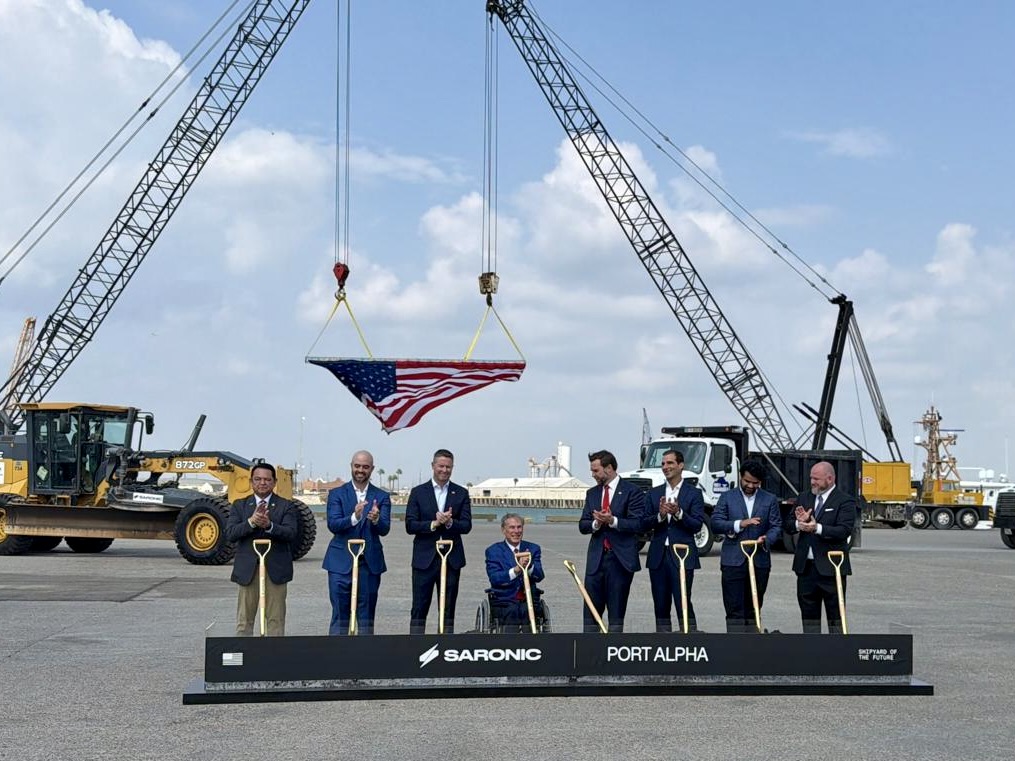
Construction began on the $3.2 billion defense contractor shipyard at the Port of Brownsville on Wednesday with some notable guests at the private event on the port docks under the brutal South Texas sun.
It was so hot that a portable air-conditioned tent short-circuited temporarily during the event and had to be restarted with generators in tow.
Sitting vice president JD Vance mingled with Saronic Technologies CEO Dino Mavrookas before touting the company’s efforts to arm the American warfighter with autonomous drone vessels and its contract with the U.S. Navy. Texas Gov. Greg Abbott joined Port of Brownsville chairman Sergio Lopez and dozens of business leaders across South Texas.
“To rebuild our Navy, to rebuild our commercial fleet. It was a call to action, and Saronic is answering that call. So we are honored to have the vice president to speak to us about exactly that,” Mavrookas, the CEO of the Austin-based technology startup, said. “We are going to invest billions of dollars into this project, into this community. [But] this is bigger than one shipyard. What stands on this ground in five years — the supplier base, the workforce, the ships themselves — is what will determine whether America leads at sea for the next century.”
When the Saronic Technologies port operation is running at full speed in about a decade, it expects to have 10,000 employees in Brownsville. Known as Port Alpha, the operation is meant to help double nationwide commercial shipbuilding capacity. It will span 835 acres with the possibility of expanding to 4,000 acres.
The shipyard is expected to open in 2028 and is estimated to create $160 billion of economic impact in South Texas. Across Texas, the project is anticipated to generate $264 billion in economic benefit.

Port Alpha is expected to generate 150,000 gross tons of annual shipbuilding capacity, up to 2 million gross tons, with vessels up to 850 feet long, with a goal to expand that to 1,200 feet long. The first phase of production will need about 1.2 million square feet of production space across about 10 buildings with 2,500 deepwater docks and capacity to process 75,000 tons of steel a year.
The contractor in charge is JE Dunn | Alberici Joint Venture — the company Saronic used to build the $300 million shipyard it just opened in Louisiana. JE Dunn Construction is based in Kansas City, Missouri, while Alberici is headquartered in St. Louis, Missouri.
Saronic Technologies has already posted at least 18 different types of jobs for the Port of Brownsville operation, including a shipyard contractor and trade partner, a shipyard optimization manager, a production engineering manager, a shipyard build strategy engineer, an accuracy control engineer, a shipyard industrial engineer, shipyard facilities operations, welding engineers, site quality managers and more.
“Texas is the new leader in American shipbuilding,” Gov. Greg Abbott said in a news release. “These ships will be built in Brownsville by American workers for the defense of the United States.”

Vance, however, emphasized during his speech at the Port of Brownsville that it wouldn’t just be American workers, but U.S. citizens at the helm of the shipbuilding effort. Sometimes, in government contracts, there are requirements, such as security clearances, that require workers to be U.S. citizens.
Job postings for Saronic Technologies roles include a notation that describes “if this role is based in the United States, it requires access to export-controlled information or items that require U.S. Person status.”
The company described U.S. Person status as the following: a U.S. citizen, legal permanent residents, otherwise known as green card holders, and certain protected classes of asylees and refugees as defined by the U.S. government.

Saronic is an international business and is also hiring a director of international growth in Australia right now, according to its website.
“What this facility represents to me is the American Dream renewed,” Vance told the crowd. “An American Dream built by American workers, created by American companies and ensuring that the next generation of America’s future is in our hands and our fellow citizens. For too long in this country we allowed the American Dream to be outsourced. We allowed our troops to go to war with tools that were not built by our own people. How can we send the next generation of Americans to go and do the most difficult job in the world if the tools are not even made by their fellow citizens?”

Kristen Mosbrucker-Garza
Reporter
Kristen Mosbrucker-Garza is a versatile multimedia news reporter who lives and works along the Texas-Mexico border in Hidalgo County. Mosbrucker-Garza is a news reporter for the Rio Grande Valley Business Journal. During her career she's worked for the McAllen Monitor, San Antonio Business Journal, The Advocate Newspaper in Louisiana, Phoenix New Times, and public media outlets in Baltimore and Philadelphia.
Most Read
- Edinburg ISD rejects nearly $6M offer for prime land near La Sienna despite $15M budget deficit
- Port of Brownsville approves $2M SpaceX pipeline deal, with millions more on the table
- What Toyota’s $3.6B San Antonio expansion could mean for the Rio Grande Valley
- McAllen’s nonstop Mexico City flight is back
- 5×5 Brewing plots $2.5M comeback with new Edinburg brewpub near UTRGV
Get the latest business news delivered to your inbox every morning for free.
Try 30 Days Free!
Get full access to award-winning journalism covering business, real estate, health care, economic trends, and the people shaping the Rio Grande Valley.
30 Days Free!
$9.95/month
Limited time offer
Subscription renews after your 30 day free trial at $9.95/mo.
Included Benefits
- Unlimited access to all articles
- Daily business news and analysis
- Subscriber-only content and features
Stories That Matter
- SpaceX makes history with first Starship catch at Starbase
- Port of Brownsville details SpaceX agreements worth more than $125M in potential revenue
- Mission’s first Small Business Expo puts $25K on the line for local entrepreneurs
- McCoy’s gives $10K, tools to launch Mid-Valley construction academy
- UT Health RGV performs new digestive procedure for first time in the Valley
- TSTC bets on advanced manufacturing to meet RGV’s industrial boom
- Pharr’s cross-border business push earns international recognition
- Brownsville eases drought restrictions after nearly three years as Rio Grande reservoir levels improve
- Texas A&M’s $53.5M McAllen research center will tackle water, food security and Valley health
- STC puts AI to work across 55 courses — from construction sites to car repair