EDINBURG — U.S. Agriculture Secretary Brooke Rollins and Gov. Greg Abbott said during a visit to the Rio Grande Valley on Monday that Texas and the U.S. have done everything possible to protect the nation’s multi-billion dollar cattle industry against the threat posed by the New World Screwworm.
Screwworms, or flies that lay eggs in open wounds that hatch into flesh-eating maggots, were eradicated from the U.S. in the 1980s, but the pests have gradually been creeping northward through Central America and Mexico for the past few years — a trend Rollins attributed to human migration on Monday.
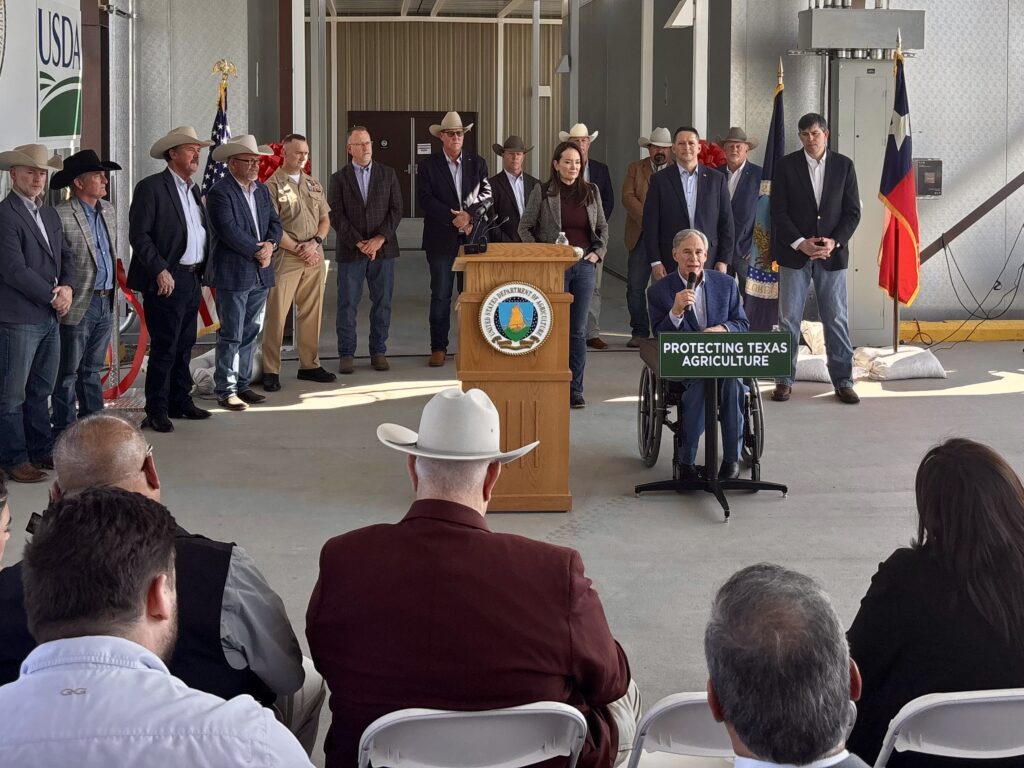
Photo Credit | Matt Wilson
Last week, the U.S. Department of Agriculture confirmed a screwworm infestation in an imported horse in Florida, and infestations have been detected in Mexico within 70 miles of the U.S. border.
Rollins called Texas “ground zero” in America’s war against the pest — a war, she said, America is prepared to fight.
“So we have tools available today that we didn’t have in the 50s and the 60s and the 70s that I sincerely believe — if it does cross our border — we are ready,” Rollins said. “We know the enemy. We know how to manage it. We know how to solve for it. And we will do everything we can to protect our country.”
Some of those new tools, Rollins said, are cameras deployed in South Texas’ wilderness that can detect screwworm flies using artificial intelligence.
Others are more traditional, like fly traps.
Since June, more than 42,000 flies have been trapped and tested in Texas, Rollins said. None of them were screwworm flies.

Photo Credit | Matt Wilson
The country’s main weapon in combatting screwworms will be the same one that allowed it to eradicate screwworms 40 years ago: sterile flies.
Female screwworms mate only once, so by breeding and releasing millions of sterile flies, the government can interrupt their lifecycle and collapse their population.
On Monday, Rollins and Abbott celebrated the opening of a sterile fly dispersal facility at Moore Air Field. The facility, near Mission, will allow the U.S. to release millions of sterile flies per week in South Texas and northern Mexico.
“This facility will be a critical part of our overall efforts to combat the new world screwworm,” Rollins said.
Abbott described the facility as a stopgap effort that’s part of a long-term solution.
That long-term solution is a $750 million sterile fly production facility at Moore Air Base that Rollins says should break ground in a month or two and be operational by the end of 2027.
Currently the only sterile fly production facility is in Panama.
Abbott said the threat screwworms pose to Texas and the United States’ economy justify a significant response.

Photo Credit | Matt Wilson
“We’re doing this because of what we know it means to the beef industry here in the state of Texas,” he said.
The impact screwworms could have on the cattle industry, Abbott said, could reverberate through the restaurant and grocery industry, and ultimately hit the wallet of anybody who buys food to put on their table.
There may not be any wild screwworm flies in the U.S., but the new dispersal facility means South Texas will soon be teeming with lab-grown sterile screwworm flies.
Last week, USDA reallocated aircraft and sterile flies to deploy them in a new dispersal area that plunges 50 miles into Texas.
On Monday, Moore Field staff demonstrated part of that process while attendees snacked on a sheetcake emblazoned with a picture of a screwworm fly.
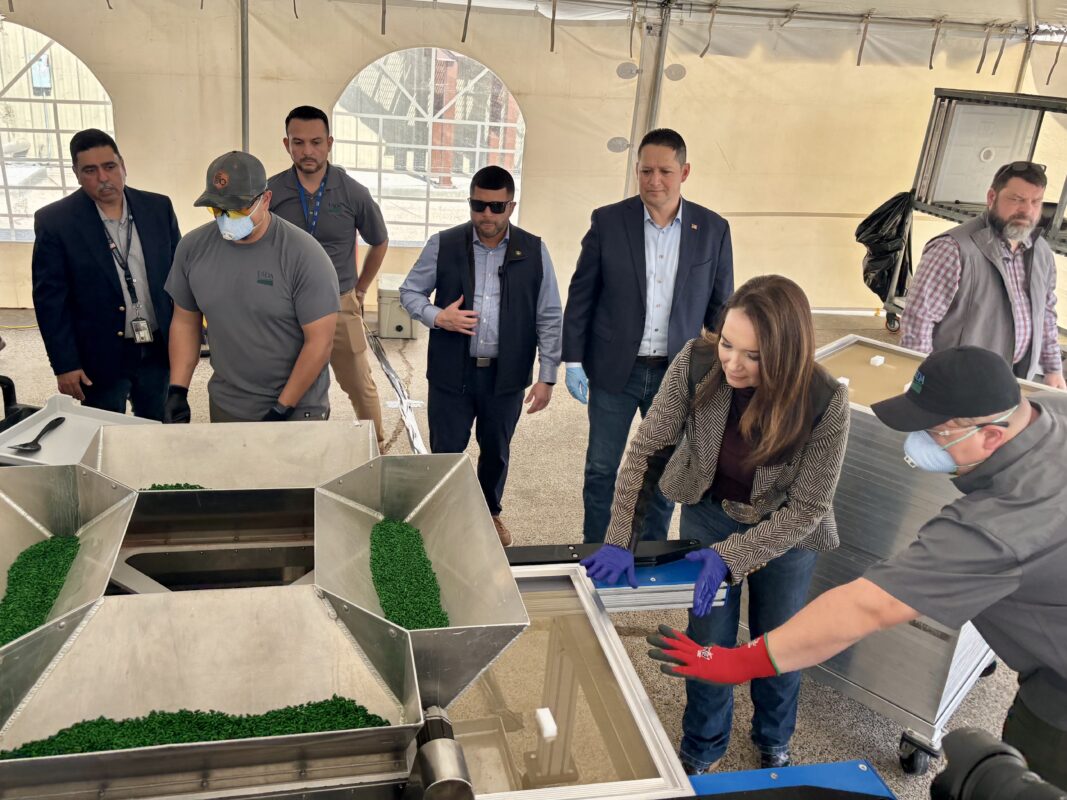
The facility receives screwworm pupa — hard little pellets — from the Panama facility.
Those pupae are placed in a hopper with a fluorescent green dye that sticks to the bugs after they hatch. Once they hatch, the dye glows under UV light, letting animal health officials differentiate them from wild flies.
Those pupae are loaded into trays with sugar water and agar food for the flies, which hatch within days and can then be dropped via airplane.
Rear Admiral Michael Schmoyer, Associate Administrator for USDA’s Animal and Plant Health Inspection Service and New World Screwworm Directorate Director, described that dispersal effort as something of a protective shield.
“This is us being preemptive,” he said.

Matt Wilson
Reporter
Matt Wilson is a Hidalgo County–based freelance reporter and contributor to the Rio Grande Valley Business Journal. He previously covered education and general assignment for The Monitor, frequently writing about the dramatic ways business changed during the coronavirus pandemic. Before that he worked as a reporter in rural Central Texas where he covered everything from house fires to school board meetings.
Most Read
- SpaceX’s futuristic city of Starbase finalizes massive 7,100-acre annexation. Here’s what we know.
- 25 Mexican businesses eye McAllen expansion after city pitches U.S. market entry program
- Australian company plans to build a $607M lithium refinery at the Port of Brownsville. It’s a big bet on America’s battery future
- Starbase cancels meeting to consider annexing 444 acres relinquished by Brownsville
- SpaceX reschedules Starship’s first flight around the Earth
Get the latest business news delivered to your inbox every morning for free.
Try 30 Days Free!
Get full access to award-winning journalism covering business, real estate, health care, economic trends, and the people shaping the Rio Grande Valley.
30 Days Free!
$9.95/month
Limited time offer
Subscription renews after your 30 day free trial at $9.95/mo.
Included Benefits
- Unlimited access to all articles
- Daily business news and analysis
- Subscriber-only content and features
Stories That Matter
- Dickey’s Barbecue Pit to open new McAllen location inside Cambria Hotel
- NADBank opens $300M financing pipeline for water, energy projects along the border
- Is SpaceX quietly building a data center at Starbase? Job postings offer clues
- Engineering firm Garver opens $5M Harlingen office, plans up to 50 new jobs
- Mission’s first Small Business Expo puts $25K on the line for local entrepreneurs
- McCoy’s gives $10K, tools to launch Mid-Valley construction academy
- UT Health RGV performs new digestive procedure for first time in the Valley
- TSTC bets on advanced manufacturing to meet RGV’s industrial boom
- Pharr’s cross-border business push earns international recognition
- Brownsville eases drought restrictions after nearly three years as Rio Grande reservoir levels improve