About a decade ago, the University of Texas-Pan American and the University of Texas at Brownsville dissolved to create the University of Texas Rio Grande Valley.
At the time, the university reviewed all departments and programs and considered ways to integrate them.
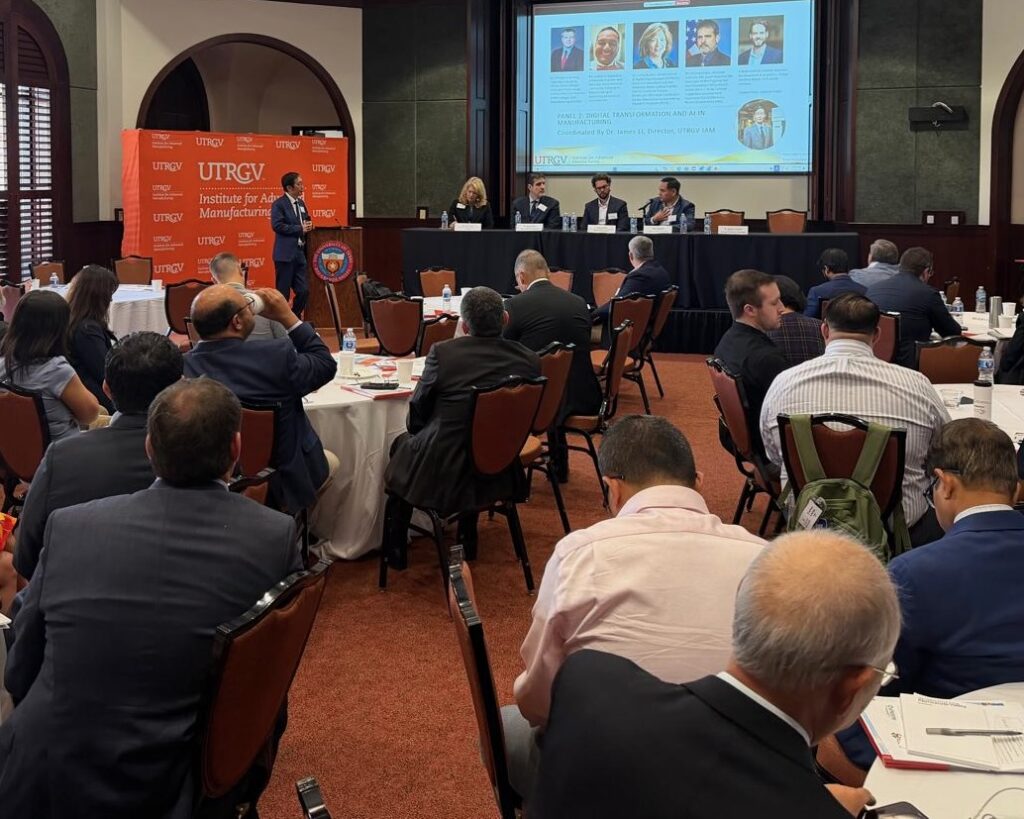
Photo Credit | Kristen Mosbrucker-Garza
Back then, a degree in engineering with a concentration in manufacturing was less popular, and at one point, there was discussion about potentially shuttering the manufacturing engineering program, which was one of only a few left nationwide, said Jianzhi “James” Li, professor at UTRGV and inaugural director of the UTRGV Institute for Advanced Manufacturing.
But after meeting fellow researchers in the field, he saw the need for a consortium and applied for grants, especially to improve the workforce pipeline.
And the key question was, “How do we bring the leadership in manufacturing back to the United States?” said Li, who is now a founding board member of the South Texas Advanced Manufacturing Partnership, too.
Instead of scaling back, officials decided to double down on the program, integrating advanced manufacturing research and training into the curriculum and building nationwide partnerships with research laboratories to help move the industry forward. For more technical and vocational training, UTRGV also operates a manufacturing tooling academy, the Texas Manufacturing Assistance Center.
The university spent $3 million on upgrades to its manufacturing research facility in Edinburg and is focused on research, development, and innovation — including a partnership with the U.S. Department of Energy’s Fusion Energy Sciences program at Oak Ridge National Laboratory in Tennessee.
The UTRGV center is also partnered with America’s Additive Foundry, a program aimed at securing the U.S. supply of metal alloys used in the defense industry.

Photo Credit | Kristen Mosbrucker-Garza
It’s also a partner of America Makes, an Ohio-based public-private partnership focused on additive manufacturing technology and education.
This week, dozens of researchers visited UTRGV’s Brownsville campus for a symposium on autonomous manufacturing, future mobility, energy, and abundance. The conference also included a tour of the Port of Brownsville and SpaceX.
The program now has a pipeline of students and industry support, while the Rio Grande Valley is expected to add thousands of manufacturing jobs in the coming years, from SpaceX in Brownsville to potentially an autonomous ocean vessel shipyard by Saronic or a software-driven auto parts maker, Valeo, in McAllen.
“We see the flood [of jobs] coming this way. So this is a perfect time for this region, and I think we all have a very critical role to play in this because none of us can do this ourselves. We really have to put this whole pipeline all together,” said Can “John” Saygin, senior vice president for research and dean of the graduate college at the University of Texas Rio Grande Valley.

Photo Credit | Kristen Mosbrucker-Garza
SpaceX was recently approved by federal regulators to launch up to 25 rockets each year.
“That’s a lot of rockets. That’s a lot of sheet metal,” Saygin said, adding that somebody will have to produce all of those pieces along the supply chain, especially for any hardened parts meant to be reused after being exposed to harsh conditions.
As for what type of industry could come to the Port of Brownsville next and benefit from advanced manufacturing research techniques, it might be the extraction of rare earth minerals from a new mine by USA Rare Earth near El Paso, expected to begin commercial production in 2028.
For example, in the commercial extraction of alumina, which is not a rare earth but is the building block of aluminum, bauxite ore is extracted from mines and smelted at high temperatures with caustic soda to produce the alumina powder.
Rare earth elements are processed through grinding or chemical leaching to extract the products used in the production of lithium-based batteries, as another example. There are 17 different types of rare earth elements at the mine near El Paso.

Kristen Mosbrucker-Garza
Reporter
Kristen Mosbrucker-Garza is a versatile multimedia news reporter who lives and works along the Texas-Mexico border in Hidalgo County. Mosbrucker-Garza is a news reporter for the Rio Grande Valley Business Journal. During her career she's worked for the McAllen Monitor, San Antonio Business Journal, The Advocate Newspaper in Louisiana, Phoenix New Times, and public media outlets in Baltimore and Philadelphia.
Most Read
- How much water does SpaceX need to operate near Brownsville? Nearly 20x its current use
- Could apartment-to-condo conversion help make $100K homeownership in the McAllen metro more affordable? One investor says yes.
- SpaceX’s futuristic city of Starbase finalizes massive 7,100-acre annexation. Here’s what we know.
- Cameron County is negotiating a $20M Fluidstack data center donation after Harlingen waffles on the same offer
- Fluidstack breaks ground on $4 billion Cameron County AI data center
Get the latest business news delivered to your inbox every morning for free.
Try 30 Days Free!
Get full access to award-winning journalism covering business, real estate, health care, economic trends, and the people shaping the Rio Grande Valley.
30 Days Free!
$9.95/month
Limited time offer
Subscription renews after your 30 day free trial at $9.95/mo.
Included Benefits
- Unlimited access to all articles
- Daily business news and analysis
- Subscriber-only content and features
Stories That Matter
- What we know about Zoho Corporation and what could be built at its 1,000-acre campus
- SpaceX bought some water rights from the Rio Grande River. Here’s what we know.
- Foreign-Trade Zone No. 12 expands into Willacy County
- Mission’s first Small Business Expo puts $25K on the line for local entrepreneurs
- Reynosa’s newest technical high school focuses on AI, semiconductors and bionics
- McCoy’s gives $10K, tools to launch Mid-Valley construction academy
- UT Health RGV performs new digestive procedure for first time in the Valley
- TSTC bets on advanced manufacturing to meet RGV’s industrial boom
- Pharr’s cross-border business push earns international recognition
- Brownsville eases drought restrictions after nearly three years as Rio Grande reservoir levels improve