The Rio Grande Valley hit 1.4 million residents, adding 8,753 residents between 2024 and 2025, according to recent U.S. Census estimates released this month.
Natural change in the population, more babies being born than individuals dying, accounted for the growth. More than 21,300 babies were born across the four-county region of Hidalgo, Cameron, Starr, and Willacy in 2025, according to U.S. Census data.
International migration slowed significantly over the past year, from 8,600 residents moving to the Valley to fewer than 400 in 2025. Typically, international immigration to the Valley outpaces domestic migration, aka individuals leaving the border counties, but the Valley lost 3,870 residents last year.
“One of the things we have seen with this new set of estimates is essentially about half the year was during the current administration, and the immigration enforcement that has come into play has resulted in very significant declines in international migration,” said Lloyd B. Potter, director of the Institute for Demographic and Socioeconomic Research and professor emeritus at the University of Texas at San Antonio.
There was a similar trend during the beginning of the COVID-19 pandemic when a global slowdown halted most international travel, but the last time there was a decline in international migration was during the Great Recession of 2008.
“International migration slowed some, but nothing like we’re seeing here with the current administration’s efforts to curb unauthorized immigration,” Potter said.
Migration data along the U.S.-Mexico border communities can be more complicated, since new arrivals who were previously residing in another nation are considered international migrants, but after one year, transition to domestic migrants, the way the data is collected.
“Let’s say you land in Hidalgo County [as an international immigrant], but then you move to Bexar County, you’re now a domestic migrant,” Potter previously told the Rio Grande Valley Business Journal.
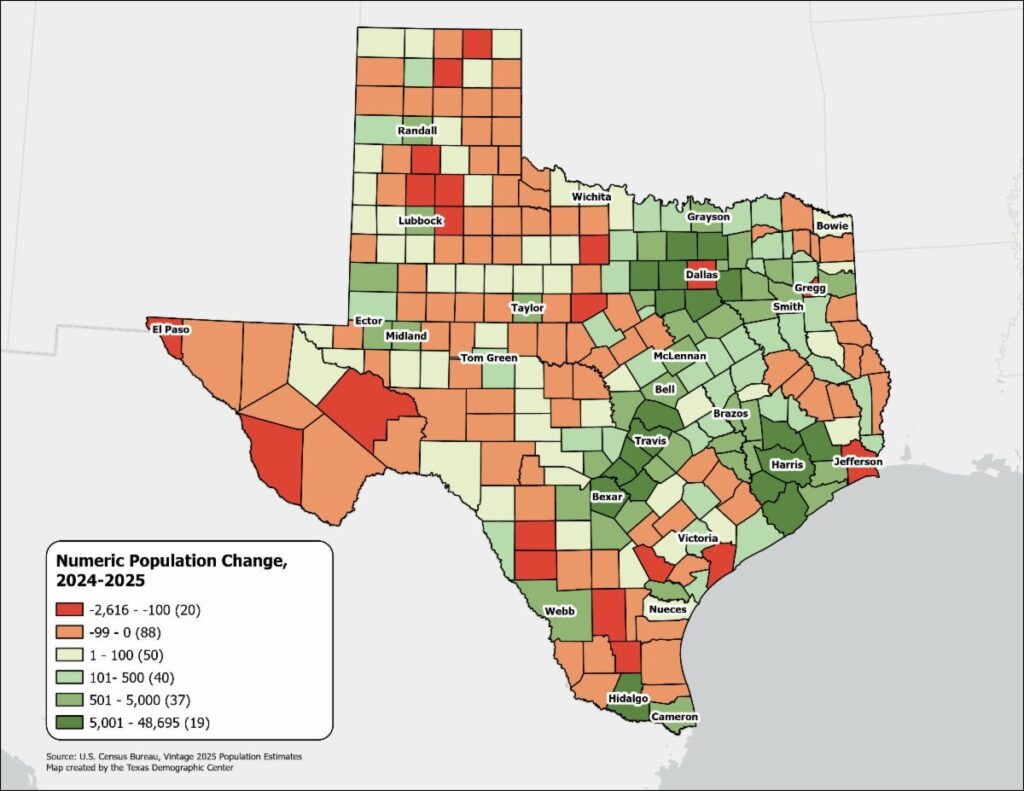
The Valley’s ‘baby boom’ may be on the decline as nationally Latinas are having fewer children on average, but the area is still growing faster than other communities, Potter mentioned.
Other counties along the Texas-Mexico border are also showing a decline in international migration, especially as President Donald Trump’s administration focused on immigration policies meant to curb the flow of unauthorized migration.
Every state across the nation saw a decline in net international migration, U.S. Census data shows. In 2024, Texas added more than 354,800 residents who were previously living abroad. By 2025, the state added 157,475 residents through international migration. That’s a nearly 53% decline in net international migration to Texas in just one year.
Webb County, where Laredo sits, grew to 281,224 residents in 2025, adding just a few hundred people overall, or less than 1% growth. The county added 260 international residents in 2025, compared to 8,592 in 2024. It lost thousands of domestic residents for a net migration of 1,990 loss in population.
El Paso is estimated to have lost population over the past year, with 877,858 residents – down from 879,894 in 2024. Its international migration dropped from 7,898 residents in 2024 to 356 in 2025. Net migration meant El Paso lost 6,226 residents in the past year, compared to adding 2,500 residents in 2024.
In the past year, Texas also changed its licensing and regulation policies, disallowing anyone without a Social Security number from obtaining any professional licenses. Any commercial driver’s licenses, such as those used in the trucking industry, will expire for non-citizens without legal status, Deferred Action for Childhood Arrivals (DACA) holders, and refugees, and cannot be renewed. Texas also now requires proof of legal residence when registering a vehicle. It’s unclear how these policies may affect incoming international residents seeking to live in Texas.

Kristen Mosbrucker-Garza
Reporter
Kristen Mosbrucker-Garza is a versatile multimedia news reporter who lives and works along the Texas-Mexico border in Hidalgo County. Mosbrucker-Garza is a news reporter for the Rio Grande Valley Business Journal. During her career she's worked for the McAllen Monitor, San Antonio Business Journal, The Advocate Newspaper in Louisiana, Phoenix New Times, and public media outlets in Baltimore and Philadelphia.
Most Read
- How much water does SpaceX need to operate near Brownsville? Nearly 20x its current use
- Could apartment-to-condo conversion help make $100K homeownership in the McAllen metro more affordable? One investor says yes.
- SpaceX’s futuristic city of Starbase finalizes massive 7,100-acre annexation. Here’s what we know.
- Cameron County is negotiating a $20M Fluidstack data center donation after Harlingen waffles on the same offer
- Fluidstack breaks ground on $4 billion Cameron County AI data center
Get the latest business news delivered to your inbox every morning for free.
Try 30 Days Free!
Get full access to award-winning journalism covering business, real estate, health care, economic trends, and the people shaping the Rio Grande Valley.
30 Days Free!
$9.95/month
Limited time offer
Subscription renews after your 30 day free trial at $9.95/mo.
Included Benefits
- Unlimited access to all articles
- Daily business news and analysis
- Subscriber-only content and features
Stories That Matter
- What we know about Zoho Corporation and what could be built at its 1,000-acre campus
- SpaceX bought some water rights from the Rio Grande River. Here’s what we know.
- Foreign-Trade Zone No. 12 expands into Willacy County
- Mission’s first Small Business Expo puts $25K on the line for local entrepreneurs
- Reynosa’s newest technical high school focuses on AI, semiconductors and bionics
- McCoy’s gives $10K, tools to launch Mid-Valley construction academy
- UT Health RGV performs new digestive procedure for first time in the Valley
- TSTC bets on advanced manufacturing to meet RGV’s industrial boom
- Pharr’s cross-border business push earns international recognition
- Brownsville eases drought restrictions after nearly three years as Rio Grande reservoir levels improve