First Brands Group’s bankruptcy is still rippling across the border — triggering layoffs, severance disputes, and exposing how differently labor laws work in Mexico and the U.S.
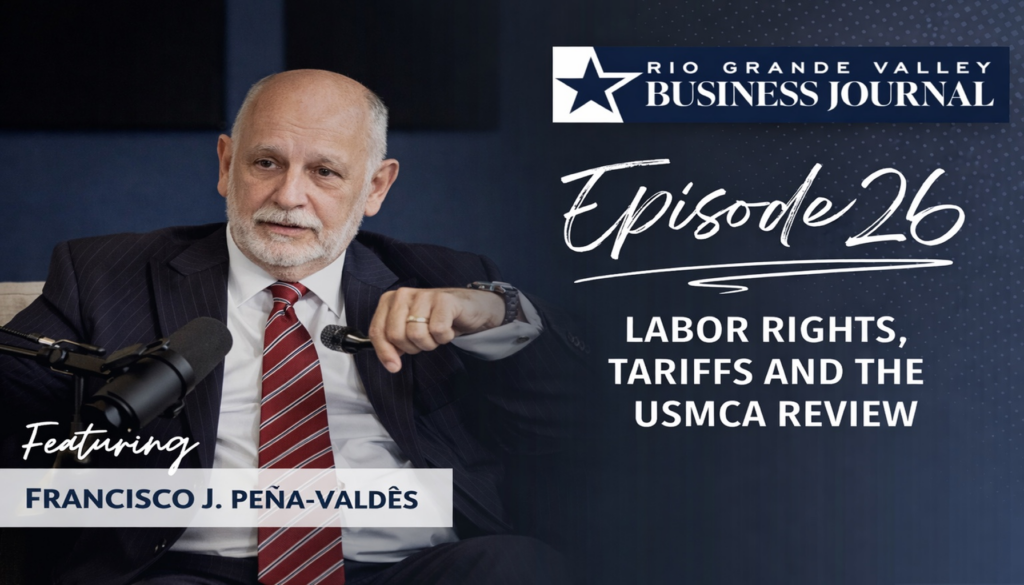
In this episode of the Rio Grande Valley Business Journal Podcast, Managing Editor Naxiely Lopez-Puente sits down with attorney Francisco J. Peña-Valdés, a partner at Cacheaux, Cavazos & Newton, to break down what happens next for workers, companies, and creditors caught in the fallout.
Peña explains why laid-off workers in Mexico are still fighting for severance, what protections they’re legally entitled to, and why those cases can take years to resolve — especially when assets, unions, and parent companies in the U.S. are involved.
The conversation also explores how tariffs and supply chain disruptions contributed to the collapse, how cross-border business structures complicate bankruptcy, and what companies must understand when operating in two legal systems.
It also looks ahead to the USMCA review, where trade policy is shifting again — and what that could mean for manufacturers, investors, and the Rio Grande Valley’s role in the North American supply chain.
The following is a rough, AI-generated transcript of the Journal’s Naxiely Lopez-Puente’s interview with attorney Francisco J. Peña-Valdés. There may be slight errors in the transcription and possible misspellings of proper names. For the full, unabridged conversation, listen to the episode above or through your preferred podcast platform.
FRANCISCO PEÑA: If you lay off an employee in Mexico, there are specific rules you need to follow. The laws in Mexico are pro-employee. There is no employment at will. That concept is foreign to Mexico.
If I hire you today, and in one hour I need to fire you, I’m obligated to pay you at least 90 days.
NAXI LOPEZ-PUENTE: Really?
FRANCISCO PEÑA: Yes. Because the law says every employee that gets terminated without proper cause is entitled to that. It doesn’t say if you worked one hour, one day, three years, or 25 years. It says an employee.
And if you are an employee of one hour and I decide to terminate you right there, then you are entitled to receive 90 days of salary. Then there’s another concept — if you have seniority, let’s say 10 years, it’s 20 days per year worked. So people in Mexico, when they get terminated, some of them get a lot of money.
Now, all proportions safeguarded, because at the end of the day you earn dollars, they earn pesos. But even with that in mind, some of them will get very well compensated.
NAXI LOPEZ-PUENTE: Thank you for joining us on this episode of the RGV Business Journal podcast. I’m Naxi Lopez-Puente, and with us today we have Francisco Peña. He is an attorney with Cacheaux, Cavazos & Newton, which is a firm that specializes in foreign investment between Mexico and the U.S., with 11 different offices across both countries. So, Mr. Peña, thank you so much for being with us today.
FRANCISCO PEÑA: Thank you very much for the invitation to be here.
NAXI LOPEZ-PUENTE: Of course. So this is a very busy time between all three countries — Canada, Mexico, and the U.S. We are under review for the USMCA. Before we get into that, tell us a little bit about yourself — who you are, what you do, and what your company does.
FRANCISCO PEÑA: Well, aside from being a husband and a dad, I’m an attorney from Mexico. I graduated from Tec de Monterrey in 1994. I’ve been working at the firm since 2000. I became a partner in 2009.
I have a niche practice. I do a little labor, environmental, and contractual work for businesses in Mexico — Reynosa, Matamoros, Monterrey. But we also represent Mexican nationals who want to do business or open businesses on this side of the border.
What we do is help them understand how to invest, who to work with, and which people can provide the services they need. Lately, we’ve also been doing a lot of international probate proceedings, because there are many Mexican nationals who pass away in Mexico but have businesses or assets in the United States. So we help their families go through the legal proceedings in Texas to recover those assets.
We’ve also been opening a lot of LLCs here in the Valley, but also in San Antonio, Houston, and Dallas, because there are a lot of opportunities in Texas for Mexican investors to come to the U.S. and sell their products, acquire assets, acquire products so they can resell them, or manufacture them in Mexico.
We also do what I specifically call international business — setting up companies in Mexico or in Texas. We’re in a unique position because of how business is conducted in Mexico and in the U.S. Even though business is business, there are specific differences that need to be addressed. But there are also similarities, and through those similarities is how you connect either with a U.S. investor in Mexico or with a Mexican investor in the U.S. Then you start walking them through the differences and paving the path so they can have fewer hiccups.
NAXI LOPEZ-PUENTE: Right.
FRANCISCO PEÑA: So in a nutshell, that’s what we do in the firm. We do a lot of intellectual property. We do a lot of brand registration in Texas. We have a specific practice in Mexico about intellectual property, so we also specialize in that. We do a lot of civil matters, mercantile matters, labor, environmental, tax, and customs matters in Mexico.
NAXI LOPEZ-PUENTE: So what I’m hearing is you basically hold their hand and say, hey, these are the things that you need to focus on if you are coming to the U.S., if you’re planning to have a business here, if you want to invest. Because depending on where you grow up and where you get your education, you learn the laws of that land. But when it comes to pivoting and building a business in another country, there’s a huge difference.
FRANCISCO PEÑA: Correct. And one of the things that goes along with it is understanding that in my firm we have both Mexican attorneys and U.S. attorneys, and we work together.
One of my partners here in the office in McAllen, Marisa Sandoval Rodriguez, says it’s very helpful to have a Mexican attorney here in the office, because instead of looking for someone or calling someone, she can just walk into my office, ask me a question, and I can explain it from the Mexican standpoint. The same goes for me when I have a question regarding U.S. law. I go to her and ask.
So within the law firm we have specialized people who can help the client jump those hoops that, at the end of the day, may end up hurting them if they don’t have the correct advice.
One thing that is important, especially when you try to invest in the United States, is this: if you go to any law firm here that has no knowledge of international matters, they may set up, let’s say, an LLC the correct way. And that LLC may work perfectly here. But you may end up losing certain advantages tied to your origin, which in this case is Mexico.
So you need to set up your company in a way that preserves those advantages and allows you to take advantage of whatever the law in the U.S. or Mexico gives you as an investor.
NAXI LOPEZ-PUENTE: And that’s a really interesting point, because we were talking earlier about how you guys specialize in USMCA. Right now, the point of origin — where a product is coming from — is very important, because these tariffs are kind of wreaking havoc on some of that and moving the supply chain a little bit.
FRANCISCO PEÑA: I would say a lot. A lot.
NAXI LOPEZ-PUENTE: Okay.
FRANCISCO PEÑA: There are a lot of companies suffering precisely because of the tariffs. Let me use the U.S. hat for a second.
NAXI LOPEZ-PUENTE: Okay.
FRANCISCO PEÑA: I somehow can see the “why” behind the imposition of tariffs on products, because for many years it became a habit not to do things the right way — jumping through loopholes, going around rules, using Senate closures and things like that, and taking advantage of loopholes. So I can see why some companies may be hurting because of those loopholes.
Charging tariffs with the intention of closing loopholes is not always working in the best interests of some of the other companies. The disruption to the supply chain suffered a lot and is still suffering.
The recent U.S. Supreme Court resolution that said IEEPA is not the right way to collect tariffs on companies — I just wrote an article that says, in reality, it did not take away anything from the president. And the reason is, there are other ways.
NAXI LOPEZ-PUENTE: Other ways too, like those tariffs — 232, 301, 308 — which we saw exactly today.
FRANCISCO PEÑA: Yes, the very next day he imposed them through a new mechanism. So in reality, what the Supreme Court did was just show a new path on how those tariffs can be charged.
There are some very aggressive mechanisms, especially Section 301. It has been used against China because of the type of competition they’re doing. So it is important to understand what other tools the federal administration has in order to keep collecting those tariffs.
Don’t get me wrong — a lot of money came in through that period of tariffs. A lot of money.
NAXI LOPEZ-PUENTE: But isn’t that supposed to be returned back to the companies?
FRANCISCO PEÑA: Well, let me use the word “supposedly” in the right context.
If you paid those tariffs and, at the end of the day, just transferred that cost to the final consumer, who is really going to be benefiting from a refund — you or the final consumer? How is the final consumer going to recoup the money they paid?
NAXI LOPEZ-PUENTE: Through higher prices.
FRANCISCO PEÑA: Correct. So you, the company, are going to recoup that money. Then you and I have the moral obligation to repay your customers. How is that going to work?
I have clients I’ve talked to about this. As a matter of fact, last week I asked a CEO, “Are we recouping the tariffs?” He said, “No, we’re not.”
I asked why not. He said, “It’s a big hassle. If I do that, how am I going to look for all the people my product got sold to and return their money to them?”
So that’s the dilemma right there. And this is not coming from me — it’s coming from a CEO explaining why they’re not choosing to do it. So some companies are going to do it, and some are not.
NAXI LOPEZ-PUENTE: Because if I’m understanding it correctly, you have to apply for that money back. There’s a process. It’s not just like, oops, here you go.
FRANCISCO PEÑA: Exactly. It’s not like, “Could you please do this? This is my savings account, please.”
NAXI LOPEZ-PUENTE: That’s not how it works. So the companies would have to apply, and you’re hearing that some of them may not be applying for that refund.
FRANCISCO PEÑA: I won’t say a lot, but there are some that decided not to apply for a refund.
The disruption that occurred through those tariffs — some companies, at that point, got bankrupt. We have First Brands. The companies that got hit with these tariffs, their supply chain came mostly from China and Asia. And when those tariffs started hitting, this company was not able to recover from them.
That company has, or had, over 30 companies in Mexico, and they did automotive supply. In some cases they were first-tier suppliers, second-tier suppliers, even third-tier suppliers to the big automotive industry.
When the supply chains got disrupted because of the imposition of tariffs, or because they were no longer able to import those assets in order to put them into the final product, then your source of income disappears. You’re not able to sell to GM or any other company, because either your prices got jacked up or you were no longer able to provide the pieces or parts needed to complete the car.
NAXI LOPEZ-PUENTE: But to be fair, there are allegations of fraud involving that company. It’s not just the supply chain issue and the tariffs. There is a legal case. Two brothers and a third person were charged in that.
FRANCISCO PEÑA: Let me put it this way. When things go the right way, nobody notices anything, because everything is earnings and winnings and Happy Meals. But when things start going south, people tend to get creative. And that creativity can become borderline illegal. That’s what the courts need to decide.
An accusation of fraud is one thing. That’s fine. But you have to investigate. And once you investigate and you get a sentence, then we can say, oh yeah, there was fraud. Right now, remember, you’re presumed innocent until proven guilty.
NAXI LOPEZ-PUENTE: Right, there’s an allegation. But that is not stopping the impact that this company is having when we’re talking about First Brands Group. That was the parent company for a lot of other companies in Matamoros, in Reynosa —
FRANCISCO PEÑA: In Juárez.
NAXI LOPEZ-PUENTE: In Juárez, and in Brownsville, and in Harlingen. And we have seen mass layoffs here just in our area in the past three months. By our count, almost 5,000 employees across the region, simply here. And that’s not including all the interior maquilas and the other locations. So we’re seeing the real impact of this bankruptcy — thousands of employees.
FRANCISCO PEÑA: And you have to take into consideration that unfortunately, when you enter bankruptcy, funds get held back. They’re not fluently being sent to Mexico.
We also have to remember that the companies in bankruptcy are U.S. companies. The companies that are in bankruptcy are the U.S. entities, and the ones being affected directly are the U.S. entities. Now the question becomes: if you have over 30 companies in Mexico that need to be served with money and whatnot, how are you going to send money over there for the employees to keep working? Nobody works for free.
So basically, it’s not that the Mexican entities themselves are bankrupt. It’s that 90 to 95% of the companies in this group receive their funding from the U.S. because of the type of industry they’re in. It’s a maquiladora, an import-export company in Mexico.
The way it works is you have your parent company in the U.S. The parent company is literally the parent — the father or the mother — and the companies in Mexico are the kids. They’re in college. And when they’re in college, they need funds to drive their cars, pay laundry, all of that. But now mom or dad are not able to send money.
So what is going to happen to my kids in Mexico? They’re going to drop out of school, or instead of going to the more expensive school, they’re going to look for a cheaper one. That’s what’s happening. Again, when things go south, you tend to get creative.
There are some companies already suffering, like the one in Matamoros. But other companies are still afloat because they managed their finances differently. I’m not into the nitty-gritty of how all of that works, but I can tell you there are some companies being affected in a much more integrated way than others in Mexico.
You also have to take into consideration two things: the laws in Mexico are different from the laws in the U.S., and that’s another story.
NAXI LOPEZ-PUENTE: Oh gosh. Well, let’s get into that a little bit, because one of the things that really stood out to us here at the Journal was when we started hearing about these layoffs, both in the U.S. and in Mexico. First of all, the way employees are notified. In the U.S., with mass layoffs, you have WARN letters, right? Basically notices that go out not just to the employees, but I believe even to the city.
FRANCISCO PEÑA: Or, if you have a union, to the union.
NAXI LOPEZ-PUENTE: Right. In the U.S., you basically have to say these X number of workers are —
FRANCISCO PEÑA: Part of a reduction in force.
NAXI LOPEZ-PUENTE: A reduction in force.
FRANCISCO PEÑA: Correct. And if you have a union, you talk to the union and let them know how that’s going to be done. Usually it’s kind of like an inventory — except instead of first in, first out, in this case it’s last in, first out. The individuals with less seniority are the first to leave, because the people with more seniority are the ones with experience, the talent you’ve built over the years. You don’t want to get rid of them — not only because they’re more expensive, but because if you get rid of them, you get rid of the talent.
NAXI LOPEZ-PUENTE: Now, is that a personal choice for the companies, or do they have to actually stick by loyalty?
FRANCISCO PEÑA: Every collective bargaining agreement is different. In companies with unions, you usually have to negotiate with your union. If you don’t have a union, normally that’s what you do — you pick and choose which ones are staying and which ones are leaving.
Remember, it’s employment at will, especially in Texas. I can hire you today and fire you tomorrow. You can come to work with me today and quit tomorrow. There’s no penalty for you, and there’s no penalty for me as an employer, unless there are specific issues that need to be individually considered. We don’t want to get into discrimination — age discrimination, gender discrimination, and so on.
If you are getting rid of people 45 and up, and not getting rid of people below 41, that could be discrimination right there. Especially if you get rid of people 45 and up and start hiring people who are 20.
NAXI LOPEZ-PUENTE: Yeah, that’s not —
FRANCISCO PEÑA: That’s not good. On paper, in your mind as HR, it may look like, well, the people over 45 are more expensive than the ones in their 20s, so I’m not hiring because of age. I’m hiring because this labor is cheaper. But in Mexico, it’s completely different.
NAXI LOPEZ-PUENTE: Right. So let’s get back to layoffs. In the U.S., you get the WARN letter. In Mexico, when you’re going to lay off a bunch of people, what are the laws there? What does a company have to do?
FRANCISCO PEÑA: Let me talk about the region here, because depending on the region, some places have unions and some do not.
For example, in Juárez, maybe half the companies have unions and half do not. In Tijuana, maybe 45% have unions. The rest either do not have unions or don’t want them, or they have unions that are very manageable and agreeable with the employer.
But in the region here — border South Mexico — Reynosa, Rio Bravo, Matamoros, Monterrey, Nuevo Laredo — I would say all of them have unions.
NAXI LOPEZ-PUENTE: So everybody here is pretty much unionized when it comes to the region.
FRANCISCO PEÑA: In this region, yes.
NAXI LOPEZ-PUENTE: And why is that? Why are we so different?
FRANCISCO PEÑA: It’s a cultural thing. In a nutshell, the union movement began in the ’30s and ’40s, but in the ’70s it really gained traction. As a matter of fact, the Mexican labor law dates back to 1971.
That tells you something. Through the years, unions in Mexico gathered a lot of strength, force, and influence. There were unions that were helping put mayors in cities, senators, representatives at different levels. That’s how strong unions were in Mexico.
Today they still have some strength, but not as much as they did in the ’70s, ’80s, ’90s, and even the early 2000s. By the 2010s, the life of the union became more of a business. Unions began to act more like companies than actual unions, because they saw that by working with businesses, they could continue to attract more business. More business meant more membership, more union dues. And at the end of the day, a union is a business.
I’m protecting your salary, I’m protecting your benefits and whatnot, but at the end of the day, I’m getting a cut from your paycheck, usually 3% or 4% of whatever you’re receiving weekly.
That began to show that unions were being defeated. Seven years ago, the system changed in Mexico. We shifted from a more capitalist to a more socialist type of environment. What changed was the law. The power got shifted to the members.
We saw in Mexico a radical change where employers used to be the submissive party and the almighty general secretary of the union was almost like God. That perspective changed. Now the masses have more power, and in many cases they kicked out the old unions and instituted new ones — the unions they thought would be the right choice. Unfortunately, time has shown them that wasn’t always the right move.
So right now it’s a new shift. Things are moving around. What is happening in Matamoros is a lack of leadership on behalf of the company, because the company is not telling employees anything.
So what is going to happen if you lay off an employee in Mexico? There are specific rules, and you need to follow them.
NAXI LOPEZ-PUENTE: Right. So that severance payment is pretty much built into the law.
FRANCISCO PEÑA: Exactly. In Mexico we call it constitutional indemnification, because it’s in the Mexican Constitution, Article 123. It says if you terminate an employee, the employee gets A, B, and C.
NAXI LOPEZ-PUENTE: That’s in the Constitution?
FRANCISCO PEÑA: In the Constitution.
NAXI LOPEZ-PUENTE: Wow. I did not know that.
FRANCISCO PEÑA: Let me explain to you why employees in Mexico are king. Article 133 of the Mexican Constitution says, more or less, that the Constitution, the laws that come out of the Constitution, and the international treaties negotiated by the president and approved by the Mexican Senate are the supreme law of the nation.
So the Mexican federal labor law is a regulatory law that comes out of Article 123 of the Constitution. This is the highest law you can find in Mexico. It is above tax law, foreign law, commercial law, civil code — everything.
As a matter of fact, if the company owes taxes, the first person that gets paid is the employee. And if there’s anything left, then the government.
NAXI LOPEZ-PUENTE: Interesting, because I was going to ask about that. Obviously there are a lot of employees in Matamoros saying this company laid me off and owes me this much. Now when they’re either not paying it, or not even matching what they’re supposed to get, what recourse does the Mexican employee have? Even though they have all this power, right? The Constitution says you are owed. But in this type of case, where do they fall in line?
FRANCISCO PEÑA: First of all, your union has to do some work. What is that work? Well, first of all, you have a collective bargaining agreement that protects the employee. If the company shut down, what the union can do is file a labor lawsuit — a labor complaint.
By doing so, most likely, if I were thinking like a union, I would file and place an embargo on any asset that is owned by the company.
Here’s the trick: most of the machinery and equipment those companies have inside their plants do not belong to the Mexican entity.
NAXI LOPEZ-PUENTE: Oh God.
FRANCISCO PEÑA: They’re in consignment. The owner is the parent company — mom or dad — in the U.S.
At the end of the day, if the U.S. entity wants to fight that, they may be able to recover some of those assets. But most likely, there is a concept in Mexico that says because you, papa or mama, are the direct beneficiary of the work performed by these employees, then those assets, even though they belong to you and not to my employer, can also be used. You got the direct benefit of my labor through the manufacturing of assets or parts. Therefore, I can attach those. That’s a principle of labor law in Mexico.
So based on that, those assets can be attached by the Mexican authorities.
NAXI LOPEZ-PUENTE: And that’s kind of what we’re seeing, right? Because we heard these workers were gathering for weeks. I don’t know if they’re still out there, but they were literally setting up shop outside these facilities where they worked, so they could stop the company from coming in and removing those assets.
FRANCISCO PEÑA: Correct. That will be the only recourse the employer may have through the union. They have to get paid.
Now, there are two types of employees in Mexico: union employees and nonunion employees. The nonunion employees are what we call confidential employees because they have confidential information, they manage the company, direct the company, inspect the products, and have commanding power over union employees.
So that’s the hierarchy. You have directors, managers, and supervisors, and then you have the rest of the manufacturing employees. Usually those are represented by unions.
In this particular case, the union in Matamoros should be, I assume, by now already filing some sort of recourse to prevent the company from taking the assets employees may need in order to get paid.
NAXI LOPEZ-PUENTE: Now, do union employees and nonunion employees rank the same under the law?
FRANCISCO PEÑA: In the eyes of the law, yes. They do. However, in this particular case, the more numbers you have, the more strength you will have. So guess who has more numbers?
NAXI LOPEZ-PUENTE: The union.
FRANCISCO PEÑA: Correct. So in this particular case, you may have 300, 400, or 1,500 union employees versus 200 or 500 nonunion employees.
All these union employees are represented by the union. All these nonunion employees are represented by themselves, because they do not have a common representative unless they get together.
NAXI LOPEZ-PUENTE: Do they do a class action or something?
FRANCISCO PEÑA: Sort of like that, yes. If you want to put a U.S. name to that. In Mexico, we would call it a collective lawsuit.
Because they would come to me as an attorney — I don’t represent employees, right? — but if they came to me and said, how many are you? And they say, we’re 10, I’d say, look for more.
Then they may come back and say, well, I don’t like Francisco, maybe I like Ramón, or maybe I like Juan. So the confidential employees or nonunion employees may end up with different attorneys.
The problem is that then the attorneys will start fighting, because they know the assets there are not going to be enough to pay both the union employees and the nonunion employees. So who filed first matters.
NAXI LOPEZ-PUENTE: That matters?
FRANCISCO PEÑA: That matters, because the first thing that needs to be resolved is the first one that got filed.
NAXI LOPEZ-PUENTE: Really?
FRANCISCO PEÑA: Of course. First come, first served. If I filed first and you filed a week later, your lawsuit cannot be resolved before mine unless yours is very simple and there isn’t much evidence to resolve.
So if my lawsuit says, out of those five machines that are there, I want two of them, well now I’ve got two machines and you have five employees for three machines. The numbers are not going to add up.
Usually what happens — and I’ve seen this happen many times, this is not new — is the nonunion employees seek advice from the union leader and say, you know what, represent us as well. So they use the attorney the union hires to represent them too.
Even though they’re not union members, the union represents them. Why? Because they’re already doing the work.
NAXI LOPEZ-PUENTE: Right. Just go ahead and represent me too.
FRANCISCO PEÑA: Exactly.
NAXI LOPEZ-PUENTE: And now where do they fall in line? Because obviously the parent company still has people it owes money to. The case is going on in the U.S. In Mexico, sure, the employee comes first. But in this issue, with the U.S. bankruptcy filing, who comes first?
FRANCISCO PEÑA: The bankruptcy only concerns the U.S. companies. That will not reach across the border. If they want to do something in Mexico, they have to do it through the Mexican courts.
NAXI LOPEZ-PUENTE: But if it’s their equipment, let’s say that —
FRANCISCO PEÑA: Then they have to prove it to the Mexican authorities. And do you know how long that’s going to take?
NAXI LOPEZ-PUENTE: Forever.
FRANCISCO PEÑA: Exactly. I’ve seen that happen. It took me three years to resolve a matter involving a Laredo company that went bankrupt. They couldn’t pay. The union put an embargo on all the assets. The nonunion employees got added to the union list, like I was telling you. It took us three years to resolve.
At the end of the day, we settled for X amount of money. I don’t even remember how much. The way it was going to be paid was that the assets needed to be sold.
A company out of Ciudad Juárez that specializes in dismantling companies and selling parts came in, dismantled everything, sold everything to different buyers, took its cut, and then the rest was distributed among the employees.
NAXI LOPEZ-PUENTE: So when it comes to these people in Matamoros that have lost their severance, are not getting paid, and are now possibly in a legal fight, this is not something that’s going to be worked out soon, is it?
FRANCISCO PEÑA: Unfortunately not. This is going to take years.
NAXI LOPEZ-PUENTE: Years?
FRANCISCO PEÑA: Yes. And if by some miracle the economy goes back up and this company gets out of bankruptcy or gets an agreement with its creditors in the U.S. and starts sending money over here, the first thing it needs to do is pay severance to the employees that got laid off.
But usually, when I get money as a parent company, I’m going to send it to the companies that are still working, still generating income, still generating assets — because those are the viable companies.
NAXI LOPEZ-PUENTE: Right, they’re the ones still operating. Revenue.
FRANCISCO PEÑA: And making money. Unfortunately — and let me be very blunt and cold here — these individuals who are no longer working are not generating anything. It’s a headache that needs to be resolved, maybe in one year, maybe in two, maybe in three or four years. But they’re not generating any income for the parent company.
So if I have $10, where am I going to send that money? To pay a debt? Or to send it to a company that can turn those $10 into $20 or $30? If I pay the $10, I lose the $10. If I invest the $10, I may be able to multiply it and maybe pay them later.
NAXI LOPEZ-PUENTE: So there’s nothing that would hold the company and say, nope, you’ve got to pay these people first before you invest money into the other companies.
FRANCISCO PEÑA: Correct. Unless the U.S. judge says otherwise, but I doubt that.
One thing we’re also forgetting is all the vendors and suppliers and the landlords. Some landlords have loans with international banks they need to pay. They were counting on rent payments so they could make their loan payments.
NAXI LOPEZ-PUENTE: And that is what’s happening in Matamoros. I did speak to the landlord in one of the facilities that had to shut down, and he pretty much said, I’m having legal issues with them too, and I can’t talk about it because —
FRANCISCO PEÑA: Right. And I don’t represent any of these companies or any of these employees. What I’m telling you is kind of an overview based on what I have seen and worked on in other cases. This is pretty much the roadmap this company is going to have to follow.
NAXI LOPEZ-PUENTE: Right. And you mentioned that you’ve seen this before. Companies go bankrupt. But when it comes to the scale, or at least the impact that we’re seeing, is that different? For somebody not in the industry, hearing 5,000 people laid off sets off alarm bells in my head.
FRANCISCO PEÑA: One of the things I’ve seen before that I also see now is this: before, social media was not a thing. Before, you would read it in the newspaper, hear it on the radio, or watch it on TV, and it would be kind of like —
NAXI LOPEZ-PUENTE: A blip.
FRANCISCO PEÑA: Exactly. Right now, with social media, everything gets blown out of proportion.
Don’t get me wrong — it is a big deal, especially if you’re in their shoes. We’re talking about several families without income that are struggling big time. But let’s not lose sight that social media has exponentially amplified it.
If you ask me whether this is bigger now than before, I’d say the suffering is the same, but the amplification is greater. Before, we wouldn’t be having this conversation because it wasn’t a media thing like it is now.
NAXI LOPEZ-PUENTE: Right.
FRANCISCO PEÑA: Is that good or bad? I think it’s good. Why? Because it’s showing the face of vulnerable people being affected in a way that somehow — if the government, the companies, the vendors, the suppliers, and everybody involved do not get together and look for a solution as a whole — I don’t think it’s going to work.
Because if I’m only looking out for my own business and you’re only looking out for yours, then you’re going to be pulling one way and I’m going to be pulling another. We’re not going to resolve anything.
The way I think it should happen — and maybe they already did this, I don’t know — is you say, okay, who do I owe? ABCD. Bring them in. What else? Employees, bring them in. The union, bring them in. First individually, then collectively. And then look for a solution.
That would be one of the ways to start knowing exactly where you stand in line.
NAXI LOPEZ-PUENTE: Because everybody seems to want to know where they fall in line.
FRANCISCO PEÑA: Exactly. Landlords, vendors, and suppliers know for a fact, based on Mexican law, that they’re going to be the last ones. The first ones are going to be the union and nonunion employees, and I would say in that order, because most likely the union already filed something.
Now, there is another possibility. Competitor companies — the ones competing against the parent company — may start getting interested. They may say, okay, how many machines do you have? How much is the debt? Let’s say $20 million.
They might say, I’ll give you $10 million, $12 million, $15 million — pick a number. And not only that, I’ll also give work to union employees and nonunion employees.
Why would I give them work? Because they already know the machines. They already know the product. They already know the processes.
NAXI LOPEZ-PUENTE: That would be the best-case scenario.
FRANCISCO PEÑA: I’ve seen it happen.
And that’s another possibility. But the competitor is not going to be able to pick and choose which machinery they want to take, because the unions are not going to let them.
Let’s say you take five machines and you pay $5 million. How are those $5 million going to be distributed among all the employees? It’s not going to do much. It’s kind of like an aspirin to a cancer patient.
NAXI LOPEZ-PUENTE: Right. A Band-Aid on a gunshot.
FRANCISCO PEÑA: Exactly.
NAXI LOPEZ-PUENTE: So you’ve got to take it all.
FRANCISCO PEÑA: Right now I’m working on something that may end up helping some of the companies that may need or may want those machines and that equipment.
NAXI LOPEZ-PUENTE: Interesting. So perhaps a little hope.
FRANCISCO PEÑA: There’s hope. Definitely there’s hope. That’s what I’m telling you. There are other options. Not just go to war. You have to show your cards. You have to put on a poker face. Sometimes it’s hard not to say you have to be paying more when in reality $5 million is a lot of money.
But talk to the employees. If I come in as a new company, and I’m offering you work, and maybe I recognize some of your seniority — or maybe none of it — but you will have work. It depends on how you manage all those things.
NAXI LOPEZ-PUENTE: So that makes me think about the labor side. You have all of these people without jobs, and then you have other maquiladoras, other plants, closing for other reasons. So now you have a lot of people looking for work. Are there enough jobs out there to absorb them?
And something else we haven’t talked about is informality. We recently had a story in the Journal about how a lot of people in Mexico are employed in informal jobs. When you started talking about those protections, it got my mind going. Are those protections offered to people working in informal jobs? Is that the big difference when we talk about formal and informal employment in Mexico?
FRANCISCO PEÑA: Picture this: in big companies, 99.99% of the time, they comply with the law. Medium-sized to small companies, maybe 85% of the time. Small to micro companies, maybe 10% to 15%.
Not that they are illegally working, but the burden imposed by the Mexican government in terms of taxation, social benefits, housing benefits, and all of that is a lot of cost that gets absorbed by the employer. So instead of registering you before Social Security, I’ll pay you a little bit more, and you take care of yourself.
NAXI LOPEZ-PUENTE: Without benefits.
FRANCISCO PEÑA: Without benefits. And that’s it.
NAXI LOPEZ-PUENTE: Wow.
FRANCISCO PEÑA: Eighty-six percent of Mexican employment is done through medium, small, and micro companies.
NAXI LOPEZ-PUENTE: That’s a huge percent.
FRANCISCO PEÑA: I mean, you would think the big companies have the bulk of employment. But here’s the statistic: in the United States, medium to small companies last an average of 20 to 22 years.
In Mexico, they last six years.
NAXI LOPEZ-PUENTE: Six? Wow.
FRANCISCO PEÑA: So every six years you’re reinventing the wheel. Every six years you’re doing something new. Every six years you’re investing in something new.
NAXI LOPEZ-PUENTE: Wow. Lots of ins and outs. So I’m glad there are experts that people can refer to, like your firm, who can help sort through some of this. Because at the end of the day, foreign investment is not going away. If anything, are we seeing more of it now?
FRANCISCO PEÑA: I would say yes, but we have to be careful. People think, oh, we’re still negotiating the USMCA, let’s take it down a notch. Think about this: the first time around, President Trump said NAFTA was the worst international treaty signed by the U.S., and he said he was going to terminate it. And he did.
NAXI LOPEZ-PUENTE: He did.
FRANCISCO PEÑA: Well, he created the USMCA. I would say 90% of NAFTA is imprinted in the USMCA. There were a few chapters added, like environmental and labor chapters. Under NAFTA those were side agreements. Under the USMCA, they were included.
Now, six years later, we are in the review that the treaty itself requires. We are not in full-blown renegotiation or replacement.
NAXI LOPEZ-PUENTE: You think so?
FRANCISCO PEÑA: Yes. Because there are things both sides are asking from each other. At the end of the day, one side or the other is going to have to concede on something.
Negotiations don’t work like this: if you give me that, then it works; if not, it doesn’t. It works like this: I’ll give you this, but I need this and this and this. It depends on what you’re negotiating and how you start.
We are just around the corner from the point where companies are going to have to start thinking about how these negotiations are going to turn. By May, they need to say, okay, I want this and I want this. By June 1, the final comments have to be presented.
So we are just around the corner from hearing people say, oh, the USMCA is going away. I don’t think it’s going away.
NAFTA went away, but the USMCA took over. I truly do not think the USMCA is going to go away. We may see USMCA 2.0, most definitely, but the USMCA framework will remain. We are too intertwined for that thing to just disappear.
Now let’s assume the worst-case scenario and the USMCA does go away. It’s not going to end like today we didn’t sign the treaty, so tomorrow everybody brings back their machinery and equipment. No. It has a 10-year grace period where things start winding down. And there are also other international commerce rules outside the USMCA that would still take effect.
So there are still other mechanisms in place to continue foreign commerce between the United States, Mexico, and Canada.
NAXI LOPEZ-PUENTE: So help us understand. By June 1, everybody is kind of submitting their public comment?
FRANCISCO PEÑA: Every country already submitted to its own government what they think they need.
NAXI LOPEZ-PUENTE: Okay. And then the government has to go —
FRANCISCO PEÑA: Governments are getting together. Last time, NAFTA was negotiated among the three countries together. Last time around with the USMCA, the U.S. negotiated with Canada, then negotiated with Mexico, and then Mexico and Canada were talking behind the scenes.
I know this for a fact because Alfonso Guajardo is a good friend through the Asociación de Empresarios Mexicanos. He discussed that. He was the Secretary of Commerce back when the USMCA was negotiated.
NAXI LOPEZ-PUENTE: From the horse’s mouth, I guess.
FRANCISCO PEÑA: Exactly. So it was a good way for the U.S. and its counterparts to come together and get this into place.
NAXI LOPEZ-PUENTE: How is it going to work this time around?
FRANCISCO PEÑA: There are new people negotiating this. The old-school people who were there and had all the experience are not there. These are completely new people. So how experienced are they? No idea.
NAXI LOPEZ-PUENTE: We’re going to find out.
FRANCISCO PEÑA: Yes, we are.
If Mexico defends itself the way it defended the first labor panel against the U.S., we’re okay. Mexico presented a very, very good defense against the U.S. government, and the international panel sided with Mexico based on the evidence presented by Mexico. I saw the hearing, and Mexico presented a very good defense.
That was under the USMCA labor component. There are specific rules now that countries can use to go after companies violating the labor rights or human rights of Mexican employees.
The company itself doesn’t hire an attorney to defend. The Mexican government defends the company against the U.S. government attacking the company. If they follow that same approach in negotiations, Mexico will be okay. But if the experience isn’t there and they get bullied around and somehow bend their hand, then yes, we’ll have a very different USMCA than the one we have now.
But again, we will still have a USMCA. The terms and conditions may be different.
NAXI LOPEZ-PUENTE: Right. And all of those terms and conditions are going to mean —
FRANCISCO PEÑA: They’re going to give me a lot to review again.
NAXI LOPEZ-PUENTE: All right. Francisco, is there anything else you want to add? I know we kind of covered the gamut here. We went all over, but there are so many angles. Any final thoughts?
FRANCISCO PEÑA: One thing that is important: we’re always talking about big companies, but let’s touch base on the little ones.
Mexican entrepreneurs, U.S. entrepreneurs — President Trump put a lot of emphasis on medium-sized to small companies being able to export their products and being able to invest in Mexico. He fought for that. So it’s like a two-way highway.
Through the Asociación de Empresarios Mexicanos, what we’re trying to do is attract Mexican investors to come to the U.S. and invest, and U.S. investors that want to invest in Mexico. We can help them there as well, because we have chapters in Mexico that can attend to their needs.
My law firm partners with the association. As a matter of fact, one of my partners, Rainmundo, was one of the founding fathers of the Asociación de Empresarios Mexicanos back in 1996.
So I think keeping in mind that it’s not just the big companies, but also entrepreneurs that want to venture out from Mexico and come to the U.S., they can use the association and they can use my law firm to be present in the U.S., to do it the right way, and to seek advice.
If you come well represented, you will be well defended. And that is very important, because at the end of the day it’s not just what you know, but who you know. Knowing the right people will help you invest.
We partner with UTRGV, with McAllen EDC, Pharr EDC, Edinburg EDC, Brownsville, JOVA, Mission EDC. We partner with a lot of EDCs, and through those partnerships, we help those Mexican entrepreneurs who want to invest, buy land, or just come and set up a business.
The way we do it — and I’ve used this phrase before — is I connect the dots. From point A to point B, and I help do it the right way.
Just because your compadre did it and he was okay, that doesn’t mean you’re going to be okay. But did your compadre tell you he spent 10 years and I don’t know how many thousands of dollars to get to where he is? Well, I’m trying to save you all that time and all that money and help you do it the right way.
NAXI LOPEZ-PUENTE: So if somebody wants to reach your firm, what’s the best way to do that?
FRANCISCO PEÑA: Through my contact information, (956) 369-9271. That’s my cell phone. You can reach me there, and then we can connect through the website, www.ccn-law.com.
NAXI LOPEZ-PUENTE: All right. Well, Francisco, thank you so much for joining us today. We really appreciate it. And for those of you at home, keep reading, keep subscribing, and we’ll see you next week.