Mexico is importing most of its natural gas from Texas — even as it sits on the same resource.
The country now imports about 75% of the gas it consumes. Much of that supply comes from the Burgos Basin, a geological formation that stretches across northeastern Mexico into South Texas.
“Eighty percent of the gas we import comes from Texas, from a basin we share with the United States,” said Luz Elena González, Mexico’s secretary of energy.
Dependence deepens as demand grows
Natural gas is central to Mexico’s economy. It fuels power generation, industrial activity and manufacturing, and is considered a key transition fuel.

Mexico currently consumes about 9 billion cubic feet per day. Of that, only 2.3 billion cubic feet is produced domestically. The rest — roughly 6.8 billion — is imported.
“Today, Mexico imports 75% of the natural gas it consumes,” González said.
Demand is expected to rise. Consumption could increase by about 30% by the end of the decade, driven largely by the power sector.
The federal government plans to bring multiple combined-cycle plants online between 2026 and 2027. Those facilities rely directly on natural gas.
“We will continue to need natural gas to sustain the country’s growth,” González said.
A border energy corridor
That imported gas enters through the northern border, where infrastructure is already concentrated.
Mexico has 22 cross-border entry points. Five account for nearly 70% of total inflows. Key nodes include Camargo and Matamoros in Tamaulipas.
Those crossings are now critical to both energy supply and industrial activity.
The dynamic reflects a deeper integration between Mexico and Texas, where energy, manufacturing and logistics are increasingly linked.
An untapped resource
At the center of the issue is the Burgos Basin.

The formation holds significant natural gas reserves and mirrors the geology of major U.S. shale plays. Yet development on the Mexican side has lagged.
Mexico has an estimated 83 trillion cubic feet of conventional reserves, along with significant unconventional potential.
“If we take advantage of these resources, we could be very close to self-sufficiency,” said Víctor Rodríguez Padilla, director general of Petróleos Mexicanos.
Production currently stands at about 2.3 billion cubic feet per day. Officials say it could nearly double by the end of the current administration and potentially reach 8.6 billion cubic feet over the next decade.
Constraints and costs
Several factors are limiting that growth.
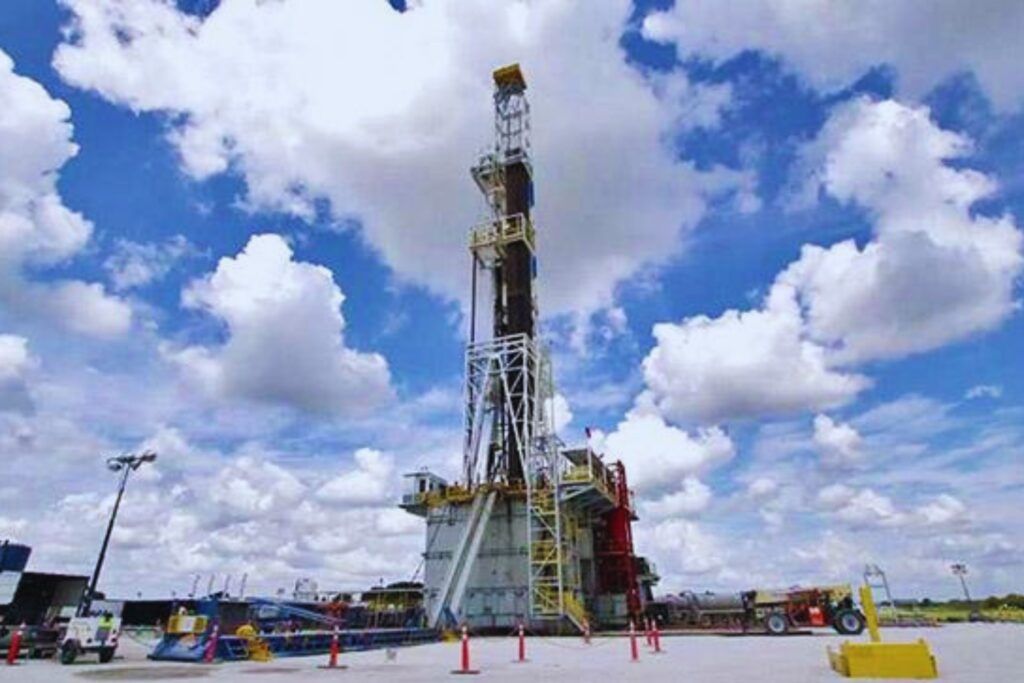
Courtesy of | SNTIMP
Some fields, such as Cantarell, produce gas with high nitrogen content, increasing processing costs. Development of unconventional resources also presents technical and environmental challenges.
Officials say new technologies — including water recycling and deeper drilling — can reduce environmental impact.
“Development must be carried out with responsibility, technical rigor and a commitment to communities,” Rodríguez Padilla said.
At the same time, the government is assembling a technical committee to evaluate best practices for expanding production.
Risks of reliance
Heavy dependence on imported gas leaves Mexico exposed to external risks.
Supply reliability depends on U.S. policy decisions, pricing conditions and infrastructure stability. Weather events, particularly in Texas, can disrupt flows.
“We depend on decisions that are outside our control, which creates uncertainty in supply reliability,” González said.
Balancing growth and transition
The government is also trying to balance energy security with long-term climate goals.
Renewables currently account for about 24% of Mexico’s electricity generation. That share is expected to rise to 38% by 2030.
But natural gas will remain essential in the near term, particularly as industrial demand grows.
“Energy is not just another commodity — it is strategic for national development,” González said.
A strategic turning point
The Burgos Basin now sits at the center of Mexico’s energy debate.
It represents both a vulnerability and an opportunity — a shared resource with Texas that remains underdeveloped on one side of the border.
In a region defined by deep economic integration, expanding domestic production could reshape energy security and competitiveness.
“The challenge is no longer geological — it is strategic.”

Anayancy Ulloa
Reporter
Most Read
- SpaceX is giving Brownsville $220M for water projects. In exchange, the city gave up zoning control of 444 acres near Starbase
- SpaceX seeks to take zoning control over nearly 450 acres from city of Brownsville as a ‘regional’ water deal takes shape
- Port of Brownsville could soon host Nodule City, a first-of-its-kind commercial deep-sea mining hub
- Cameron County is negotiating a $20M Fluidstack data center donation after Harlingen waffles on the same offer
- How much water does SpaceX need to operate near Brownsville? Nearly 20x its current use
Get the latest business news delivered to your inbox every morning for free.
Try 30 Days Free!
Get full access to award-winning journalism covering business, real estate, health care, economic trends, and the people shaping the Rio Grande Valley.
30 Days Free!
$9.95/month
Limited time offer
Subscription renews after your 30 day free trial at $9.95/mo.
Included Benefits
- Unlimited access to all articles
- Daily business news and analysis
- Subscriber-only content and features
Stories That Matter
- McAllen’s $204M water investment expects to seek construction bids in 2027
- Saronic lands Navy landing craft contract, first build at Brownsville’s Port Alpha
- The Rio Grande Valley’s tech industry is small but growing — meet some of the next-gen workforce
- Entrepreneurs enter Mission EDC’s ‘Shark Tank’ competition for $25K top prize
- Mission’s first Small Business Expo puts $25K on the line for local entrepreneurs
- Reynosa’s newest technical high school focuses on AI, semiconductors and bionics
- McCoy’s gives $10K, tools to launch Mid-Valley construction academy
- UT Health RGV performs new digestive procedure for first time in the Valley
- TSTC bets on advanced manufacturing to meet RGV’s industrial boom
- SpaceX reschedules Starship’s first flight around the Earth